The Book Surgeon

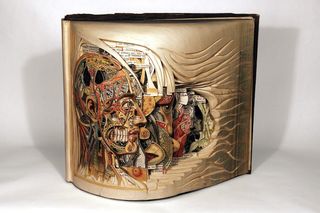
BrianDettmer1 Via Andrew Sullivan, Eugene over at My Modern Met (see some of Dettmer's other work there):

Using knives, tweezers and surgical tools, Brian Dettmer carves one page at a time. Nothing inside the out-of-date encyclopedias, medical journals, illustration books, or dictionaries is relocated or implanted, only removed.

Dettmer manipulates the pages and spines to form the shape of his sculptures. He also folds, bends, rolls, and stacks multiple books to create completely original sculptural forms.

“My work is a collaboration with the existing material and its past creators and the completed pieces expose new relationships of the book’s internal elements exactly where they have been since their original conception,” he says.

“The richness and depth of the book is universally respected yet often undiscovered as the monopoly of the form and relevance of the information fades over time. The book’s intended function has decreased and the form remains linear in a non-linear world. By altering physical forms of information and shifting preconceived functions, new and unexpected roles emerge.”

Here is an interview with Dettmer and more images.
The Revolutionary Rosa Luxemburg

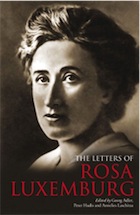
The-Letters-of-Rosa-Luxembur Sheila Rowbotham in The Guardian:

George Shriver's new translation of The Letters of Rosa Luxemburg is the most comprehensive collection of her correspondence yet to appear in English. It transports us directly into the private world of a woman who has never lost her inspirational power as an original thinker and courageous activist in first the Marxist Social Democratic party, and then the German revolutionary group, the Spartacist League. She suffered for her convictions; jail sentences in 1904 and 1906 were followed by three and a half years in prison for opposing the first world war. Her brutal death at the hands of the militaristic Volunteer Corps during the 1919 workers uprising in Berlin has contributed to her mystique: she is revered as the revolutionary who never compromised. This collection of her letters reveals that the woman behind the mythic figure was also a compassionate, teasing, witty human being.

Annelies Laschitza, one of the volume's editors, observes in her introduction that the revelation in 1956 of Stalin's purges, along with new waves of activism during the 60s and 70s, reawakened interest in Luxemburg. My generation of left-libertarians did indeed hail Luxemburg's defiance of Lenin's “night-watchman spirit”. Against his emphasis on the centralised party, many of us were drawn to Luxemburg's conviction that workers' action brought new social and political understandings.

Luxemburg's criticism of Marxism as dogma and her stress on consciousness exerted an influence on the women's liberation movement which emerged in the late 60s and early 70s. When I was writing Woman's Consciousness, Man's World during 1971, I drew on her analysis in The Accumulation of Capital (1913) of capital's greedy quest for non-capitalist markets, adapting it as a metaphor for the commodification of sexual relations and the body.

The awkward truth, however, was that Luxemburg herself had never identified with the feminist movement of her day. Moreover, she maintained a semi-detached relationship with the socialist women whom her friend Clara Zetkin organised in the Marxist Social Democratic party in Germany. Though she would be profoundly moved when they came to meet her from prison in 1916, and when they filled her flat with precious luxuries such as tea bags, cocoa, flowers and fruitcake, Luxemburg always carefully avoided being categorised as a “woman”. Her resistance was partly strategic; she was determined not to be sidelined within the party. But it was also bound up with her theoretical conviction that class struggle was the key to change, along with a strong aversion to being regarded as a victim.

A Blazing Defense of Individualism

022511_michelstaedter Benjamin Ivry in The Forward:

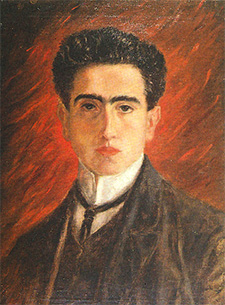
When the brilliant young Italian-Jewish philosopher, poet and artist Carlo Michelstaedter killed himself in 1910 at age 23, he must not have suspected that a century on, he and his works would be internationally celebrated. After initial neglect, a major exhibit, “Carlo Michelstaedter. Far Di Se Stesso Fiamma” (“Carlo Michelstaedter: Transform Yourself Into a Flame”), opened in October and is on view until February 27 at the National Savings Bank Foundation (Fondazione Cassa di Risparmio) of his native city of Gorizia in northeastern Italy, close to the Slovenian border.

“Carlo Michelstaedter. Far Di Se Stesso Fiamma,” features more than 250 manuscripts, books, photos and artworks. Of the last-mentioned, the most impressive are several poignantly painted self-portraits that would express melancholy even if the author’s tragic fate were not known. Accompanied by an elegant, profusely illustrated catalog from Marsilio Editori, the exhibit gives a strong sense of the complex identity issues confronted by sensitive, intellectually creative Italian Jews at the turn of the century. As Thomas J. Harrison’s insightful “1910: The Emancipation of Dissonance” (University of California Press, 1996) observes, the Michelstaedter family was “firmly Italian, even if educated, like most citizens of the [Austro-Hungarian] empire, primarily in German. Italian for themselves and Austrian for the state, they were primarily Jews for others. On such disinherited fringes of states, questions of identity are not a choice but a painful fatality.”

Michelstaedter was not alone; fellow northern Italians such as the tormented novelist Italo Svevo (born Aron Ettore Schmitz) and poet Umberto Saba (born Poli) were other neurotic overachievers. Yet their achievement came at an obvious cost.

Joseph Brodsky: A Literary Life

4687513_569341t Carol Rumens reviews Lev Loseff's new biography, in The Independent:

Joseph Brodsky's observation that what he liked about life in the US was “being left alone to do what I can do” is faintly reminiscent of Philip Larkin's commendation of Hull as “a town that lets you write.” In fact, the free-range Russian exile and the travel-shy Englishman share several affinities, including jazz. Lev Loseff records Brodsky's early poetic attempts at creating an effect of improvisation: “I'm a son of the outskirts, the outskirts, the outskirts,/ in a wire cradle, dank hallways, are my door and my address,/ streetcars clanking, rattle bang ring, stone sidewalks, soles,/ girls lined against painted wood fences,/ grassy banks, oil spot/ factory lights” (“Russian Gothic”).

Brodsky (unlike Larkin) was cavalier about “the toad, work”. He dropped out of school at 15, and hopped from menial job to job before being charged with “parasitism” and despatched to a labour camp near Archangelsk. His real crime, Loseff notes, was that he had broken the rigid rules of initiation into Soviet society. His sentence was commuted after international pressure, and an exit-visa to Israel provided (he changed course at Vienna).

His attachment to a vast range of European literature and his deep individualism seem inevitably to have pointed him west. His youthful poems were published not only in samizdat, but in tamizdat (“over there”). But what mattered to Brodsky far more than ethnicity or country was the Russian language: his only nation-state.

Ten Years On: Why a Complete Human Genome Mattered

Feat-human-genome-list-thumb-640xauto-19652John Timmer in Ars Technica:

Open a recent edition of Science or Nature, and you're likely to be bombarded with articles about a significant anniversary: ten years have passed since the announced completion of the human genome.

These articles tend to focus on how the genome is (or isn't) transforming medicine, science, or society. Sure, it sounds like a terrific milestone, but did it change anything about life in the lab?

I started graduate school back when the debate about whether to sequence the human genome began, and my research career ultimately benefitted from the technology that came out of the program. Most of what you'll read about the anniversary will involve grand perspectives and talk of “breakthroughs,” and those are important, but I'd like to offer a grunt-level view of just how much the human genome project changed biology. This is a personal perspective, and any mis-rememberances or erroneous interpretations are my own.

One of my clearest memories, however, is that back when the project was first proposed, there were real questions about whether it would ever get off the ground…

My graduate career began at the same time that biologists and policymakers had kicked off a public debate about whether to sequence the entire human genome. The project would be an enormous undertaking in terms of funding, resources, and personnel, one that might pull federal funding from individual labs.

It was also a bit of a departure for biology, which hadn't known the big-budget science projects that were common in fields like astronomy and physics. Needless to say, allocating this much money to one idea made many researchers uneasy.

And it wasn't clear that such a project was even necessary.

The Collaborator

Kamila Shamsie in The Guardian:

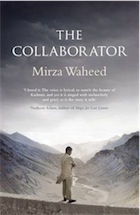
The-Collaborator The unnamed protagonist of Mirza Waheed's devastating debut novel grows up in “the forgotten last village before the border”. The border is not really a border but – in official parlance – the Line of Control, which divides the former princely state of Kashmir between India and Pakistan; the time period is the early 1990s, when the confrontation between the Indian state and Kashmiris demanding azaadi (freedom) turned particularly violent. Such a place, in such a time, cannot remain forgotten very long.

The novel starts when the eponymous narrator is 19, and the forgotten days of the village are long past. He is employed by a captain in the Indian army to go down into a valley near the village and collect the ID cards and weapons of the corpses – thousands of them – which are strewn about the valley floor. The corpses are those of Kashmiri “militants” or “freedom fighters”, depending on which side of history you're on, who crossed the Line of Control into Pakistan for training and were gunned down by the Indian army while crossing back. Their ID cards can be used for PR purposes when the Indian army issues press releases about the militants it has killed; the corpses themselves are just “dead meat”, left to rot.

More here.

The Billionaire Who Is Planning His 125th Birthday

From The New York Times:

Murdock-t_CA1-popup-v2 One morning in early January, David Murdock awoke to an unsettling sensation. At first he didn’t recognize it and then he couldn’t believe it, because for years — decades, really — he maintained what was, in his immodest estimation, perfect health. But now there was this undeniable imperfection, a scratchiness and swollenness familiar only from the distant past. Incredibly, infuriatingly, he had a sore throat. “I never have anything go wrong,” he said later. “Never have a backache. Never have a headache. Never have anything else.” This would make him a lucky man no matter his age. Because he is 87, it makes him an unusually robust specimen, which is what he must be if he is to defy the odds (and maybe even the gods) and live as long as he intends to. He wants to reach 125, and sees no reason he can’t, provided that he continues eating the way he has for the last quarter century: with a methodical, messianic correctness that he believes can, and will, ward off major disease and minor ailment alike.

So that sore throat wasn’t just an irritant. It was a challenge to the whole gut-centered worldview on which his bid for extreme longevity rests. “I went back in my mind: what am I not eating enough of?” he told me. Definitely not fruits and vegetables: he crams as many as 20 of them, including pulverized banana peels and the ground-up rinds of oranges, into the smoothies he drinks two to three times a day, to keep his body brimming with fiber and vitamins. Probably not protein: he eats plenty of seafood, egg whites, beans and nuts to compensate for his avoidance of dairy, red meat and poultry, which are consigned to a list of forbidden foods that also includes alcohol, sugar and salt.

More here. (Note: Thanks to Alia Raza.)

Sunday Poem

Some People Have No Respect For Our Belief

Jesus I learned you lived and lived
Jesus we heard you died and die
Jesus I see them painting of you so white
Jesus I hear them sing, you lackey of God they sang.
Jesus I know people today use you wrong
they came with guns in hand
shot our minds with
untrue words
Black – the meaning of sin
Black – the heathen savages
Black – the false, the lies
Black – the inhuman without a home and culture
These pink skinned people say “You light of God”
and make us wash black sins to be close to white.
O, Jesus, if so you were true
You were black
fighting against a white regime.
O, Jesus, they tear away our hearts
that yell for Nature
They will do things of tension, fear, control,
death, brutality and murder to our Aboriginal people’s
beliefs.
Why they must do this O, Jesus, this once Jesus
All in the name of you
Jesus Christ
“Offering, offering, hear the pennies fall
Everyone for Jesus, the Church shall have them all”

by Lionel Fogarty
from Kargun
publisher: Cheryl Buchanan,
North Brisbane, 1978

Saturday, March 5, 2011

‘What I Really Want Is Someone Rolling Around in the Text’

06Riff-t_CA0-articleLarge

Sam Anderson in the NYT Magazine:

One day in college I was trawling the library for a good book to read when I found a book called “How to Read a Book.” I tried to read it, but must have been doing something wrong, because it struck me as old-fashioned and dull, and I could get through only a tiny chunk of it. That chunk, however, contained a statement that changed my reading life forever. The author argued that you didn’t truly own a book (spiritually, intellectually) until you had marked it up.

his hit home for me — it spoke to the little scribal monk who lives deep in the scriptorium of my soul — and I quickly adopted the habit of marginalia: underlining memorable lines, writing keywords in blank spaces, jotting important page numbers inside of back covers. It was addictive, and useful; I liked being able to glance back through, say, “Great Expectations,” and discovering all of its great sentences already cued up for me. (Chapter 4, underlined: “I remember Mr. Hubble as a tough high-shouldered stooping old man, of a sawdusty fragrance, with his legs extraordinarily wide apart: so that in my short days I always saw some miles of open country between them when I met him coming up the lane.”) This wasn’t exactly radical behavior — marking up books, I’m pretty sure, is one of the Seven Undying Cornerstones of Highly Effective College Studying. But it quickly began to feel, for me, like something more intense: a way to not just passively read but to fully enter a text, to collaborate with it, to mingle with an author on some kind of primary textual plane.

Soon my little habit progressed into a full-on dependency. My markings grew more elaborate — I made stars, circles, checks, brackets, parentheses, boxes, dots and lines (straight, curved and jagged). I noted intra- and extratextual references; I measured cadences with stress marks. Texts that really grabbed me got full-blown essays (sideways, upside-down, diagonal) in the margins. I basically destroyed my favorite books with the pure logorrheic force of my excitement, spraying them so densely with scribbled insight that the markings almost ceased to have meaning.

against Shirky and the web utopians

300_The_Net_Delusion

In The Net Delusion, by Evgeny Morozov, we finally have a long-overdue market correction to cyber-utopianism, which Morozov defines as “a naïve belief in the emancipatory nature of online communication that rests on a stubborn refusal to acknowledge its downside.” Morozov, a Belarussian web activist who works with the New America Foundation, sizes up the social media web for what it is—a powerful tool for communication, which like most such tools in modern history is subject to grievous distortion and manipulation by antidemocratic regimes. Since the remarkable popular protests that ousted Egyptian President Hosni Mubarak from power in February, Shirky’s cyber-utopian vision of crowdsourced social virtue has gone viral. US media have devoted extensive coverage to Egypt’s so-called Facebook and Twitter generation, the young anti-Mubarak activists who have been praised for using social media and cellphones to organize protesters in Tahrir Square and topple a tyrant. One activist ideally suited to this story line was 30-year-old Wael Ghonim, a Google executive detained by the Egyptian police for twelve days for acting as the anonymous administrator of a Facebook page that was facilitating the protests. Sure enough, the American media promptly adopted Ghonim as the face of Egypt’s revolt shortly after his release from detention. Social networking mattered in Egypt, but the root causes of the uprising were scarcity, official corruption and social conflict, none of which fit the cyber-utopian narrative or flatter America’s technological vanity.

more from Chris Lehmann at The Nation here.

doomsday

Rhodes-articleInline

Every thousand years a doomsday threatens. Early Christians believed the day of judgment was nigh. Medieval millenarians expected the world to end in 1000 A.D. These fatal termini would have required supernatural intervention; in the old days humans lacked sufficient means to destroy themselves. The discovery, in 1938, of how to release nuclear energy changed all that. Humankind acquired the means of its own destruction. Even were we to succeed in eliminating our weapons of doomsday — one subject of “How the End Begins” — we would still know how to build them. From our contemporary double millennium forward, the essential challenge confronting our species will remain how to avoid destroying the human world. Ron Rosenbaum is an author who likes to ask inconvenient questions. He has untombed the secrets of the Yale secret society Skull and Bones, tumbled among contending Shakespeare scholars and rappelled into the bottomless darkness of Adolf Hitler’s evil. But nothing has engaged his attention more fervently than doomsdays real or threatening, especially the Holocaust and nuclear war. Both catastrophes ominously interlink here.

more from Richard Rhodes at the NYT here.

Così fan tutte?

Ab1ccbee-45fb-11e0-acd8-00144feab49a

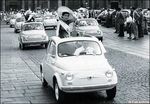
In 1962 Giorgio Bocca, a social commentator and essayist, fatalistically predicted the submergence of Italy’s rich diversity of regional and local identities under a tide of modern materialism. He wrote: “What the Medici’s pope-king, Dante’s emperor-messiah, Machiavelli’s prince, Cavour’s Piedmontese bureaucracy and Mussolini’s fascists all failed to accomplish is coming together under the auspices of the consumer civilisation and its television oracle. Before long the Italians will be a compact people with identical customs, habits and ideals, from Sicily to the Alps. They will dress, think, eat and enjoy themselves all in the same way, as the small screen dictates and imposes.” At the time it might have seemed a plausible forecast. During Italy’s “golden age of capitalism”, stretching from roughly 1950 to 1973, rapid economic growth and social modernisation produced a mass national market in which increasing numbers of Italians drove the same cars (Fiats), rode the same scooters (Vespas), watched the same television programmes (Carosello – a show that popularised TV commercial messages), drank the same coffee (Paulista) and ate the same pasta (Barilla). It was as if centuries of difference were disappearing in the solvent of a standardised prosperity. Today, as Italy marks its 150th anniversary as a nation-state, Bocca’s fears appear much exaggerated.

more from Tony Barber at the FT here.

Mind Games: How toxic chemicals are impairing children’s ability to learn

From Orion:

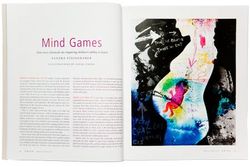
Baby WHEN MY HUSBAND AND I SET OUT to find a nursery school for our daughter, Faith, nearly ten years ago we took the decision seriously. I looked at large parent-run cooperatives and visited small home-based operations. Jeff studied the pink towers and chiming bells at the Montessori school on the hill and considered the wonder balls and wooden fairies at the Waldorf school in the valley. In the end, we chose a nursery school that operated out of a community center close to home. There was a frog pond out front and a play structure out back. The trees were full of chickadees and nuthatches. We had weighed many considerations in the decision-making process, and we all, Faith included, were happy about it.

That is, until I discovered that, like many of its kind, the school’s beloved play structure —with its wooden gangway, turrets, and tunnels —was made out of pressure-treated lumber, which, at the time, contained arsenic, a carcinogen. A bladder carcinogen, in fact. I am a bladder cancer survivor. I am familiar with this particular disease and all the ongoing medical surveillance it requires. So, after a lot of research and discussion, we eventually decided to move our daughter to a different nursery school. The risk of doing nothing just seemed too high.

More here.

‘House of Mirth,’ Updated

From The New York Times:

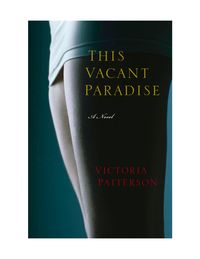
This-Vacant-Paradise-Book-Cover To take on a reinterpretation of one of the greatest novels of the 20th century in one’s debut is, to put it mildly, a gutsy move. Victoria Patterson’s first novel, “This Vacant Paradise,” set in Newport Beach, Calif., in the expansive, bullish 1990s, is a modern take on Edith Wharton’s “House of Mirth.” Patterson’s first book, a story collection, “Drift,” was also set in Newport Beach, but it concerned itself mainly with drifters, lowlifes and working stiffs rather than the upper crust. Southern California’s Orange County is known to viewers of reality television as the quintessentially upper-middle-class, suburban, mostly white, Christian and Republican enclave where class, social strictures and the pressure to “marry well” still pervade — it is, in other words, a world not so different from Lily Bart’s. In “This Vacant Para­dise,” Esther Wilson is a gorgeous, materialistic, self-absorbed college dropout who, at 33, fears that her beauty is on the cusp of fading. She works as a cashier at a boutique and embezzles small amounts of cash to augment her modest income. Occasionally she also receives handouts from her capricious, wealthy grand­mother, with whom she lives. Lonely and in debt, Esther feels desperate to snag a rich man soon, before she’s too old to cash in on her beauty.

Once Esther’s eyes have been opened — by sex, by ideas, by the experience of love — she can’t close them. The final scenes of Patterson’s novel depart from Wharton’s in a significant way. So as not to reveal the ending, suffice it to say that some important things have changed for women in the last century. Although we are still judged as harshly as ever, primarily by one another, and although the past can never be escaped, we have won the literary right, it seems, to fall from grace without being killed for it. This is a sort of progress. Patterson beautifully parses the consequences of one woman’s fall in this memorable, penetrating, fully achieved novel.

More here.

Saturday Poem

Vocation

Each cold October morning he went out
into the Gate Field and walked up and down,
like the horse-drawn seed-drill quartering every inch
to make sure the harvest was kept constant,
reading his Office, every sentence
of the forty pages for the day. In the evening,
as the colder darkness fell with the crows’
harsh calling, he sat alone in the back
benches of the unheated chapel, hour
after hour, staring for inspiration
at the golden, unresponsive tabernacle.

by Bernard O'Donoghue
publisher: PIW, 2011

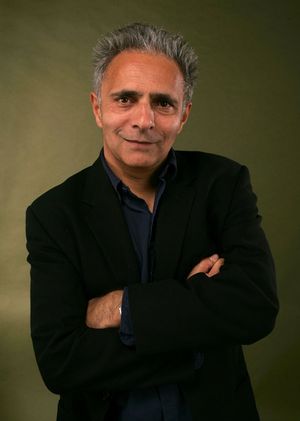
Hanif Kureishi reveals how to succeed in the worlds of fiction and film

Hanif Kureishi in The Independent:

Kureishi_getty_569464t I had wanted to be a writer – to devote myself to words and storytelling – from the age of 14. I can remember the moment it occurred to me, one day at school, and how differently I felt about the world after, the door to the future opening. But I hadn't given much thought as to how I would support myself, and later, a family. I seemed to believe that I'd get by somehow. The details didn't matter, particularly since I made the decision to write in 1968 – a time when creativity rather than “bread” was the key. And the writers I'd admired – Kafka, Beckett, Kerouac, Henry Miller, among others – hardly had “professional writer” on their passports.

They were artists, which was different, and none of them, to my knowledge, seemed concerned about the price of prams, or had children at private school – both of which, according to a rather arch idea of Cyril Connolly's, were lethal for writers: “There is no more sombre enemy of good art than the pram in the hallway.”

Perhaps, for some people, becoming an artist implies abandoning ordinary life for the excitement of bohemianism, but I can't say I know many writers like that. Writing is as steady a job as any job can be. Routine makes the imagination possible. “Acting in”, you could call it, as opposed to acting out. Writers are envied because writing, or perhaps any form of art, is the most gratifying sublimation of all; it is one thing you don't have to leave the house to do – warm but not impressive underwear being the only requirement, apart from some talent.

More here.

Pakistan: Silence has become the mother of all blasphemies

Mohammed Hanif in The Guardian:

Mohammed_hanif Two months ago, after Governor Salmaan Taseer's murder and the jubilant support for the policeman who killed him, religious scholars in Pakistan told us that since common people don't know enough about religion they should leave it to those who do – basically anyone with a beard.

Everyone thought it made a cruel kind of sense. So everyone decided to shut up: the Pakistan Peoples party (PPP) government because it wanted to cling to power, liberals in the media because they didn't want to be the next Taseer. The move to amend the blasphemy law was shelved.

It was an unprecedented victory for Pakistan's mullah minority. They had told a very noisy and diverse people to shut up and they heard back nothing but silence. After Pakistan's only Christian federal minister, Shahbaz Bhatti – the bravest man in Islamabad – was murdered on Tuesday, they were back on TV, this time condemning the killing, claiming it was a conspiracy against them, against Islam and against Pakistan. The same folk who had celebrated one murder and told us how not to get murdered were wallowing in self pity.

In a very short span of time, Pakistan's mullahs and muftis have managed to blur the line between what God says and what they say. The blasphemy law debate was about how to prosecute people who have committed blasphemy against the prophet Muhammad and the Qur'an. Since repeating a blasphemy, even if it is to prove the crime in a court of law, is blasphemous, no Pakistani has a clear idea what constitutes blasphemy. Taseer had called the blasphemy law “a black law” and was declared a blasphemer. The line between maligning the Holy Prophet and questioning a law made by a bunch of mullahs was done away with. What would come next?

More here.

Circadian clock without DNA–History and the power of metaphor

Bora Zivkovic in Scientific American:

Bora-zivkovic Last week, two intriguing and excellent articles appeared in the journal Nature, demonstrating that the transcription and translation of genes, or even the presence of DNA in the cell, are not necessary for the daily (“circadian”) rhythms to occur (O’Neill & Reddy 2011, O’Neill et al., 2011). (Scientific American is part of Nature Publishing Group.)

The two papers received quite a lot of media coverage, and deservedly so, but very few science bloggers attempted to write in-depth blog posts about them, placing them in a broader historical, theoretical and methodological context. I had a feeling that everyone was waiting for me to do so. Which is why you are now reading this. I know it is a long “Explainer” (which is all the rage in science journalism these days) but I hope you have patience for it and that you find it informative and rewarding.

What I intend to do is to, first, briefly describe and explain the research in these two papers, though the press release and media coverage were quite accurate this time. Diana Gitig did the best job of it at Ars Technica – I highly recommend you read her piece for clear background information.

Then I will try to give you a historical perspective so you can get a feel for the context in which this research was performed. This look at the history will bring into sharp relief how powerful the scientific metaphors are in guiding the questions that researchers try to answer in their laboratories. Finally, a look at the media coverage will show that the lay audience (including journalists) is guided by other metaphors – not always the same ones that are used by researchers.

More here.

Friday, March 4, 2011

Can the Brain Explain Your Mind? A New Mysterian Reviews Ramachandran

Mcginn_1-032411_jpg_230x840_q85 Colin McGinn reviews V.S. Ramachandran's The Tell-Tale Brain: A Neuroscientist’s Quest for What Makes Us Human, in the NYRB:

Is studying the brain a good way to understand the mind? Does psychology stand to brain anatomy as physiology stands to body anatomy? In the case of the body, physiological functions—walking, breathing, digesting, reproducing, and so on—are closely mapped onto discrete bodily organs, and it would be misguided to study such functions independently of the bodily anatomy that implements them. If you want to understand what walking is, you should take a look at the legs, since walking is what legs do. Is it likewise true that if you want to understand thinking you should look at the parts of the brain responsible for thinking?

Is thinking what the brain does in the way that walking is what the body does? V.S. Ramachandran, director of the Center for Brain and Cognition at the University of California, San Diego, thinks the answer is definitely yes. He is a brain psychologist: he scrutinizes the underlying anatomy of the brain to understand the manifest process of the mind. He approvingly quotes Freud’s remark “Anatomy is destiny”—only he means brain anatomy, not the anatomy of the rest of the body.

But there is a prima facie hitch with this approach: the relationship between mental function and brain anatomy is nowhere near as transparent as in the case of the body—we can’t just look and see what does what. The brain has an anatomy, to be sure, though it is boneless and relatively homogeneous in its tissues; but how does its anatomy map onto psychological functions? Are there discrete areas for specific mental faculties or is the mapping more diffuse (“holistic”)?: