If life is misery, why do we bear it?

Leopardi

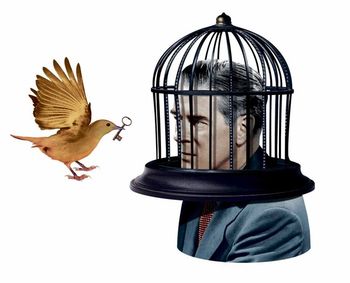
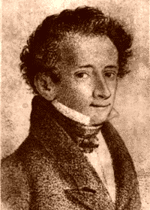
There are only 41 of them, but they were the distillation of a lifetime’s thinking in poetry, continually reworked until his death in 1837 at 39. They include some of the most famous poems in Italian. Leopardi lived much of his life in Recanati, a backwater within the backward Papal States near Ancona. This spurred him on to become something of a literary prodigy: by 11 he had translated Horace’s Odes and was well on the way to having taught himself Greek, Hebrew, French, Spanish and English. His father had already dismissed the priest who was instructing young Giacomo in Latin for having nothing more to teach him. Through his teenage years he embarked on what he later described as “seven years of insane and desperate study” in his father’s library of 16,000 volumes. He ruined his health and developed a serious hunchback. Leopardi is Italy’s great romantic poet, and while there are similarities with Wordsworth and Coleridge, the contrasts are more striking. Most of these stem from Giacomo’s cosmic pessimism. Leopardi looked to classical authors for ideals of rationality and stoicism to face the suffering and nullity of the world. For this he was at odds with his century’s frenzied rallying calls to nationalism and progress, and more in line with Schopenhauer and Nietzsche, both of whom he influenced. For literary historian Francesco De Sanctis, Leopardi’s scepticism heralds the end of the world of theology and metaphysics and the inauguration of material nihilism.

more from Simon West at The Australian here.

wrong

David-cameron-s-first-military-intervention-comes-over-the-libyan-desert-$14010797$300

THERE ARE so many things wrong with the Libyan intervention that it is hard to know where to begin. So, a few big things, in no particular order: First, it is radically unclear what the purpose of the intervention is—there is no endgame, as a U.S. official told reporters. Is the goal to rescue a failed rebellion, turn things around, use Western armies to do what the rebels couldn’t do themselves: overthrow Qaddafi? Or is it just to keep the fighting going for as long as possible, in the hope that the rebellion will catch fire, and Libyans will get rid of the Qaddafi regime by themselves? Or is it just to achieve a cease-fire, which would leave Qaddafi in control of most of the country and probably more than willing to bide his time? The size of the opening attack points toward the first of these, but success there would probably require soldiers on the ground, which no one in France, Britain, or the United States really wants. The second is the most likely goal, though it would extend, not stop, the bloodshed.

more from Michael Walzer at Dissent here.

scars

Homefires_carpenter1-blog427

The New York Times has just run an online series by war artist Michael Fay that is exceptionally moving and thought-provoking. Over the past decade, Fay has seen action as a war artist with US troops in both Iraq and Afghanistan, but his latest journey was to a military veterans’ hospital in Richmond, Virginia. In the resulting New York Times blogs, he relays his meetings with three young men severely wounded in Afghanistan. His account of their injuries and rehabilitation is gripping, but what really deepens the reporting are his drawings, reproduced alongside the articles. Fay is clearly sympathetic with soldiers and his affinity with them is reflected in the very style of these drawings. “Strong and sensitive” would be the simplest way to characterise his on-the-spot observations. A bold, manly line delineates damaged faces and bodies, but with a softening edge of affection. There is real feeling in the sketches, as well as a painstaking accuracy that vindicates the idea of sending artists to war. Fay’s drawings have a disarming humanity that it is hard to imagine being captured by a TV camera. You feel – you hope – these drawings were therapeutic for the men themselves.

more from Jonathan Jones at The Guardian here.

Tuesday Poem

Thanks Gilles Deleuze

They were quoting you
Murmuring your name like a prophet coming from afar
From whose mouth a unique music issues

My own French was not good enough even to purchase bread decently
But the ring of your name
In the sidewise discussions had a special magic
Which for long put my extreme ignorance to shame

Migration is a sacred right, you said once
Nobody said that before you, and no one dared say it after
In this country which we married for love
I, Mohamed, Abdelkader, and Fatima
And other Arabs whose dusty names this poem is too narrow to contain.
Until now I haven’t met anyone who could explain the mysteries of your obscure expression
Laws say the opposite from one government to the other
And the caretaker is French of Portuguese origin
Yet he looks down on philosophers

I was in the subway stealing glances at a newspaper someone was reading
When I saw your name printed in bold, and the headline your death
It seems you threw yourself from the window
But why all those who love you to blindness
Love life more than anything else
I felt ashamed of my ignorance once again
And hated myself in plain Arabic
Despite the grumblings of the coloured owner of the newspaper

Migration is a sacred right
An expression which is enough it was once said
For me every morning to pursue my own sacred right

by Abdel-ilah Salhi
translation: Norddine Zouitni
publisher: PIW, © 2004

Gilles Deleuze

Do You Have Free Will? Yes, It’s the Only Choice

John Tierney in The New York Times:

Will Suppose that Mark and Bill live in a deterministic universe. Everything that happens this morning — like Mark’s decision to wear a blue shirt, or Bill’s latest attempt to comb over his bald spot — is completely caused by whatever happened before it. If you recreated this universe starting with the Big Bang and let all events proceed exactly the same way until this same morning, then the blue shirt is as inevitable as the comb-over. Now for questions from experimental philosophers:

1) In this deterministic universe, is it possible for a person to be fully morally responsible for his actions?

2) This year, as he has often done in the past, Mark arranges to cheat on his taxes. Is he is fully morally responsible for his actions?

3) Bill falls in love with his secretary, and he decides that the only way to be with her is to murder his wife and three children. Before leaving on a trip, he arranges for them to be killed while he is away. Is Bill fully morally responsible for his actions?

To a classic philosopher, these are just three versions of the same question about free will. But to the new breed of philosophers who test people’s responses to concepts like determinism, there are crucial differences, as Shaun Nichols explains in the current issue of Science. Most respondents will absolve the unspecified person in Question 1 from full responsibility for his actions, and a majority will also give Mark a break for his tax chiseling. But not Bill. He’s fully to blame for his heinous crime, according to more than 70 percent of the people queried by Dr. Nichols, an experimental philosopher at the University of Arizona, and his Yale colleague Joshua Knobe.

More here.

An Elegant Multiverse?

From Research:

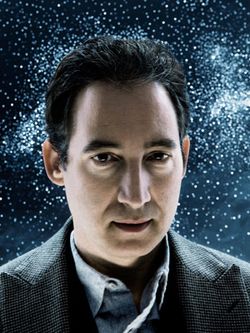
Fashion6-brian-greene-0109-fb-87953557 You might think it’s hard to have a conversation with theoretical physicist Brian Greene. His research specialty is superstring theory, the hypothesis that everything in the universe is made up of miniscule, vibrating strands of energy. Luckily for an interviewer, Greene has a knack for explaining difficult concepts to non-scientists. His first book, the best-selling The Elegant Universe, which explains the quest to unify all the laws of nature, was a finalist for the Pulitzer Prize and led to an award-winning PBS series. He is a co-founder of the World Science Festival, an annual event in June whose aim is to make “the esoteric understandable and the familiar fascinating,” which pretty much sums up Greene’s modus operandi. “Science is a living, breathing, exciting, evolving subject,” he says. “A large part of my motivation in reaching out to a general audience is to show people that science is not this finished subject where all of the results are in these thick textbooks that you lug around when you’re taking a science course.” Greene, 48, grew up on the Upper West Side and spent many a rainy day at the Hayden Planetarium, when it was a dark and musty place and not the shiny glass cube it is today. “That definitely played a part in my excitement for these ideas.” But it was the pure beauty of mathematics that really grabbed him. “As a kid I was playing with numbers all the time,” he says. “And when I learned that those numbers could be more than a game, those numbers could actually describe stuff that was out there in the real world, that’s when I was hooked for good.” His latest book, The Hidden Reality, explores another mystery: whether there are other universes beyond ours.

Q. Your new book talks about the concept of a multiverse. Can you explain what that means?

When we hear the word “universe,” we think that means everything: every star, every galaxy, everything that exists. But in physics, we’ve come upon the possibility that what we’ve long thought to be everything may actually only be a small part of something that is much, much bigger. The word “multiverse” refers to that bigger expanse, the new totality of reality, and our universe would be just a piece of that larger whole.

More here.

Monday, March 21, 2011

The Winners of the 3 Quarks Daily 2011 Arts & Literature Prize

Arts_160_winner WinnerStrange2011 Arts_&_lit_2011_gulls

Laila Lalami has picked the three winners:

  1. Top Quark, $1000: Namit Arora, Joothan: A Dalit's Life
  2. Strange Quark, $300: Edan Lepucki, Reading and Race: On Slavery in Fiction
  3. Charm Quark, $200: Elliot Colla, The Poetry of Revolt

Here is what Dr. Lalami had to say about them:

The finalists for this year’s 3QD prize write in very different genres, but they were
all very impressive, which made the task of choosing just three difficult indeed.
Here are my selections:

Namit Arora’s powerful review of Omprakash Valmiki’s Joothan: A Dalit’s Life for 3
Quarks Daily places this 1997 memoir in a personal, cultural, and literary context.
Arora gives a very moving portrayal of a kind of life I knew little about, an honest
reckoning of the privileges of his own upbringing, and a thoughtful analysis both of
Valmiki’s work in Hindi and its translation into English.

All too often, the subject of race is felt to be the sole purview of people of color—as if
white people were completely unaffected by racial history or reality. Edan Lepucki’s
candid piece for The Millions, in which she discusses her exposure to questions of
race and slavery through various novels, shows us how literature, which requires us
to have imaginative empathy, can also help us develop actual empathy.

Elliot Colla’s analysis of Egyptian revolutionary slogans for Jadaliyya is both
sensitive and original. In discussing how poetry is created, performed, and
remembered—not just right now in Tahrir Square, but also during earlier historical
periods—he reminds us that literature and life are not distinct or divergent spheres,
but indivisible aspects of the human experience.

Congratulations from 3QD to the winners (I will send the prize money later today or tomorrow–and remember, you must claim the money within one month from today–just send me an email). And feel free to leave your acceptance speech as a comment here! And thanks to everyone who participated. Thanks also, of course, to Laila Lalami for doing the final judging.

The three prize logos at the top of this post were designed, respectively, by Carla Goller, me and Sughra Raza. I hope the winners will display them with pride on their own blogs!

Details about the prize here.

Sunday, March 20, 2011

Small Changes, Big Results

Ndf_glennerster_kremer_36.2_globaldev Over at the Boston Review, there is a forum on the promise of applying the lessons of behavioral economics to challenges in development, with the lead piece by Rachel Glennerster and Michael Kremer and comments from: Diane Coyle; Eran Bendavid; Pranab Bardhan; José Gómez-Márquez; Chloe O’Gara; Jishnu Das, Shantayanan Devarajan, and Jeffrey S. Hammer; and Daniel N. Posner. From the lead piece:

According to a standard economic model, a fourteen-year-old girl in Kenya will go to school if doing so will enable her to earn more than she spent on her education. A family will buy dilute-chlorine solution, measure out capfuls to treat their water, and wait for the chlorine to disinfect their water if the health benefits exceed the cost of the chlorine. Since a school uniform that lasts a year or two costs only six dollars, and a month’s supply of chlorine runs about $0.30, these costs should be fairly minor factors. Influenced in part by these arguments, many governments in the developing world and nongovernmental organizations (NGOs) concerned with development have maintained small charges for education and preventative health care.

However, in recent decades economists have increasingly come to recognize what most of us have long known: human beings don’t always make the best decisions.

A new type of economics, dubbed “behavioral economics,” seeks to understand deviations from the simple “rational agent” model that has dominated economics for most of its history—why people procrastinate, say, or why Americans don’t exercise or save enough.

In the developed world, these ideas are beginning to affect policy. For instance, the Pension Protection Act of 2006 encourages U.S. employers to establish automatic enrollment for retirement plans. Could such approaches help alleviate poverty in developing countries? If policies based on behavioral economics can help Americans save more, could they also help Indian children get vaccinated or Kenyan children get cleaner water?

Evidence from randomized evaluations in the developing world suggests they might.

When Did We Start Signing Our Names to Authenticate Documents?

110318_EX_jHancockTN Julia Felsenthal in Slate:

Slate tech columnist Farhad Manjoo argued recently that the fax machine lives on largely because of our attachment to the written signature. Manjoo's observation piqued the Explainer's curiosity: When did scribbling your name on a piece of paper become a means of authentication?

A long time ago. Signatures on written transactions have been customary in Jewish communities since about the second century and among Muslims since the Hegira (the migration of Muhammad and his followers to Medina) in 622. In Europe, the signature dates to the sixth century. But it didn't catch on widely there for another thousand-odd years, until the 16th and 17th centuries, when education and literacy were on the rise and more agreements were made in writing. In England, the 1677 Statute of Frauds—which stipulated that contracts must exist in writing and bear a signature—was pivotal. Signatures became a standard form of validating agreements—a practice that was also adopted in colonial America.

Between the sixth century, when signatures first appeared, and the 17th century, when signing became standard practice, Europeans used various customs to formalize contracts. Wax seals bearing an impressed or embossed figure were common, particularly among the French, who brought the tradition to England during the Norman invasion. (Seals also appear in the Bible, and to this day sealing, not signing, is standard practice in China, Japan, and Korea.) One popular way to create these impressions was to press a signet ring into beeswax. Signet rings themselves were also used as validation: A king might, for example, dispatch a herald bearing an oral message to a foreign power, and give him the royal signet ring so that the message's recipient would be confident of its origin.

Interior Landscapes

Film Daisy Rockwell over at Bookslut:

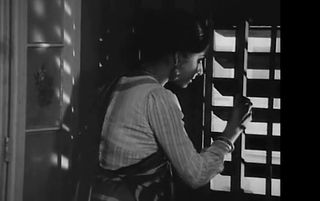
A bored young woman walks from room to room in her beautiful house. She sprawls on her bed and leafs through a novel, then wanders to the living room and looks through the bookcases for a new book. Suddenly she hears an interesting sound. She rushes to the windows and peers through the slats in the dark shutters. She sees a performer with a monkey, then some men carrying a palanquin, then a foolish man waddling along with an umbrella. Excited, she moves from shutter to shutter to peer through as these characters cross back and forth through her line of vision. She fetches a lorgnette, so she can see them better. When all disappear from view, she walks back through the living room, still holding up the lorgnette and stands on the porch that encloses the house’s interior verandah. Her husband walks by, fetches a book, and walks back again. He doesn’t notice her. She focuses her lorgnette on him. As his figure recedes into a different part of the house, her hand, still holding the lorgnette, drops to her side, and the camera zooms abruptly away from her.

Satyajit Ray’s film Charulata (1964) tells the story of a lonely young housewife whose distracted husband fails to notice until too late that she has fallen in love with his younger brother. The film is based on Rabindranath Tagore’s Bengali novella Broken Nest (Nashtaneer), which, along with two other Tagore novellas, Two Sisters (Dui Bon) and The Orchard (Malancha), about complicated marriages, has just come out in an excellent new translation by Arunava Sinha as the collection Three Women.

What We Talk About When We Talk About the Postsecular

John D. Boy over at The Immanent Frame:

The concept is not just all over The Immanent Frame. It has also appeared in the titles of about forty books, most in English and German, the majority of which were published within the past five years. Additionally, the concept features prominently in seventeen dissertations indexed by ProQuest, which largely reflects dissertations completed at North American universities. More than half of these dissertations were deposited after 2007. And that is to say nothing of the dozens of articles in scholarly journals that are an important part of the discussion of the postsecular, or the approximately half-dozen academic conferences held on both sides of the Atlantic in the last three years. These numbers indicate that both established and emerging scholars are staking their work on the concept of the postsecular. Finally, illustrating a broader trend in intellectual debate, significant interventions in the discussion have also appeared online, especially at Eurozine, ResetDOC, and on this very blog.

For over a decade now, the concept has been appearing at an ever increasing rate in academic debates in a number of different areas. The watershed event for several of these debates was a speech given by the renowned German philosopher and sociologist Jürgen Habermas on the occassion of his being awarded the Peace Prize of the German Book Trade, in October 2001. However, Habermas’s speech, called “Faith and Knowledge,” is not the only impetus behind these discussions. In fact, some uses of the postsecular predate his speech, and they range across a wide variety of literatures. A few months ago, I tried to get as comprehensive an overview as possible and found that the concept has been used in cultural and literary studies, theology, philosophy, sociological theory and the sociology of religion, political theory, postcolonial thought, feminist thought, and even in urban studies. Reflecting the challenging reality of interdisciplinary work, some of the recurring themes in discussions of the postsecular are exploration, mapping, positionings, going “beyond” something, or being “between” two things. In what follows, I want to briefly summarize some of the recurring themes in these explorations.

Will the crisis create a new Japan?

From The Washington Post:

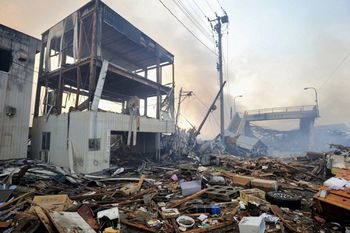
Japan On Sept. 1, 1923, a 7.9-magnitude temblor struck Tokyo. More than 100,000 people lost their lives and more than 3 million were left homeless in the Great Kanto Earthquake. Fueled by rumors that ethnic Koreans were poisoning water wells, mobs killed thousands of Koreans in the days that followed. The Japanese government declared martial law, but the civilian authorities’ inability to deal with the disaster contributed to an eventual military takeover. Seventy-one years later, on Jan. 17, 1995, Kobe was hit by a 6.9-magnitude quake. The Great Hanshin Earthquake killed 6,400 people. Damage was estimated at more than $100 billion, or 2.5 percent of Japanese national income — similar to current estimates of the toll of last week’s 9.0-magnitude temblor in the Tohoku region of northern Japan. Yet, within 18 months, economic activity in Kobe had reached 98 percent of its pre-quake level. A state-of-the-art offshore port facility was built, housing was modernized — and a scruffy port city became an international showpiece. It is tempting to regard the different responses to these tragedies as proof that a more advanced society will respond more constructively to adversity. The simpler truth is that disasters can quickly transform a nation — for better, or for worse.

Which way will Japan go?

The March 11 earthquake and tsunami devastated a society that, for all its wealth, was stuck in a rut. Over the past two decades, Japan’s economic growth averaged an anemic 1 percent a year. Politically, the country was rudderless. The Liberal Democratic Party, which had governed almost continuously since the end of the U.S. military occupation following World War II, had finally worn out its welcome. And the novice Democratic Party of Japan, which had assumed power in 2009, was flailing.

More here.

Out of options: A surprising culprit in the nuclear crisis

From The Boston Globe:

Outofoptions__1300560325_5514 As the nuclear crisis in Japan unfolded last week, experts scrambled to understand why things were going so horribly wrong. While no one was surprised that a 9.0 earthquake and a massive tsunami had caused severe and complicated problems, critics charged that various aspects of the Fukushima Daiichi plant’s design had made the catastrophe more perilous than it had to be. Some considered the particulars: Why had the cooling system’s backup generators been installed in a way that left them vulnerable to the tsunami? Why did the reactors use a cost-saving containment vessel whose disaster-worthiness had been repeatedly questioned by scientists? Why had the pool of spent fuel rods overheated?

For those taking a longer view, however, there is a larger question looming over the disaster: Why was Japan, a nation at high risk for earthquakes and natural disasters, using a type of reactor that needed such active cooling to stay safe? And the answer to that doesn’t lie with Japan, or the way the plant was built. The problem lies deeper, and concerns the entire nuclear industry. Japan’s reactors are “light water” reactors, whose safety depends on an uninterrupted power supply to circulate water quickly around the hot core. A light water system is not the only way to design a nuclear reactor. But because of the way the commercial nuclear power industry developed in its early years, it’s virtually the only type of reactor used in nuclear power plants today. Even though there might be better technologies out there, light water is the one that utility companies know how to build, and that governments have historically been willing to fund.

More here.

Saturday, March 19, 2011

Now that the Planes are Off, Two Reactions to Libya

First, Phyllis Bennis in The Real News:

While the UN resolutionwas taken in the name of protecting civilians, it authorizes a level of direct U.S., British, French, NATO and other international military intervention far beyond the”no-fly zone but no foreign intervention” that the rebels wanted. Its real goal, evident in the speeches that followed the Security Council's March 17th evening vote, is to ensure that “Qaddafi must go,” – as so many ambassadors described it. Resolution 1973 is about regime change, to be carried by the Pentagon and NATO with Arab League approval, instead of by home-grown Libyan opposition.

The resolution calls for a no-fly zone, as well as taking “all necessary measures… to protect civilian populated areas under threat of attack in the Libyan Arab Jamahiriya, including Benghazi, while excluding a foreign occupation force of any form on any part of Libyan territory.” The phrase “all necessary measures” is understood to include air strikes, ground, and naval strikes to supplement the call for a no-fly zone designed to keep Qaddafi's air force out of the skies. The U.S. took credit for the escalation in military authority, with Ambassador Susan Rice as well as other Obama administration officials claiming their earlier hesitation on supporting the UN resolution was based on an understanding of the limitations of a no-fly zone in providing real protection to [in this case Libyan] civilians. It's widely understood that a no-fly zone is most often the first step towards broader military engagement, so adding the UN license for unlimited military escalation was crucial to getting the U.S. on board. The”all necessary measures” language also appears to be the primary reason five Security Council members abstained on the resolution.

Rodger A. Payne over at Duck of Minerva responds:

Certainly, opponents of the no fly zone want to frame the debate around regime change in order to question the legitimacy of the intervention. For instance, Phyllis Bennis of the Institute for Policy Studies asserts that “it's widely understood that a no-fly zone is most often the first step towards broader military engagement.” However, I would challenge that view. The U.S. for many years helped enforce a no-fly zone in Iraq that was eventually controversial and certainly was not the key stepping stone that legitimized war in Iraq. The Bush administration likely would have pursued war on Iraq even without a no fly zone. And much of the world opposed the war in Iraq precisely because it violated international norms about the use of force.

Bennis also worries about the authorization of “all necessary measures..to protect civilians and civilian populated areas under threat of attack in the Libyan Arab Jamahiriya, including Benghazi, while excluding a foreign occupation force of any form on any part of Libyan territory.” She sees this as a virtual blank check for broader military intervention, though she overlooks the last clause.

Tibet’s Quiet Revolution

AP06060303958_jpg_470x419_q85 Pico Iyer in the NYRB:

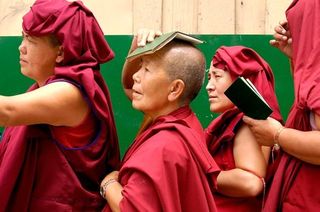
It’s been startling to witness mass demonstrations in countries across the Middle East for freedom from autocracy, while, in the Tibetan community, a die-hard champion of “people power” tries to dethrone himself and his people keep asking him to stay on. Again and again the Dalai Lama (who tends to be more radical and less romantic than most of his followers) has sought to find ways to give up power, and his community has sought to find ways to ensure he can’t. It could be said that almost the only time Tibetans don’t listen to the Dalai Lama is when he tells them they shouldn’t listen to him. Now, on the eve of an important election for Tibet’s government-in-exile, he has announced he is relinquishing formal political authority entirely—and the Tibetan government has accepted his decision, even as the move has alarmed many around the world and struck some as the end of an era.

In truth, the Dalai Lama’s statement was merely a continuation—and a stronger expression—of what he has been saying for years: that political leadership for the Tibetan people (in exile at least) belongs with the democratically elected government-in-exile he has so painstakingly set up over decades in Dharamsala, in India (elections for a new prime minister are to be held March 20); that he will function only as a “senior advisor,” helping to oversee the transition to a post-Dalai Lama era; and, most important, that the spiritual and temporal sides of Tibetan rule will at last be separate. As he noted in the speech that mentioned his “retirement”—his annual state-of-the-nation address, in effect, delivered on March 10, the anniversary of the 1959 Tibetan uprising against the People’s Republic of China and a frequent day of protest—he has believed, since childhood, that church and state should not be one and that the fate of Tibet should be in the hands of all Tibetans.