what’s a guitar?

ID_PI_GOLBE_GUITA_AP_001

And though any instrument-as-object can express this estrangement, there’s something about a silent guitar — especially one that’s beautiful, or precious, or two-dimensional — that particularly aches. When a guitar becomes a symbol, the very thing that makes it a guitar, its immediacy, disappears. For “immediacy” is why a guitar is a folk instrument, i.e. the instrument of folks. The guitar is lightweight, cheap, easy to play. Anyone — and I would like to stress anyone — with two hands and the inclination can spend an afternoon learning three major chords (A D E is a good combo or D A G) and be then well equipped to instantly rock scores of songs from “Back in Black” to “You Are My Sunshine.” (Like the old ‘70s fanzine said: “This is a chord, this is another, this is a third. Now form a band.”) This is not so with the piano, nor the drums, the flute, the fiddle. Flung over the heart or across the back, the guitar is good for anywhere and any occasion. The guitar is a folk instrument because it is an easy extension of our bodies, and therefore an easy expression of our humanity. The guitar — and all its predecessors and incarnations: the bouzouki, the saz, the oud, the guitarrón — represents the parts of us that are spontaneous, angry, lazy, joyous, raw, unsophisticated and unadorned. The only other instrument that surpasses the guitar in capturing this immediacy is the voice. Which is the final reason why the guitar is not just a folk instrument but the folk instrument — it’s an easy companion to singing.

more from Stefany Anne Golberg at The Smart Set here.

Listening to Bacteria

Natalie Angier in The Smithsonian:

Bacteria-Bonnie-Bassler-631 Bassler, 48, has been fabulously successful in her career, winning laurels like a MacArthur Foundation “genius” award, membership in the National Academy of Sciences, a coveted position with the Howard Hughes Medical Institute and the presidency of the American Society for Microbiology. And all that can be traced to her deep appreciation for the power of communication. Messaging is the medium in which Bassler shines. Bassler is at the forefront of the fast-growing field of “quorum sensing,” the study of how microbes communicate with each other as they go about building the vast interlocking infrastructure of life on which we macrobes depend.

In recent years she and other microbiologists have discovered that bacteria are not the dull solipsists of long-standing reputation, content to merely suck in food, double in size, divide down the middle and repeat ad infinitum, attending to nothing but their obtuse, unicellular selves. Instead, bacteria turn out to be the original newshounds, glued to their cellphones and Internet chat lines. They converse in a complex chemical language, using molecules to alert one another to who’s out there, in what numbers and how best to behave given the present company. Bacteria survey their ranks, they count heads, and if the throng is sufficiently large and like-minded—if there is a quorum—they act. Through chemical signaling, tiny bacterial cells can band together and perform the work of giants. They can compost an elephant, fertilize an oak forest or light up the oceans in the eerie teal glow of bioluminescence. Some bacterial collusions are far less charming and do real harm. Molecular communication allows 600 different species of bacteria to organize themselves into the slimy dental plaque that leads to tooth decay, for example, and it likely enables the nasty pathogens that cause streptococcal pneumonia or bubonic plague to time the release of their toxins for maximum impact on their human hosts.

More here.

New findings on the developments of the earthquake disaster

From PhysOrg:

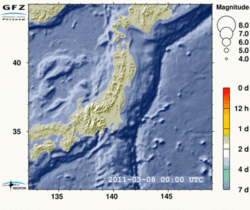
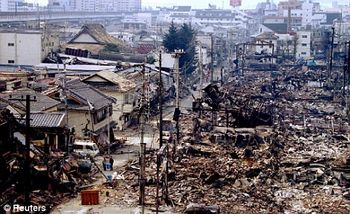
Quake The earthquake disaster on 11 March 2011 was an event of the century not only for Japan. With a magnitude of Mw = 8.9, it was one of the strongest earthquakes ever recorded worldwide. Particularly interesting is that here, two days before, a strong foreshock with a magnitude Mw = 7.2 took place almost exactly at the breaking point of the tsunami-earthquake. The geophysicist Joachim Saul from the GFZ German Research Centre for Geosciences (Helmholtz Association) created an animation which shows the sequence of quakes since March 9.

It shows the earthquake activity in the region of Honshu, Japan, measured at the GFZ since 8 March 2011. After a seismically quiet 8th March, the morning (coordinated universal time UTC) of the March 9 began with an earthquake of magnitude 7.2 off the Japanese east coast, followed by a series of smaller aftershocks. The morning of March 11 sees the earthquake disaster that triggered the devastating tsunami. This earthquake is followed by many almost severe aftershocks, two of which almost reach the magnitude 8. In the following time period the activity slowly subsides, and is dominated today (March 16) by relatively small magnitude 5 quakes, though several earthquakes of magnitude 6 are being registered on a daily basis. The activity of aftershocks focuses mainly on the area of the March 11 earthquake. Based on the distribution of the aftershocks, the length of the fraction of the main quake can be estimated at about 400 km. Overall, 428 earthquakes in the region of Honshu were registered at the GFZ since March 9.

More here.

Jamal Mahjoub interviews Ahdaf Soueif

In Guernica:

Soueif2-300 Soueif has written about Egypt for decades. Arguably the foremost Arab author writing in English today, her work has won her critical acclaim and a wide audience around the world. Edward Said described her as “one of the most extraordinary chroniclers of sexual politics now writing.” Her first novel, In the Eye of the Sun (1991), described as a masterpiece by the Sunday Telegraph’s Anthony Thwaite, rapidly became a modern classic. It recounts the liberation of Asya, a young Egyptian woman trapped in an unhappy marriage, who gains the confidence needed to break free while studying in England. The novel intersperses the story with vignettes describing current political events in Egypt. It is this combination of the actual and the fictitious which gives her work its solid grounding, setting the lives of her characters within a framework of historical developments. Soueif’s second novel, The Map of Love, consolidated her success. Shortlisted for the prestigious Booker Prize in 1999, the book has been translated into sixteen languages, including Arabic, and has sold over half a million copies in English alone. The Map of Love switches between past and present, describing events in the nineteenth century with as much clarity as it does the contemporary world, both in Egypt and New York.

In recent years Soueif’s fiction has come under pressure from the author’s increasing role as a political commentator. A collection of essays, Mezzaterra, published in 2004 underlined this new trajectory. In 2007, she launched PalFest, a literary festival aimed at breaking the deadlock in the Middle East and providing a cultural platform for dialogue between Palestine and the West. Adopting as its motto Said’s remark championing “the power of culture over the culture of power,” PalFest engages with Palestinian writers and cultural centers in promoting a dialogue between East and West, taking well-known writers like Michael Palin, Henning Mankell, Roddy Doyle, or Claire Messud, to experience the situation on the ground first-hand.

More here.

Owsley Stanley, Artisan of Acid, Is Dead at 76

Margalit Fox in the New York Times:

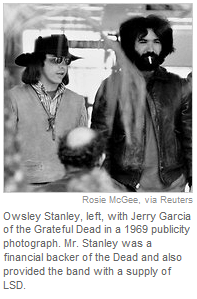
ScreenHunter_02 Mar. 17 10.21 Owsley Stanley, the prodigiously gifted applied chemist to the stars, who made LSD in quantity for the Grateful Dead, the Beatles, Jimi Hendrix, Ken Kesey and other avatars of the psychedelic ’60s, died on Sunday in a car accident in Australia. He was 76 and lived in the bush near Cairns, in the Australian state of Queensland.

His car swerved off a highway and down an embankment before hitting trees near Mareeba, a town in Queensland, The Associated Press reported. Mr. Stanley’s wife, Sheilah, was injured in the accident.

Mr. Stanley, the Dead’s former financial backer, pharmaceutical supplier and sound engineer, was in recent decades a reclusive, almost mythically enigmatic figure. He moved to Australia in the 1980s, as he explained in his rare interviews, so he might survive what he believed to be a coming Ice Age that would annihilate the Northern Hemisphere.

Once renowned as an artisan of acid, Mr. Stanley turned out LSD said to be purer and finer than any other. He was also among the first individuals (in many accounts, the very first) to mass-produce the drug; its resulting wide availability provided the chemical underpinnings of an era of love, music, grooviness and much else. Conservatively tallied, Mr. Stanley’s career output was more than a million doses, in some estimates more than five million.

More here.

Wednesday, March 16, 2011

Multiversism

Cover00

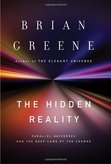
And once you become willing to take on the philosophical baggage of a multifoliate universe (and aren’t bothered by your countless identical twins), some of the deepest and most vexing problems about physics become easy to understand. All those nonsensical-seeming quantum-mechanical laws—that a particle can be in two places at once, that two objects can have a spooky connection that appears to transcend the laws governing space and time—instantly become explicable the moment you view our universe as one among many. And from Greene’s point of view, the 10⁵⁰⁰ different cosmoses described by string theory have ceased to be an unwanted artifact of the theory’s equations, instead becoming a factual description of universes that actually exist. Each of these universes is a bubble cosmos with its own cosmological constants, and as he says, “with some 10⁵⁰⁰ possibilities awaiting exploration, the consensus is that our universe has a home somewhere in the landscape.” Which is to say, string theory can no longer be accused of describing a landscape of fictional universes; our universe is just one in a collection of cosmoses as real as our own, even if we’re unable to see them. Multiversism is a radical, ambitious, and frustrating argument that relies on many lines of evidence and modes of thought—cosmological reasoning about the nature of the big bang, quantum-mechanical reasoning about the nature of matter on the smallest scale, information-theoretic reasoning about the nature of black holes—and it can be bewildering. Furthermore, Greene argues for nine distinct varieties of multiverse, each of which approaches the issue from a slightly different direction. And since the majority of his readers are untutored in the mathematical formalism that physicists use to understand the underpinnings of a scientific theory, Greene must use the much less precise tools of metaphor and simile to do the intellectual heavy lifting.

more from Charles Seife at Bookforum here.

fish and fandom

Stanley-fish-1

Academics: beware of loving what you write about. Fandom can tempt intellectuals to take uncharacteristic risks with their primary sources. Even Stanley Fish, who as the author of Is There a Text In This Class? knows better than anyone how important the division of insider and outsider is for keeping amateurs at bay. In 1993, Fish-the-fan, enamoured of the American television series The Fugitive, joined the faithful at a convention in Hollywood to rerun, adore and discuss the episodes, to listen to actors and directors of the programme talk about their experience. There’s probably an internally understood hierarchy of TV series obsessives, but I don’t know where Fugitive-heads come in relation to Trekkies, Python freaks or Dynasty divas. On the other hand, and at the same time, Fish-the-intellectual wanted to write a book about The Fugitive as it ‘celebrated and anatomised the ethic of mid-20th-century liberalism’, and, without doing a Christopher Ricks, who unnecessarily upgraded Bob Dylan’s songs to Great Poetry rather than the more-than-adequate great lyrics that they are, also wanted to claim that there was enough serious and educated thought behind the creation of the series to merit his academic attention. It is central to his essay that the people who conceived, pitched and wrote The Fugitive were not simply writing popular fiction in a winning formula but, in setting up the drama series and conceiving each episode, had the conscious intention to explore the same ideas as Fish does in writing about it.

more from Jenny Diski at the LRB here.

The Strangest Spice

Peppercorns Jon Fasman in More Intelligent Life:

There are many drawbacks to becoming a food writer—money and fatness spring to mind. But they all pale in comparison to the problem of translation. When food delights it does not delight in words; it delights in a way that exceeds, or slips past, or twists around words. People who write about music have this same problem, which is why both fields seem to turn out so many gossipy profiles: you can’t describe a transcendent song or dish, but you can easily describe the marital or financial peccadilloes of the person who created them. A meal is usually memorable for reasons ancillary to the food—the company, or the setting—but even when the food itself is memorable, memory calcifies it. It is a rare taste that breaks through the film of words.

All of this is by way of saying that about six years ago I sat down with three others for the full ten-course parade at Per Se, complete with wine pairings. I remember the austere but elegant restaurant, the way that around course five the meal tipped from Lucullan into some sort of strange performance art, but I can recall only one taste from the fifty or so dishes we tried that night: a single shortbread cookie, around the size of a domino, flavoured with Sichuan pepper and served as a companion to some sort of warm-spice ice-cream (cinnamon, I think, though it could have been anise or nutmeg).

That was not my first taste of the spice: its more familiar habitat, as its name suggests, is in the cuisine of south-western China. New York’s Grand Sichuan restaurants have made their reputation largely through liberal use of Sichuan peppercorns and dried chillies. And Peter Chang—a prodigiously gifted and famously itinerant genius of Sichuanese cuisine—has been the subject of Mash notes from more exalted food writers than I (such as Todd Kliman and Calvin Trillin), largely for his expert use of the spice.

Richard Dawkins & AC Grayling Discuss Evidence for the Supernatural

A podcast over at the Pod Delusion:

Richard Dawkins and AC Grayling discuss whether there can ever be evidence for the supernatural in an unmoderated, unrehearsed armchair discussion. The event was sponsored by the British Humanist Association, and organised as a part of Oxford Think Week by the Oxford Atheists, Secularists and Humanists (OxASH) in conjunction with Oxford Humanists, Oxford Skeptics in the Pub and Oxford Sea of Faith.

Egypt: Does the Revolution Include the Copts?

Nelly van Doorn-Harder in openDemocracy:

One of the concerns discussed in the western press is the issue of what it will mean for the country’s new democracy if the trans-national Muslim Brotherhood, the country's oldest Islamic movement, gains the majority vote. For the moment there are few organized political groups in Egypt capable of creating new governmental structures. In the 2005 elections Brotherhood members earned twenty percent of the seats in parliament, and over fourteen hundred charitable foundations make the organization immensely popular among Egypt’s poor and lower classes.

Mr. Subhi Saleh, the Brothers’ representative in the transition committee creating a new government, maintains that he advocates democracy. Yet, many Egyptians perceive the entire committee to be Islamist oriented. It has proposed amending the laws concerning presidential elections, but not the second article of Egypt’s soon-to-be-revised Constitution: “Islam is the Religion of the State. Arabic is its official language, and the principal source of legislation is Islamic Jurisprudence (Shar`iah).” This article coincides with the Brotherhood’s 2007 Charter and does not guarantee equal citizenship for all Egyptians – one of the main demands of many groups involved in the January 25th Revolution.

Dubai on Empty

Its skyline erupting from the desert in just two decades, Dubai is a cautionary tale about what money can’t buy: a culture of its own. After gorging on the Viagra of easy credit, the emirate has the world’s tallest building, the world’s most expensive racetrack, and a financial crisis to match. From the Western mercenaries and Asian drones who maintain the gaudy show to 100-odd families who are impervious to any economic reality, A. A. Gill discovers that no one truly belongs in Dubai, where the legacy of oil has made everything worthless.

A. A. Gill in Vanity Fair:

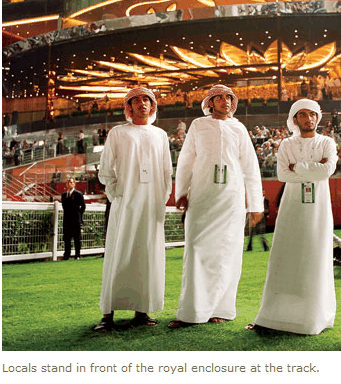
ScreenHunter_01 Mar. 16 13.00 The only way to make sense of Dubai is to never forget that it isn’t real. It’s a fable, a fairy tale, like The Arabian Nights. More correctly, it’s a cautionary tale. Dubai is the story of the three wishes, where, as every kid knows, with the third wish you demand three more wishes. And as every genie knows, more wishes lead to more greed, more misery, more bad credit, and much, much, much more bad taste. Dubai is Las Vegas without the showgirls, the gambling, or Elvis. Dubai is a financial Disneyland without the fun. It’s a holiday resort with the worst climate in the world. It boils. It’s humid. And the constant wind is full of sand. The first thing you see when you arrive is the airport, with its echoing marble halls. It’s big enough to be the hub of a continent. Dubai suffers from gigantism—a national inferiority complex that has to make everything bigger and biggest. This includes their financial crisis.

Outside, in the sodden heat, you pass hundreds and hundreds of regimented palm trees and you wonder who waters them and what with. The skyline, in the dusty haze, looks like the cover of a dystopian science-fiction novella. Clusters of skyscrapers lurch out at the gray desert accompanied by their moribund cranes, propped up with scaffolding, swagged in plastic sheeting. Dubai thought it was going to grow up to be the Arab Singapore—a commercial, banking, and insurance service port on the Gulf with hospitality and footballers’ time-shares, an oasis of R&R for the less well endowed. But it hasn’t quite worked out.

More here.

Wednesday Poem


Caravaggio: Swirl & Vortex

In the Borghese, Caravaggio, painter of boy whores, street punk, exile & murderer,
Left behind his own face in the decapitated, swollen, leaden-eyed head of Goliath,
And left the eyelids slightly open, & left on the face of David a look of pity

Mingling with disgust. A peach face; a death mask. If you look closely you can see
It is the same face, & the boy, murdering the man, is murdering his own boyhood,
His robe open & exposing a bare left shoulder. In 1603, it meant he was available,

For sale on the street where Ranuccio Tomassoni is falling, & Caravaggio,

Puzzled that a man would die so easily, turns & runs.

Wasn't it like this, after all? And this self-portrait, David holding him by a lock
Of hair? Couldn't it destroy time if he offered himself up like this, empurpled,
Bloated, the crime paid for in advance? To die before one dies, & keep painting?

This town, & that town, & exile? I stood there looking at it a long time.

A man whose only politics was rage. By 1970, tinted orchards & mass graves.

Read more »

Dis[Locating] Culture: Contemporary Islamic Art In America

From The Huffington Post:

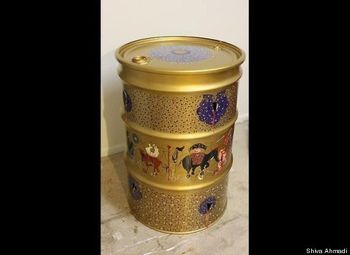
Slide_18048_251692_large The power of art to reveal commonalities between seemingly distant sets of beliefs is powerfully displayed in an upcoming exhibit, entitled “Dis[Locating] Culture: Contemporary Islamic Art in America,” at the Michael Berger Gallery in Pittsburgh, Penn., and co-curated by Reem Alalusi. “Dis[Locating] Culture” will be the city’s first exhibit of contemporary Islamic art, and certainly one of the first in America’s Midwest. Held at a gallery owned by a Jewish American art collector, the show is a direct affront to the binary thinking and exclusionary conclusions, carried across the airwaves by an insistently normalizing, ever vocal talkocracy, that produces mistaken, typecast notions of Islamic art as a mutually incompatible field to that of the Contemporary project. Though Islamic art is conventionally considered a separate category from Western Art, the artists in “Dis[Locating] Culture” blur the categories and push the boundaries of each. This is neither Islamic nor Western, per se; this is Contemporary Art.

More here.

In Japan, No Time Yet for Grief

KAZUMI SAEKI in The New York Times:

Japan-Earthquake-And-Tsunami WHEN the earthquake struck, I was at the hot springs in Sakunami, about 15 miles from my home in Sendai. I was playing host to a couple from Britain, and as I soaked in an open-air bath with Ben, the husband, powdery snow began to shake off the surrounding boulders. The next moment, small pieces of broken stone came tumbling down. “It’s an earthquake, a big one,” I said, urging Ben on to the changing room next door. Without bothering to dry off, I pulled on my bathrobe. As I struggled to keep my legs from buckling and tied my sash with trembling hands, I was struck by the terrifying realization that the great earthquake off Miyagi Prefecture, predicted for so long, had at last arrived. The fierce rolling of the earth lasted longer than I had ever experienced. As I learned later, this was not just the predicted earthquake. It was a giant quake in the waters off Miyagi; off the Sanriku coast in Iwate Prefecture to the north; off Fukushima Prefecture to the south. It lasted six minutes. I heard screams from the women’s changing room and eventually Ben’s wife, Liz, appeared, supported by my wife. Earthquakes are rare in Britain, and I could see plainly Liz’s great shock at experiencing one.

Public transportation back to Sendai, the big city closest to the epicenter, had stopped running, cellphones were not working and all flow of information had ceased. The inn kindly let us spend the night, and the following day a young tourist from Tokyo drove us in his rental car back to Sendai. The roads were torn apart and blocked at points by collapsed inns. The windows of larger buildings were smashed and the tile roofs of houses had crumbled to the ground, while old concrete-block walls were reduced to rubble. Scenes of disaster appeared before my eyes, but in all honesty, I felt the scale of destruction was rather small. When I reached my home, on high ground, the lock on the front door was broken and the floor was covered with books, CDs and plates that had fallen from the shelves. But everything was dry, and there was nothing to alter my perception of the scope of the disaster.

More here.

Tuesday, March 15, 2011

The Mad Genius of “Modernist Cuisine”

110321_r20650_p233 John Lanchester in The New Yorker:

In 2004, Nathan Myhrvold, who had, five years earlier, at the advanced age of forty, retired from his job as Microsoft’s chief technology officer, began to contribute to the culinary discussion board egullet.org, on the subject of a kitchen technique called “sous vide.” The French term means “under vacuum,” and it refers to a process that has been around since the nineteen-seventies but has, in recent decades, become a favorite technique of the cutting-edge professional kitchen.

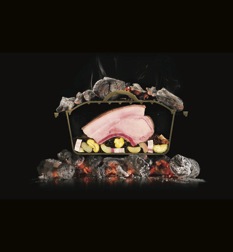
In sous-vide cooking, ingredients and flavorings are prepared and put in a plastic bag, from which all the air is subsequently extracted by suction. The food is then cooked in a circulating water bath at a highly precise temperature—and this precision is what chefs love. A sous-vide steak, for instance, is not cooked rare or medium rare; it is cooked to 126 or 131 degrees Fahrenheit, respectively. At these low temperatures, cooking times can be as long as seventy-two hours, and the results are often extraordinary. As David Chang puts it in his cookbook “Momofuku,” “If you know what temperature you want the thing to be, just cook it at that temperature for long enough to bring the whole thing up to that temperature and presto! It’s like magic: you’re not sitting there poking or prodding the meat or worrying that it’s rare or raw or overcooked.”

Myhrvold is fascinated by invention and innovation. He is the founder and C.E.O. of the company Intellectual Ventures, which has developed hundreds of patents. He is also a serious amateur cook, trained at La Varenne cooking school, in Burgundy, and a member of a team that won several prizes in a 1991 world barbecue championship. He is the “chief gastronomic officer” of Zagat Survey, the company that publishes the eponymous restaurant guides. At the time he grew interested in sous vide, there was no book in English on the subject, and he resolved to write one, incorporating primary research on the science of the technique, especially as it bore on the question of food safety.

Pakistan Doubles its Nuclear Arsenal: Is it Time to Start Worrying?

Alexander H. Rothman and Lawrence J. Korb in The Bulletin of the Atomic Scientists:

Pakistan's jump from an estimated 60 to 110 nuclear weapons is unlikely to shift the balance of power vis a vis India. With 60 warheads, Pakistan possessed enough weapons for a viable nuclear deterrent and second-strike capability against India or any other nation. While the jump to 110 weapons may put Pakistan's arsenal slightly ahead of India's in numerical terms, it does not increase the effectiveness of Pakistan's deterrent.

In fact, Pakistan's focus on nuclear buildup appears unlikely to improve the country's security in any way. While relations between Pakistan and India are far from cordial, the most immediate threats to Pakistani stability are domestic. Heavily reliant on foreign aid, Pakistan faces severe economic problems as well as an armed, extremist insurgency. Additional nuclear weapons are unlikely to help the Pakistani government solve either of these internal problems — particularly considering the fact it's almost impossible to think of a situation in which it makes sense for a government to use nuclear weapons domestically.

In working to double the size of its already substantial nuclear arsenal, Pakistan continues to place a disproportionate focus on its nuclear program ahead of other key security concerns. This behavior is far from new. In 1972, Pakistani President Zulfikar Ali Bhutto famously proclaimed, “even if we have to eat grass we will make nuclear bombs.” Four decades later, Pakistan continues to pursue this strategy of nuclear buildup at any cost, thereby diverting resources away from other programs that could attempt to address the country's internal security and economic threats.

David Hume at 300

Hume Howard Darmstadter in Philosophy Now:

Born May 7, 1711 of respectable parents in the Scottish Lowlands, his early life was outwardly uneventful. After leaving Edinburgh University, he at first contemplated a legal career, and briefly worked as a clerk for a Bristol merchant. But in his late teens Hume was seized by ideas that “opened up to me a new scene of thought.” He decided to become the Newton of the moral sciences.

Newton had shown that all of the material world was governed by the same mechanical laws. Hume’s great project was to base the study of man and society on similar universal principles. Indeed, the Treatise of Human Nature bore the subtitle Being an Attempt to Introduce the Experimental Method of Reasoning into Moral Subjects.

In the Treatise, Hume tried to formulate the laws governing the succession of our thoughts. The result was a long and generally unconvincing exposition of numerous rules said to direct our mental life. But intertwined with this failed attempt at a complete theory of the mind, and at times buried by it, is Hume’s development of the startling implications of a scientific view of man. His two later Enquiries brought these implications powerfully to the fore.

Like most philosophers of his time, Hume conceived of thought as a flow of mental images. Seeing a tree, imagining a tree, or remembering a tree, were all thought to consist of our having a mental image, more vivid for the seen tree, less vivid for the imagined or remembered tree. A sentence like ‘The Earth is round’ would have a certain type of mental image as its meaning, and believing that the Earth is round necessarily involved a vivid mental image of that type. This theory also explained why certain beliefs were logically impossible. For example, a four-sided triangle was logically impossible (and a three-sided triangle logically necessary) because we could not form a mental image of a triangle that did not have three sides. (Try it.) Hume’s disturbing insight from this way of thinking about thinking, was that all our factual and moral beliefs can therefore only be justified in terms of the psychological laws that govern the succession of images in our minds.