True Colors: Hair Dye and the Hidden History of Postwar America

My favorite Malcolm Gladwell piece:

In 1956, when Shirley Polykoff was a junior copywriter at Foote, Cone & Belding, she was given the Clairol account. The product the company was launching was Miss Clairol, the first hair-color bath that made it possible to lighten, tint, condition, and shampoo at home, in a single step-to take, say, Topaz (for a champagne blond) or Moon Gold (for a medium ash), apply it in a peroxide solution directly to the hair, and get results in twenty minutes. When the Clairol sales team demonstrated their new product at the International Beauty Show, in the old Statler Hotel, across from Madison Square Garden, thousands of assembled beauticians jammed the hall and watched, openmouthed, demonstration after demonstration. “They were astonished,” recalls Bruce Gelb, who ran Clairol for years, along with his father, Lawrence, and his brother Richard. “This was to the world of hair color what computers were to the world of adding machines. The sales guys had to bring buckets of water and do the rinsing off in front of everyone, because the hairdressers in the crowd were convinced we were doing something to the models behind the scenes.”

Miss Clairol gave American women the ability, for the first time, to color their hair quickly and easily at home. But there was still the stigma-the prospect of the disapproving mother-in-law. Shirley Polykoff knew immediately what she wanted to say, because if she believed that a woman had a right to be a blonde she also believed that a woman ought to be able to exercise that right with discretion. “Does she or doesn't she?” she wrote, translating from the Yiddish to the English. “Only her hairdresser knows for sure.” Clairol bought thirteen ad pages in Life in the fall of 1956, and Miss Clairol took off like a bird. That was the beginning. For Nice 'n Easy, Clairol's breakthrough shampoo-in hair color, she wrote, “The closer he gets, the better you look.” For Lady Clairol, the cream-and-bleach combination that brought silver and platinum shades to Middle America, she wrote, “Is it true blondes have more fun?” and then, even more memorably, “If I've only one life, let me live it as a blonde!” (In the summer of 1962, just before “The Feminine Mystique” was published, Betty Friedan was, in the words of her biographer, so “bewitched” by that phrase that she bleached her hair.) Shirley Polykoff wrote the lines; Clairol perfected the product. And from the fifties to the seventies, when Polykoff gave up the account, the number of American women coloring their hair rose from seven per cent to more than forty per cent.

Gender and the Philosophy Club

Women200 Stephen Stich and Wesley Buckwalter in The Philosopher's Magazine:

Once upon a time, a Club was started by some really clever people. It was a very prestigious Club whose members were thought to be some of the deepest thinkers in all the world. Since the members of the Club were lovers of wisdom, they were called “Philosophers”. To get into the Club, one had to be very bright and very well educated; one also had to relish argument and debate and be very good at it. The Club was founded a long, long time ago, back in the days when men got to do all the cool stuff, and women were treated as second-class citizens (or worse!). So there were no women in the Club.

In addition to being very clever, and very good at argument and debate, there was also another requirement for getting into the Club, and that will take a bit of explaining. In their arguments and debates, Philosophers frequently come up with rather odd hypothetical cases – thought experiments, as they are sometimes called – that pose interesting philosophical questions. Some of these thought experiments focus on whether a character in a hypothetical story really has knowledge of some proposition; others ask whether an action recounted in the story was just or morally permissible; still others raise questions about free will, personal identity, meaning and other matters. Here’s an example that focuses on knowledge:

Bob has a friend, Jill, who has driven a Buick for many years. Bob therefore thinks that Jill drives an American car. He is not aware, however, that her Buick has recently been stolen, and he is also not aware that Jill has replaced it with a Pontiac, which is a different kind of American car. Does Bob really know that Jill drives an American car, or does he only believe it?

Thought experiments like this one are called “Gettier cases” since a man named “Gettier” first proposed them. Philosophers often find that they can make spontaneous judgments about these questions. After hearing or reading a thought experiment, a compelling answer just pops into their minds. They have no conscious awareness of the psychological processes that lead to that answer. Nonetheless, the answer seems to be true.

My Brother’s a Keeper

110324_SN_CoachVCU_TN

“Honey, Shaka’s trending again!” I realize my brother has moved into a new phase of sports celebrity when his name—Shaka Smart—becomes a trending topic on Twitter, right alongside Rebecca Black. His name is being inserted into spam tweets from China (“ShakaSmart International IQ Test … Play Free Online”), and women are posting comments about … well, you know. A Tennessee Volunteers fan, whose team is in the market for a hot young coach, jokingly speculates on the fact that Shaka wore an “orange tie” against Purdue. (Actually, the tie was golden.) A confused Brazilian asks, in Twitter Portuguese, “Does anyone know what is Shaka Smart?” In his second year as the men’s basketball coach at Virginia Commonwealth University, Shaka has become “one of the most talked-about young coaches in the game,” sayeth the AP. This all happened very quickly. First, VCU beat USC in the NCAA Tournament’s “First Four.” Then the Rams demolished Georgetown. Two days later, Purdue met a similar fate, and VCU entered the Sweet 16 as a media darling. By this point, anything Shaka did or said was a newsworthy event. After the Purdue game, a Sports Illustrated writer reveled in a courtside hug between my brother and my mom. When I called mom to ask about it, she said she’d just gotten off the phone with the Washington Post. “The reporter was asking about his early character-building experiences,” she said.

more from our own, dear J.M. Tyree at Slate here.

the universe, a clock

Clockwork-universe-isaac-newton-royal-society-bkadbl002991

London before the mid-1600s was a general calamity. The streets were full of thieves, murderers and human waste. Death was everywhere: doctors were hapless, adults lived to about age 30, children died like flies. In 1665, plague moved into the city, killing sometimes 6,000 people a week. In 1666, an unstoppable fire burned the city to the ground; the bells of St. Paul’s melted. Londoners thought that the terrible voice of God was “roaring in the City,” one witness wrote, and they would do best to accept the horror, calculate their sins, pray for guidance and await retribution. In the midst of it all, a group of men whose names we still learn in school formed the Royal Society of London for the Improvement of Natural Knowledge. They thought that God, while an unforgiving judge, was also a mathematician. As such, he had organized the universe according to discernible, mathematical law, which, if they tried, they could figure out. They called themselves “natural philosophers,” and their motto was “Nullius in verba”: roughly, take no one’s word for anything. You have an idea? Demonstrate it, do an experiment, prove it. The ideas behind the Royal Society would flower into the Enlightenment, the political, cultural, scientific and educational revolution that gave rise to the modern West.

more from Ann Finkbeiner at the NYT here.

philosophy war

TLS_steiner_735345a

Dr Kissinger famously said that the fierceness of academic quarrels is proportionate to the triviality of the issues; he was mistaken. These issues can engage fundamental questions of intellectual and moral life. They can far outweigh the factitious mummeries of diplomacy. When Heidegger ruled that the destiny of the West turned on the Latin mistranslation of the Greek “to be”, he was exaggerating, but his hyperbole was meaningful. According to Pierre Bouretz, a “thirty years’ war has rent apart the philosophical conscience of Europe”. (Where conscience signifies both “conscience” and “consciousness”, a blurring duality integral to French.) This war set at radical odds the deconstruction and reconstruction of reason; the subversion or transgression of metaphysics; antithetical ways of eliminating classical concepts of the ego and of individual consciousness. Implicit in the polemics were the liquidation or salvation of the heritage of Kant and the Enlightenment, a casus belli crucial to Theodor Adorno and the Frankfurt School no less than to Michel Foucault. Further in the background, but of consequence, were almost incompatible readings of Descartes opposing Jacques Derrida to Foucault in the period from 1963 to 1972. And although it is the European matrix that is the origin and context of these clashes, the impact on philosophical teaching and argument in the United States (later in Japan) proved seminal.

more from George Steiner at the TLS here.

scandinavian noir

Dda52b0e-56a1-11e0-9c5c-00144feab49a

Crime fiction has long depended on a sense of dark forces lurking below calm surfaces and it is not unusual for it to have a reformist, critical edge. Critics have pointed to US noir novels and films as an allegory for fears of subversion and communism in the 1940s and 50s. English country-house crime of the Mousetrap genre depended on an assumption that, behind the tennis and the gin, bestial passions waited their time. But in Scandinavian noir this is frequently married to a revolutionary intent. Most of these writers are militantly left-wing. It is a tradition started by Maj Sjöwall and Per Wahlöö, a couple of Swedish journalists who, between 1965 and 1975 (when Wahlöö died in his late 40s) wrote the 10-novel Martin Beck series. Beck, a Stockholm police inspector who resembles the later Wallander, stoically solves crimes that are often rooted in upper-class chicanery or lower-class desperation. Interviewed by The Observer in 2009, Sjöwall said: “We wanted to describe society from our left point of view … we could show readers that under the official image of welfare-state Sweden there was another layer of poverty, criminality and brutality. We wanted to show where Sweden was heading: towards a capitalistic, cold and inhuman society, where the rich got richer, the poor got poorer.”

more from John Lloyd at the FT here.

Godless in Tumourville

From The Telegraph:

Hitch_1850928c Writing in his memoirs, Hitch-22, of the numerous perils that he has faced as a reporter around the globe in places as various as Afghanistan, Northern Ireland and Beirut, Christopher Hitchens reflects that a little danger or discomfort can be a salutary thing: 'I still make sure to go, at least once every year, to a country where things cannot be taken for granted, and where there is either too much law and order or too little.’ He could never have guessed how prescient those words would be. In June last year, while on a tour of America to promote the hardback publication of his book, Hitchens was taken ill in New York and was subsequently diagnosed with cancer of the oesophagus. Thus did he acquire his visa to a place where nothing can be taken for granted. Hitchens has christened it 'Tumourville’.

Until the publication three years ago of his book God Is Not Great Hitchens had been, in the words of his late friend the author Susan Sontag, 'a sovereign figure in the small world of those who tilled the field of ideas’ – but largely unknown outside it. He reviewed books for Atlantic magazine, wrote regular columns for Vanity Fair and Slate, and regularly appeared on cable news programmes in America. To those who follow not only politics but also the fortunes of those who commentate on politics, he was well-known for his perceived move from Left to Right over the war in Iraq.

More here.

How Gandhi Became Gandhi

From The New York Times:

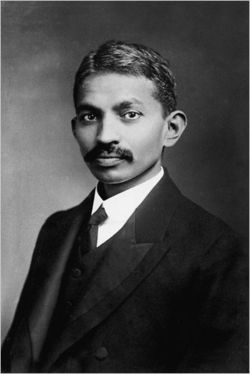
Gandhi Some years ago, the British writer Patrick French visited the Sabarmati ashram on the outskirts of Ahmedabad in the Indian state of Gujarat, the site from which Mahatma Gandhi led his salt march to the sea in 1930. French was so appalled by the noisome state of the latrines that he asked the ashram secretary whose job it was to clean them. A sweeper woman stopped by for an hour a day, the functionary explained, but afterward things inevitably became filthy again. But wasn’t it a central tenet of the Mahatma’s teachings that his followers clean up after themselves? “We all clean the toilets together, on Gandhiji’s birthday,” the secretary answered, “as a symbol to show that we understand his message.”

Gandhi had many messages, some ignored, some misunderstood, some as relevant today as when first enunciated. Most Americans — many middle-class Indians, for that matter — know what they know about the Mahatma from Ben Kingsley’s Academy Award-winning screen portrayal. His was a mesmerizing performance, but the script barely hinted at the bewildering complexity of the real man, who was at the same time an earnest pilgrim and a wily politician, an advocate of celibacy and the architect of satyagraha (truth force), a revivalist, a revolutionary and a social reformer. It is this last avatar that interests Joseph Lelyveld most. “Great Soul” concentrates on what he calls Gandhi’s “evolving sense of his constituency and social vision,” and his subsequent struggle to impose that vision on an India at once “worshipful and obdurate.” Lelyveld is especially qualified to write about Gandhi’s career on both sides of the Indian Ocean: he covered South Africa for The New York Times (winning a Pulitzer Prize in 1986 for his book about apartheid, “Move Your Shadow”), and spent several years in the late 1960s reporting from India. He brings to his subject a reporter’s healthy skepticism and an old India hand’s stubborn fascination with the subcontinent and its people.

More here.

Friday, March 25, 2011

Friday Poem

As We Are So Wonderfully Done with Each Other

As we are so wonderfully done with each other
We can walk into our separate sleep
on floors of music where the milkwhite cloak of childhood
lies

oh my love, my golden lark, my soft long doll
Your lips have splashed my dull house with print of flowers
My hands are crooked where they spilled over your dear
curving

It is good to be weary from that brilliant work
It is being God to feel your breathing under me

A waterglass on the bureau fills with morning…..
Don't let anyone in to wake us

by Kenneth Patchen
from Kenneth Patchen Selected Poems
New Directions Books 1957

Love remains a main source of regret for typical American

From PhysOrg:

Sources_of_regret You’re not alone. A new study by Neal Roese, Kellogg professor of marketing, finds that romance is the most common source of regret among Americans. Other common sources of regret include family interactions, education, career, finances and parenting. For the study, Roese and Mike Morrison of University of Illinois at Urbana-Champaign analyzed data from a telephone survey of 370 adult Americans. Subjects were asked to describe one regret in detail, including the time in which the regret happened and whether the regret was based on an action or inaction. “We found that one’s life circumstances, such as accomplishments or shortcomings, inject considerable fuel into the fires of regret,” Roese said. “Although regret is painful, it is an essential component of the human experience.”

Key findings from the study include:

• About 44 percent of women reported romance regrets versus 19 percent of men. Women also had more family regrets than men. About 34 percent of men reported having work-oriented regrets versus 27 percent of women reporting similar regrets. Men also had more education regrets than women.
• Individuals who were not currently in a relationship were most likely to have romance regrets.
• People were evenly divided on regrets of situations that they acted on versus those that they did not act on. People who regretted events that they did not act on tended to hold on longer to that regret over time.
• Individuals with low levels of education were likely to regret their lack of education. Americans with high levels of education had the most career-related regrets.

More here.

South Asia Scholar Says Pakistan’s Police, Not Military, Is Key to Fighting Terrorism

From The Record:

AbbasHassan2009 Fourteen years ago, Hassan Abbas served on the police force in his homeland, Pakistan. Now from his perch at the School of International and Public Affairs, Abbas has come up with a plan to reform his country’s weak police system, which he argues would be far better than the military at fighting terrorism. “Nuclear bombs and attacks are not going to save Pakistan from militant threat,” says Abbas, the Quaid-i-Azam Professor with the South Asia Institute. “You need better law enforcement mechanisms to tackle the growing violence and crime in the country.” In February, Abbas’ research was published in a report released by the nonpartisan United States Institute of Peace. His recommendations include improving coordination between various policing agencies, streamlining the decision-making process, modernizing investigative skills and increasing police salaries.

Abbas’ research is timely as Pakistan becomes increasingly dangerous. Earlier this month, minority affairs minister Shahbaz Bhatti was gunned down in his car. Bhatti, a Roman Catholic, was the second government official to be assassinated in the past two months for seeking to reform Pakistan’s harsh blasphemy laws, which impose the death penalty for insulting the Prophet Muhammad. Salmaan Taseer, the Punjab governor, was murdered in January by one of his own bodyguards after he called for a pardon of a Christian woman sentenced to death under the law.

More here. (Note: This proposal is almost exactly similar to what our own 3qd editor Abbas Raza had sent as an aopen letter to President Musharraf more than five years ago)

‘Eurydice’ Emerges From Darkness

This is a story about one 3QD writer's poem and quotes another 3QD writer! Paul Levy in the Wall Street Journal:

EI-BJ837B_EURID_G_20110323181856 For years, harried commuters in a gloomy South Bank underpass drew courage from the words that greeted them as they entered a long pedestrian tunnel to Waterloo Station.

“I am not afraid as I descend, step by step, leaving behind the salt wind blowing up the corrugated river…” begins “Eurydice”—a poem by Sue Hubbard based on the story from Greek mythology, in which Orpheus tries to retrieve his dead lover Eurydice from the Underworld. The poem was painted in bronze and rust on both walls of the underpass 10 years ago, its stanzas taking people all the way from either entrance to the other, past occasional homeless men sleeping in the tunnel.

The poem was commissioned when Avery Architects renovated the Southbank cultural center, a concrete city that houses the London Eye, IMAX Cinema, the British Film Institute, the Hayward Gallery and the National Theatre complex, among others. In 2001 the Arts Council and the British Film Institute selected Ms. Hubbard, a poet with a track record as a public-places artist, able to collaborate easily with graphic designers and visual artists. The font, “Disturbance,” was designed by Jeremy Tankard.

The public welcomed the poem, which stretched along the wall of the tunnel, which runs from the IMAX cinema to Waterloo Station. In autumn 2009, Time Out magazine listed the poem as one of the best-kept secrets of London.

So it came as a shock when just weeks after the poem's brush with broader cultural fame, workmen employed by Network Rail, which owns the site, painted over it. A modern protest movement ensued.

More here.

Villainous Aggressor, Falling Man, Human Shield

Terrance Tomkow in his blog:

If we have any rights, we surely have the right to self-defense. And yet self-defense has proven very puzzling to Rights theorists. To see why, take a simple case:

VILLAINOUS AGGRESSOR
There are two agents, AGGRESSOR and VICTIM: AGGRESSOR resents VICTIM for his sauve good looks and skill on the dance floor and has made it clear that he intends to kill him. One day AGGRESSOR shows up at the dance hall, gun in hand. He takes a shot at VICTIM but misses narrowly. He prepares to fire again, taking more careful aim, but VICTIM too has a gun and his only hope of surviving is to return fire and kill or disable AGGRESSOR.

Is it morally permissible for Victim to shoot aggressor? Of course! But now here's the puzzle. Rights Theorists have wanted to say:

  1. It is permissible for VICTIM to shoot AGGRESSOR because VICTIM has the right to self-defense.
  2. VICTIM has the right to self-defense because he, like everyone, has the right not to be killed or harmed. (That is why, if you are attempting to kill or harm him, you are doing something wrong.)
  3. In defending himself, VICTIM will kill or harm the AGGRESSOR.
  4. If the AGGRESSOR, had a right not to be killed or harmed, then it would be impermissible to kill or harm him.

The puzzle is: what happened to AGGRESSOR’s right not to be harmed?

It seems we must say that, by launching his attack, the attacker somehow loses his right not to be harmed. But where does it go?

More here.

Thursday, March 24, 2011

Preserving the Triangle Factory Fire’s Lessons, 100 Years Later

110324_golstein_lead Nancy Goldstein in The American Prospect:

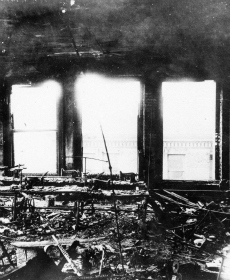
Tomorrow marks the 100th anniversary of the notorious Triangle Shirtwaist Factory fire that trapped and killed 146 workers, most of them young immigrant women, on the upper floors of a New York City sweatshop. It's a time to honor and mourn the Triangle's victims, commemorate the tragedy's importance as a turning point in the history of the American labor movement, and reaffirm the crucial role of unions and regulatory bodies in advancing worker rights. Both are taking a beating in America's 21st-century iteration of the Gilded Age, as industrialists (hello, Koch brothers) paired with the craven politicians who do their bidding (greetings, Gov. Scott Walker, Sen. Scott Brown, et al.) take another pass at ridding our country of all those nasty laws that protect consumers and workers, and cut into their bottom line.

It was unions — led by the International Ladies' Garment Workers (now Workers United) in league with the Women's Trade Union League — that began harnessing public outrage in the wake of the fire to demand the regulations regarding worker health, well-being, and safety that protect many workers to this day, whether or not they belong to a union. Think workers' compensation, unemployment insurance, the 40-hour workweek, weekends, holidays, sick pay, employee benefits, and safety standards. While you're at it, peruse this excellent chart from the Service Employers International Union that illustrates the many ways unions succeeded in making workplace buildings safer in the wake of the Triangle tragedy. These included pressuring legislators to mandate emergency exits, sprinkler systems, and maximum-occupancy laws.

Intervening in Libya

Vijay Prashad in Counterpunch:

On March 19, 2011, the United Nations Security Council voted for Resolution 1973 to establish a “no-fly” zone over Libya. The violence against civilians and media personnel is cited as the reasons for the new resolution (an earlier one, 1970, languishes). The Council authorizes a ban on all flights over Libya (except for humanitarian purposes), freezes selective assets of the Libyan high command and proposes that a Panel of Experts be set up to look into the issue within the next year. Even as members of the Council raised their paddles to indicate their votes, French Mirage fighters powered up to begin their bombing runs and U. S. ships loaded their cruise missiles to fire into Libyan targets. Their bombardments were intended to dismantle Libyan air defenses. This is the prelude to the establishment of a “no-fly” zone.

To create the “no fly” zone, the Council allowed member states to act “nationally or through regional organizations,” viz. NATO, “to take all necessary measures to enforce compliance with the ban on flights.” It is the “all necessary measures” that allows the member states (the U. S., the U.K. and France) to extend the zone at will, and to push from enforcement of a “no-fly” zone to the removal of Qaddafi, including by the targeting of his compound in Tripoli. For Obama, the war aim is to remove Qaddafi, which exceeds the authority of UN Resolution 1973. US cruise missiles struck Libyan armed forces units and Qaddafi’s home (what the media call his “compound”).

The murkiness of the mission perplexes General Carter Ham of the U. S. African Command. He acknowledged that many of the rebels are themselves civilians who have taken up arms. Resolution 1973 does not call upon the member states to assist the rebels, only to protect civilians. Would the “no fly” zone give an advantage to the rebels, and so violate the mandate? “We do not provide close air support for the opposition forces,” General Ham notes, “We protect civilians.” However, “It’s a very problematic situation. Sometimes these are situations that brief better at the headquarters than in the cockpit of an aircraft.”

Why Germany was Against the Libya Intervention.

Merkel_0 Jeffrey Herf in The New Republic:

Since the bitter disputes over nuclear weapons in the 1980s, elements of the mood that Schwarz described on the West German left have become part of a much broader consensus in the German foreign policy establishment. For its adherents, this mood is a civilized and decent response to the aggression and crimes of the Nazi regime. It means the replacement of primitive nationalisms of the past with multilateral principles of an integrated Europe. And it assumes that webs of interdependence created by the global economy will make problems solvable through negotiations and dialogue.

These views have dominated German politics since at least summer 2002, when Gerhard Schröder emphatically opposed the coming Iraq war—but the ascension of this worldview went beyond just Iraq. As Andrei Markovits has convincingly demonstrated in his book Uncouth Nation, Schröder’s opposition to Bush’s policies stoked anti-American sentiments in German society. While Germany did send 7,000 soldiers to Afghanistan, their rules of engagement are far more restricted than are those of American and other coalition forces, and their presence remains unpopular in Germany. The massive support for Obama in the summer of 2008—when 200,000 people turned out to cheer him in Berlin—rested partly on the belief that, as the “anti-Bush,” he would turn away from American military intervention, especially in the Middle East. Moreover, in the long and drawn-out negotiations with Iran about its nuclear program, there has been a powerful establishment current opposing tougher economic sanctions and certainly any hint of a military option. Indeed, in a 2009 book about Germany and Iran, the German political scientist Matthias Küntzel referred to the emergence of a “new constellation. On the one side, the Western powers, the USA, France and Great Britain and on the other side, Russia, China and the Federal Republic of Germany.”

The current government of Chancellor Angela Merkel and Vice-Chancellor and Foreign Minister Guido Westerwelle is steeped in this intellectual consensus.

dealing

Matt-Kenyon-illustration--007

Like it or not, Germany still provides the global benchmark for political evil. Hitler is the devil of a secularised Europe. Nazism and the Holocaust are comparisons people reach for everywhere. Godwin’s Law, named after the American free speech lawyer Mike Godwin, famously states that “as an online discussion continues, the probability of a reference or comparison to Hitler or to Nazis approaches 1”. That is something today’s Germans have to live with. But there is a brighter side to this coin. For out of the experience of dealing with two dictatorships – one fascist, one communist – contemporary Germany offers the gold standard for dealing with a difficult past. Modern German has characteristically long words such as Geschichtsaufarbeitung and Vergangenheitsbewältigung to describe this complex process of dealing with, working through and even (the latter implies) “overcoming” the past. Using skills and methods developed to deal with the Nazi legacy, and honed on the Stasi one, no one has done it better. Just as there are the famous DIN standards – German industrial norms for many manufactured products – so there are DIN standards for past-beating.

more from Timothy Garton Ash at The Guardian here.

the script

Images

JUST AS IN OUR DAY a fervid minority denounces the digitization of literary experience, fifteenth-century literati responded to their own depredations. In 1492, Johannes Trithemius, Abbot of Sponheim, wrote De Laude Scriptorum, “In Praise of Scribes,” a polemic addressed to Gerlach, Abbot of Deutz. Trithemius’s intention was to uphold scribal preeminence while denouncing the temptations of the emerging press: “The printed book is made of paper and, like paper, will quickly disappear. But the scribe working with parchment ensures lasting remembrance for himself and for his text.” Trithemius asserted that movable type was no substitute for solitary transcription, as the discipline of copying was a much better guarantor of religious sensibility than the mundane acts of printing and reading. As evidence he offers the account of a Benedictine copyist, famed for his pious perspicuity, who had died, was buried by his brethren, then subsequently (though inexplicably) exhumed. According to Trithemius, the copyist’s corpus had decomposed but for three fingers of his composing hand: his right thumb, forefinger, and middle finger—relics, like manuscripture itself, of literary diligence.

more from Joshua Cohen at triplecanopy here.

Down with art!: the age of manifestos

TLS_Eagleton_735334a

In the world of polite letters, literature is the enemy of programmes, polemics, sectarian rancour, the sour stink of doctrinal orthodoxies. It is the home of the unique particular, the provisional and exploratory, of everything that resists being reduced to a scheme or an agenda. This, one might note, is a fairly recent point of view. That literature should be free of doctrinal orthodoxy would have come as a surprise to Dante and Milton. Swift is a great writer full of sectarian rancour. Terms like “provisional” and “exploratory” do not best characterize Samuel Johnson’s literary views. Nor do they best describe the views of the various twentieth-century avant-gardes, which set out to demolish this whole conception of art. From the Futurists and Constructivists to the Surrealists and Situationists, art became militant, partisan and programmatic. It was to be liberated from the libraries and museums and integrated with everyday life. In time, the distinction between art and life, the playful and the pragmatic, would be erased. There were to be no more professional artists, just common citizens who occasionally wrote a poem or made a piece of sculpture. The summons rang out to abandon one’s easel and design useful objects for working people, as some of the Russian Constructivists did. Poets were to read their poetry through megaphones in factory yards, or scribble their verses on the shirt-fronts of passing strangers. A moustache was appended to the Mona Lisa. A Soviet theatre director took over a whole naval port for several days, battleships and all, and commandeered its 300,000 citizens for his cast.

more from Terry Eagleton at the TLS here.