Thursday Poem

The Agamemnon Rag
.
Atlas, you’re Homer. I am so glad you’re Hera.
Thera so many things to tell you. I went on that
minotaur of the museum. The new display centaurs
on how you can contract Sisyphus if you don’t use
a Trojan on your Dictys. It was all Greek to me, see.
When I was Roman around,
I rubbed Midas against someone. “Medea, you look like a Goddess,”
he said. The Minerva him! I told him to
Frigg off, oracle the cops. “Loki here,” I said.
“In Odin times men had better manners.” It’s best to try
and nymph that sort of thing in the bud. He said he knew
Athena two about women like me, then tried to Bacchus
into a corner. Dryads I could, he wouldn’t stop.
“Don’t Troy with my affections,” he said.
“I’m already going to Helen a hand basket.”
I pretended to be completely Apollo by his behavior.
If something like that Mars your day, it Styx with you
forever. “I’m not Bragi,” he said. “But Idon better.”
Some people will never Lerna. Juno what I did?
Valhalla for help. I knew the police would
Pegasus to the wall. The Sirens went off.
Are you or Argonaut guilty, they asked.
He told the cops he was Iliad bad clams.
He said he accidentally Electra Cupid himself
trying to adjust a lamp shade. This job has its
pluses and Minos. The cops figured he was Fulla it.
He nearly Runic for me. I’m telling you,
it was quite an Odyssey, but I knew things would
Pan out. And oh, by the way, here’s all his gold.
I was able to Fleece him before the museum closed.
.
by Jack Conway
from Poetry, July 2005
Why don’t we love our intellectuals?

From Guardian:

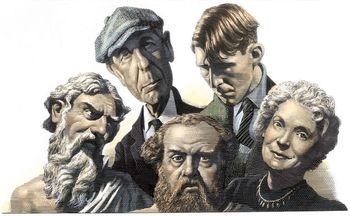
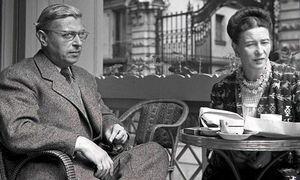
Sartre-004 One of the distinctive aspects of British culture is that the word “intellectual” seems to be regarded as a term of abuse. WH Auden summed it up neatly when he wrote: “To the man-in-the-street, who, I'm sorry to say, / Is a keen observer of life,/ The word 'Intellectual' suggests right away/ A man who's untrue to his wife.”

Auden wasn't alone in thinking that intellectuals suffer from ethical deficiencies. The journalist and historian Paul Johnson once devoted an entire book, Intellectuals: from Marx and Tolstoy to Sartre and Chomsky (2000), to proving that some of the 20th century's most prominent thinkers were moral cretins. And in his book The Intellectuals and the Masses (Faber, 1992) the literary critic John Carey argued that most of our culture's esteemed thinkers over several centuries despised the masses and devoted much of their efforts to excluding the hoi-polloi from cultural life. Both Johnson and Carey were pushing at an open door. Britain is a country in which the word “intellectual” is often preceded by the sneering adjective “so-called”, where smart people are put down because they are “too clever by half” and where a cerebral politician (David Willetts) was for years saddled with the soubriquet “Two Brains”.

More here.

Tracking Lineage Through a Bramble

From The New York Times:

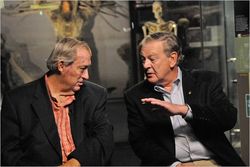
Don Those stars among the hunter-gatherers of fossils related to human origins, Donald C. Johanson and Richard Leakey, returned last week to the American Museum of Natural History in New York, the scene of a bitter televised brawl between the two 30 years ago. They were older, presumably wiser and definitely much more temperate. The title of the program, “Human Evolution and Why It Matters: A Conversation with Leakey and Johanson,” signaled that this was not to be a re-enactment.

At the start, Mr. Leakey called attention to scars on his face and a thick bandage on his scalp, the result of skin-cancer treatment. With a smile and a wink in his voice, he said, “I assure you this was the work of a doctor, not a colleague.” Everyone laughed, including Dr. Johanson, and relaxed for the next hour and a half as the two paleoanthropologists conducted a tour of their science’s unfinished business, from the search for the last common ancestor of the chimpanzee and human lineages to a deeper understanding of how early modern Homo sapiens developed the gift of symbolic thinking and language. In a field as contentious as theirs, it was probably inevitable that by 1981 the two men, both in their mid-30s, had become rivals who clashed over interpretations drawn from the meager sampling of bones coming to light. Dr. Johanson was riding a wave of fame as the discoverer of the skeleton nicknamed Lucy, then the earliest known hominid species and judged by him to be a direct ancestor of humans.

More here.

Wednesday, May 11, 2011

Sex and the Single Cell

Real-sexual-revolution-in-biology-could-spring-from-asexual-creatures_1 Dave Mosher in Scientific American:

Much of what we know about sex, or think we know, stems from the animal kingdom. No surprise there—we're animals and the nuances of the genetic tango are easier to study in organisms larger than infinitesimal blobs.

Trouble is, animal sex is specialized to the point of distraction. Most researchers have learned to avoid seeking universal sexual truths by examining animals' twig on the tree of life, but some still rely heavily on single animal models whereas others hawk dated taxonomic ideas without realizing it, says protistologist Frederick Spiegel of the University of Arkansas in Fayetteville.

“Huge numbers of trees are killed over the origin and function of sex, but some people writing and teaching this material still have animal sex in the back of their minds. It's biased, and it's backwards,” says Spiegel, author of a commentary on sex published online May 10 in Proceedings of the Royal Society B.

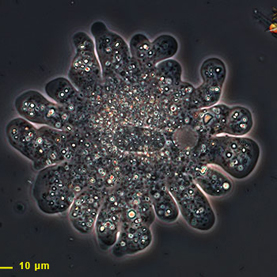
Enter the amoeba: a collection of blobby, typically asexual microorganisms that taxonomists have historically swept under the rug as evolutionary oddities. If biologists want to understand sex's universal features, especially its benefits and costs, Spiegel argues there's no better critter to start with.

“Sex is one of the most primitive characteristics of all eukaryotic life,” he says. “There are only a few eukaryotic lineages where we've never seen sex, and they're all amoebae. With these asexual organisms, we can compare and ask some truly synthetic questions about sex.”

Amoebas are single-celled blobs that house their DNA in nuclei, just like all of their eukaryotic relatives (humans included). Although some amoebas presumably cannot have sex and divide by mitosis, others are among the eukaryotes that can have sex—a process that can most simply be defined as ripping a genome in half and later recombining it. The practice fuels diversity by juggling genes and ultimately helps lineages weather catastrophic change over generations as natural selection acts on them.

Cry Havoc! And Let Slip the Maths of War

20110402_std001 In The Economist:

IN 1948 Lewis Fry Richardson, a British scientist, published what was probably the first rigorous analysis of the statistics of war. Richardson had spent seven years gathering data on the wars waged in the century or so prior to his study. There were almost 300 of them. The list runs from conflicts that claimed a thousand or so lives to the devastation of the two world wars. But when he plotted his results, he found that these diverse events fell into a regular pattern. It was as if the chaos of war seemed to comply with some hitherto unknown law of nature.

At first glance the pattern seems obvious. Richardson found that wars with low death tolls far outnumber high-fatality conflicts. But that obvious observation conceals a precise mathematical description: the link between the severity and frequency of conflicts follows a smooth curve, known as a power law. One consequence is that extreme events such as the world wars do not appear to be anomalies. They are simply what should be expected to occur occasionally, given the frequency with which conflicts take place.

The results have fascinated mathematicians and military strategists ever since. They have also been replicated many times. But they have not had much impact on the conduct of actual wars. As a result, there is a certain “so what” quality to Richardson’s results. It is one thing to show that a pattern exists, another to do something useful with it.

In a paper currently under review at Science, however, Neil Johnson of the University of Miami in Coral Gables, Florida, and his colleagues hint at what that something useful might be. Dr Johnson’s team is one of several groups who, in previous papers, have shown that Richardson’s power law also applies to attacks by terrorists and insurgents. They and others have broadened Richardson’s scope of inquiry to include the timing of attacks, as well as the severity. This prepared the ground for the new paper, which outlines a method for forecasting the evolution of conflicts.

Progress, of a sort

Dr Johnson’s proposal rests on a pattern he and his team found in data on insurgent attacks against American forces in Afghanistan and Iraq. After the initial attacks in any given province, subsequent fatal incidents become more and more frequent. The intriguing point is that it is possible, using a formula Dr Johnson has derived, to predict the details of this pattern from the interval between the first two attacks.

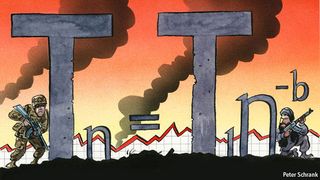
The formula in question (T(n) = T(1)n^-b) is one of a familiar type, known as a progress curve, that describes how productivity improves in a range of human activities from manufacturing to cancer surgery. T(n) is the number of days between the nth attack and its successor. (T(1) is therefore the number of days between the first and second attacks.) The other element of the equation, b, turns out to be directly related to T(1). It is calculated from the relationship between the logarithms of the attack number, n, and the attack interval, T(n). The upshot is that knowing T(1) should be enough to predict the future course of a local insurgency. Conversely, changing b would change both T(1) and T(n), and thus change that future course.

How to Make Money in Microseconds

Donald MacKenzie in the LRB:

What goes on in stock markets appears quite different when viewed on different timescales. Look at a whole day’s trading, and market participants can usually tell you a plausible story about how the arrival of news has changed traders’ perceptions of the prospects for a company or the entire economy and pushed share prices up or down. Look at trading activity on a scale of milliseconds, however, and things seem quite different.

When two American financial economists, Joel Hasbrouck and Gideon Saar, did this a couple of years ago, they found strange periodicities and spasms. The most striking periodicity involves large peaks of activity separated by almost exactly 1000 milliseconds: they occur 10-30 milliseconds after the ‘tick’ of each second. The spasms, in contrast, seem to be governed not directly by clock time but by an event: the execution of a buy or sell order, the cancellation of an order, or the arrival of a new order. Average activity levels in the first millisecond after such an event are around 300 times higher than normal. There are lengthy periods – lengthy, that’s to say, on a scale measured in milliseconds – in which little or nothing happens, punctuated by spasms of thousands of orders for a corporation’s shares and cancellations of orders. These spasms seem to begin abruptly, last a minute or two, then end just as abruptly.

Little of this has to do directly with human action. None of us can react to an event in a millisecond: the fastest we can achieve is around 140 milliseconds, and that’s only for the simplest stimulus, a sudden sound. The periodicities and spasms found by Hasbrouck and Saar are the traces of an epochal shift. As recently as 20 years ago, the heart of most financial markets was a trading floor on which human beings did deals with each other face to face. The ‘open outcry’ trading pits at the Chicago Mercantile Exchange, for example, were often a mêlée of hundreds of sweating, shouting, gesticulating bodies. Now, the heart of many markets (at least in standard products such as shares) is an air-conditioned warehouse full of computers supervised by only a handful of maintenance staff.

The deals that used to be struck on trading floors now take place via ‘matching engines’, computer systems that process buy and sell orders and execute a trade if they find a buy order and a sell order that match. The matching engines of the New York Stock Exchange, for example, aren’t in the exchange’s century-old Broad Street headquarters with its Corinthian columns and sculptures, but in a giant new 400,000-square-foot plain-brick data centre in Mahwah, New Jersey, 30 miles from downtown Manhattan. Nobody minds you taking photos of the Broad Street building’s striking neoclassical façade, but try photographing the Mahwah data centre and you’ll find the police quickly taking an interest: it’s classed as part of the critical infrastructure of the United States.

The New Faces of the European Far-Right

Front_National_2010-05-01_n04-682x1024 Nilüfer Göle in The Immanent Frame:

The new faces of the far-right have gained power in their political parties by virtue of their capacity to make a place for themselves in debate—in other words, by manufacturing public personalities—as well as by stirring up controversies over the presence of Islam in Europe. They take great care over their self-presentation, which is given precedence over their political representation and their function in the party. We are witnessing a process whereby the presence of actors in the public sphere and the media determines the place they occupy in the political arena. However, public popularity and political engagement do not always follow the same logic, and, indeed, they sometimes come into tension with each other. There are those among the French public, for instance, who declare the National Front an obstacle to the popularity of Marine Le Pen.

Hence, we face a movement that has been revived politically by its entry to the public sphere, through which it acquires legitimacy for its ideas and puts an end to the stigma of the far-right. These parties are no longer at the end of the political spectrum but seek their political legitimacy at the center of public opinion, and they do so in large part by making Islam a common enemy. Thinkers from the republican right and intellectuals from the left both express perplexity over the rise of right-wing movements that do not hesitate to endorse egalitarian, feminist, and secular ideas. They have been dispossessed of the ideas that previously guaranteed the far-right’s restriction to the margins of the political system.

The rising stars of the European far-right, such as Marine Le Pen in France, in fact scramble the divide between right and left, thus distinguishing themselves from the preceding generation of conservatives. They sometimes display a habitus evocative of European counter-culture—something completely out of step with the style of their predecessors. The leader of the far-right Freedom Party of Austria, Heinz-Christian Strache, who often sports a tee-shirt emblazoned with an effigy of Che, and the Swiss politician Oskar Freysinger, who wears his long hair in a ponytail, do not hesitate to borrow the emblems of cultural revolt. In choosing Islam as a target, they make themselves out to be defenders of sexual equality, feminism, and freedom of expression, as well as supporters of the fight against homophobia and anti-Semitism. Hijacking the cultural legacy of the left, they promote those values to which the preceding, patriarchal, xenophobic, and anti-Semitic far-right was hostile.

tzvetan

Todo2

According to French intellectual lore, Tzvetan Todorov, upon alighting in France from Bulgaria in 1963 at the age of twenty-four, headed directly for the Sorbonne. Armed with a letter of introduction from his supervisor at the University of Sofia, he sought out the dean of the Faculty of Letters in order to propose a research project on “stylistics”—a rigorously formalist approach to literary study that abstracts from history, sociology, and psychology. At the time, however, the Sorbonne was a bastion of French traditionalism: explication de texte and nationally based literary history predominated. As Todorov recounts in his autobiography, Duties and Delights: The Life of a Go-Between: “[The dean] looked at me as though I came from another planet and explained to me, quite coldly, that there was no literary theory going on in his university, nor were there any plans for it in the future.” (Here and elsewhere, I have relied on the French original, Devoirs et Délices: Une vie de passeur, from Éditions du Seuil.) End of conversation. But hardly the end of the story. As it turned out, coincident with the young Bulgarian’s arrival, the structuralist wave was cresting in Paris. Within a few months France would be awash in innovative approaches to the study of literature—approaches that, according to the Sorbonne’s dean, “didn’t exist.”

more from Richard Wolin at TNR here.

matisse v picasso

Le-Bonheur-de-Vivre-1905-06-Barnes

We still do not know how to clearly distinguish the two poles that magnetize painting: their effects often interfere. While clearly obvious are the differences between the art of Picasso and of Matisse, this polarity supports the evident of only a single kind of painting in the twentieth century. These remarks by Roger de Piles, for example, at the beginning of the eighteenth century, suffice in situating with enough certitude the classical tradition, that of the rhetoric of passions the painter disposes: There are in the passions two manners of movement; the first are lively and violent, others are calm and moderate. Quintilian calls the first pathetic, and the other moral. The pathetic commands, the moral persuades; the first bears up under any trouble and powerfully stirs the heart, the other insinuates calm into the mind, and both require a good deal of art to be well expressed.14 But despite this classic polarity of violent commandment and subtle persuasion, which appears throughout art of the twentieth century, these two contradictory components often mix in a single work that the art of today has recapitulated by hurling us between the two poles, between Matisse and Picasso, that is to say between acceptance and expulsion, between the Redemption and the Fall, in a sort of impossible double bind. As it was understood, the “great narrative” of the West, into which I would suggest Picasso inserted himself in a singular way because it was contradictory, this great narrative was in fact Christianity itself. And his rivalry with Matisse, who said to him one day: “You are like me: what we both search for in art is the climate of our first communion,”15 this rivalry also served as his own explanation of Christianity and his theology on salvation through the image. Matisse still wanted to believe that the lie in art revealed the truth of myth—that is, more or less, Christianity. Picasso thought on the contrary that the lie of art could give access to that truth of myth as a lie. But to exorcize the lie of Salvation, the myth of the Fall must be conserved.

more from Eric Michaud at Nonsite here.

this

Milutis-470

A SEARCH FOR THE WORD THIS on the Web will get you RickRoll’D. The various unrelated hits that appear include This American Life, This Is Why You’re Fat, and a site that asks: “If you are feeling suicidal now, please stop long enough to read this.” When one takes advantage of a more sophisticated Google device, the increasingly popular Ngram Viewer, the statistical portrait served up from the depths of Google’s digitized book collection is just as opaque. Even though it carries with it an aura of the scientific, this Ngram tells us no more about the demonstrative pronoun’s most interesting uses than do even the ridiculously irrelevant top search results for this.

Yet this is a piece of literary minutiae, which, while straining the capacities of any search engine, has had a profound effect on literary experimentation. Why, for example, is our search not topped with William Carlos Williams’s:

—of this, make it of this, this
this, this, this, this .

more from Joe Milutis at Triple Canopy here.

masdar city

Masdar-City-driverless-po-006

Masdar City is like a mirage: a walled city growing out of the desert sands in the emirate of Abu Dhabi. Yet it is real, and remarkably so; for this intriguing city not only exists but is also one of the most unexpected in the Gulf region or anywhere in the world. Behind those walls and wind towers is one of the world’s first zero-carbon cities. I went to see it recently, just shortly before families from across Abu Dhabi turned up in their thousands for The Market @ Masdar City, the first one-day fair designed to showcase the architecture and planning of this brave attempt at shaping a truly sustainable city of the future. Designed by Foster and Partners for the Abu Dhabi Future Energy Company and set in the desert 17km from the skyscrapers of Abu Dhabi, Masdar is an intriguing experiment in urban design and living. The six square kilometre city – powered by solar energy and other renewable resources – is an attempt to show what kind of future might lie ahead for urban development in the Gulf now that the high-rise city of gas-guzzling towers, that has characterised the region in recent decades, has been increasingly discredited.

more from Jonathan Glancey at The Guardian here.

“Dorian Gray” as Wilde actually wrote it

From Salon:

Dorian More than a century after its publication, Oscar Wilde's novella “The Picture of Dorian Gray” is recognized as one of the classics of English literature, a masterpiece of fin-de-siècle aestheticism and in many respects a harbinger of the modernist movement. Its current iconic status could not have been foreseen in 1890 when the story first appeared — simultaneously in Britain and the United States — in the pages of Lippincott's Magazine. This review from London's Daily Chronicle voiced the outrage of many:

Dulness and dirt are the chief features of Lippincott's this month: The element that is unclean, though undeniably amusing, is furnished by Mr. Oscar Wilde's story of “The Picture of Dorian Gray.” It is a tale spawned from the leprous literature of the French decadents — a poisonous book, the atmosphere of which is heavy with the mephitic odours of moral and spiritual putrefaction — a gloating study of the mental and physical corruption of a fresh, fair and golden youth, which might be fascinating but for its effeminate frivolity, its studied insincerity, its theatrical cynicism, its tawdry mysticism, its flippant philosophizings…. Mr. Wilde says the book has “a moral.” The “moral,” so far as we can collect it, is that man's chief end is to develop his nature to the fullest by “always searching for new sensations,” that when the soul gets sick the way to cure it is to deny the senses nothing.

“Unclean,” “corruption,” “leprous,” “putrefaction,” and “French decadents” were of course all coded terms for “homosexuality” — a word that would not enter the English language until two years later, and a concept that could not be openly discussed in a respectable newspaper of the time, nor mentioned in polite company; when “Dorian Gray” was revised for publication in book form a good portion of the material deemed unclean and leprous had to be removed.

More here.

Wednesday Poem

Mistakes

You think I’ve finally arrived, but these
are only the first heavy footsteps of rain.

You think it’s a new sorrow, but it’s
only a whitewashed wall from time immemorial.

It’s temptation twisting and turning, you think,
but it’s only a silken paper snake.

You think it’s a single gun shot,
but only the wind slamming a door.

You think it’s me,
but it’s only me.

by Dan Pagis
from Kol Hashirim Dan Pagis
publisher Hakibbutz Hameuchad and the Bialik Institute
Tel Aviv & Jerusalem, © 1991
translation: 2010, Lisa Katz

This year’s best illusion reveals a visual quirk

From MSNBC:

Dot A mysterious illusion that illustrates how motion can render color changes invisible won the “Best Illusion of the Year” for 2011, and it also taught researchers something they didn't know. “It is a really beautiful effect, revealing something about how our visual system works that we didn't know before,” said Daniel Simons, a professor at the University of Illinois, Champaign-Urbana. Simons studies visual cognition, and did not work on this illusion. Before its creation, scientists didn't know that motion had this effect on perception, Simons said.

A viewer stares at a speck at the center of a ring of colored dots, which continuously change color. When the ring begins to rotate around the speck, the color changes appear to stop. But this is an illusion. For some reason, the motion causes our visual system to ignore the color changes. (You can, however, see the color changes if you follow the rotating circles with your eyes.) [See video of illusion winner] This illusion is the work of Jordan Suchow, a graduate student in cognitive science at Harvard University, and his adviser George Alvarez. Their illusion took first place at the conclusion of the seventh annual Best Illusion of the Year Contest in Florida. Suchow discovered it when his laptop, which was displaying a similar set of color-changing circles, slipped and the dots appeared to stop changing.

More here.

Tuesday, May 10, 2011

the many unknowns of the arab spring

Arab+Spring2

Yet we know that the spring of revolutions is followed by the passions of summer and the discord of fall. At least since Hegel’s analysis of the follies of the French Revolution in Phenomenology of Spirit, it has become commonplace to think that the Revolution will devour its own children. Such warnings were expressed not only by Hillary Clinton in the first days of the Egyptian uprising; the many commentators who have hidden their distrust in the capacity of the Arab peoples to exercise democracy are now rejoicing that the first signs of contention between religious and secular groups are breaking out in Egypt and Tunisia. The journalists and intellectuals of the European Right, who have spilt a lot of ink on whether or not “Islamophobia” is racist, are now attempting to cover their tracks, while Israel’s “pseudo-friends” among European conservatives are prophesying imminent attacks on Israel by Hizbollah in the north and Egypt cum Hamas in the south.[1] None of this is inevitable. It is not inevitable, or even likely, that fundamentalist Muslim parties will transform Tunisia or Egypt into theocracies; nor is it inevitable that Iran will gain ascendance and that the Arab states will conduct a new war against Israel. What we have witnessed is truly revolutionary, in the sense that a new order of freedom – a novo ordo saeclorum – is emerging transnationally in the Arab world.

more from Seyla Benhabib at Eurozine here.

You don’t resist Picasso … a woman doesn’t resist Picasso

Picasso110509_198b

Picasso and Marie-Thérèse: L’Amour fou,” the rapturous, vagino-­maniacal show of more than 80 Pablo Picasso works at Gagosian, is a love story. It tells a tale of a devouring monster, a goddess and doormat, frenzied sex, and abject cruelty. The woman of the show’s title is Marie-Thérèse Walter, called “the greatest sexual passion of Picasso’s life,” “endlessly submissive and willing,” the sumptuous voluptuary who surrendered to his sadomasochistic demands. He himself once called her “a slice of melon,” and she said of herself, “I always cried with Picasso. I bowed my head in front of him.” “L’Amour fou” was curated by John Richardson and Diana Widmaier Picasso, granddaughter of the artist and Marie-Thérèse. Widmaier Picasso once told a British paper that her grandmother talked of their “secrets,” some of which have been widely reported. Richardson (in his acclaimed three-part Picasso biography) says that Picasso enjoyed “the perverse pleasure of denying [Walter] the release of orgasm.” Yet Walter herself rhapsodized, many years later, that sex with Picasso was “completely fulfilling,” describing him as “very virile.” For decades, no one knew of Walter or that she was Picasso’s mistress from 1927 until around 1937. Not only was she his submissive sexual conquest, artistic muse, psychic victim, and mother of his daughter; she’s the fleshy subject of some of his juiciest paintings. Picasso said she saved his life. And it’s true that from the moment she appears in his work, in early 1927, his art gets plusher and more immediate, catapulting him out of Cubism, paving the way for all his subsequent efforts. Marie-Thérèse is the fertile inspiration that made Picasso Picasso after Cubism.

more from Jerry Saltz at New York Magazine here.

the intimate orwell

Leys_1-052611_jpg_190x868_q85

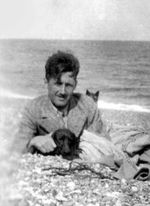
All the diaries of Orwell that are still extant (some were lost, and one was stolen in Barcelona during the Spanish civil war, by the Stalinist secret police—it may still lie today in some Moscow archive) were first published in 1998 by Peter Davison and included in his monumental edition of The Complete Works of George Orwell (twenty volumes; nine thousand pages). They are now conveniently regrouped here in one volume, excellently presented and annotated by Davison. The diaries provide a wealth of information on Orwell’s daily activities, concerns, and interests; they present considerable documentary value for scholars, but they do not exactly live up to their editor’s claim: “These diaries offer a virtual autobiography of his life and opinions for so much of his life.” This assessment would much better characterize the utterly fascinating companion volume (also edited by Peter Davison), George Orwell: A Life in Letters. Orwell’s diaries are not confessional: here he very seldom records his emotions, impressions, moods, or feelings; hardly ever his ideas, judgments, and opinions. What he jots down is strictly and dryly factual: events happening in the outside world—or in his own little vegetable garden; his goat Muriel’s slight diarrhea may have been caused by eating wet grass; Churchill is returning to Cabinet; fighting reported in Manchukuo; rhubarb growing well; Béla Kun reported shot in Moscow; the pansies and red saxifrage are coming into flower; rat population in Britain is estimated at 4–5 million; among the hop-pickers, rhyming slang is not extinct, thus for instance, a dig in the grave means a shave; and at the end of July 1940, as the menace of a German invasion becomes very real, “constantly, as I walk down the street, I find myself looking up at the windows to see which of them would make good machine-gun nests.”

more from Simon Leys at the NYRB here.

Osama bin Laden mission agreed in secret 10 years ago by US and Pakistan

Declan Walsh in The Guardian:

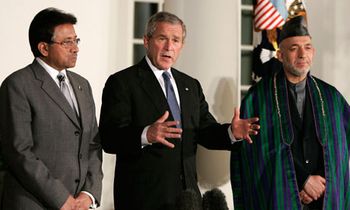
Pervez-Musharraf-and-Geor-007 The US and Pakistan struck a secret deal almost a decade ago permitting a US operation against Osama bin Laden on Pakistani soil similar to last week's raid that killed the al-Qaida leader, the Guardian has learned.

The deal was struck between the military leader General Pervez Musharraf and President George Bush after Bin Laden escaped US forces in the mountains of Tora Bora in late 2001, according to serving and retired Pakistani and US officials.

Under its terms, Pakistan would allow US forces to conduct a unilateral raid inside Pakistan in search of Bin Laden, his deputy, Ayman al-Zawahiri, and the al-Qaida No3. Afterwards, both sides agreed, Pakistan would vociferously protest the incursion.

“There was an agreement between Bush and Musharraf that if we knew where Osama was, we were going to come and get him,” said a former senior US official with knowledge of counterterrorism operations. “The Pakistanis would put up a hue and cry, but they wouldn't stop us.”

The deal puts a new complexion on the political storm triggered by Bin Laden's death in Abbottabad, 35 miles north of Islamabad, where a team of US navy Seals assaulted his safe house in the early hours of 2 May.

Pakistani officials have insisted they knew nothing of the raid, with military and civilian leaders issuing a strong rebuke to the US. If the US conducts another such assault, Prime Minister Yousaf Raza Gilani warned parliament on Monday, “Pakistan reserves the right to retaliate with full force.”

More here.

Unspoken Truths

Until cancer attacked his vocal cords, the author didn’t fully appreciate what was meant by “a writer’s voice,” or the essential link between speech and prose. As a man who loved to talk, he turns to the masters of such conversation, both in history and in his own circle.

Christopher Hitchens in Vanity Fair:

I have seen the moment of my greatness flicker,
And I have seen the eternal Footman hold my coat, and snicker,
And in short, I was afraid.

—T. S. Eliot, “The Love Song of J. Alfred Prufrock.”

L-hitchens Like so many of life’s varieties of experience, the novelty of a diagnosis of malignant cancer has a tendency to wear off. The thing begins to pall, even to become banal. One can become quite used to the specter of the eternal Footman, like some lethal old bore lurking in the hallway at the end of the evening, hoping for the chance to have a word. And I don’t so much object to his holding my coat in that marked manner, as if mutely reminding me that it’s time to be on my way. No, it’s the snickering that gets me down.

On a much-too-regular basis, the disease serves me up with a teasing special of the day, or a flavor of the month. It might be random sores and ulcers, on the tongue or in the mouth. Or why not a touch of peripheral neuropathy, involving numb and chilly feet? Daily existence becomes a babyish thing, measured out not in Prufrock’s coffee spoons but in tiny doses of nourishment, accompanied by heartening noises from onlookers, or solemn discussions of the operations of the digestive system, conducted with motherly strangers. On the less good days, I feel like that wooden-legged piglet belonging to a sadistically sentimental family that could bear to eat him only a chunk at a time. Except that cancer isn’t so … considerate.

Most despond-inducing and alarming of all, so far, was the moment when my voice suddenly rose to a childish (or perhaps piglet-like) piping squeak. It then began to register all over the place, from a gruff and husky whisper to a papery, plaintive bleat. And at times it threatened, and now threatens daily, to disappear altogether. I had just returned from giving a couple of speeches in California, where with the help of morphine and adrenaline I could still successfully “project” my utterances, when I made an attempt to hail a taxi outside my home—and nothing happened. I stood, frozen, like a silly cat that had abruptly lost its meow.

More here.