a world beneath our world

4a1b91ba-7790-11e0-824c-00144feabdc0

When we describe ourselves as products of our environment, we usually think of class, money and parenting. Only rarely do we reflect on how our identities are shaped by space, and specifically by the random spaces of the modern city, what the historian Leif Jerram calls “the myriad nooks and crannies, backstreets and thoroughfares, clubs and bars, living rooms and factories”. We forget, for example, that the London Underground, now merely another element of our mundane daily lives, was once novel and exciting, forcing people to behave in entirely new ways. Travelling by Tube is both an intensely solitary experience, each of us cocooned in our thoughts, and an eminently collective one: inside the carriage, all distinctions of class and status are forgotten. No wonder, then, that in the early 1930s, the Soviet authorities saw the building of the Moscow Metro as the ideal way to create a new communist man. As hundreds of thousands of rural peasants flooded into the capital, taking up new identities as technicians and engineers, it seemed that a new proletariat was being born. “How many people,” asked a Pravda headline, “recreated themselves making the Metro?”

more from Dominic Sandbrook at the FT here.

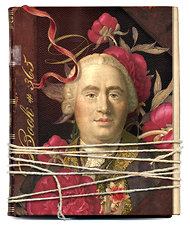
On Hume’s 300th Birthday: A Philosopher in Love

07oped-art-articleInline In late 1960s, perhaps spring of 1968 or 1969, Sidney Morgenbesser taught the first class on Marx to be offered by Columbia’s philosophy department. Sidney’s take was in the spirit of the later to develop analytic Marxism, meaning he read Marx through the lenses of methodological individualism, a rationality assumption, a search for microfoundations, especially for historical materialism, and a rejection of any hint of functional explanation. (He told me this story because I was sitting in on Jon Elster’s class on rational choice.) A junior faculty member (“…then he was to left of me, now he’s to the right of me…” was how Sidney described him) sat in on the class.  The spring passed without the colleague making any comment at all in or about the class. During the summer, the two were having lunch, and Sidney who had been wondering about his colleague’s opinion about the class asked point blank what he thought of it. His colleague looked up and said, “Sidney, that was the best class on David Hume I have ever taken.”

Hume’s and Marx’s birthdays are separated by only 2 days. Today is Hume’s 300th. Robert Zaretsky in the NYT on Hume’s reason and passion and love:

TODAY is the 300th birthday of David Hume, the most important philosopher ever to write in English, according to The Stanford Encyclopedia of Philosophy. The conferences being held on Hume this year in Austria, the Czech Republic, Russia, Finland and Brazil suggest that the encyclopedia’s claim is perhaps too modest.

Panelists will cite Hume’s seismic impact on epistemology, political theory, economics, historiography, aesthetics and religion, as well as his deep skepticism of the powers of reason. But chances are they won’t have much to say about Hume the man.

It’s not surprising; Hume was most concerned with the nature of knowledge, morality, causality — not with fashioning a philosophy for everyday life. And yet his life, like his work, does offer insights about how to live. Consider an episode in Hume’s life that reflects his most provocative and misunderstood claim: that reason is and always will be the slave to our passions. Predictably, it happened in Paris.

In 1761, Hippolyte de Saujon, the estranged wife of the Comte de Boufflers and celebrated mistress of the Prince de Conti, sent a fan letter to Hume. His best-selling “History of England,” she wrote, “enlightens the soul and fills the heart with sentiments of humanity and benevolence.” It must have been written by “some celestial being, free from human passions.”

From Edinburgh, the rotund and flustered Hume, long resigned to a bachelor’s life, thanked Mme. de Boufflers. “I have rusted amid books and study,” he wrote, and “been little engaged … in the pleasurable scenes of life.” But he would be pleased to meet her.

And so he did, two years later, when he was posted to the British Embassy in Paris. Boufflers and Hume quickly became intimate friends, visiting and writing to each other often. Hume soon confessed his attachment and his jealousy of Conti. Boufflers encouraged him, though no one knows how far: “Were I to add our deepened friendship to my other sources of happiness … I cannot conceive how I could ever complain of my destiny.”

A Matter of Degrees

From The New York Times:

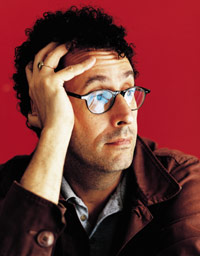
Jonathan-caren-tony-kushner In 1940, a Brooklyn woman named Jean Kay filed a suit with the State Supreme Court against the her city’s Board of Higher Education claiming that the renowned mathematician and philosopher Bertrand Russell was morally unfit to teach at the City College of New York, where he had been offered a professorship. Kay, supported by a host of others in the public scrum, including Bishop William Manning of the Episcopal Church, argued that Russell, who advocated sex before marriage and other heretical lifestyle choices, posed a threat to the virtue of her daughter — even though the impressionable youth was not actually a student at the college. A judge ruled in Kay’s favor. Russell, who was not allowed to speak in his own defense, was denied his appointment at the college, which was, and is, part of the publicly financed City University of New York system. Today, the now-notorious incident is chronicled in an exhibition on City College’s Web site, called “The Struggle for Free Speech at CCNY, 1931-1942,” as is a recounting of the subsequent firings, spurred by the McCarthy era Rapp-Coudert Committee, of faculty members accused of being Communist Party members.

Though the issues and stakes have changed, CUNY now finds itself at the center of another free speech controversy, which has erupted, 71 years and some months after Kay filed her complaint — as Patrick Healy of The Times, among others, reported on Wednesday:

In a rare move, the trustees of the City University of New York have voted to shelve an honorary degree that one of its campuses, John Jay College, planned to award to Tony Kushner, the Pulitzer Prize-winning playwright of “Angels in America.” The vote on Monday evening came after a CUNY trustee said that Mr. Kushner had disparaged the State of Israel in past comments, a characterization that the writer attacked on Wednesday.

More here.

Saturday Poem

The Connoisseur

When it came to happiness she was a gourmet,
a connoisseur of small moments and extravagance.
Like a hummingbird, free as jazz, she floated away.

She wasn’t immune to love. But her need to stay
on top of things meant she didn’t rate romance
when it came to happiness. She was a gourmet

of the ungraspable now, savouring on the spot, without delay,
what the rest of us reheat at a bitter distance.
Like a hummingbird, free as jazz, she floated away.

I envied her of course, which isn’t to say
her dance, her casual way, didn’t leave me in a trance.
When it came to happiness she was a gourmet.

To recognise contentment was her gift, her forte,
sipping the nectar from selected instants
like a hummingbird. Free as jazz, she floated away

from me with the old line: Is there anything I can say
to make this easier for you?
Not a chance.
When it came to happiness she was a gourmet.
Like a hummingbird, free as jazz, she floated away.

by Billy Ramsell
from Complicated Pleasures
publisher: Dedalus, Dublin, © 2007

How Obesity Spreads in Social Networks

From Scientific American:

Social-spread-obesity_1 The people we associate with can have a powerful effect on our behavior—for better or for worse. This holds true for human health and body mass, too. The heavier our close friends and family, the heavier we are likely to be. This correlation, described in 2007 by a team that analyzed data from the longitudinal Framingham Heart Study, is well established. But just how this transpires—whether via shared norms, common behavior or just similar environments—has been the subject of much debate. The authors of the 2007 study proposed that social norms shared among friends and relatives might be a strong determinant of body mass index (BMI). And a new study, published online May 5 in the American Journal of Public Health, drills down to see just how these social forces might be at work. The study of more than 100 women—and hundreds of their friends and family members—however, suggests that social attitudes might not be key in determining obesity clusters after all.

“Going in as anthropologists we assumed that the norms would have a strong influence” on BMI, says Alexandra Brewis, executive director of the School of Human Evolution and Social Change at Arizona State University in Tempe. She and her colleagues found themselves surprised how small an effect the norms had on a person's BMI. Just one type of social dynamic seemed to play a statistically significant role—and that was only about 20 percent. But a small effect is not no effect, points out James Fowler, a professor at the University of California, San Diego School of Medicine and Division of Social Sciences, and co-author of the 2007 The New England Journal of Medicine paper that described the influence of social ties on obesity rates. The finding that even 20 percent of weight status can be attributed to social norms suggests that “at least some of what is spreading are ideas about body size.” And that, he says, is “incredibly exciting,” as it hints at some methods to start stemming the social spread of obesity.

More here.

The endlessly deepening crisis that is Pakistan

Ahmed Rashid in The New Republic, via Goatmilk:

Rashid200 Many factors are helping to spread extremism and its resulting wave of intolerance: the continuing American-led war in Afghanistan and its fallout in Pakistan; a bankrupt economy; a disastrously corrupt and incompetent government; the near-collapse of the public educational system; the fifth largest nuclear arsenal in the world, which is massively expensive to run and to keep safe, and which dictates the country’s foreign policy. But the most important cause of contemporary Pakistani extremism is the simple fact that for the past three decades the state itself has sponsored many of these groups, so as to further its foreign policy aims in Afghanistan or Indian Kashmir. The Pakistani state’s patronage of these militant groups, which has continued even after September 11, 2001, has helped to sustain Islamic extremism in south and central Asia. Is it surprising, then, that none of Pakistan’s neighbors or the West really trusts it?

The military is now partially trying to reverse this trend, but the path ahead is not looking bright. In April, the White House bleakly reported to Congress that “there remains no clear path toward defeating the insurgency in Pakistan, despite the … deployment of over 147,000 forces.” The report describes the situation as deteriorating rapidly along Pakistan’s border with Afghanistan, with no ability by the Pakistani army “to hold and build” in insurgency-hit areas. (A Pakistani government spokesman rejected the report, saying that it “should not be held accountable for the failings of coalition strategy in Afghanistan.”) Europe and the United States are particularly concerned about this situation because almost all the global terrorist plots uncovered recently have involved European citizens of Pakistani origin or in Taliban camps in Pakistan.

Apart from the Taliban insurgency, Pakistan faces another bloody separatist insurgency in the province of Baluchistan and the mayhem created by recent unexplained killings in Karachi.

More here.

Mother of all embarrassments

Ayaz Amir in Pakistan's daily, The News:

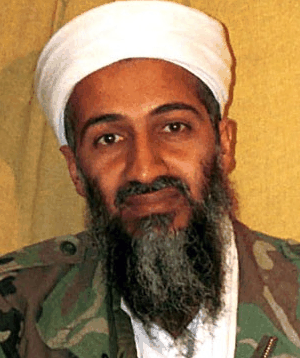
ScreenHunter_07 May. 07 10.55 For a country with more than its share of misfortunes and sheer bad luck, we could have done without this warrior of the faith, Osama bin Laden, spreading his beneficence amongst us. He was a headache for us while he lived, but nothing short of a catastrophe in his death. For his killing, and the manner of it, have exposed Pakistan and its security establishment like nothing else.

To say that our security czars and assorted knights have been caught with their pants down would be the understatement of the century. This is the mother of all embarrassments, showing us either to be incompetent – it can’t get any worse than this, Osama living in a sprawling compound a short walk from that nursery school of the army, the Pakistan Military Academy and, if we are to believe this, our ever-vigilant eyes and ears knowing nothing about it – or, heaven forbid, complicit.

I would settle for incompetence anytime because the implications of complicity are too dreadful to contemplate.

And the Americans came, swooping over the mountains, right into the heart of the compound, and after carrying out their operation flew away into the moonless night without our formidable guardians of national security knowing anything about it. This is to pour salt over our wounds. The obvious question which even a child would raise is that if a cantonment crawling with the army such as Abbottabad is not safe from stealthy assault what does it say about the safety of our famous nuke capability, the mainstay of national pride and defence?

More here.

Noam Chomsky: My Reaction to Osama bin Laden’s Death

Noam Chomsky in Guernica:

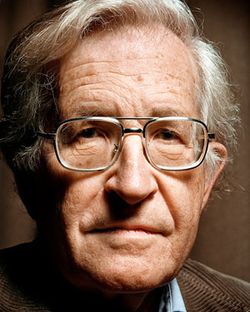
Chomsky300 It’s increasingly clear that the operation was a planned assassination, multiply violating elementary norms of international law. There appears to have been no attempt to apprehend the unarmed victim, as presumably could have been done by 80 commandos facing virtually no opposition—except, they claim, from his wife, who lunged towards them. In societies that profess some respect for law, suspects are apprehended and brought to fair trial. I stress “suspects.” In April 2002, the head of the FBI, Robert Mueller, informed the press that after the most intensive investigation in history, the FBI could say no more than that it “believed” that the plot was hatched in Afghanistan, though implemented in the UAE and Germany. What they only believed in April 2002, they obviously didn’t know 8 months earlier, when Washington dismissed tentative offers by the Taliban (how serious, we do not know, because they were instantly dismissed) to extradite bin Laden if they were presented with evidence—which, as we soon learned, Washington didn’t have. Thus Obama was simply lying when he said, in his White House statement, that “we quickly learned that the 9/11 attacks were carried out by al Qaeda.”

Nothing serious has been provided since. There is much talk of bin Laden’s “confession,” but that is rather like my confession that I won the Boston Marathon. He boasted of what he regarded as a great achievement.

More here.

Friday, May 6, 2011

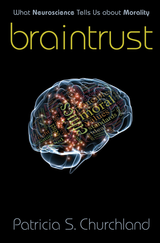
Braintrust: What Neuroscience Tells Us about Morality

J9399The first chapter of Patricia S. Churchland's recent book, over at Princeton University Press:

So what is it to be fair? How do we know what to count as fair? Why do we regard trial by ordeal as wrong? Thus opens the door into the vast tangled forest of questions about right and wrong, good and evil, virtues and vices. For most of my adult life as a philosopher, I shied away from plunging unreservedly into these sorts of questions about morality. This was largely because I could not see a systematic way through that tangled forest, and because a lot of contemporary moral philosophy, though venerated in academic halls, was completely untethered to the “hard and fast”; that is, it had no strong connection to evolution or to the brain, and hence was in peril of floating on a sea of mere, albeit confident, opinion. And no doubt the medieval clerics were every bit as confident.

It did seem that likely Aristotle, Hume, and Darwin were right: we are social by nature. But what does that actually mean in terms of our brains and our genes? To make progress beyond the broad hunches about our nature, we need something solid to attach the claim to. Without relevant, real data from evolutionary biology, neuroscience, and genetics, I could not see how to tether ideas about “our nature” to the hard and fast.

Despite being flummoxed, I began to appreciate that recent developments in the biological sciences allow us to see through the tangle, to begin to discern pathways revealed by new data. The phenomenon of moral values, hitherto so puzzling, is now less so. Not entirely clear, just less puzzling. By drawing on converging new data from neuroscience, evolutionary biology, experimental psychology, and genetics, and given a philosophical framework consilient with those data, we can now meaningfully approach the question of where values come from.

From ‘End of History’ Author, a Look at the Beginning and Middle

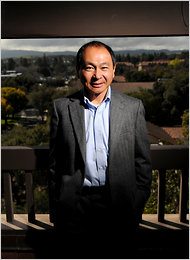
08fukuyama-articleInline Nicholas Wade on Francis Fukuyama's forthcoming The Origins of Political Order, in the NYT:

Human social behavior has an evolutionary basis. This was the thesis in Edward O. Wilson’s book “Sociobiology” that caused such a stir, even though most evolutionary biologists accept that at least some social behaviors, like altruism, could be favored by natural selection.

In a book to be published in April, “The Origins of Political Order,” Francis Fukuyama of Stanford University presents a sweeping new overview of human social structures throughout history, taking over from where Dr. Wilson’s ambitious synthesis left off.

Dr. Fukuyama, a political scientist, is concerned mostly with the cultural, not biological, aspects of human society. But he explicitly assumes that human social nature is universal and is built around certain evolved behaviors like favoring relatives, reciprocal altruism, creating and following rules, and a propensity for warfare.

Because of this shared human nature, with its biological foundation, “human politics is subject to certain recurring patterns of behavior across time and across cultures,” he writes. It is these worldwide patterns he seeks to describe in an analysis that stretches from prehistoric times to the French Revolution.

Previous attempts to write grand analyses of human development have tended to focus on a single causal explanation, like economics or warfare, or, as with Jared Diamond’s “Guns, Germs and Steel,” on geography. Dr. Fukuyama’s is unusual in that he considers several factors, including warfare, religion, and in particular human social behaviors like favoring kin.

Few people have yet read the book, but it has created a considerable stir in universities where he has talked about it.

It’s Even Less in Your Genes

Lewontin_1-052611_jpg_230x716_q85Richard C. Lewontin reviews Evelyn Fox Keller's The Mirage of a Space Between Nature and Nurture in the NYRB:

In trying to analyze the natural world, scientists are seldom aware of the degree to which their ideas are influenced both by their way of perceiving the everyday world and by the constraints that our cognitive development puts on our formulations. At every moment of perception of the world around us, we isolate objects as discrete entities with clear boundaries while we relegate the rest to a background in which the objects exist.

That tendency, as Evelyn Fox Keller’s new book suggests, is one of the most powerful influences on our scientific understanding. As we change our intent, also we identify anew what is object and what is background. When I glance out the window as I write these lines I notice my neighbor’s car, its size, its shape, its color, and I note that it is parked in a snow bank. My interest then changes to the results of the recent storm and it is the snow that becomes my object of attention with the car relegated to the background of shapes embedded in the snow. What is an object as opposed to background is a mental construct and requires the identification of clear boundaries. As one of my children’s favorite songs reminded them:

You gotta have skin.
All you really need is skin.
Skin’s the thing that if you’ve got it outside,
It helps keep your insides in.

Organisms have skin, but their total environments do not. It is by no means clear how to delineate the effective environment of an organism.

One of the complications is that the effective environment is defined by the life activities of the organism itself. “Fish gotta swim and birds gotta fly,” as we are reminded by yet another popular lyric. Thus, as organisms evolve, their environments necessarily evolve with them. Although classic Darwinism is framed by referring to organisms adapting to environments, the actual process of evolution involves the creation of new “ecological niches” as new life forms come into existence. Part of the ecological niche of an earthworm is the tunnel excavated by the worm and part of the ecological niche of a tree is the assemblage of fungi associated with the tree’s root system that provide it with nutrients.

The vulgarization of Darwinism that sees the “struggle for existence” as nothing but the competition for some environmental resource in short supply ignores the large body of evidence about the actual complexity of the relationship between organisms and their resources.

David Hume’s Dialogues Concerning Natural Religion

Our own Morgan Meis in The Smart Set:

230173_10150178527413954_80 David Hume turns 300 on May 7. It is fitting, I suppose, that a man so resolutely mortal should be enjoying such immortality. Most of Hume's contemporaries are long forgotten. Hume, somehow, endures. His old pal Adam Smith (author of The Wealth of Nations), relates that in Hume's dying days he told his friends, “I have done every thing of consequence which I ever meant to do, and I could at no time expect to leave my relations and friends in a better situation than that in which I am likely to leave them: I therefore have all reason to die contented.”

It was that ancient and ugly Greek, Socrates, who first made the claim that philosophy is a preparation for death. He said it just before taking his hemlock, so we can assume that he was being serious. What Socrates meant, more or less, was that philosophy is an attempt to come to terms with life. We are born, through no particular fault of our own, and so we must deal with that ambivalent gift. Soon we discover that although we have been given life, we are fated, alas, to die. This all happens rather quickly: the being born, the growing old, the dying. The best thing, Socrates suggests, would be to embrace the brevity of our life, as we hurtle inexorably toward death, with a dose of equanimity. Since we are always engaged in the act of dying, thought Socrates, we might as well try to do it well.

David Hume was — at least on the matter of death and dying — a Socratic man. Even in his most canonical works, A Treatise of Human Nature and An Enquiry concerning Human Understanding, Hume was largely preoccupied with establishing limits. The way Hume saw it, our brief lives, crowned by unavoidable death, are unlikely to put us in touch with any grand absolutes. On the other hand, the human mind is an indubitably powerful tool and its powers of reasoning have penetrated many an enigma. Hume was as amazed by human knowledge as the next guy. He simply wanted us to be honest about its failings and limitations.

More here.

The Kind of Israel the Middle East Needs More Of

Paul R. Pillar in The National Interest:

Israeli%20jordanian The continued demand in Middle Eastern streets for greater political rights is leading to ever more rhetorical scrambling by Israel, and by those in this country eager to come to Israel’s ostensible defense (but who really are defending a certain set of Israeli policies). The backdrop to the scrambling is, as I have described before, a threefold Israeli worry about the regional political upheaval. First, increased popular sovereignty in Arab states gives heightened attention to the lack of popular sovereignty for Palestinian Arabs living under Israeli occupation. Second, continued (and even intensified) criticism of Israel from Arab states that are more responsive than before to popular sentiment belies the Israeli contention that animosity toward Israel is chiefly a device used by authoritarian rulers to distract attention from their own shortcomings. Third, the emergence of new Arab democracies in the Middle East will remove the single biggest rationale—that Israel is the only democracy in the region—for the extraordinary special relationship that Israel enjoys with the United States.

The current rhetoric on behalf of Israel repeats most of the themes that have been heard for years—including the themes about criticism of Israel being a creature of Arab authoritarianism and about how the United States must embrace the only democratic ally it has in the Middle East. But there is a sense of greater urgency in the rhetoric. The articulate Israeli ambassador to the United States, Michael Oren, recently contributed an argument as an article titled “The Ultimate Ally.” It was a game effort to do part of what ambassadors are supposed to do. But to understand what Oren was talking about, see Stephen Walt’s powerfully argued and thoroughly supported demolition of Oren’s piece.

More here.

Unravelling the ultimate political conspiracy

My friend Hadi Ghaemi sent me this with a note which said, “An account of real events just two years ago in Guatemala, that is so surreal and full of twists and turns, I don't think the minds of Borges, Garcia Marquez, Agatha Christie, with a dash of Salvador Dali, combined, could even conceive and produce such a bizarre and complex story.” Decide for yourself.

David Grann in The New Yorker:

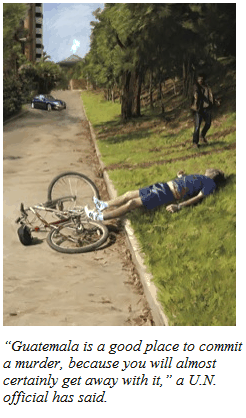
ScreenHunter_06 May. 06 14.47 Rodrigo Rosenberg knew that he was about to die. It wasn’t because he was approaching old age—he was only forty-eight. Nor had he been diagnosed with a fatal illness; an avid bike rider, he was in perfect health. Rather, Rosenberg, a highly respected corporate attorney in Guatemala, was certain that he was going to be assassinated.

Before he began, in the spring of 2009, to prophesy his own murder, there was little to suggest that he might meet a violent end. Rosenberg, who had four children, was an affectionate father. The head of his own flourishing practice, he had a reputation as an indefatigable and charismatic lawyer who had a gift for leading other people where he wanted them to go. He was lithe and handsome, though his shiny black hair had fallen out on top, leaving an immaculate ring on the sides. Words were his way of ordering the jostle of life. He spoke in eloquent bursts, using his voice like an instrument, his hands and eyebrows rising and falling to accentuate each note. (It didn’t matter if he was advocating the virtues of the Guatemalan constitution or of his favorite band, Santana.) Ferociously intelligent, he had earned master’s degrees in law from both Harvard University and Cambridge University.

More here.

Silver Screens and Blackboards

Alec Barrett in the Harvard Political Review:

ScreenHunter_05 May. 06 14.16 In the summer of 2010, USA Today’s Greg Toppo asked, “Is 2010 the year of the education documentary?” The article seized on a striking trend: the sudden emergence of films examining the problem of public education in the United States. Three of these, 2010’s highly acclaimed Waiting for “Superman,” the lesser-known 2009 film The Cartel, and the soon-to-be-released TEACHED come from different political perspectives and focus on different aspects of educational reform. They even use some of the same footage, including a rather jarring clip of New York mayor Michael Bloomberg saying, “A parent says to me, ‘Oh, my kid goes to a great school,’ and I said, “Lady, your kid can’t read or add two and two. What do you mean it’s a good school?’” Yet the fact that three such different filmmakers have created films around the theme not only demonstrates Hollywood’s interest in educational films like these but also a widespread, national interest in seeing them…

TEACHED creator Kelly Amis brings her experience as a teacher to her film. In an email to the HPR, she said, “We let teachers talk…instead of mostly talking about them.” Amis is the least political of the three filmmakers and seeks to show as much as tell her viewers. Before the full documentary was released, she put out a series of short films online, which will target a wider audience through digital media. The first, “Path to Prison,” features a former convict who taught himself to read at age 17 after being pushed through the Los Angeles school system without so. In five minutes of one man’s experience, we hear about inept teachers, ineffective evaluations, and the socioeconomic consequences of a broken system. Amis’s project “will not necessarily follow the traditional film trajectory,” but the film strives to be both a rallying cry to galvanize those who would fight for change and a source of hope for those who have lost faith in the system.

More here. Kelly Amis is, of course, not only the filmmaker behind TEACHED but also a 3QD writer. She is trying to raise funds to finish the movie with a Kickstarter campaign. Please do consider donating a few dollars to this important effort: http://www.kickstarter.com/projects/teached/teached.

A Tale of Exile and Extremism

From The Christian Science Monitor:

Book Biographer Deborah Baker was “on the prowl” in the New York Public Library – not looking for anything in particular. But while “idly clicking” through library files, she glimpsed the name “Maryam Jameelah” – apparently a well-known figure in the Muslim world. Curious, Baker put in a request for the file. Little did Baker know the kind of journey she was about to embark upon – one that would culminate in the profoundly disorienting biography that she calls The Convert: A Tale of Exile and Extremism. Maryam Jameelah, it turns out, was once Margaret Marcus, born in 1934 to a non-observant Jewish family living in a pleasant New York suburb. Her parents (who liked cruises and card games) and her sister, Betty (destined to become a New Jersey housewife), aspired simply to the comforts of postwar middle-class American life. Margaret, however, from her very youth, seemed driven by deeper passions. Rejected by her girlfriends as a teenager, Margaret turned her considerable intellect and enthusiasm in an unlikely direction: She developed a fascination with Arab life. As a young woman, Margaret renounced not only Judaism, but the whole of Western civilization. She finally converted to Islam, declaring that she would devote her life to the struggle against the “materialistic philosophic-secularism” of the West.

A voracious reader, Margaret dived deep into Muslim texts and entered into correspondence with any Islamists willing to answer her letters. One of these turned out to be Mawlana Mawdudi, an influential Pakistani journalist and theologian who was also founder of the Islamic revivalist party Jamaat-e-Islami. Drawn to the brilliant young convert who revealed herself to him through her letters, Mawdudi eventually offered to liberate Margaret from the West by bringing her to Pakistan so she could live a proper Muslim life with his wife and daughters while he found her a pious Muslim husband.

More here.

What Animal is the Best Mother?

From The Smithsonian:

Best-Mother-Animal-Cheetah-631 Parenting styles have been and always will be a subject of hot debate. But rather than judge who among our own kind is the fittest mother, we turn our gaze to the entire animal kingdom and ask, what animal is the best mother?

Props could certainly go to elephant mothers who endure staggering 22-month pregnancies. Also, polar bears. A female polar bear has to double her weight or else her body might absorb the fetus. (Both animals made Animal Planet’s list of “Top 10 Animal Moms.”) Then there are lions, who make especially benevolent mothers. In fact, each lactating mother in a pride will allow any offspring, including other females’ cubs, to nurse from her. With so many factors to weigh, I took the question to Craig Saffoe, a biologist and curator of the Great Cats and Bears units at the Smithsonian’s National Zoo. “I think if you are looking at who are the best moms, you’d have to think about who protects their young, who ensures that their young survive to independence,” says Saffoe. “And then there is also just how they deal with the infants. Infants are so fragile, and not every animal is great with that.”

More here.

Thursday, May 5, 2011

Apocalypse: What Disasters Reveal

Junot Diaz in the Boston Review:

Diaz_36_3_walls Apocalypse comes to us from the Greek apocalypsis, meaning to uncover and unveil. Now, as James Berger reminds us in After the End, apocalypse has three meanings. First, it is the actual imagined end of the world, whether in Revelations or in Hollywood blockbusters. Second, it comprises the catastrophes, personal or historical, that are said to resemble that imagined final ending—the Chernobyl meltdown or the Holocaust or the March 11 earthquake and tsunami in Japan that killed thousands and critically damaged a nuclear power plant in Fukushima. Finally, it is a disruptive event that provokes revelation. The apocalyptic event, Berger explains, in order to be truly apocalyptic, must in its disruptive moment clarify and illuminate “the true nature of what has been brought to end.” It must be revelatory.

“The apocalypse, then,” per Berger, “is the End, or resembles the end, or explains the end.” Apocalypses of the first, second, and third kinds. The Haiti earthquake was certainly an apocalypse of the second kind, and to those who perished it may even have been an apocalypse of the first kind, but what interests me here is how the Haiti earthquake was also an apocalypse of the third kind, a revelation. This in brief is my intent: to peer into the ruins of Haiti in an attempt to describe what for me the earthquake revealed—about Haiti, our world, and even our future.

After all, if these types of apocalyptic catastrophes have any value it is that in the process of causing things to fall apart they also give us a chance to see the aspects of our world that we as a society seek to run from, that we hide behind veils of denials.

More here.