Japanese lab invents Internet kissing machine

Doug Gross (aptly?) at CNN:

ScreenHunter_04 May. 06 11.29 We admit to being sort of creeped out by this: A Japanese lab has created a device that may let let you “French kiss” someone over the Internet.

And by “kiss,” we mean waggle your tongue on a plastic straw, thereby making another plastic straw waggle remotely on someone else's tongue.

Hot, huh?

Well, the folks at Tokyo's Kajimoto Laboratory say it's just the beginning of what could become a full-on person-to-person experience over the Internet.

The lab, part of The University of Electro-Communications, posted a video in which a researcher demonstrates the “Kiss Transmission Device.” It's a motorized box that looks a little like a police Breathalyzer.

In the video, Nobuhiro Takahashi, a graduate student and researcher at the university, manipulates the plastic tube on one device with his tongue. A program stores the movements on a computer and then transmits them to another device, causing its tube to move — presumably in someone else's mouth.

More here.

Kamel Daoud’s Daily Dose of Subversion

Suzanne Ruta in Berfrois:

ScreenHunter_03 May. 06 10.26 Le Quotidien d’Oran is one of Algeria’s most widely read French language dailies. People say they buy it just to read Kamel Daoud’s page three chronique or column, Raina raikoum, (my opinion, your opinion). In a country where the lone TV station is state controlled and investigative reporting is just about impossible, Daoud has fought for the right to offer a daily “dose of subversion.” He is the paper’s editor and a gifted novelist as well. (O Pharaon, 2005, a portrait of a small town war lord, reads like Garcia Marquez minus the butterflies.) But, he was once a street reporter, covering the surreal atrocities of Algeria’s recent civil war. The chroniques are savvy and down to earth but also capable of great leaps of faith or despair, depending on the day.

After ten years of civil war and another ten of political lockdown, Algerians have not taken the same risks as their amazing neighbors in Egypt, Tunisia and Libya. Daoud reveals what Algeria – once a beacon to oppressed nations – has these days instead of revolutionary stirrings; the harraga – the many thousands of young men who risk their lives each year, trying to reach Europe in flimsy boats, and an endless succession of ad hoc riots. A youth riot in early January left several dead and the gerontocratic regime nervous, but when in the weeks following, a new coalition of human rights activists and labor leaders, tried to start a Tunisian style uprising at home. They failed, because the oil rich Algerian regime can throw money at its problems and because timid political demonstrations have been blocked by massive deployments of police and hired thugs. At the first pro-democracy march on February 12th, 2011, Daoud was dragged through the street in Oran and crudely insulted by the police. That became the subject of his next pithy column…

More here.

Where is that feeling of never again?

Images

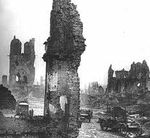
For the last half-dozen years, I’ve been mentally living in that 1914-1918 world, writing a book about the war that killed some 20 million people, military and civilian, and left large parts of Europe in smoldering ruins. I’ve haunted battlefields and graveyards, asked a Belgian farmer if I could step inside a wartime concrete bunker that now houses his goats, and walked through reconstructed trenches and an underground tunnel which protected Canadian troops moving their ammunition to the front line. In government archives, I’ve looked at laconic reports by officers who survived battles in which most of their troops died; I’ve listened to recordings of veterans and talked to a man whose labor-activist grandfather was court-martialed because he wrote a letter to the Daily Mail complaining that every British officer was assigned a private servant. In a heartbreakingly beautiful tree-shaded cemetery full of British soldiers mowed down with their commanding officer (as he had predicted they would be) by a single German machine gun on the opening day of the Battle of the Somme, I found a comment in the visitors’ book: “Never Again.” I can’t help but wonder: Where are the public places for mourning the mounting toll of today’s wars? Where is that feeling of never again?

more from Adam Hochschild at Guernica here.

Mangled to a meme in less than two days

Martin_Luther_King_Jr_NYWTS

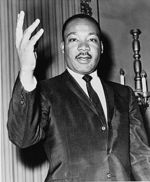
This quote went viral on the internet, following the killing of Osama Bin Laden: ‎”I mourn the loss of thousands of precious lives, but I will not rejoice in the death of one, not even an enemy. Returning hate for hate multiplies hate, adding deeper darkness to a night already devoid of stars. Darkness cannot drive out darkness: only light can do that. Hate cannot drive out hate: only love can do that.” The citation was attributed to Martin Luther King, Jr., but a number of people came forward to debunk it. A Salon article attributed the quote to famous magician Penn Jillette. Megan McArdle of The Atlantic wrote, “Out of Osama’s Death, a Fake Quotation is Born.” But when I (silly me) posted the quotation on my Facebook page and heard about kerfuffle, I found someone who indeed attributed the quote to MLK’s 1963 Strength to Love.

more from Cynthia Haven at Bookhaven here.

a poet of freedom

TLS_Maguire_736456a

Holbrook argues that freedom is the one item we could not subtract from Shakespeare’s plays “without their, in effect, ceasing to be his”. Freedom is both a personal and a political concept and Holbrook explores them jointly: Shakespeare is aware that personal freedom can often conflict with ethics and morality and social norms. Cordelia’s insistence on speaking in her own voice rather than another’s is both ethically principled and ethically disastrous; the autonomy of villains such as Aaron conflicts with society but so too does that of public rulers like Antony and Cleopatra. Such tensions between self and society lead to larger questions: if it is right for Hermia to disobey her father in A Midsummer Night’s Dream, is it also right for a people to rebel against a king? Holbrook extends these themes to an analysis of Victorian and Modernist Shakespeare criticism. F. J. Furnivall’s approach to Shakespeare “reflects the liberal’s wish to break with a coercive morality”; Walter Pater, Oscar Wilde and others see Shakespeare “as standing for life and against a life-crushing morality”. T. S. Eliot objected to Shakespeare because he was morally problematic but Holbrook argues that fidelity to self-realization can be ethical; for Shakespeare (as for Montaigne, who gets much attention here), cultivating the self is more important than capitulating to expectation. When Shakespeare presents vice as a choice it becomes a positive marker of self-determination. Richard of Gloucester determines to be a villain, Aaron embraces his blackness, Antony and Cleopatra choose passion rather than just giving in to it.

more from Laurie Maguire at the TLS here.

Thursday Poem

Eccles Street

It was the silver age of the sepia print.
From Eccles Street
the wanderer set out in the heat of June,
to take the epic route,

to make a day of small detours
with cronies in the meeting rooms
and hostelries.
Journey-man. Pilgrim. Tenant
of a creaky house

that after slow decline was gone in time,
I retrace your path
from the precinct of the dispossessed
to the dunes in Sandymount

and the round Martello with its climbing
steps and assonant echoes
that echo still, a hundred years since
Odysseus prowled his Dublin streets
and bawdy-house.

by Gerard Smyth
from The Mirror Tent
publisher: Dedalus, Dublin, © 2007

What will happen to us?

From The Boston Globe:

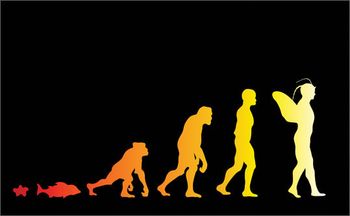
Whatwillhappentous__1304105915_8700 Humans have been interested in the future for millennia, mostly as a subject for theologians. But theologians were, along with everyone else, thinking small. Most humans who have ever lived have died in conditions almost exactly like the ones into which they were born, and without written history had no way to grasp that the future might be different at all. Only now have we gained the scientific knowledge necessary to appreciate how exactly how deep a rabbit-hole the future really is: not just long enough to see empires rise and crumble, but long enough to make all human history so far seem like a sneeze of the gods.

This newfound appreciation for the depths of time has led a handful of thinkers like Rees, a theoretical cosmologist by training, to begin venturing some of humanity’s first real educated guesses about what may lie far, far, far ahead. Serious futurologists are not a large group yet. “It’s a fairly new area of inquiry,” says Nick Bostrom, an Oxford University philosophy professor who heads the school’s Future of Humanity Institute. But they are trying to give a first draft of a map of the future, using the kinds of rigor that theologians and uneducated guessers from previous generations didn’t have at their disposal. In the history of prediction, there are a few examples of rigorous attempts to look far into the future — long-term climate-change modelers, say, or radiophysicists who consider where to stash nuclear waste. But more often, Bostrom says, speculation about the future has been “a projection screen, on which we display our hopes and fears.”

More here.

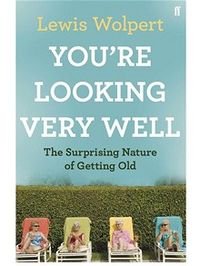
You’re Looking Very Well: the Surprising Nature of Getting Old

From The Telegraph:

Wolpert2_1882970f One of the many virtues of Lewis Wolpert’s excellent investigation of “the surprising nature of getting old” is that he does not treat the elderly as an undifferentiated blob, distinguished only by different degrees of dependency, deafness, cantankerousness, technological incompetence and resistance to novelty. Variety, rather than uniformity, is to be expected since we bring to our later years a lifetime of experiences. Increasing age is typically marked by decline in physiological function, a growing burden of disease and a rising probability of dying, but many factors determine our physical nick and attitudes to life.

Our genetic inheritance, our quality of life in utero, education, class, career, lifestyle, status, levels of physical, mental and social activity are just some of the main influences. The ageing body is like a field self-sown with mines. Wolpert treats us to a sprightly tour that encompasses the diseases and neurological conditions that may await us en route to extinction. But even this familiar territory is planted with surprises. For example, those who earlier in life endorse negative stereotypes of their elders are more prone to poor health when they themselves are old, in part because they are more likely to attribute remediable problems to irremediable ageing.

More here.

Wednesday, May 4, 2011

facts and values

Sam+Harris+and+atheism+and+atheist+and+new+atheist+and+The+End+of+Faith+and+letter+to+a+Christian+nation

“If God does not exist, everything is permitted.” Dostoevsky never actually wrote that line, though so often is it attributed to him that he may as well have. It has become the almost reflexive response of believers when faced with an argument for a godless world. Without religious faith, runs the argument, we cannot anchor our moral truths or truly know right from wrong. Without belief in God we will be lost in a miasma of moral nihilism. In recent years, the riposte of many to this challenge has been to argue that moral codes are not revealed by God but instantiated in nature, and in particular in the brain. Ethics is not a theological matter but a scientific one. Science is not simply a means of making sense of facts about the world, but also about values, because values are in essence facts in another form. Few people have expressed this argument more forcefully than the neuroscientist Sam Harris. Over the past few years, through books such as The End of Faith and Letter to a Christian Nation, Harris has gained a considerable reputation as a no-holds-barred critic of religion, in particular of Islam, and as an acerbic champion of science. In his new book, The Moral Landscape: How Science Can Determine Human Values, he sets out to demolish the traditional philosophical distinction between is and ought, between the way the world is and the way that it should be, a distinction we most associate with David Hume. What Hume failed to understand, Harris argues, is that science can bridge the gap between ought and is, by turning moral claims into empirical facts.

more from Kenan Malik at Eurozine here.

Baird’s tapir

Mccann_36.3_jungle

I came to San Rafael to look for Baird’s tapir, Central America’s largest mammal, weighing in at over 500 pounds, and one of the most endangered animals in the Neotropics. The tapir suffers somewhat from illegal—and increasingly efficient—hunting, but its greatest struggle is against the loss and fragmentation of its habitat due to commercial and private logging and the expansion of agriculture and pasture. The coffee industry is one of the most grievous offenders. It is easy to see how habitat loss can harm a species, but fragmentation—without any loss, per se—can be just as bad. Fragmentation creates isolation, and isolated populations can experience rapid evolutionary change, normally to their detriment. Decreased genetic diversity leaves such groups susceptible to debilitating disorders that would be less likely, and less damaging, in free-ranging populations. With my brother-cum-field-assistant and two guides—the first, concerned by abundant jaguars in the area, insisted that we pick up a second—I set out from the village to find tapir. Or, not exactly tapir, but evidence of them: their feces. In order to learn about the genetic health of a population—levels of inbreeding, say—one needs DNA samples. Each bolus scrapes off a few intestinal cells as it passes through the colon, and, there we are, enterprising scientists, to collect them. We followed a track, cut only that week, deep into the jungle, as far as an enormous cedar tree that the villagers had just felled. Along the way we passed a pit viper impaled on a stake in the middle of the path. From the end of the path we headed into virgin territory, following a maze of streams. Here we made camp.

more from Niall McCann at Boston Review here.

Global Energy: The Latest Infatuations

Vaclav Smil in American Scientist:
ScreenHunter_02 May. 04 16.00 To follow global energy affairs is to have a never-ending encounter with new infatuations. Fifty years ago media ignored crude oil (a barrel went for little more than a dollar). Instead the western utilities were preoccupied with the annual double-digit growth of electricity demand that was to last indefinitely, and many of them decided that only large-scale development of nuclear fission, to be eventually transformed into a widespread adoption of fast breeder reactors, could secure electricity’s future. Two decades later, in the midst of the second energy “crisis” (1979–1981, precipitated by Khomeini’s takeover of Iran), rising crude oil prices became the world’s prime existential concern, growth of electricity demand had slumped to low single digits, France was the only nation that was seriously pursuing a nuclear future, and small cars were in vogue.

After world crude oil prices collapsed in 1985 (temporarily below $5 per barrel), American SUVs began their rapid diffusion that culminated in using the Hummer H1, a civilian version of a U.S. military assault vehicle weighing nearly 3.5 tonnes, for trips to grocery stores—and the multinational oil companies were the worst performing class of stocks of the 1990s. The first decade of the 21st century changed all that, with constant fears of an imminent peak of global oil extraction (in some versions amounting to nothing less than lights out for western civilization), catastrophic consequences of fossil fuel-induced global warming and a grand unraveling of the post-WW II world order.

All of this has prompted incessant calls for the world to innovate its way into a brighter energy future, a quest that has engendered serial infatuations with new, supposedly perfect solutions: Driving was to be transformed first by biofuels, then by fuel cells and hydrogen, then by hybrid cars, and now it is the electrics (Volt, Tesla, Nissan) and their promoters (Shai Agassi, Elon Musk, Carlos Ghosn) that command media attention; electricity generation was to be decarbonized either by a nuclear renaissance or by ubiquitous wind turbines (even Boone Pickens, a veteran Texas oilman, succumbed to that call of the wind), while others foresaw a comfortable future for fossil fuels once their visions of mass carbon capture and sequestration (CCS) were put in practice.

More here.

Obama should use Osama Bin Laden’s death to declare victory and end the legal war on terror

Dahlia Lithwick in Slate:

110502_JURIS_osamaTN The Bush administration's extra-legal exploits in the months and years after 9/11 have already been credited, in some quarters, for the killing of Bin Laden. That was to be expected. In a statement released earlier today, for instance, former Attorney General Alberto Gonzales said: “I congratulate President Obama and his team for this significant accomplishment. I also congratulate President Bush who carried the War on Terror to our enemies and adopted the legal framework for that effort that continues today.” That's code for the claim that it was years of Bush-sanctioned warrantless eavesdropping, coercive interrogation, and indefinite detention that led to this victory. Rep. Steve King, R-Iowa, went one better, tweeting, “Wonder what President Obama thinks of water boarding now?”

There are reports that it was ultimately Guantanamo detainees who disclosed the identity of the trusted courier who, along with his brother, might have been protecting Bin Laden. Thus, the argument goes, Guantanamo is in fact an intelligence godsend that should be kept open indefinitely. And already some of America's most zealous torture apologists are taking the position that without the torture of Khalid Sheikh Mohammed and Abu Faraj al-Libi, all of this valuable information could never have been obtained and that we should be thankful that the “enhanced interrogation program” was in place all along.

More here.

The curious case of Osama bin Laden

Pervez Hoodbhoy in The Express Tribune:

ScreenHunter_01 May. 04 15.15 Osama’s killing is now a bone stuck in the throat of Pakistan’s establishment that can neither be swallowed nor spat out. To appear joyful would infuriate the Islamists who are already fighting the state. On the other hand, to deprecate the killing would suggest that Pakistan had knowingly hosted the king of terrorists.

Now, with bin Laden gone, the military has two remaining major strategic assets: America’s weakness in Afghanistan and Pakistan’s nuclear weapons. But moving these chess pieces around will not assure the peace and prosperity that we so desperately need. They will not solve our electricity or water crises, move us out of dire economic straits, or protect us from suicide bombers.

Bin Laden’s death should be regarded as a transformational moment by Pakistan and its military. It is time to dispense with the Musharraf-era cat and mouse games. We must repudiate the current policy of verbally condemning jihadism — and actually fighting it in some places — but secretly supporting it in other places. Until the establishment firmly resolves that it shall not support armed and violent non-state actors of any persuasion — including the Lashkar-e-Taiba — Pakistan will remain in interminable conflict both with itself and with the world.

More here.

Wednesday Poem

Toward Accuracy

We’re high enough that what I call fog might be cloud.
Not Everest high, or Chomuolungma, “Mother Goddess
of the World.” If we named things what they are,
our sentences would be monsoons, long rains of sound.
Morning is “the time I suspect I am a horse,” dusk
“the light which treats our shadows like taffy.”
The number of times my name changes in a day,
from “looking at the world with eyes of wood rasps”
to “feathers have replaced my bones,” rules out
the wearing of name tags: I wear a chalk board,
thesaurus, that book of whispers, of meaning sex.
“There’s a woman who smokes a cigarette
now and then, who picks tobacco off her tongue
as something moves along the fault line
of the horizon, knees pulled to her chest,
her breath wearing a dress of smoke”
is one way I think of you when I think of you.
And when I think of you, “wants to be a candle”
isn’t romantic but accurate, wicked light
leans in, away, writhes to get out of, to leap harder
into what it is.

by Bob Hicok
from Poetry, Vol. 187, No. 6, March
publisher Poetry, Chicago, © 2006

Was he betrayed? Of course. Pakistan knew Bin Laden’s hiding place all along

Robert Fisk in The Independent:

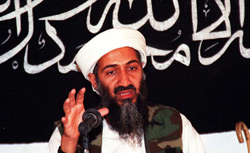
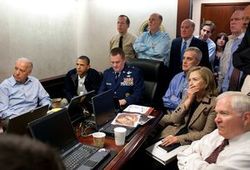
Obama_602857t A middle-aged nonentity, a political failure outstripped by history – by the millions of Arabs demanding freedom and democracy in the Middle East – died in Pakistan yesterday. And then the world went mad. Fresh from providing us with a copy of his birth certificate, the American President turned up in the middle of the night to provide us with a live-time death certificate for Osama bin Laden, killed in a town named after a major in the army of the old British Empire. A single shot to the head, we were told. But the body's secret flight to Afghanistan, an equally secret burial at sea? The weird and creepy disposal of the body – no shrines, please – was almost as creepy as the man and his vicious organisation. The Americans were drunk with joy. David Cameron thought it “a massive step forward”. India described it as a “victorious milestone”. “A resounding triumph,” Israeli Prime Minister Netanyahu boasted. But after 3,000 American dead on 9/11, countless more in the Middle East, up to half a million Muslims dead in Iraq and Afghanistan and 10 years trying to find Bin Laden, pray let us have no more “resounding triumphs”. Revenge attacks? Perhaps they will come, by the little groupuscules in the West, who have no direct contact with al-Qa'ida. Be sure, someone is already dreaming up a “Brigade of the Martyr Osama bin Laden”. Maybe in Afghanistan, among the Taliban.

But the mass revolutions in the Arab world over the past four months mean that al-Qa'ida was already politically dead. Bin Laden told the world – indeed, he told me personally – that he wanted to destroy the pro-Western regimes in the Arab world, the dictatorships of the Mubaraks and the Ben Alis. He wanted to create a new Islamic Caliphate. But these past few months, millions of Arab Muslims rose up and were prepared for their own martyrdom – not for Islam but for freedom and liberty and democracy. Bin Laden didn't get rid of the tyrants. The people did. And they didn't want a caliph.

More here.

I control therefore I am

From PhysOrg:

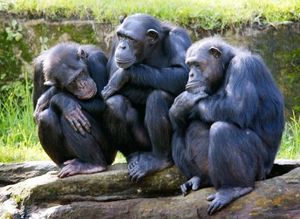
Chimpanzeesa Chimpanzees are self-aware and can anticipate the impact of their actions on the environment around them, an ability once thought to be uniquely human, according to a study released Wednesday. The findings, reported in the Proceedings of the Royal Society B, challenge assumptions about the boundary between human and non-human, and shed light on the evolutionary origins of consciousness, the researchers said. Earlier research had demonstrated the capacity of several species of primates, as well as dolphins, to recognize themselves in a mirror, suggesting a fairly sophisticated sense of self.

The most common experiment consisted of marking an animal with paint in a place — such as the face — that it could only perceive while looking at its reflection. If the ape sought to touch or wipe off the mark while facing a mirror, it showed that the animal recognised itself. But even if this test revealed a certain degree self-awareness, many questions remained as to how animals were taking in the information. What, in other words, was the underlying cognitive process?

More here.

Tuesday, May 3, 2011

Picasso’s Erotic Code

L-picasso-mistress

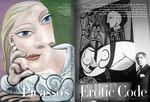
Marie-Thérèse Walter is the subject of “Picasso and Marie-Thérèse: L’Amour Fou,” a major exhibition opening at the Gagosian Gallery on West 21st Street, in New York, this month. Marie-Thérèse was Picasso’s love and principal muse from the time he came upon her—she was 17, he was 45—outside the Galeries Lafayette department store, in Paris, in January 1927, until 1941. Art historian Diana Widmaier-Picasso, Marie-Thérèse’s granddaughter, who is preparing a catalogue raisonné of Picasso’s sculptures, has made this retrospective possible. As the guest curator, she has been instrumental in obtaining rarely seen works as well as archival material from the Picasso family and loans from important collections and museums. Marie-Thérèse was an easygoing but respectable bourgeois girl who lived in Maisons-Alfort, a suburb southeast of Paris, with her mother and two sisters. She was at the Galeries Lafayette that day to buy a col Claudine—a Peter Pan collar—and matching cuffs. “You have an interesting face,” Picasso told her. “I would like to do a portrait of you. I am Picasso.” The name meant nothing to Marie-Thérèse, but the fact that an artist found her beautiful thrilled her. Although she always claimed to have resisted Picasso for six months, she was sleeping with him a week later.

more from John Richardson at Vanity Fair here.

The Immortal Horizon

Article_jamison

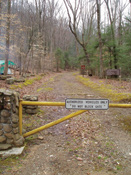
On the western edge of Frozen Head State Park, just before dawn, a man in a rust brown trench coat blows a giant conch shell. Runners stir in their tents. They fill their water pouches. They tape their blisters. They eat thousand-calorie breakfasts: Pop-Tarts and candy bars and geriatric energy drinks. Some of them pray. Others ready their fanny packs. The man in the trench coat sits in an ergonomic lawn chair beside a famous yellow gate, holding a cigarette. He calls the two-minute warning. The runners gather in front of him, stretching. They are about to travel more than a hundred miles through the wilderness—if they are strong and lucky enough to make it that far, which they probably aren’t. They wait anxiously. We, the watchers, wait anxiously. A pale wash of light is barely visible in the sky. Next to me, a skinny girl holds a skinny dog. She has come all the way from Iowa to watch her father disappear into this gray dawn. All eyes are on the man in the trench coat. At precisely 7:12, he rises from his lawn chair and lights his cigarette. Once the tip glows red, the race known as the Barkley Marathons has begun.

more from Leslie Jamison at The Believer here.