Will The US Have A “Debt Crisis”?

Pa3741c_thumb3 Simon Johnson in Project Syndicate:

John Boehner, Speaker of the United States House of Representatives, is leading the Republican Party’s charge on fiscal policy, arguing that his side needs to see “trillions of dollars” in spending cuts in order for Congress to approve an increase in the US government’s debt ceiling. But framing the issue this way creates a major problem for Boehner: it will directly, completely, and quickly antagonize one of the Republicans’ most important constituencies – the US corporate sector.

Focusing on the debt ceiling creates a political trap for Boehner and the Republicans. It is true that the US Treasury’s ability to borrow will reach its legally authorized limit in early August. It is also true that whenever Republicans rattle their sabers about the debt ceiling, and threaten not to raise it, the bond market yawns and there is no significant impact on yields.

If the Republicans’ threats were credible, any news that increased the likelihood of a problem with the debt ceiling would send Treasury bond prices down and yields up. This is not happening, because bond traders cannot imagine that the Republicans would be able – or even willing – to follow through.

After all, the consequences of failing to increase the debt ceiling would be catastrophic. The entire credit system in the US – and in much of the rest of the world – is based on the notion that there are “risk-free assets,” namely US government securities. There is no provision in the US Constitution to guarantee that the US will always pay its debts, but the American Republic has proven itself for 200-plus years to be about as good a credit risk as has ever existed.

An Indefensible Defense

Dsk 3 David Rieff on Bernard-Henri Lévy's defense of Dominique Strauss-Kahn, in TNR:

Early in the summer of 1995, a colleague and I went into South Sudan to report from the side of the South Sudanese guerrilla army, the SPLA. At dinner on the day we arrived, completely out of the blue, one of our minders turned to me and said, “I am so sorry about this Gennifer Flowers.” I had expected to talk about many things in South Sudan, but the woman with whom Bill Clinton had had an affair in the 1980s was certainly not one of them. Not quite sure of how I should answer, I took refuge in sanctimonious platitudes. We take sexual exploitation of women by powerful men very seriously in the United States, I said. Hearing this, the minder only smiled. “With us,” he said, “the fault is always with the woman.”

I have not thought of this incident for years, but the reaction of so many leading French public figures—and not just his allies within the French Socialist Party—to the arrest of Dominique Strauss-Kahn brought it all back to me. The International Monetary Fund’s managing director who, until this week, was widely believed to have a good chance of being elected president of France in next year’s elections is facing seven charges, including attempted rape and unlawful imprisonment of a maid at the New York hotel in which he was staying. From Bernard-Henri Lévy to Jean Daniel, the longtime editor of the weekly Le Nouvel Observateur, to the distinguished human rights lawyer turned politician Robert Badinter, who, as Francois Mitterand’s justice minister secured the abolition of the death penalty, the French elite consensus seems to be that it is Strauss-Kahn himself and not the 32-year-old maid who is the true victim of this drama.

To be sure, Strauss-Kahn might not be guilty. But French intellectuals’ vociferous defense of him, without all the facts of the situation, goes too far. In his weekly column in Le Point, Lévy asked “how a chambermaid could have walked in alone, contrary to the habitual practice of most New York hotels of sending a ‘cleaning brigade’ of two people, into the room of one of the most closely watched figures on the planet.” For his part, Daniel wrote in an editorial for his magazine that the fate meted out to DSK, as Strauss-Kahn is generally referred to in the French press, has made him think that, “We [French] and the Americans do not belong to the same civilization,” and demanded to know—shades of my guerrilla friend in South Sudan—why “the supposed victim was treated as worthy and beyond any suspicion?”

a certain pleasure in questioning the sacred tenets

Galbraith1

In a 1930 essay titled “Economic Possibilities for our Grandchildren,” John Maynard Keynes ridiculed economists for having a high opinion of themselves and their work. As the Great Depression engulfed the world, Keynes looked back at historic rates of economic growth, arguing that the real problem people would face in the future was not poverty but the moral quandary of how to live in a society of such abundance and wealth that work would cease to be necessary. The “economic problem,” as he put it, was technical, unimportant in the larger scheme of things. “If economists,” he wrote, “could manage to get themselves thought of as humble, competent people, on a level with dentists, that would be splendid!” John Kenneth Galbraith—the Harvard-based economist whose books shaped the public conversation on economic matters for a generation in mid-twentieth-century America—would have agreed. Today, given the rise of mathematical methods and computer modeling, economics is if anything even more labyrinthine, esoteric and inaccessible to the layman than it was in the days of Keynes and Galbraith. It is also more intellectually and politically ascendant than it was in the 1930s. Its methods now dominate much of the social sciences, having made inroads in law and political science. Its central theme of the superiority of free markets is the gospel of political life. This makes the publication of the Library of America edition of four of Galbraith’s best-known books—American Capitalism; The Great Crash, 1929; The Affluent Society and The New Industrial State—a cause for celebration. (The volume is edited by Galbraith’s son James, also an economist.) Galbraith delighted in puncturing the self-importance of his profession. He was a satirist of economics almost as much as a practitioner of it. He took generally accepted ideas about the economy and turned them upside down. Instead of atomistic individuals and firms, he saw behemoth corporations; instead of the free market, a quasi-planned economy.

more from Kim Phillips-Fein at The Nation here.

hitch on sex

110518_FW_Dominique_Strauss-Kahn-Court_TN

Why is it that we cannot read any discussion of a political sex scandal, or a sex scandal involving a politician, without pseudo-sophisticated comments about the supposedly different morals of Americans and Europeans? And why is it that this goes double if the politician is French, or if the reactions being quoted are from Gallic sources? And when did this annoying journalistic habit become so prevalent? It must have sprung up quite recently, or at least since the time when Charles de Gaulle and John F. Kennedy were presidents of their respective countries. The first man was a strict and fastidious Puritan who never gave his wife Yvonne a moment’s cause for complaint, while the second was a sensational debauchee who went as far as importing a Mafia gun-moll into the White House sleeping quarters. Yet the American culture, which regards Kennedy as a virtual Galahad, is the supposedly shockable one, while in France—ah, la France—a much more broad-minded and adult attitude prevails. Surely France and its partisans are not saying that the attempted rape of a chambermaid would not rearrange so much as an eyebrow in the supposedly refined salons of Paris? (After all, the endlessly cited François Mitterrand may have had a daughter out of wedlock, but he took good care to keep it a secret for as long as he could.) The problem arises from mentioning the two types of sexual behavior in the same breath. A related problem derives from the belief that Americans will not tolerate marital infidelity from their politicians.

more from Christopher Hitchens at Slate here.

apocalypse nowish

Apocalypse-billboard-300x222

Why May 21, 2011? Because, according to Family Radio’s president Harold Camping, it’s exactly 7,000 years to the day after God originally showed his infinite love—my words, not his—by drowning almost every woman, man, and child on earth in a worldwide flood. I’d explain the math behind Camping’s calculations, but, honestly, I don’t understand it. I tried. The timeline in the back of his book, Time Has an End, which I ordered from Amazon a few weeks ago, didn’t make the reasoning any clearer. I got hung up on passages like this: “The year 391 B.C. is the year when the Old Testament was finished, and 2,011 + 391 – 1 = 2,401, or 7 × 7 × 7 × 7. In the perfectly complete end of time, Christ will finish speaking to this present world.” How seriously do believers take this message? One guy I met in the Family Radio lobby had just returned from an RV proselyting trip that went as far as Colorado. Another told me he drove up from Los Angeles that morning just to correct a translation error in one of the ministry’s tracts. Some listeners in China have sold their homes and are donating the money to Family Radio’s campaign. NPR reports that in the U.S., one couple—with one kid and another on the way—cashed out their savings accounts and budgeted to run out of money on the big day.

more from Ted Cox at Killing The Buddha here.

Thursday Poem

Light

Another drought morning after a too brief dawn downpour,
uncountable silvery glitterings on the leaves of the withering maples—

I think of a troop of the blissful blessed approaching Dante,
“a hundred spheres shining,” he rhapsodizes, “the purest pearls . . .”

then of the frightening, brilliant, myriad gleam in my lamp
of the eyes of the vast swarm of bats I found once in a cave,

a chamber whose walls seethed with a spaceless carpet of creatures,
their cacophonous, keen, insistent, incessant squeakings and squealings

churning the warm, rank, cloying air; of how one,
perfectly still among all the fitfully twitching others,

was looking straight at me, gazing solemnly, thoughtfully up
from beneath the intricate furl of its leathery wings

as though it couldn’t believe I was there, or was trying to place me,
to situate me in the gnarl we’d evolved from, and now,

the trees still heartrendingly asparkle, Dante again,
this time the way he’ll refer to a figure he meets as “the life of . . .”

not the soul, or person, the life, and once more the bat, and I,
our lives in that moment together, our lives, our lives,

his with no vision of celestial splendor, no poem,
mine with no flight, no unblundering dash through the dark,

his without realizing it would, so soon, no longer exist,
mine having to know for us both that everything ends,

world, after-world, even their memory, steamed away
like the film of uncertain vapor of the last of the luscious rain.

by C.K. Williams
from Wait
Farrar, Straus and Giroux, New York

© 2010

Food Like You’ve Never Seen Before

From Smithsonian:

Extreme-cuisine-hamburgers-cooking-631 Late on a rainy evening in March, the black-sweatered crowd filled the hallways of New York City’s Institute of Culinary Education. It was late because that’s when many of the guests, who toil in restaurant kitchens, got off work. They wore black because it’s the costume of the cultural avant-garde, a movement whose leadership has improbably devolved from artists, composers and writers to the people who cut up chickens. Professional chefs, long counted among the most reliable acolytes of the bourgeoisie—why else would they be so drawn to Las Vegas?—have seized the vanguard of Revolution and are carrying it out, one hors d’oeuvre at a time. At this very moment, in fact, a half dozen of them are hunched conspiratorially over bowls of mysterious white flakes, arranging them in heaps onto spoons to be passed around by waiters.

“Any hints on how to eat this?” I asked a young woman, a food stylist for a cooking magazine. “Don’t breathe out,” she advised. I coughed, sending a powdery white spray cascading onto my shirt front. For the rest of the evening I wore a dusting of elote, a Mexican street-food snack of corn on the cob. Except this was elote deconstructed, reimagined and assembled into an abstraction of flavors, a Cubist composition of brown butter powder, freeze-dried corn kernels and powdered lime oil. The flavors of corn and butter burst onto my tongue in an instant, and were gone just as quickly.

“It’s delicious, isn’t it?” the woman said.

“Yes, and very, uh…”

“Light?”

“Actually I was thinking it would stay on the spoon better if it was heavier.”

This party marks the moment the Revolution has been waiting for: the publication of Modernist Cuisine, the movement’s manifesto, encyclopedia and summa gastronomica, 2,438 pages of cooking history, theory, chemistry and microbiology in five oversize, lavishly illustrated volumes, plus a spiralbound book of recipes on waterproof paper, weighing 43 pounds.

More here.

Religious factors may influence changes in the brain

From PhysOrg:

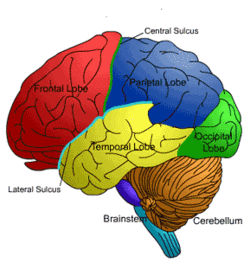
Brain Researchers at Duke University Medical Center have found an apparent correlation between religious practices and changes in the brains of older adults.

“One interpretation of our finding — that members of majority religious groups seem to have less atrophy compared with minority religious groups — is that when you feel your beliefs and values are somewhat at odds with those of society as a whole, it may contribute to long-term stress that could have implications for the brain,” said Owen, who was lead author of the study. “Other studies have led us to think that whether a new experience you consider spiritual is interpreted as comforting or stressful may depend on whether or not it fits in with your existing religious beliefs and those of the people around you,” Hayward said. “Especially for older adults, these unexpected new experiences may lead to doubts about long-held religious beliefs, or to disagreements with friends and family. “Several studies have found that, for many people, belonging to a religious group seems to be related to better health in later life, but not all religious people experience the same benefits. This study may help us to understand some of the reasons for those differences,” Hayward said. While this stress may be a plausible interpretation of the findings of this study, the authors caution that not enough detail is known about the mechanics of how stress affects brain atrophy.

More here.

Wednesday, May 18, 2011

library death

Hartland-library_jpg_470x487_q85

I don’t know of anything more disheartening than the sight of a shut down library. No matter how modest its building or its holdings, in many parts of this country a municipal library is often the only place where books in large number on every imaginable subject can be found, where both grownups and children are welcome to sit and read in peace, free of whatever distractions and aggravations await them outside. Like many other Americans of my generation, I owe much of my knowledge to thousands of books I withdrew from public libraries over a lifetime. I remember the sense of awe I felt as a teenager when I realized I could roam among the shelves, take down any book I wanted, examine it at my leisure at one of the library tables, and if it struck my fancy, bring it home. Not just some thriller or serious novel, but also big art books and recordings of everything from jazz to operas and symphonies. In Oak Park, Illinois, when I was in high school, I went to the library two or three times a week, though in my classes I was a middling student. Even in wintertime, I’d walk the dozen blocks to the library, often in rain or snow, carrying a load of books and records to return, trembling with excitement and anticipation at all the tantalizing books that awaited me there. The kindness of the librarians, who, of course, all knew me well, was also an inducement. They were happy to see me read so many books, though I’m sure they must have wondered in private about my vast and mystifying range of interests.

more from Charles Simic at the NYRB here.

The Achilles’ Heel of Biological Complexity

News294-i1.0 Philip Ball in Nature News:

Why are we so complicated? You might imagine that we've evolved that way because it conveys adaptive benefits. But a study published by Nature today suggests that the complexity in the molecular 'wiring' of our genome — the way our proteins talk to each other — may simply be a side effect of a desperate attempt to stave off problematic random mutations in proteins' structures.

Ariel Fernández, previously at the University of Chicago, Illinois, and now at the Mathematics Institute of Argentina in Buenos Aires, and Michael Lynch of Indiana University in Bloomington argue that complexity in the network of our protein interactions arises because our relatively small population size — compared with that of single-celled organisms — makes us especially vulnerable to 'genetic drift': changes in the gene pool due to the reproductive success of certain individuals by chance rather than by superior fitness.

Whereas natural selection tends to weed out harmful mutations in genes and their related proteins, genetic drift does not. Fernández and Lynch argue that the large number of physical interactions between our proteins — a crucial component of how information is transmitted in our cells — compensates for the reduction in protein stability wrought by drift.

mona’s story

1304946908196

It was the 26th of January in Delhi, a crisp, clear, spicy-radish-and-tomatoes-in-the-sun winter morning that makes you glad to be alive. On this date, some fifty years ago, India had become a republic. Mona had chosen the anniversary to celebrate the birthday of her adopted daughter Ayesha; it pleased her that Ayesha had come into her arms precisely on the 26th of January. She would be free, like India. The route to the graveyard, the walls of its compound, the pillars at its gate, were plastered with posters inviting all and sundry to the party; it was certainly the most unusual invitation I’d ever seen. Beside a somewhat makeshift, unfinished structure stood a wall about five feet high, and behind it men and women cooked food in large vats. Pakodas were being fried, their delicious aroma wafting out along the clear morning air, vying with the mouth-watering smell of meat curry and hot, oven-baked rotis. At one end of the compound, next to a cluster of graves, two people were busy chopping bananas, guavas and oranges into a spicy fruit chaat. Mona, large and imposing, hennaed and cropped hair spiking every which way, teeth stained with paan, her dark skin catching the winter sun, walked among her guests, offering food to one, a cold drink to another. But something was amiss. She didn’t seem dressed for a party; her clothes were rumpled and somewhat grimy, her hair dishevelled. She looked distracted and unhappy – and there was no sign of her child.

more from Urvashi Butalia at Granta here.

Kleist: Eine Biographie

Schulz-kleist Alexander Kosenina reviews Gerhard Schulz's Kleist: Eine Biographie and Jens Bisky's Kleist: Eine Biographie in The Modern Language Review:

Heinrich von Kleist, the most modern of all classic authors, has had hardly any attention from biographers in recent decades. The opposite might have been expected given his uninterrupted popularity among theatregoers and readers. To a far greater extent than Lessing, Goethe, or Schiller, Kleist was on an existential quest. He did not write to live, but lived to write, 'weil ich es nicht lassen kann'. Not until Kafka would any other author sound so possessed again. Puzzles about the inexpressible 'I' and the innermost core of being are his bread and butter. His works do not permit clear answers or distance from the text. His complex, difficult life, a marked contrast with his disciplined oeuvre, reads like a modern novel. A Kleistbiography is a considerable challenge; Jens Bisky and Gerhard Schulz have now taken it up at the same time.

Both books are beautifully written, and they have more in common than their identical titles. The wealth of information they present and their attention to lesser-known details are further similarities. Both authors have resisted the temptation, prevalent in research on Kleist, to dress conjecture as fact for want of sources. Life is harder here with Kleist than with other German Klassiker. The body of source material is comparatively sparse and patchy: his correspondence, for example, spans nineteen years (1793-1811) with only two hundred and forty letters and twenty replies, and by and large it is addressed only to family members and a handful of friends. There are no extent diaries or Ideenmagazine. Cryptic allusions and quotations turn the biographer into a literary detective. Kleist's letters, a fascinating read in themselves, are also the key to his life and works. They reveal intimate facts, their language is intoxicating, and they are an education in visual observation. They contain almost all the basic motifs of the literary works. Schulz, indeed, asks whether these letters are a work of fiction with Kleist as its sole hero–a question as pertinent as it is shrewd.

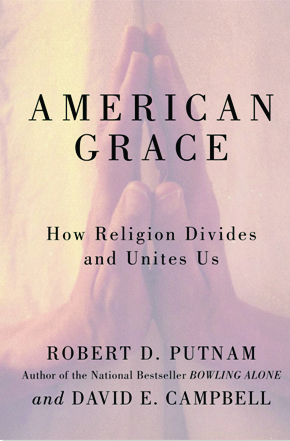
American Grace: How Religion Divides and Unites Us

Croft-1 James Croft reviews Robert D. Putnam and David E. Campbell's new book, in The Humanist:

American religion is a conundrum. Americans manage to combine deep religious devotion with wide religious diversity, all the while remaining remarkably tolerant of each other. What factors have shaped the current religious landscape in the United States? What characteristics do people of faith have, in comparison to those of other faiths and those with none? And what explains America’s unique combination of diversity, devotion, and tolerance?

These are the questions that Robert Putnam, Harvard professor of public policy and the sociologist who shone a spotlight on American community in Bowling Alone, and David Campbell, professor of political science at Notre Dame, set out to answer in their book American Grace. In short, the authors seek to provide a definitive snapshot and analysis of the state of contemporary religiosity in America. They ask about the relationship between religion and politics, between religion and civic values, whether religion plays a divisive role or brings people together and, in the opening chapters, how America got to where it is today, religiously speaking. The breadth of the book’s ambition, along with its hefty dimensions (the main text runs to 550 pages) and steepled hands on the cover, convey the intention clearly: this is to be the new bible for sociologists of religion.

The majority of the book is based on two large surveys (3,108 participants in the first, and 1,909 in the second) conducted in 2006 and 2007. The sample drawn for the first was representative of the population of the United States and was randomly selected. The second followed up with as many of the individuals surveyed in the first as possible, and asked most of the same questions. Therefore, the authors argue, it is possible to see how some measures change (like church attendance) between one year and the next. This second survey is important because it enables the authors to “test” whether one variable alters with another: if making a friend of another religion coincides with a warmer view of that religion, for example, then one might plausibly hypothesize that making friends with people of another faith leads to warmer feelings for others of that same faith. This is not enough to establish causality, but it does give useful hints that would not emerge without the second survey.

Joseph Brodsky and the Fortunes of Misfortune

110523_r20902_p465 Keith Gessen in The New Yorker:

In the fall of 1963, in Leningrad, in what was then the Union of Soviet Socialist Republics, the young poet Dmitry Bobyshev stole the young poet Joseph Brodsky’s girlfriend. This was not cool. Bobyshev and Brodsky were close friends. They often appeared, in alphabetical order, at public readings around Leningrad. Bobyshev was twenty-seven and recently separated from his wife; Brodsky was twenty-three and intermittently employed. Along with two other promising young poets, they’d been dubbed “the magical chorus” by their friend and mentor Anna Akhmatova, who believed that they represented a rejuvenation of the Russian poetic tradition after the years of darkness under Stalin. When Akhmatova was asked which of the young poets she most admired, she named just two: Bobyshev and Brodsky.

The young Soviets felt the sixties even more deeply than their American and French counterparts, for, while the Depression and the Occupation were bad, Stalinism was worse. After Stalin died, the Soviet Union began inching toward the world again. The ban on jazz was lifted. Ernest Hemingway was published; the Pushkin Museum in Moscow hosted an exhibit of the works of Picasso. In 1959, Moscow gave space to an exhibition of American consumer goods, and my father, also a member of this generation, tasted Pepsi for the first time.

The libido had been liberated, but where was it supposed to go? People lived with their parents. Their parents, in turn, lived with other parents, in what were known as communal apartments. “We never had a room of our own to lure our girls into, nor did our girls have rooms,” Brodsky later wrote from his American exile. He had half a room, separated from his parents’ room by bookshelves and some curtains. “Our love affairs were mostly walking and talking affairs; it would make an astronomical sum if we were charged for mileage.” The woman with whom Brodsky had been walking and talking for two years, the woman who broke up the magical chorus, was Marina Basmanova, a young painter. Contemporaries describe her as enchantingly silent and beautiful. Brodsky dedicated some of the Russian language’s most powerful love poetry to her. “I was only that which / you touched with your palm,” he wrote, “over which, in the deaf, raven-black / night, you bent your head. . . . / I was practically blind. / You, appearing, then hiding, / taught me to see.”

Almost unanimously, people in their circle condemned Bobyshev. Not because of the affair—who didn’t have affairs?—but because, as soon as Bobyshev began to pursue Basmanova, Brodsky began to be pursued by the authorities.

Egypt: Why Are the Churches Burning?

GettyImages_109868491_jpg_470x396_q85 Yasmine El Rashidi in the NYRB blog:

On a recent afternoon this month, in a busy downtown Cairo street, armed men exchanged gunfire, threw rocks and Molotov cocktails, and freely wielded knives in broad daylight. The two-hour fight, which began as an attempt by some shop-owners to extort the customers of others, left eighty-nine wounded and many stores destroyed. In the new Egypt, incidents like this are becoming commonplace. On many nights I go to bed to the sound of gunfire, and each morning I leaf through newspapers anticipating more stories of crime. Stopped at gun-point; car stolen; head severed; kidnapped from school, held at ransom; armed men storm police station opening fire and killing four; prison cells unlocked—91 criminals on the loose. Many people I know have already bought guns; on street corners metal bludgeons are being sold for $3; and every week I receive an email, or SMS, or Facebook message about a self-defense course, or purse-size electrocution tool, or new shipments of Mace. “These are dangerous times,” my mother told me recently as she handed me a Chinese-made YT-704 “super high voltage pulse generator.” “You have to take precautions, keep it in your bag.”

Even more worrying, it seems increasingly clear that a variety of groups have been encouraging the violence, in part by rekindling sectarian tensions that had disappeared during the Tahrir Square uprising, when Muslim and Coptic protesters protected one another against Mubarak’s thugs. Since then, there have been a series of attacks on Copts, and the perpetrators seem to include hardline Islamists (often referred to as Salafis), remnants of the former regime, and even, indirectly, some elements of the military now in charge, who have allowed these attacks to play out—all groups that in some way have an interest in disrupting a smooth transition to a freely elected civil government and democratic state.

Wednesday Poem

Angels of Choice

We lie trapped beneath
The Masonic geometry of Washington,
our bodies racked by long vistas,
our hearts bearing the tall spike’s pain.
Black-windowed limos rake my chest
with the loose gravel of power.

One of my hands reaches into a pocket
and small coins become bombs.
The other marks an X beside the black man’s name,
and soon he begins to lie.
Along the lines of my flesh I hear
the dark weeping of the disappeared.

There is no escape from the weight of this geometry.
My shackled movements shake small dirt
from boots that are always marching.
Ignorance is pressed into us as
we accept the banked protocol that
drives there along the avenues of shame.

Year after year, I unwrap the paper skin
of a garlic bulb, separate the cloves,
press each piece of the pinwheel
into cool October soil, while in my mind
green spears arise from the dirt
as April’s earth turns light.

Here I could dwell, here I could
let words fall out of the sky onto a white page,
here I could cradle the head of a neighbor
old now and fallen from his heights.
Here geometry is written on paper as thin
as a summer cloud disappearing.

by Susie Patlove

Excavation

From Guernica:

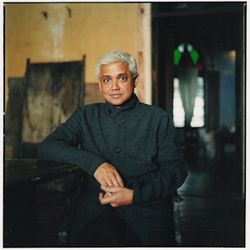
Amitav Lila Azam Zanganeh interviews Amitav Ghosh:

Many novelists start out dreaming in their bed at night. As Sartre describes in The Words, they dream of how they’ll write these wild romantic novels. But Amitav Ghosh seems to come from quite a different place. As a young man he worked as a journalist; his first job was at the Indian Express newspaper, based in New Delhi. He next earned a PhD at Oxford in social anthropology, followed by a stint in Egypt. As he tells Lila Azam Zanganeh, our “Nabokovian“ interviewer, his background in anthropology—as opposed to, say, an MFA—might have been the best training imaginable for his fiction and essays: “What does an anthropologist do?” he asks. “You just go and talk to people, then at the end of the day you write down what you see.… It trains you to observe, and it trains you to listen to the ways in which people speak.”

Ghosh published the first of his six novels, The Circle of Reason, in 1986, and his career was given a boost when France awarded the book a prestigious Prix Médicis Etranger. While he lives in Brooklyn, writes in English and feels at home in the New York publishing scene, his sensibility is clearly that of an internationalist. Enabled in his career by writers such as Salman Rushdie and V.S. Naipaul, he cares almost nothing about identity in its narrowest sense. Why? Because of India. “One of the reasons why is because anybody who's lived in India knows that India is incredibly, incredibly diverse.… That’s one of the wonderfully liberating things about India; it lets you be exactly who you want to be.”

More here.

Stress can shorten telomeres in childhood

From Nature:

Orph A long-term study of children from Romanian orphanages suggests that the effects of childhood stress could be visible in their DNA as they grow up. Children who spent their early years in state-run Romanian orphanages have shorter telomeres than children who grew up in foster care, according to a study published today in Molecular Psychiatry1. Telomeres are buffer regions of non-coding DNA at the ends of chromosomes that prevent the loss of protein-coding DNA when cells divide. Telomeres get slightly shorter each time a chromosome replicates during cell division, but stress can also cause them to shorten. Shorter telomeres are associated with a raft of diseases in adults from diabetes to dementia. The study is part of the Bucharest Early Intervention Project, a programme started in 2000 by US researchers who aimed to compare the health and development of Romanian children brought up in the stressful environment of an orphanage with those in foster families, where they receive more individual attention and a better quality of care.

When the study began, state orphanages were still common in Romania, and a foster care system was established specifically for this project. The study focused on 136 orphanage children aged between 6 and 30 months, half of whom were randomly assigned to foster families. The other half remained in orphanages. The researchers obtained DNA samples from the children when they were between 6 and 10 years old, and measured the length of their telomeres. They found that the longer the children had spent in the orphanage in early childhood – before the age of four and half – the shorter their telomeres. “It shows that being in institutional care affects children right down to the molecular level,” says clinical psychiatrist Stacy Drury of Tulane University in New Orleans, Louisiana, one of the lead authors on the study.

More here.

Tuesday, May 17, 2011

The case against using plants as monuments

Rochelle Gurstein in The New Republic:

Twoers2 As we headed toward the Cherry Esplanade at the Brooklyn Botanic Garden so that we could take in one of the great joys of spring in New York—cherry trees in full, glorious bloom—we entered a path between a double row of youngish oak trees that were now beginning to attain the height and fullness that will eventually give them the stately architectural elegance of an allée. I was asking my husband if he remembered how forlorn they had looked as saplings when we noticed a bronze plaque at the foot of a tree just filling in with deep green leaves. It read: “In Memory of the Heroes of Engine Company 280 and Ladder Company 132 Who Made the Supreme Sacrifice On September 11, 2001 In Defense of Their Country,” followed by the names of seven men who were killed. And with that, our delight in the beauty of what was a perfect spring day was interrupted by the presence of September 11.

We were taken off guard, but then we remembered that a number of years ago these oaks had been planted to replace the magnificent allée of old, soaring Norway maples that had been planted by the first generation of Brooklyn Botanic gardeners in 1918 to honor the Armistice and that had sadly come to the end of their natural life spans over 80 years later.

More here.

Monk, Mystic, Mechanic

1687071034 Avner Shapira in Ha'aretz:

Ludwig Wittgenstein may have declared at the beginning of his book “Philosophical Investigations” that “explanations come to an end somewhere,” but as far as his philosophy is concerned, the finish line is still nowhere in sight. Since his death 60 years ago, on April 29, 1951, numerous explanations and interpretations of his philosophy, or to be more precise, his philosophies, have been proposed. His influence has seeped into other spheres of knowledge and his unique personality has also been the subject of many analyses and portrayals.

The exhibition “Ludwig Wittgenstein: Contextualizations of a Genius,” at the Schwules Museum in Berlin offers new keys to understanding one of the 20th century's greatest intellects, who helped lay the foundations for the linguistic revolution that occurred in the world of philosophy. It underscores the connections between his philosophy and his life and sheds light on two key yet murky aspects of his biography: his ambivalent attitude toward his family's Jewish origins and his sexual identity.

At the entrance to the exhibition, a series of self-portraits of Wittgenstein, taken in 1922, are screened in a continuous loop. His changing expressions allude to the exhibition's aim – exposing the many facets of his personality. “On the 60th anniversary of his death, we wished to sketch character by means of observation not only of his pioneering theories, but also of his family, the culture from whence he came, the historical and intellectual sources that influenced him, his social connections and the many places that he lived,” says Kristina Jaspers, the exhibition's co-curator and the co-editor of the book of the same title (with Jan Drehmel ).

Jaspers says that making a connection between the philosophy and the biography of the philosopher is apt in Wittgenstein's case because he himself discerned such an affiliation. “He believed that in order to do philosophy properly, you had to live properly – in other words, that life and philosophy go hand in hand. The changes that occurred in his philosophical views could become clear in light of his biography: On the one hand, there is the indecision, the doubts and fear of mistakes that constantly haunted him, in life as well as in his theoretical pursuits; and on the other hand, whenever he felt that he needed to change his life or when he became convinced that he had erred in his philosophical conclusions, he made firm decisions and resolutely stuck to them.”