Why eating together matters

From Salon:

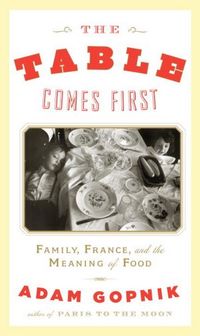
EatWe sapiens are the only animals that look each other in the eye while eating without getting violent. At least most of the time. The other beasts fight over their food; we talk over ours, and share. We have ancient rules of the table, early glimpses of civilization, covenants that have softened into traditions reflecting the basic humanity we find in eating, its rituals, and its memories. If there is a leitmotif that follows the sinuosities of Adam Gopnik’s “The Table Comes First” — his investigation into the pleasures of the table, peeling back its veneer to examine the mechanisms that make it tick — it is “the simple path between eating well and feeling happy,” whether the table is at Noma or the humble home of a friend.

Gopnik writes with an easy cultural fluency; his sentences are roomy and comfortable, but agile. He alternates between chapters with definite shape and momentum, with specific centers of gravity, and chapters that chew on ideas, a ruminant grazing in a field of culinary philosophy. The birth of what we would identify as a restaurant, in Paris in the mid-18th century, falls into the first group. It is a terrific story, told here with grace and insight, that buries the old tale of chefs being shown the château door during the French Revolution and, so, opening their own. The restaurant rose earlier, when Paris was awash in a cult of health and simplicity, when the Palais Royal assumed the mantle of the modern street store, and when notions of caste were already in disarray, long before the revolution. A public place, welcoming as home — women, too, anyone with a sou — but capable of “a primal magic, a mood of mischief, stolen pleasures, a retreat from the world, a boat on the ocean.”

More here.

What will the $1000 genome do for you?

From MSNBC:

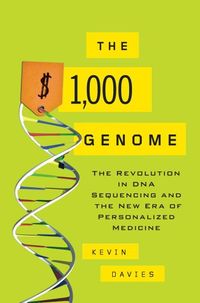
BookThe $1,000 genome has been hotly sought ever since a crude map of the human genome was first published in 2001. The Carlsbad, Calif. biotech company, part of Life Technologies, will sell its device to research labs and medical clinics for $99,000 to $149,000, compared to the current price of about $750,000 for existing sequencers, Reuters reported on its website Tuesday. According to Reuters, a doctor will be able to sequence a patient’s entire genome for $1,000, compared to the current rate of $3,000 just to test for breast cancer gene mutations, for example. And the company says its new machine can complete the genome analysis within a day, rather than the two months previously needed. It's widely believed this type of genetic analysis will revolutionize medicine, that patients will learn their risk profile for potential diseases by having their DNA read right in the doctor's office. Drugs and vaccines will be designed to fit our genes, in order to maximize efficacy and minimize any side-effects. Newborn babies would have someone peek at their genes so parents could take steps to prevent genetic risks from becoming realities.

…Will genetic information be any more motivating to get people to lose weight, stop smoking, reduce their stress, stay active, wear a seatbelt or a condom, than stepping on a scale or coping with a smokers’ hack? Two cheers to scientists and businessmen for reaching the $1,000 genome. But, only two cheers. There is a long way to go before the achievement gets translated into bottom line health results that we can put to practical use.

More here.

Tuesday, January 10, 2012

Friendship in the Time of Terror

Nadezhda_mandelshtamFelix Philipp Ingold in Sign and Sight (for Marina S.):

Although the Russian poet Anna Akhmatova (1889–1966) never received the highest literary honour, the Nobel Prize, the veneration she enjoyed during her lifetime as well as her ever increasing posthumous fame have made her one of the luminary figures of modern Europe. Few authors of the past century have been portrayed more often in paintings, sculptures or photographs; few bodies of poetry has been more extensively translated, interpreted, recorded and illustrated; few individuals have featured more in the letters, journals or memoirs of her contemporaries. The extensive biographical chronicles of Lydia Chukovskaya, Emma Gerstein, Mikhail Ardov and other associates have helped create a larger-than-life and almost heroic image of the poet, which has become inseparable from her work.

Anna Akhmatova herself propelled this image to mythical dimensions through the consistent self-stylisation and dramatisation of her own persona. A modern-day Cassandra, she lamented, exhorted, raged. Her view of life was characterised by an omnipresence of violence, betrayal and death. Her first husband was executed as a counterrevolutionary; her son was repeatedly sent to labour camps for political reasons; her second husband was murdered in prison; numerous friends and colleague were victims of the so-called purges.

Meanwhile, she was prohibited from publishing, forced to eke out an existence, mostly living in other people's apartments, places of asylum, emergency accommodation. The body of work that she was able to garner in the midst of her extreme suffering in life and love is a unique and varyingly orchestrated requiem. The fact that the poet was officially and publicly reviled as “half whore, half nun” in the post-war Stalinist period is certainly due to the aura and exalted image that enveloped her, and which was to be maligned at all costs – because it posed an intolerable provocation to the Soviet literary scene.

Among those who accompanied Anna Akhmatova throughout the “century of the wolves” and enjoyed her steadfast trust was Nadezhda Mandelstam.

Fellini’s Fantastic TV Commercials

Mike Springer in Open Culture:

Last month we brought you some little-known soap commercials by Ingmar Bergman. Today we present a series of lyrical television advertisements made by the great Italian filmmaker Federico Fellini during the final decade of his life.

In 1984, when he was 64 years old, Fellini agreed to make a miniature film featuring Campari, the famous Italian apéritif. The result, Oh, che bel paesaggio! (“Oh, what a beautiful landscape!”), shown above, features a man and a woman seated across from one another on a long-distance train. The man (played by Victor Poletti) smiles, but the woman (Silvia Dionisio) averts her eyes, staring sullenly out the window and picking up a remote control to switch the scenery. She grows increasingly exasperated as a sequence of desert and medieval landscapes pass by. Still smiling, the man takes the remote control, clicks it, and the beautiful Campo di Miracoli (“Field of Miracles”) of Pisa appears in the window, embellished by a towering bottle of Campari.

Is Evolving Reproductive Technology Ushering in a New Age of Eugenics?

WEBbaby-jpg_jpg_1360199cl-8Carolyn Abraham in The Globe and Mail:

Humanity has long dreamed of perfection, striving to be faster, stronger and brighter, pushing nature to the limit. Four centuries before people were conceived in a petri dish, Swiss alchemist Paracelsus claimed flawless little beings could be grown in pumpkins filled with urine and horse dung, but there is no record he produced a crop.

With the birth of Louise Brown in 1978, the test tube finally succeeded where the pumpkin had failed, and the year she turned 11, scientists moved beyond making life in a lab: They found a way to peer into an embryo's genes and predict what that life might be like.

That ability is now morphing into a whole new approach to baby-making, one that gives people an unprecedented power to preview, and pick, the genetic traits of their prospective children.

Just as Paracelsus wrote that his recipe worked best if done in secret, modern science is quietly handing humanity something the quirky Renaissance scholar could only imagine: the capacity to harness our own evolution. We now have the potential to banish the genes that kill us, that make us susceptible to cancer, heart disease, depression, addictions and obesity, and to select those that may make us healthier, stronger, more intelligent.

The question is, should we?

It has been barely a year since the Supreme Court of Canada struck down the federal government's attempt to regulate assisted reproductive technology, handing the reins to the provinces, most of which have done nothing to fill the void.

King of the Cosmos

NeilCarl Zimmer profiles Neil deGrasse Tyson:

On a hay-mown crest, dozens of people are crouching in the dark. The Earth has turned away from the sun, and the sky has flowed down a color chart, from light gray to orange to bluish-black. A sliver of a waxing moon has appeared briefly and then slipped below the western horizon, leaving the sky to blinking airplanes rising from La Guardia fifty miles to the south, to satellites gliding in low orbit, to Jupiter and its herd of moons and to the great river of the Milky Way beyond.

The crowd that sits in this chilly field in North Salem, New York, is surrounded by a ring of telescopes. There’s a Dobsonian, a giant barrel-shaped contraption that’s so tall you have to climb a stepladder to look through its eyepiece. Small, squat Newtonian cylinders sit on tripods, rigged to computers that give off a weak lamp-glow from their monitors. A few older men are fussing over the telescopes, but everyone else is huddled on the grass.

“Just get snuggly. There’s nothing wrong with that. Get snuggly.”

The voice is deep and loud–not loud from shouting, but from some strange acoustic property that gives it a conversational boom. It comes from a man who looms in the dark at the edge of the crowd.

CIA agents in Pakistan

Najam Sethi in Pakistan's Friday Times:

Najam sethiThese are difficult times for professional journalists in Pakistan. Eleven were killed last year in the line of duty. They were either caught in the crossfire of ethnic or extremist violence or targeted and eliminated by state and non-state groups for their political views.

Saleem Shehzad, for example, was abducted, tortured and killed last year and a commission of inquiry is still floundering in murky waters. He had exposed the infiltration of the armed forces by elements affiliated with Al-Qaeda or the Taliban. Several journalists from Balochistan have been killed by non-state vigilantes sponsored by state agencies, others have fled to Europe or USA because they had sympathies with the nationalist cause in the province. Some from Karachi have taken refuge abroad because they were threatened by ethnic or sectarian groups or parties.

Now an insidious campaign is afoot to target senior journalists who question the wisdom of the security establishment on a host of thorny issues. They are being labeled as “American-CIA agents”. This is an incitement to violence against them in the highly charged anti-American environment in Pakistan today. Consider.

If you say the military's notion of “strategic depth” in Afghanistan is misplaced, outdated or counter-productive, you are a CIA agent.

If you say the military was either complicit or incompetent in the OBL-Abbottabad case, you are a CIA agent.

If you say that the civilians should have control over the military as stipulated in the constitution, you are a CIA agent.

More here.

If I ruled the world: Steven Pinker

Steven Pinker in Prospect:

ScreenHunter_17 Jan. 10 18.05Language mavens commonly confuse their own peeves with a worsening of the language. A century ago editors issued fatwas against barbarous innovations such as “standpoint,” “bogus,” “to run a business,” and “to quit smoking.” Decades ago they fulminated against “six people” (as opposed to persons), “fix” (for repair), and the verbs “to contact” and “to finalise.” Today this linguistic contraband is unexceptionable, if not indispensable. Also vilified is the seepage of new technological jargon into the language (leverage, incentivise, synergy). Yet old technological jargon (proportional, placebo, false positive, trade-off) has made it easier for everyone to think about abstract concepts, and may even have contributed to the Flynn effect, the relentless increase in IQ scores during the 20th century.

And speaking of technology, today's Luddites have a short memory. Parents who lament the iPods and mobile phones soldered onto the ears of teenagers forget that their own parents made the same complaint about them and their bedroom telephones and transistor radios. The abbreviated prose in tweets and instant messages is no more likely to corrupt the language or shorten attention spans than the telegrams, radio ads, and advertising catchphrases of yesteryear. Email can seem like a curse, but who would go back to stamps, phone booths, carbon paper, and piles of phone messages? And now that dinner companions can fact-check any assertion on an iPhone, we are coming to realise how many of our everyday beliefs are false—a valuable lesson in the fallibility of memory.

But nowhere is the confusion of a data point with a trend more pernicious than in our understanding of violence. A terrorist bomb explodes, a sniper runs amok, an errant drone kills an innocent, and commentators ask “What is the world coming to?” Yet they seldom ask, “How bad was the world in the past?”

More here.

The Daughter of the Disappeared

When Victoria Donda learned that her supposed father was accused of being a notorious torturer in Argentina and that her true parents were political prisoners, she soon unraveled a web of family secrets and lies.

Mei-Ling Hopgood in Marie Claire:

ScreenHunter_16 Jan. 10 17.42On a cold, gray August day in 2003, Victoria Donda, a 26-year-old law student, got a call from her friend Isaac. “We need to meet. It's urgent,” he said. The petite Argentine was having a hellish week. Her father had tried to kill himself and now lay comatose with a self-inflicted gunshot wound. She had barely left his side since, even to shower or eat. Now, her head spinning from lack of sleep, her dark eyes swollen and red from crying, Victoria raced from the hospital to a nearby café to meet Isaac.

Earlier that week, the Argentine government had publicized allegations that her father, along with other ex-military officers, had taken part in Argentina's military dictatorship in the 1970s. He was accused of interrogating and torturing prisoners; he'd tried to commit suicide the night the news broke. Entering the café and sliding into a seat by the window, Victoria desperately hoped that Isaac, a friend from her volunteer work, would tell her the charges had been a huge mistake. Instead, he just looked at her, his eyes welling up behind his thick glasses.

Negrita,” he said, using a term of endearment for the black-haired Victoria, “you are the daughter of a couple murdered during the dictatorship. The people who raised you aren't your parents,” he continued. She'd been kidnapped, and her identity had been changed at birth.

Victoria froze. She knew about the “children of the disappeared” — everyone in Argentina did.

More here. [Thanks to Kris Kotarski.]

Young zebra finch telomeres serve as a marker for lifespan

From Nature:

BirdProtective caps known as telomeres that help to preserve the integrity of chromosomes can also predict lifespan in young zebra finches (Taeniopygia guttata), researchers have found.

Telomeres are stretches of repetitive DNA sequence that are found at the ends of chromosomes, where they help to maintain cell viability by preventing the fraying of DNA and the fusion of one chromosome to another. The relationship between normal ageing and telomere decline has long been suspected — and even asserted by some companies that measure customers’ telomere length — but the link remains unproven in humans (see 'Spit test offers guide to health').Most studies of longevity and telomere length have relied on only one or two measurements from an individual during their lifespan. But population ecologist Pat Monaghan of the University of Glasgow, UK, and her colleagues found that measuring telomere length periodically over the course of a zebra finch’s life revealed a tight association between length and lifespan — particularly when those measurements were taken when the birds were only 25 days old. The results are reported online this week in Proceedings of the National Academy of Sciences.

More here.

Finishing With No Regrets

Jane Brody in The New York Times:

AdParents undermine children’s self-confidence and self-esteem by punishing them physically or pushing them down paths, both academic and athletic, that they are ill equipped to follow. And myriad prescriptions for antidepressants and anti-anxiety drugs reflect a widespread tendency to sweat the small stuff, a failure to recognize time-honored sources of happiness, and a reliance on material acquisitions that provide only temporary pleasure. Enter an invaluable source of help, if anyone is willing to listen while there is still time to take corrective action. It is a new book called “30 Lessons for Living” (Hudson Street Press) that offers practical advice from more than 1,000 older Americans from different economic, educational and occupational strata who were interviewed as part of the ongoing Cornell Legacy Project. Its author, Karl Pillemer, a professor of human development at the College of Human Ecology at Cornell and a gerontologist at the Weill Cornell Medical College, calls his subjects “the experts,” and their advice is based on what they did right and wrong in their long lives. Many of the interviews can be viewed at legacyproject.human.cornell.edu. Here is a summary of their most salient thoughts.

ON MARRIAGE A satisfying marriage that lasts a lifetime is more likely to result when partners are fundamentally similar and share the same basic values and goals. Although romantic love initially brings most couples together, what keeps them together is an abiding friendship, an ability to communicate, a willingness to give and take, and a commitment to the institution of marriage as well as to each other. An 89-year-old woman who was glad she stayed in her marriage even though her young husband’s behavior was adversely affected by his military service said, “Too many young people now are giving up too early, too soon.”

More here.

Tuesday Poem

The Four Quartets
…..—excerpt from Burnt Norton

At the still point of the turning world. Neither flesh nor fleshless;
Neither from nor towards; at the still point, there the dance is,
But neither arrest nor movement. And do not call it fixity,
Where past and future are gathered. Neither movement from nor towards,
Neither ascent nor decline. Except for the point, the still point,
There would be no dance, and there is only the dance.

by T.S. Eliot

Monday, January 9, 2012

Sunday, January 8, 2012

Happy Birthday, Stephen Hawking

Sean Carroll in Cosmic Variance:
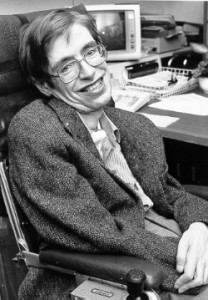
Stephen_Hawking.StarChild-208x300At the end of 1992 I was a finishing grad student, applying for postdocs. One of the places I applied was Cambridge, to Hawking’s group at DAMTP. There is a slight potential barrier for American students to travel to the UK for postdocs, so they like to get out ahead of things and offer jobs early. Unfortunately I was out of my office the day Hawking called to offer me a position. Fortunately, my future-Nobel-Laureate officemate was there, and he took the call. He explained that Stephen Hawking had called to offer me a job — I was thrilled about the offer, but understood “Hawking called” as metaphorical. But no, Brian later convinced me that it actually was Hawking on the other end of the line, which he described as a somewhat surreal experience. Of course after the initial introduction the phone gets handed over to someone else, but still.

Cambridge is one of the world’s best places to do theoretical physics, and I was sorely tempted, but I ended up going to MIT instead. Three years later, I went through the process again, as postdocs typically do. And again Cambridge offered me the job — and again, after a very tough decision, I said no, heading of the the ITP in Santa Barbara instead.

Up to this point I had never actually met Hawking in person, although I had been in the audience for one of his lectures. But every year he visits Caltech and Santa Barbara, so I finally got to be with him in the same place. The first time he visited he brought along a young grad student named Raphael Bousso, who has gone on to do quite well for himself in his own right. As a group of us went to lunch, I mentioned to Raphael that I had never said hi to Stephen in person, so I’d appreciate it if he would introduce us. But, I cautioned, I hope he wasn’t upset with me, because he had offered me a postdoc and I turned it down.

Raphael just laughed and said, “Don’t worry, there’s this one guy who he offered a postdoc to twice, and he turned it down both times!” So I had to explain that this guy was actually me. At which point Raphael ran up to Hawking, exclaiming “Stephen! Stephen, this is the guy — the one who turned down DAMTP for postdocs twice in a row!”

More here.

On Neutrinos and Angels

318468-PervezHoodbhoynewagain-1326035518-347-640x480Pervez Hoodbhoy in Tribune (Pakistan):

Speed of light issues have often moved sections of religious people in rather strange ways. Way back in 1973, as a young physics lecturer at Quaid-i-Azam University, I had been fascinated by the calculation done by the head of our department. Seeking the grand synthesis of science and faith, this pious gentleman — who left on his final journey last month — had published calculations that proved Heaven (jannat) was running away from Earth at one centimeter per second less than the speed of light. His reasoning centred around a particular verse of the Holy Quran that states worship on the night of Lailat-ul-Qadr (Night of Revelation) is equivalent to a thousand nights of ordinary worship. Indeed, if you input the factor of 1,000 into Einstein’s famous formula for time dilatation, this yields a number: one centimeter per second less than the speed of light!

These days the internet groans under the weight of claims that the Holy Quran had specified the speed of light 1400 years ago. Dr Mansour Hassab El Naby, said to be a physicist from Egypt, announces that according to his Quranic calculations, this speed is 299,792.5 kilometres per second. He even gives error bars! Another video gives a still more precise figure of 299792.458 km/sec. Given the unrestrained leaps of logic made by the authors, it is not surprising that they all arrive at more or less the same numbers.

Interested readers may also wish to visit an intricately-designed website that has clocked up over 750,000 visitors so far. Chockful of mathematical formulae, diagrams, and pictures, it starts from the premise that “angels are low density creatures” taking orders from a “Preserved Tablet” and says “the speed at which they commute to and from this Tablet turned out to be the known speed of light”. To enhance the visual impact, the website has a Java applet showing a white Caucasian scientist who moves his eyes up, down, and around in wondrous rapture. While doing so he sonorously pronounces — in what sounds like an Australian accent to me — that the extra space-time dimensions demanded by the physics of string theory are exactly those predicted in the Quran. The final conclusion: “Einstein’s theory of General Relativity proves the Quran right”.

So, What is a “Temporal Cloak”, Anyway?

Over at Skulls in the Stars (for Jonathan H and via Zite):

This week, the experimental realization* of a “space-time cloak” or “temporal cloak” by researchers at Cornell University has made national news. This novel device differs from the “invisibility cloaks” discussed previously on this blog in that it hides temporal events, not spatial objects. Loosely speaking, this has also been referred to as a “history editor”. Naturally, the discussion of “cloaking” has again brought out references to “Harry Potter cloaks” and other dramatic imagery; the reality is much more mundane, but still fascinating — and an amazing achievement. Let’s take a look at what was done, what was not done — and why it’s quite cool!

First, let’s get rid of some misconceptions that the terminology naturally brings to mind. The terms “space-time cloak” and “history editor” make it sound like the device is ripping a hole in the fabric of space-time itself — like a time machine equipped with a big eraser! This is definitely not what is happening here! There is no manipulation of time itself, but rather a manipulation of a beam of light to hide something that the light would otherwise detect.

It is difficult to come up with a simple analogy to explain what is really going on, but let us imagine a beam of light as a long moving train of hanging curtains, as illustrated below:

We might imagine that these curtains are at an assembly line and have recently been dyed, and are still wet (I told you, analogies for this phenomenon are tough!). We want to pass objects from one side of the curtains to another, but any attempt to simply push an object between them will mess up the dye and leave a mark.

Walter Benjamin on the 120th Anniversary of his Birth

193744519Avner Shapira in Ha'aretz:

If 2012 is the year our world comes to an end, as doomsayers predict, that will provide additional employment for the angel of history, who observes the past and the wreckage of humanity as described by Walter Benjamin in his essay “On the Concept of History.” But if the world and its inhabitants continue to exist, they will be able to observe, next July 15, the 120th anniversary of Benjamin's birth. His influence has only been growing in recent decades, and his writings are increasingly the inspiration for discussion and reconsideration.

The growing corpus of works about Benjamin is about to be augmented with the publication, in January, of a comprehensive study, “Walter Benjamin: A Philosophical Portrait,” by Prof. Eli Friedlander (Harvard University Press ). Friedlander, head of the Philosophy Department at Tel Aviv University, discusses Benjamin's approaches to concepts such as history, mythology, language, beauty and truth. His aim is to tie together the threads of thought spun by the philosopher, who committed suicide in 1940.

Rethinking the Growth Imperative

Pa77c_thumb3Kenneth Rogoff in Project Syndicate:

There is a certain absurdity to the obsession with maximizing long-term average income growth in perpetuity, to the neglect of other risks and considerations. Consider a simple thought experiment. Imagine that per capita national income (or some broader measure of welfare) is set to rise by 1% per year over the next couple of centuries. This is roughly the trend per capita growth rate in the advanced world in recent years. With annual income growth of 1%, a generation born 70 years from now will enjoy roughly double today’s average income. Over two centuries, income will grow eight-fold.

Now suppose that we lived in a much faster-growing economy, with per capita income rising at 2% annually. In that case, per capita income would double after only 35 years, and an eight-fold increase would take only a century.

Finally, ask yourself how much you really care if it takes 100, 200, or even 1,000 years for welfare to increase eight-fold. Wouldn’t it make more sense to worry about the long-term sustainability and durability of global growth? Wouldn’t it make more sense to worry whether conflict or global warming might produce a catastrophe that derails society for centuries or more?

Will Wilkinson in Big Think.