
Category: Recommended Reading
Guantánamo: Ten Years and Counting
David Cole in The Nation:

But in another way, Guantánamo is a deeper problem today than it ever was. No longer a temporary exception, it has become a permanent fixture in our national firmament. And although at one time we could blame President George W. Bush’s unilateral assertions of unchecked executive power for the abuses there, the continuing problem that is Guantánamo today is shared by all three government branches, and ultimately by all Americans. With President Obama’s signing of the National Defense Authorization Act (NDAA) on New Year’s Eve, the prison is sure to be with us—and its prisoners sure to continue in their legal limbo—for the indefinite future.
More here.
Thursday, January 12, 2012
A Monument to Forgetting
Our own Morgan Meis in the Virginia Quarterly Review:

It was an incredible event, for a country to lose so many of its top civilian and military leaders in a single blow like that. But these people were Polish after all, and in Poland, tragedies have a way of magnifying and expanding through history. The rest of the world was less aware, however, of the background history and thus less aware of just how strange an event that plane crash really was. You see, this was not the first time that the forests around Smolensk had claimed the lives of so many prominent Poles. It had all happened before. In shocking and unexpected ways, history was repeating itself.
More here.
A three-word definition of life
Carl Zimmer in Txchnologist:
Defining life poses a challenge that’s downright philosophical. There’s no ambiguity in looking for water, because we have a clear definition of it. That definition is the same whether you’re on Earth, on Mars, or in intergalactic space. It is the same whether you’re dealing with water as ice, liquid, or vapor. But there is no definition of life that’s universally agreed upon. When Portland State University biologist Radu Popa was working on a book about defining life, he decided to count up all the definitions that scientists have published in books and scientific journals. Some scientists define life as something capable of metabolism. Others make the capacity to evolve the key distinction. Popa gave up counting after about 300 definitions.
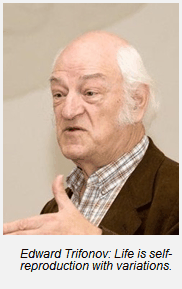
Trifonov acknowledges that each definition of life is different, but there’s an underlying similarity to all of them. “Common sense suggests that, probably, one could arrive to a consensus, if only the authors, some two centuries apart from one another, could be brought together,” he writes in a recent issue of the Journal of Biomolecular Structures and Dynamics (article PDF).
In lieu of resurrecting dead scientists, Trifanov analyzed the linguistic structure of 150 definitions of life, grouping similar words into categories. He found that he could sum up what they all have in common in three words. Life, Trifonov declares, is simply self-reproduction with variations.
More here.
Tricky mirror scene
EU on verge of abandoning hope for a viable Palestinian state
Donald MacIntyre in The Independent:

The report, approved by top Brussels officials, argues that EU support, including for a wide range of building projects, is now needed to protect the rights of “ever more isolated” Palestinians in “Area C”, a sector that includes all 124 Jewish settlements – illegal in international law – and which is under direct Israeli control. It comprises 62 per cent of the West Bank, including the “most fertile and resource rich land”.
With the number of Jewish settlers now at more than double the shrinking Palestinian population in the largely rural area, the report warns bluntly that, “if current trends are not stopped and reversed, the establishment of a viable Palestinian state within pre-1967 borders seem more remote than ever”.
The 16-page document is the EU's starkest critique yet of how a combination of house and farm building demolitions; a prohibitive planning regime; relentless settlement expansion; the military's separation barrier; obstacles to free movement; and denial of access to vital natural resources, including land and water, is eroding Palestinian tenure of the large tract of the West Bank on which hopes of a contiguous Palestinian state depend.
More here.
huxley hopped up
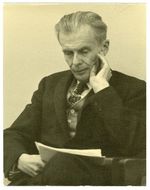
Between his 1932 vision of a sterile dystopia in Brave New World and the 1962 novel Island about a spiritual utopia, the author Aldous Huxley experienced two things; the Hindu religious philosophy known as Vedanta and psychedelic drugs. In Brave New World, people are addicted to Soma, a hallucinogenic that artificially simulates a kind of dull transcendent state, and so makes religion irrelevant. In Island, the Palanese (residents of Pala where the book takes place) ritually use the drug moksha for spiritual and mystical insights. It wasn’t that by the time he was writing Island Huxley no longer believed that civilization was potentially doomed to a homogenized over-indulgent consumer culture, but rather that there was another possibility for human destiny. Soon after writing Brave New World Huxley saw this other opportunity but believed it would take work, a disciplined and rigorous adherence to a spiritual ideal. By the time he got around to writing Island he was convinced there was a faster, less strenuous way to find the higher purpose of human consciousness: mescaline. Huxley had long been interested in the hallucinogenic properties of certain plants but it wasn’t until 1953 that he encountered the work of Humphry Osmond, a British psychiatrist who had set up shop at a mental hospital in Saskatchewan, Canada, and who was interested in the common features of hallucinogenic drug experiences and schizophrenia.
more from Peter Bebergal at The Revealer here.
Treasure Island!!!
There are times in life when one’s hand moves, with the autonomous drive of a divining rod, toward a book that is the very thing needed at that precise moment. Needed for what? Needed, one learns within a page or two, to be The Source, the new idea, the clear, firm, blessedly wakening voice that can save you. This is the choice made by the unnamed female narrator of Treasure Island!!!, a novel that chases with a high-held lantern its unpunctuated namesake, Robert Louis Stevenson’s Treasure Island. The first novel by seasoned short-fiction writer Sara Levine, Treasure Island!!! offers a wild, funny, rambunctiously surprising look at what happens when the very thing needed to shake up a life does its job far too well. When a trip to the library allows her searching grip to land on the spine of Treasure Island (“It’s classic. The gold letters say so.”), our girl is hopeless, hapless, and, at twenty-five, burrowing weakly into the sandy soil of postcollegiate living. Through TI, as the locals call the buccaneer-themed Las Vegas casino of the same name, the narrator discovers a way out of the doldrums and into a white-water adventure. Intrinsically, this isn’t a bad impulse, self-diagnosing and then medicating through fiction. Nonetheless, we are soon reminded to use even the mildest drugs with caution.
more from Alison Powell at the LA Review of Books here.
enthusiasms
W hen reading for relaxation, Mark Girouard explains in the introduction to this highly diverting collection of essays, “I have often come across something that has especially intrigued or irritated me: a clue that I wanted to follow up, a point that others seem to have overlooked, a misidentification that I long to correct, a neglected work that I would like to publicise, and so on”. Enthusiasms is the result of these promptings and is rather like a bumper issue of Notes and Queries. Is Arundel, rather than Carisbrooke, the setting for Charlotte Mew’s poem “Ken”? Is Edward Lear’s Yonghy-Bonghy-Bo really modelled on Oscar Wilde? These “literary excursions”, as he calls them – away-days from Girouard’s career as one of our leading architectural historians – sometimes turn out to be wild goose chases, but they are nonetheless entertaining for that. “It would be wearisome to go in any detail into my work in libraries, on the computer and in the National Archives, my trawling through Post Office directories, wills and censuses”, he writes about his attempts to uncover the identity of “Walter”, the anonymous author of My Secret Life (c.1882–94); but we are drawn into his dogged pursuit, which leads him to the streets of Camberwell in South London. If, as he at first deduces, Walter’s family house was on the corner of De Crespigny Terrace and Love Lane, then it is possible that the author’s real name was Horner. This all sounds too good to be true, and indeed it is: the essay is subtitled “a hunt but no kill”.
more from Peter Parker at the TLS here.
Tilda Swinton on Virginia Woolf’s Orlando
Tilda Swinton in The Telegraph:
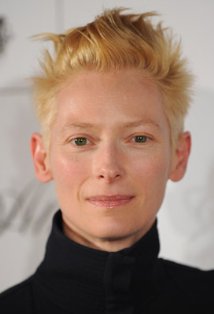
Virginia Woolf was the loyal daughter, not only of an erudite and distinguished biographer, but also of his library, her early dependence on which formed the foundation of her entire intellectual life. Her later biography of Roger Fry must have satisfied this debt in a quite particular way. But at this point she wanted to write freely – “wildly” – as an imaginative novelist, and Orlando gave her the chance to split the atom: a fantastical biography – inspired by a very real human being – but essentially a whim of imagination, a wild-goose chase. She called it her “writer’s holiday”. Vita Sackville-West was the intended recipient of “the longest love letter in the world”, as Sackville-West’s own son Nigel Nicholson described it. She was certainly its primary inspiration. Writing to her on the day of Orlando’s inception, Woolf asks: “Suppose Orlando turns out to be Vita… there’s a kind of shimmer of reality which sometimes attaches itself to my people, as the lustre on an oyster shell… shall you mind? Say yes or no.
More here.
Thursday Poem
The Coora Flower
Today I learned the coora flower
grows high in the mountains of Itty-go-luba Bésa.
Province Meechee.
Pop. 39.
Now I am coming home.
This, at least, is Real, and what I know.
It was restful, learning nothing necessary.
School is tiny vacation. At least you can sleep.
At least you can think of love or feeling your boy friend
ppppppppp against you
(which is not free from grief).
But now it's Real Business.
I am Coming Home.
My mother will be screaming in an almost dirty dress.
The crack is gone. So a Man will be in the house.
I must watch myself.
I must not dare to sleep.
by Gwendolyn Brooks
from Children Coming Home
The David Company, 1991
Evolution is written all over your face
From PhysOrg:
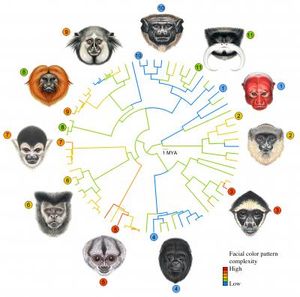
The life scientists divided each face into 14 regions; coded the color of each part, including the hair and skin; studied the patterns and anatomy of the faces; and gave each a “facial complexity” score. They studied how the complexity of primate faces evolved over time and examined the primates' social systems. To assess how facial colors are related to physical environments, they analyzed environmental variables, using the longitude and latitude of primates' habitats as a proxy for sun exposure and temperature. They also used statistical methods to analyze the evolutionary history of the primate groups and when they diverged from one another. “We found very strong support for the idea that as species live in larger groups, their faces become more simple, more plain,” said lead author Sharlene Santana, a UCLA postdoctoral scholar in ecology and evolutionary biology and a postdoctoral fellow with UCLA's Institute for Society and Genetics. “We think that is related to their ability to communicate using facial expressions. A face that is more plain could allow the primate to convey expressions more easily.
More here.
Wednesday, January 11, 2012
The Accidental Universe: Science’s Crisis of Faith

In the fifth century B.C., the philosopher Democritus proposed that all matter was made of tiny and indivisible atoms, which came in various sizes and textures—some hard and some soft, some smooth and some thorny. The atoms themselves were taken as givens. In the nineteenth century, scientists discovered that the chemical properties of atoms repeat periodically (and created the periodic table to reflect this fact), but the origins of such patterns remained mysterious. It wasn’t until the twentieth century that scientists learned that the properties of an atom are determined by the number and placement of its electrons, the subatomic particles that orbit its nucleus. And we now know that all atoms heavier than helium were created in the nuclear furnaces of stars.
The history of science can be viewed as the recasting of phenomena that were once thought to be accidents as phenomena that can be understood in terms of fundamental causes and principles. One can add to the list of the fully explained: the hue of the sky, the orbits of planets, the angle of the wake of a boat moving through a lake, the six-sided patterns of snowflakes, the weight of a flying bustard, the temperature of boiling water, the size of raindrops, the circular shape of the sun. All these phenomena and many more, once thought to have been fixed at the beginning of time or to be the result of random events thereafter, have been explained as necessary consequences of the fundamental laws of nature—laws discovered by human beings.
This long and appealing trend may be coming to an end. Dramatic developments in cosmological findings and thought have led some of the world’s premier physicists to propose that our universe is only one of an enormous number of universes with wildly varying properties, and that some of the most basic features of our particular universe are indeed mere accidents—a random throw of the cosmic dice. In which case, there is no hope of ever explaining our universe’s features in terms of fundamental causes and principles.
Braintrust: A Public Conversation about Morality and the Brain
A conversation with Patricia Churchland over at The Science Network:
The Far-Apart Artists
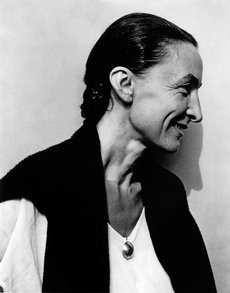
It is tempting to imagine Stieglitz as Pygmalion, with O’Keeffe groomed and marketed until her work sold for sufficiently high prices to make her, according to Barbara Buhler Lynes, “a millionaire in today’s dollars” by 1929. And yet, as one reads the letters and considers the shifting shapes of these complicated careers, one has the impression that it was Stieglitz, past fifty when they first met, who experienced the greater awakening. He felt a renewed sense of purpose in his self-consciously American gallery; at the same time, he rededicated himself to photography, embarking on an ambitious project of photographing cloud formations reminiscent of Constable’s studies. These he named “Equivalents,” suggesting that he was finding sublime metaphors in the sky. On one occasion, he bragged to the poet Hart Crane, with his customary grandiosity, that he had “photographed God.”
In a parallel undertaking, Stieglitz began to compile the series of over three hundred photographic images that comprised his “Portrait of O’Keeffe.” He photographed every part of her body, nude and variously clothed. In one intriguing letter, a meditation on an artist’s relation to her own hands, she tried to make sense of her hand holding one of Stieglitz’s photographs of her hand:
I wondered at my hand—my left one as I saw it on the last printed page of the last book—and my mind wandered to the prints of my hands—I moved to get up to look for them—No—The other hand reached for the book…. So I sat looking at the hand—then at them both—I’ve looked at them often today—they have looked so white and smooth and wonderful—I’ve wondered if they were really mine—
The cloud studies and the portraits intersected when Stieglitz titled a dramatic convolution of clouds, resembling a torso with open legs, Portrait of Georgia.
The Idea of Happiness
Ashis Nandy in Economic & Political Weekly:

However, I am not concerned here with comparative happiness or the methodology of studying happiness. I am concerned with the emergence of happiness as a measurable, autonomous, manageable, psychological variable in the global middle-class culture. And the two events can be read as parts of the same story. If the first factoid – discovery of happiness as a teachable discipline – suggests that in some parts of the world happiness is becoming a realm of training, guidance and expertise, the second reaffirms the ancient “self-consoling” “naïve” belief that you cannot always be happy just by virtue of being wealthy, secure or occupied. You have to learn to be happy.
Together they partly explain why clenched-teeth pursuit of happiness has become a major feature and a discovery of our times.
More here.
The Grammarian Was a He
Jessica Love in The American Scholar:
According to modern-day grammar books, “they” as a singular, gender-neutral pronoun (e.g., I saw someone, but I don’t think they saw me) is incorrect, since a plural pronoun cannot describe a singular referent. And so we have settled on the generic “he.” This is, we are told, the way things have always been—good enough for Jonathan Swift or Jane Austen.
Except that what was in fact good enough for Swift and Austen was “they.” As Ann Bodine argues in her 1975 article “Androcentrism in Prescriptive Grammar,” prior to the 19th century, “they” was commonly—and uncontroversially—used as a generic singular pronoun. Grammarians were the ones who inserted the generic “he” into English about 200 years ago in an effort to improve the language.
Bodine is skeptical that such logical improvements are either improvements or logical. She points out that although “they” does not agree with a singular, gender-neutral referent by the single feature of number, “he” also does not agree with its singular, gender-neutral referent by the single feature of gender. “A non-sexist ‘correction,’ ” she writes, “would have been to advocate ‘he or she,’ but rather than encourage this usage the grammarians actually tried to eradicate it also, claiming ‘he or she’ is ‘clumsy,’ ‘pedantic,’ or ‘unnecessary.’ Significantly, they never attacked terms such as ‘one or more’ or ‘person or persons,’ although the plural logically includes the singular more than the masculine includes the feminine.”
More here.
Brooklyn Qawwali Party plays Mustt Mustt
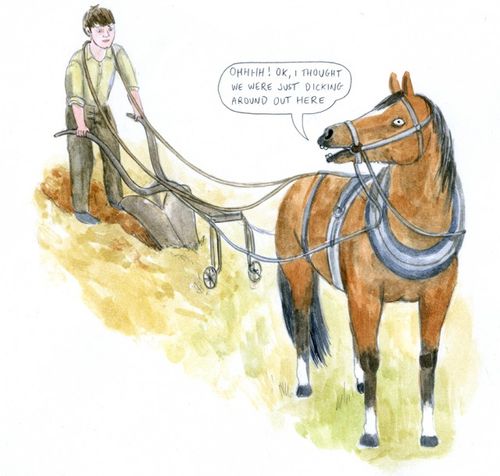
War Horse: An Illustrated Review
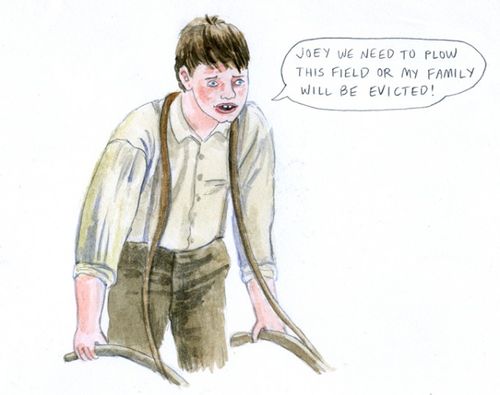
The Browser calls this “Arguably the best review ever. Certainly of “War Horse”, as filmed by Steven Spielberg. Possibly of any film. Or indeed anything else. Charming, concise, evocative.” Lisa Hanawalt in The Hairpin:
• The woman sitting in front of me keeps falling asleep and I want to yell “HEY SNORE HORSE” so bad it hurts.
• Spielberg made a big deal about casting an unknown actor as the main dude, but he's really just a hunk, a baby Casper Van Dien. He's good at running through fields and aiming wet looks at the horse.
• If you explain how important something is to a horse, it will understand you and do that thing!
More here.
Wednesday Poem
Chernobyl
No, child, not rain.
It was not rain fallen down
to make the mind go flying quick,
away, above the fields, to turn
the bodies of the people into ramshackle yards,
depositories of poison dressed as clouds. Say,
It was not the fault of sky.
It was not the plan of the weather.
The poison caught fire in Belarus. &, child,
I cannot forget your eyes,
how they sit like two grey stones
or ringed steel in the hollows of your face.
& your brain ballooning out
from its eggshell skull.
& your young boy legs
swelled large as legs of horses. Still,
you cannot walk, even when the heart sings, “Walk!”
Even when the heart sings, “Get up
from there.” Instead, the days push through you
like an oxygen tube
whose air blindly fumbles
through your body of arms
until deep in the bulrush
of your bones & curtains,
the heart shuts its red, fat eye,
& sends what’s left of you out: gentle-like
& finished into world.
by Aracelis Girmay
from Teeth
© 2007, Curbstone Press