How Doctors Die

Docs_die_grave_picKen Murray in Zocalo Public Square (via Kottke):

It’s not a frequent topic of discussion, but doctors die, too. And they don’t die like the rest of us. What’s unusual about them is not how much treatment they get compared to most Americans, but how little. For all the time they spend fending off the deaths of others, they tend to be fairly serene when faced with death themselves. They know exactly what is going to happen, they know the choices, and they generally have access to any sort of medical care they could want. But they go gently.

Of course, doctors don’t want to die; they want to live. But they know enough about modern medicine to know its limits. And they know enough about death to know what all people fear most: dying in pain, and dying alone. They’ve talked about this with their families. They want to be sure, when the time comes, that no heroic measures will happen—that they will never experience, during their last moments on earth, someone breaking their ribs in an attempt to resuscitate them with CPR (that’s what happens if CPR is done right).

Almost all medical professionals have seen what we call “futile care” being performed on people. That’s when doctors bring the cutting edge of technology to bear on a grievously ill person near the end of life. The patient will get cut open, perforated with tubes, hooked up to machines, and assaulted with drugs. All of this occurs in the Intensive Care Unit at a cost of tens of thousands of dollars a day. What it buys is misery we would not inflict on a terrorist. I cannot count the number of times fellow physicians have told me, in words that vary only slightly, “Promise me if you find me like this that you’ll kill me.” They mean it. Some medical personnel wear medallions stamped “NO CODE” to tell physicians not to perform CPR on them. I have even seen it as a tattoo.
steve jobs and the joseph stalin charm school

Image

It takes confidence to sit in front of an audience, armed with a few pages of notes and one glass of water, wearing clothes you may have slept in, using your rubbery face as your primary prop, to discuss warmly but ultimately damningly, for nearly two hours, a man you never met. A man thought of as a rare contemporary hero. A man who died five weeks earlier. What gives Mike Daisey, a veteran monologist, the confidence and endurance to perform The Agony and the Ecstasy of Steve Jobs daily is, I suspect, justice. The jumpy, chilling, riotous monologue has the expected: scenes from the life of Steve Jobs and Apple; hilarious set pieces about Daisey’s technology geekishness. But its heart lies in Daisey’s disillusionment from his “religion” of Apple after years researching how Apple products are made, most upsettingly by interviewing workers outside the Shenzhen, China factory of Foxconn, a major manufacturer of Apple products. Daisey witnessed the company that produced his objects of identity be ruthlessly indifferent to the lives of the workers making them. His indictment is personal, directed at Jobs, but it leaves no one innocent. After the performance, I needed to run an errand, to buy a toaster. But the stores—buying and selling—sickened me. Toast would have to wait.

more from 3QD friend Gary Sernovitz at n+1 here.

the must-have boson

189_science_elwes

In the next few months, scientists at the Large Hadron Collider at Cern may detect one of the fundamental building blocks of the universe: the elusive Higgs boson. The collider, one of the most ambitious machines ever built—which sends two beams of subatomic particles around an underground circuit 27km in circumference, to crash into each other at close to the speed of light—may already have given them the crucial data. The Swiss government asks Cern, the joint European research institution, to shut down the circuit in winter, to spare it the demand on the electricity grid; these cold months are used for analysing the torrent of data from the summer’s experiments. If scientists find the Higgs boson, then it will be one of the greatest advances ever in physics. The world’s attention—including that of the Nobel committee, will turn to, among others, Peter Higgs, 82, emeritus professor at the school of physics and astronomy at the University of Edinburgh. But if they don’t find the particle, the consequences could be even more interesting—as Peter Higgs explains in this interview for Prospect. The particle that he has argued must exist “plays such a role” in the modern theory of the structure of the physical world “that if you tried to modify the theory to take it out, the whole thing becomes nonsense.”

more from James Elwes at Prospect Magazine here.

life as a dark fairy tale

Silverstein-cover-3

“He wrote on everything,” says archivist Joy Kingsolver. She has pulled a flat box labeled “Work in Progress” down from a shelf, set it on a table, and—pushing her gold-rimmed glasses up the ridge of her nose—opened it to reveal a heap of scrap paper covered with narrow, urgent handwriting. “He wrote on menus, napkins, restaurant placemats, paperbacks. Anything that was available.” She leafs through the box and picks up a bank deposit slip. In the upper left-hand corner, it reads SHEL SILVERSTEIN in blocky type. A few lines of lyrics are scrawled across it: a quick sketch for a song—or maybe a poem—about a bank robbery. This little piece of paper is one of Joy’s favorite artifacts in the whole Silverstein Archive, a collection of the author’s manuscripts, sketches, demo recordings, and ephemera that she helps to oversee. “I imagine him standing in line at the bank, bored, and composing it,” she says. “He just continuously wrote and wrote and wrote. There’s a constant creative flow. It never seemed to stop.”

more from Delaney Hall at Poetry here.

Mohamed Hashem belongs in the same company as Havel and Hitchens

Boyd Tonekin in The Independent:

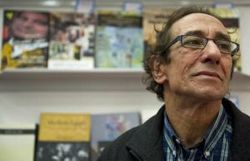
Arab-spring-frankfurt-book-fair-afp-543I first met Mohamed Hashem as, wreathed in smoke from his endless cigarettes, and holding a glass of red wine, he talked and joked among Cairo's writers and publishers at a party at the Nile Hilton – not much more than a stone's throw from Tahrir Square. Although only a few years back, it felt then as if Hashem – journalist and author turned fearless, pioneering publisher – still had a mountain to climb in his campaigns for freedom of thought and expression against Egypt's entwined establishments, religious and political alike.

Then came the revolution. The books and writers he championed through his independent house Dar Merit – the boldest in Egypt, committed to quality as much as liberty, and the imprint that launched the career of global bestseller Alaa Al-Aswany – did much more to prepare the ground for rapid change than any Facebook page or Twitter feed. But with this spring's triumph came new dangers. General Adel Emara of the ruling military council recently denounced Hashem as a “saboteur”. According to the general, he has used the Merit offices near Tahrir Square to “incite violence” – by distributing free food, head protection and gas masks to protesters! According to Hashem, an arrest warrant against him has been drawn up, though as I write the authorities have made no attempt to seize him.

More here.

The Grid at 200: Lines That Shaped Manhattan

From The New York Times:

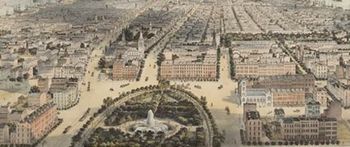
NyIn the old photograph, a lonely farmhouse sits on a rocky hill, shaded by tall trees. The scene looks like rural Maine. On the modern street, apartment buildings tower above trucks and cars passing a busy corner where an AMC Loews multiplex faces an overpriced hamburger joint and a Coach store. They are both the same spot. Not so long ago, all things considered, the intersection of Broadway and 84th Street didn’t exist; the area was farmland. “The Greatest Grid: The Master Plan of Manhattan, 1811-2011,” now at the Museum of the City of New York, unearths that 1879 picture of the Brennan Farm among other historic gems. The show celebrates the anniversary of what remains not just a landmark in urban history but in many ways the defining feature of the city. After all, before it could rise into the sky, Manhattan had to create the streets, avenues and blocks that support the skyscrapers. The grid was big government in action, a commercially minded boon to private development and, almost despite itself, a creative template. With 21st-century problems — environmental, technological, economic and social — now demanding aggressive and socially responsible leadership, the exhibition is a kind of object lesson.

Simeon De Witt, Gouverneur Morris and John Rutherfurd were entrusted with planning the city back in 1811. New York huddled mostly south of Canal Street, but it was booming, its population having tripled to 96,373 since 1790 thanks to the growing port. Civic boosters predicted that 400,000 people would live in the city by 1860. They turned out to be half-right. New York topped 800,000 before the Civil War. The planners proposed a grid for this future city stretching northward from roughly Houston Street to 155th Street in the faraway heights of Harlem. It was in many respects a heartless plan. There were virtually no parks or plazas. The presumption was that people would gravitate east and west along the numbered streets to the rivers when they wanted open space and fresh air, and not spend lots of time moving north or south. That partly explains why there were only a dozen avenues. In the abstract, the idea was really nothing revolutionary; grid plans went back to ancient Greece and Rome. But installing one in Manhattan was deeply subversive because, while still undeveloped, the island was already parceled into irregularly shaped, privately owned properties.

More here.

Monday, January 2, 2012

Sunday, January 1, 2011

Freakonomics: What Went Wrong?

Andrew Gelman and Kaiser Fung in American Scientist:

ScreenHunter_04 Jan. 01 23.53The nonfiction publishing phenomenon known as Freakonomics has passed its sixth anniversary. The original book, which used ideas from statistics and economics to explore real-world problems, was an instant bestseller. By 2011, it had sold more than four million copies worldwide, and it has sprouted a franchise, which includes a bestselling sequel, SuperFreakonomics; an occasional column in the New York Times Magazine; a popular blog; and a documentary film. The word “freakonomics” has come to stand for a light-hearted and contrarian, yet rigorous and quantitative, way of looking at the world.

The faces of Freakonomics are Steven D. Levitt, an award-winning professor of economics at the University of Chicago, and Stephen J. Dubner, a widely published New York–based journalist. Levitt is celebrated for using data and statistics to solve an array of problems not typically associated with economics. Dubner has perfected the formula for conveying the excitement of Levitt’s research—and of the growing body of work by his collaborators and followers. On the heels of Freakonomics, the pop-economics or pop-statistics genre has attracted a surge of interest, with more authors adopting an anecdotal, narrative style.

As the authors of statistics-themed books for general audiences, we can attest that Levitt and Dubner’s success is not easily attained. And as teachers of statistics, we recognize the challenge of creating interest in the subject without resorting to clichéd examples such as baseball averages, movie grosses and political polls. The other side of this challenge, though, is presenting ideas in interesting ways without oversimplifying them or misleading readers. We and others have noted a discouraging tendency in the Freakonomics body of work to present speculative or even erroneous claims with an air of certainty. Considering such problems yields useful lessons for those who wish to popularize statistical ideas.

More here.

An ambitious plan for curing cancer in a businesslike way is in the works

From The Economist:

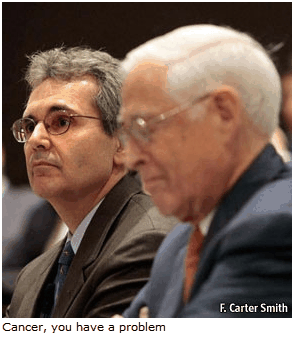
ScreenHunter_05 Jan. 02 00.00Dr DePinho is the new president of the MD Anderson Cancer Centre in Houston, Texas. (He took over in September, having previously headed the Belfer Institute, part of Harvard’s Dana-Farber Cancer Institute.) Mindful of his adopted city’s most famous scientific role, as home to Mission Control for the Apollo project, he says his own mission is akin to a moon shot. He aims to cure not one but five varieties of cancer. What he has not yet decided is: which five?

That it is possible to talk of curing even one sort of cancer is largely thanks to an outfit called the International Cancer Genome Consortium. Researchers belonging to this group, which involves 39 projects in four continents, are using high-throughput DNA-sequencing to examine 50 sorts of tumour. They are comparing the mutations in many examples of each type, to find which are common to a type (and thus, presumably, causative) and which are mere accidents. (The DNA-repair apparatus in malignant cells often goes wrong, so such accidents are common.)

The consortium’s work is progressing fast, and preliminary results for many tumours are already in. But such knowledge is useless unless it can be translated into treatment. That is where Dr DePinho comes in—for his career has taken him into the boardroom as well as the clinic.

More here.

Is this the twilight of blues music?

Howard Reich in the Chicago Tribune:

ScreenHunter_03 Jan. 01 23.38No musical genre goes away entirely. The devout still sing Gregorian chant — among the oldest known written scores — in select cathedrals. Guillaume de Machaut's 14th century motets turn up in performances of early music groups. Operettas by Franz Lehar, folk songs of Appalachia and even disco hits of the Bee Gees enjoy an afterlife in remote corners of our musical culture.

Ever since notes could be etched on paper, no beloved music has gone completely silent, especially since recorded technology emerged in the late 19th century. But some genres have become so peripheral to American lives as to be reduced to historical footnotes. Studied by academics, performed by die-hards and applauded by connoisseurs, they're forgotten by nearly everyone else.

This is where Chicago blues is headed. A once visceral, urgent, profoundly complex music that told the story of a people — and, in so doing, ricocheted around the world — is slipping from public embrace in its primary home, Chicago, and beyond.

More here.

The Joy of Quiet

Pico Iyer in The New York Times:

IyerABOUT a year ago, I flew to Singapore to join the writer Malcolm Gladwell, the fashion designer Marc Ecko and the graphic designer Stefan Sagmeister in addressing a group of advertising people on “Marketing to the Child of Tomorrow.” Soon after I arrived, the chief executive of the agency that had invited us took me aside. What he was most interested in, he began — I braced myself for mention of some next-generation stealth campaign — was stillness. A few months later, I read an interview with the perennially cutting-edge designer Philippe Starck. What allowed him to remain so consistently ahead of the curve? “I never read any magazines or watch TV,” he said, perhaps a little hyperbolically. “Nor do I go to cocktail parties, dinners or anything like that.” He lived outside conventional ideas, he implied, because “I live alone mostly, in the middle of nowhere.” Around the same time, I noticed that those who part with $2,285 a night to stay in a cliff-top room at the Post Ranch Inn in Big Sur pay partly for the privilege of not having a TV in their rooms; the future of travel, I’m reliably told, lies in “black-hole resorts,” which charge high prices precisely because you can’t get online in their rooms.

Has it really come to this?

In barely one generation we’ve moved from exulting in the time-saving devices that have so expanded our lives to trying to get away from them — often in order to make more time. The more ways we have to connect, the more many of us seem desperate to unplug. Like teenagers, we appear to have gone from knowing nothing about the world to knowing too much all but overnight. Internet rescue camps in South Korea and China try to save kids addicted to the screen. Writer friends of mine pay good money to get the Freedom software that enables them to disable (for up to eight hours) the very Internet connections that seemed so emancipating not long ago.

More here.

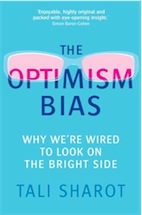
The Optimism Bias

From The Guardian:

The-Optimism-Bias-Why-were-wWe like to think of ourselves as rational creatures. We watch our backs, weigh the odds, pack an umbrella. But both neuroscience and social science suggest that we are more optimistic than realistic. On average, we expect things to turn out better than they wind up being. People hugely underestimate their chances of getting divorced, losing their job or being diagnosed with cancer; expect their children to be extraordinarily gifted; envision themselves achieving more than their peers; and overestimate their likely life span (sometimes by 20 years or more). The belief that the future will be much better than the past and present is known as the optimism bias. It abides in every race, region and socioeconomic bracket. Schoolchildren playing when-I-grow-up are rampant optimists, but so are grown-ups: a 2005 study found that adults over 60 are just as likely to see the glass half full as young adults.

You might expect optimism to erode under the tide of news about violent conflicts, high unemployment, tornadoes and floods and all the threats and failures that shape human life. Collectively we can grow pessimistic – about the direction of our country or the ability of our leaders to improve education and reduce crime. But private optimism, about our personal future, remains incredibly resilient. A survey conducted in 2007 found that while 70% thought families in general were less successful than in their parents' day, 76% of respondents were optimistic about the future of their own family. Overly positive assumptions can lead to disastrous miscalculations – make us less likely to get health checkups, apply sunscreen or open a savings account, and more likely to bet the farm on a bad investment. But the bias also protects and inspires us: it keeps us moving forward rather than to the nearest high-rise ledge.

More here.

Sunday Poem

November
.
After three days of steady rain –
over two inches said the radio –
I follow the example of monks
who write by a window, sunlight on the page.
.
Five times this morning,
I loaded a wheelbarrow with wood
and steered it down the hill to the house,
and later I will cut down the dead garden
.
with a clippers and haul the soft pulp
to a grave in the woods,
but now there is only
my sunny page which is like a poem
.
I am covering with another poem
and the dog asleep on the tiles,
her head in her paws,
her hind legs played out like a frog.
.
How foolish it is to long for childhood,
to want to run in circles in the yard again,
arms outstretched,
pretending to be an airplane.
.
How senseless to dread whatever lies before us
when, night and day, the boats,
strong as horses in the wind,
come and go,
.
bringing in the tiny infants
and carrying away the bodies of the dead.
.
.
by Billy Collins
from Sailing Alone Around the Room

Saturday, December 31, 2011

Progressives and the Ron Paul fallacies

Glenn Greenwald in Salon:

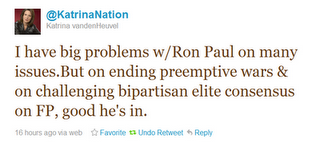
The Ron Paul candidacy, for so many reasons, spawns pervasive political confusion — both unintended and deliberate. Yesterday, The Nation‘s long-time liberal publisher, Katrina vanden Heuvel, wrote this on Twitter:

Paul

That’s fairly remarkable: here’s the Publisher of The Nation praising Ron Paul not on ancillary political topics but central ones (“ending preemptive wars & challenging bipartisan elite consensus” on foreign policy), and going even further and expressing general happiness that he’s in the presidential race. Despite this observation, Katrina vanden Heuvel — needless to say — does not support and will never vote for Ron Paul (indeed, in subsequent tweets, she condemned his newsletters as “despicable”). But the point that she’s making is important, if not too subtle for the with-us-or-against-us ethos that dominates the protracted presidential campaign: even though I don’t support him for President, Ron Paul is the only major candidate from either party advocating crucial views on vital issues that need to be heard, and so his candidacy generates important benefits.

Whatever else one wants to say, it is indisputably true that Ron Paul is the only political figure with any sort of a national platform — certainly the only major presidential candidate in either party — who advocates policy views on issues that liberals and progressives have long flamboyantly claimed are both compelling and crucial. The converse is equally true: the candidate supported by liberals and progressives and for whom most will vote — Barack Obama — advocates views on these issues (indeed, has taken action on these issues) that liberals and progressives have long claimed to find repellent, even evil.