“Time Cloak” Created; Can Make Events Disappear

Time-cloak-light-spectrum_46524_600x450Scientists have made a hole in time. Brian Handwerk over at National Geographic News:

Einstein's theories of relativity suggest that gravity can cause time to slow down. Now scientists have demonstrated a way to stop time altogether—or at least, to give the appearance of time stopping by bending light to create a hole in time.

The new research builds on recent demonstrations of “invisibility cloaks” that can make objects seem to disappear by bending waves of visible light.

The idea is that, if light moves around an object instead of striking it, that light doesn't get scattered and reflected back to an observer, making the object essentially invisible.

Now Cornell University scientists have used a similar concept to create a hole in time, albeit a very short one: The effect lasts around 40 trillionths of a second.

“Imagine that you could divert light in time—slow it down, speed it up—so that you create a gap in the light beam in time,” said study co-author and Cornell physicist Alex Gaeta.

“In this case, any event that occurs at that instant of time won't lead to scattering of light. It appears as if the event never occurred.”

(Related: “Space-Time Cloak Possible, Could Make Events Disappear?”)

For example, Gaeta said, think of laser beams crisscrossing a museum display to protect priceless works of art.

“You have a laser beam and a detector set up to detect when all of a sudden the beam is broken and there is no light. So if you pass through that beam, an alarm goes off,” he said.

“But what if a device would perhaps speed up a portion of the beam and slow down another portion of it so that there is an instant of time with no beam. You could pass through, and then [on the other side of the event] the device would do the opposite—speed up the part that had been slowed and slow the part that had been sped up,” he explained.

“That would put the beam of light back together, so to speak, so the detector would never recognize that anything had happened.”

Mapping the Republic of Letters

Via Maria Popova over at the awesome Brain Pickings, who spotlights 7 important digitization projects in the Humanities: this one Mapping the Republic of Letters is wonderful:

When early modern scholars (from the Renaissance through the Enlightenment) described the broadest community to which they belonged, they most frequently called this international community of scholars the “Republic of Letters.”

The Republic of Letters was an intellectual network initially based on the writing and exchange of letters that emerged with and thrived on new technologies such as the printing press and organized itself around cultural institutions (e. g. museums, libraries, academies) and research projects that collected, sorted, and dispersed knowledge. A pre-disciplinary community in which most of the modern disciplines developed, it was the ancestor to a wide range of intellectual societies from the seventeenth-century salons and eighteenth-century coffeehouses to the scientific academy or learned society and the modern research university. Forged in the humanist culture of learning that promoted the ancient ideal of the republic as the place for free and continuous exchange of knowledge, the Republic of Letters was simultaneously an imagined community (a scholar’s utopia where differences, in theory, would not matter), an information network, and a dynamic platform from which a wide variety of intellectual projects – many of them with important ramifications for society, politics, and religion – were proposed, vetted, and executed.

Ron Paul’s Strange Bedfellows

Katha pKatha Pollitt in The Nation:

Ron Paul has an advantage over most of his fellow Republicans in having an actual worldview, instead of merely a set of interests—he opposes almost every power the federal government has and almost everything it does. Given Washington’s enormous reach, it stands to reason that progressives would find targets to like in Paul’s wholesale assault. I, too, would love to see the end of the “war on drugs” and our other wars. I, too, am shocked by the curtailment of civil liberties in pursuit of the “war on terror,” most recently the provision in the NDAA permitting the indefinite detention, without charge, of US citizens suspected of involvement in terrorism. But these are a handful of cherries on a blighted tree. In a Ron Paul America, there would be no environmental protection, no Social Security, no Medicaid or Medicare, no help for the poor, no public education, no civil rights laws, no anti-discrimination law, no Americans With Disabilities Act, no laws ensuring the safety of food or drugs or consumer products, no workers’ rights. How far does Paul take his war against Washington? He wants to abolish the Federal Aviation Authority and its pesky air traffic controllers. He has one magic answer to every problem—including how to land an airplane safely: let the market handle it.

It’s a little strange to see people who inveigh against Obama’s healthcare compromises wave away, as a detail, Paul’s opposition to any government involvement in healthcare. In Ron Paul’s America, if you weren’t prudent enough or wealthy enough to buy private insurance—and the exact policy that covers what’s ailing you now—you find a charity or die. And if civil liberties are so important, how can Paul’s progressive fans overlook his opposition to abortion and his signing of the personhood pledge, which could ban many birth control methods? Last time I checked, women were half the population (the less important half, apparently). Technically, Paul would overturn Roe and let states make their own laws regulating women’s bodies, up to and including prosecuting abortion as murder. Add in his opposition to basic civil rights law—he maintains his opposition to the 1964 Civil Rights Act and opposes restrictions on the “freedom” of business owners to refuse service to blacks—and his hostility to the federal government starts looking more and more like old-fashioned Southern-style states’ rights. No wonder they love him over at Stormfront, a white-supremacist website with neo-Nazi tendencies. In a multiple-choice poll of possible effects of a Paul presidency, the most popular answer by far was “Paul will implement reforms that increase liberty which will indirectly benefit White Nationalists.” And let’s not forget his other unsavory fan base, Christian extremists who want to execute gays, adulterers and “insubordinate children.” Paul’s many connections with the Reconstructionist movement, going back decades, are laid out on AlterNet by Adele Stan, who sees him as a faux libertarian whose real agenda is not individualism but to prevent the federal government from restraining the darker impulses at work at the state and local levels.

Hoberman Is Out at Village Voice, and Curtain Drops on an Era

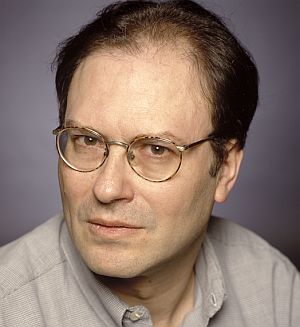
030408hobermanStupid, stupid, stupid Village Voice. David Carr in the NYT's Media Decoder:

On Wednesday, two long-running trends in journalism came together in a single layoff: Jim Hoberman, a senior film critic at the Village Voice since 1988, was let go, yet another instance of the The Voice taking aim at a veteran — and presumably well paid — employee. He joins a list of longtime Voice writers who have been laid off.

Mr. Hoberman’s departure is yet another instance of a critic leaving the ranks of full-time movie criticism, a trend that has been like the unfolding of a large, slow-moving disaster movie.

For many years, The Voice had a cultural reach beyond New York, setting an agenda in music, film and arts criticism. But like many weeklies — and newspapers in general — The Voice came under significant financial pressure in the last decade as the print business faltered in the competition with the Web over advertising dollars.

Belt-tightening has become an almost annual ritual at the weekly after The Voice, along with other publications, was bought bought by New Times, a chain of weeklies. What then became Village Voice Media was formed in the belief that a combined group of weeklies could use a national advertising approach to resist the broader economic tide.

Thursday Poem

Nervous System

Make a list
of everything that’s
ever been

on fire –

Abandoned cars
Trees
The sea

Your mother burned down to the skeleton

so she could come back, born back from her bed, and walk
around the
……….. house again, exhausted
……….. in slippers

What else?

Your brain
Your eyes
Your lungs

*

When you look down
inside yourself
what is there?

You are a walking bag of surgical instruments
shining from the inside out

and that’s just
today

Tomorrow it could be different

When I think of the childhood inside me I think of sunlight
dying on
……….. a windowsill

The voices of my friends
in the sunlight

All of us running around
outside our
deaths

*

Someone is here
to see you
again

Someone has come a long way with their arms out in front of
them
………. like a child

walking down a hallway
at night

Make room for them –
they’re very tired

I wish I could look down past the burning chandelier inside
me

where the language begins
to end
and

down


by Michael Dickman
from The End of The West

Copper Canyon Press 2009

Nice Nihilism

Richard Marshall in 3ammagazine:

THE ATHEIST'S GUIDE TO REALITY by Alex Rosenberg

Theatheistsguide‘This is a book for atheists’. Rosenberg makes this explicit in the preface. Atheism requires a whole view of the world based on science that is ‘demanding, rigorous, breathtaking.’ There’s a feeling you get when reading Rosenberg that he’s fed up with atheists who avoid facing up to the big persistent questions such as: ‘what is the nature of reality, the purpose of the universe, and the meaning of life? Is there any rhyme or reason to the course of human history? Why am I here? Do I have a soul, and if so, how long will it last? What happens when we die? Do we have free will? Why should I be moral? What is love, and why is it usually inconvenient?’ Rosenberg demands that atheists just stop arguing with theists, for one because ‘contemporary religious belief is immune to rational objection’ but also because it eats into the time atheists should be taking to work through the implications of their own worldview. Atheists need to spend more time getting to grips with what they should know about the reality we inhabit because science reveals it is ‘stranger than even many atheists recognise.’

So he’s just not all that interested in going over the old arguments that keep getting reheated by lazy atheists who haven’t any news but do have a publishing deal. The God Delusion, God Is Not Great, Letter To A Christian Nation and so on are dull books that probably make more sense in the USA than from where I am but they bring nothing new to the table, play to a home crowd and change no one’s mind. Rosenberg is doing something different from being a cheerleader. He’s bringing a few home truths to the table. I suspect some atheists will not be able to swallow them whole and that just like the theists will also find ways of ducking the question.

More here.

Deep-Brain Stimulation Found to Fix Depression Long-Term

From Scientific American:

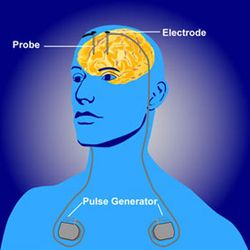
Deep-brain-stimulation-found_1Deep depression that fails to respond to any other form of therapy can be moderated or reversed by stimulation of areas deep inside the brain. Now the first placebo-controlled study of this procedure shows that these responses can be maintained in the long term. Neurologist Helen Mayberg at Emory University in Atlanta, Georgia, followed ten patients with major depressive disorder and seven with bipolar disorder, or manic depression, after an electrode device was implanted in the subcallosal cingulate white matter of their brains and the area continuously stimulated. All but one of twelve patients who reached the two-year point in the study had completely shed their depression or had only mild symptoms. For psychiatrists accustomed to seeing severely depressed patients fail to respond—or fail to maintain a response—to antidepressant or cognitive therapy, these results seem near miraculous.

More here.

Wednesday, January 4, 2012

Remembering Michael Dummett

Stone-michael-dummett-blog427Simon Critchley, Hilary Putnam, Tim Crane, Timothy Williamson, Dorothy Edgington, Crispin Wright, and others remember Dummett in the NYT. Simon Critchley:

As is well known, professional philosophers are broadly and lamentably divided into two opposed camps: analytic and Continental. It is Dummett’s conviction that the only way to reestablish communication amongst philosophers is by going back to the historical and conceptual point where those traditions divided. This is Dummett’s strategy in his hugely influential 1993 book “Origins of Analytical Philosophy.” Dummett recounts the history of analytic philosophy from Frege onwards in the laudable hope that a clearer understanding of the philosophical past will be a precondition for some sort of mutual comprehension between contemporary philosophers. He wrote:

I do not mean to pretend that one should pretend that philosophy in the two traditions is basically the same; obviously that would be ridiculous. We can re-establish communication only by going back to the point of divergence. It’s no use now shouting across the gulf. It is obvious that philosophers will never reach agreement. It is a pity, however, if they can no longer talk to one another or understand one another. It is difficult to achieve such understanding, because if you think people are on the wrong track, you may have no great desire to talk with them or to take the trouble to criticize their views. But we have reached a point at which it is as if we’re working in different subjects.

Dummett was a wonderful example of how philosophers might behave towards each other and usefully engage with the public realm. His death is a massive loss.

The Reactionary Mind

Lilla_1-011212_jpg_230x420_q85Mark Lilla reviews Corey Robin's The Reactionary Mind: Conservatism from Edmund Burke to Sarah Palin, in the NYRB:

Robin is a lumper, an über-lumper, which may please his beleaguered readers on the left, but makes his entire enterprise incoherent. He fails to see that it is based on a glaring fallacy of composition: he posits a class, isolates a characteristic of one of its members, and then ascribes that characteristic to every member of the class. Catholic reactionary Joseph de Maistre and George W. Bush are both on the right in Robin’s scheme; following his logic, since Maistre spoke flawless French, Bush must too. Which would be some national secret. Yet that’s exactly how Robin proceeds, until he has corralled everyone he doesn’t like into a pen and labeled them all conservatives and reactionaries and right-wingers, terms he fails to distinguish. (More on that in a moment.)

But if there’s anything we’ve learned over the past century, it is that la destra è mobile. The right used to be isolationist, then became internationalist, and to judge by recent Republican debates may be tiptoeing back to isolationism again. In the 1970s, if you thought that public schools were being used for social indoctrination, that power over them should be decentralized, and that children would be better off learning at home, that put you on the far left. Today those views put you on the right. Are we to think that these shifts were only about how best to keep power from the people?

Alex Gourevitch responds to Lilla, in Jacobin:

[T]he aim of Robin’s book is to connect an account of the essence of conservatism to the obvious fact of its historical variation. That is why the book is mostly composed of a series of chapters examining concrete, historical examples—Hobbes, Burke, Rand, neoconservatism. The organizing assumption of these chapters is that conservatism revolves around a political principle that is consistent yet adaptive, an idea that is sensitive to context and capable of producing a wide array of concrete, if conflicting, prescriptions. The common principle binding together strange bedfellows is the rejection of the quest for equal freedom: “Conservatism is the theoretical voice of this animus against the agency of the subordinate classes. It provides the most consistent and profound argument as to why the lower orders should not be allowed to exercise their independent will, why they should not be allowed to govern themselves or the polity.”

That conservatism is reaction makes it no less principled. Rather, reaction is inscribed in the political principle itself. But as reaction conservatism will assume a variety of forms depending on the particular struggle it is mobilizing against: “If conservatism is a specific reaction to a specific movement of emancipation, it stands to reason that each reaction will bear the traces of the movement it opposes….Not only has the right reacted against the left, but in the course of conducting its reaction, it also has consistently borrowed from the left. As the movements of the left change—from the French Revolution to abolition to the right to vote to the right to organize to the Bolshevik Revolution to the struggles for black freedom and women’s liberation—so do the reactions of the right.”

The End of the Nuclear Renaissance

Solar_panelsJohn Quiggin in The National Interest:

In 2011, nuclear power ceased to be a serious option for meeting the world’s energy needs, and solar photovoltaics (PV) finally became an option worth noting.

The “solar vs. nuclear” dispute had been largely symbolic for several decades. After rapid growth in the 1960s and 1970s, new installations of nuclear power came to a grinding halt. This was partly a result of safety fears created by the accidents at Three Mile Island and Chernobyl. Economic factors were even more significant. Far from being too cheap to meter, nuclear power turned out to be far more expensive than its main rival, coal, primarily because of unpredictable capital costs and generally high interest rates.

As a result, since 1977, when the River Bend plant in Louisiana commenced construction, not one new nuclear-power plant has been ordered and completed in the United States. The situation in most other developed countries was similar. Only where some combination of military funding and concern about national self-sufficiency allowed for substantial subsidies was there any new construction of nuclear-power plants.

Meanwhile, the case of PV was reminiscent of what used to be said about Brazil as a country of enormous but permanently unfulfilled promise—that is, it seemed PV was doomed always to be the energy source of an ever-receding future. Despite decades of promising press releases from research labs, the average price of PV cells at the beginning of the twenty-first century was more than $5 per installed watt, leading to a cost of more than 50c per kilowatt hour. The global installed base of PV totaled a mere 1.4 gigawatts (GW), about equal to one medium-sized coal or nuclear plant.

Daron Acemoglu on Inequality

In_0A FiveBooks interview, over at The Browser:

What do non-economists think, in your view?

My caricature of a layman’s view is that inequality is an indication of something that is failing in society. If a group of people used to earn twice as much as another group of people, and then, over 20 years, that ratio increases to four, that’s something that is concerning and might indicate a failure of social policy. My own view is a mixture of the two. If you’re looking at the average college graduate versus the average high school graduate, or the 90th versus the 10th percentile, then the things economists have emphasised – technology, globalisation, offshoring and outsourcing, changes in the supply of skills, et cetera – have played a major role and probably tell the bulk of the story. But if you want to understand the top inequality, why the top 0.1% – even more than what the 1% Occupy Wall Streeters are talking about – have been earning such huge amounts, then really you have to think about the social policy aspects of it and the politics of it. There is perhaps some sort of failure in how our system is working.

In terms of the actual figures, how bad is inequality in the US and, say, the UK?

Based on the work of Thomas Piketty and Emmanuel Saez, if you look from the 1950s up to the end of the 1970s, the share of total national income in the US earned by the richest 1% was about 10%. If you look at the 2000s, it’s well over 20%. It rose up to nearly 25% and then came down. In the UK it’s at about 15%, up from 7% or so. The trend towards inequality over the last 50 years has been very similar in the Anglo-Saxon economies, though it’s important to say that it’s not just an Anglo-Saxon phenomenon. There are similar trends in many economies, though there are a few that haven’t experienced it to any notable extent.

Such as?

Finland and Sweden. Even there, there’s been an increase in the top percentile share – which is not so surprising, given they have many multinational companies where the CEOs make a lot of money – but the increase is much less pronounced. The share of the national income that the top one percentile captures is significantly lower.

Not So Nasty, Brutish, and Short: Steven Pinker’s Good News

Claude S. Fischer in the Boston Review:

PinkerPinker makes three strategic moves in explaining the drop in violence. First, he considers every kind of violence—even metaphoric violence, such as racist attitudes—as a single entity. Thus, he needs all expressions of violence, from genocide to spanking, to decline, and all of these declines need to follow a common story line. A more timid author might have been satisfied with explaining just the decline of, say, war. And a more timid author might worry that a nuclear exchange between India and Pakistan would destroy the whole analysis overnight.

Second, Pinker takes on the burden of explaining every fluctuation and nuance in violence trends. He doesn’t let a jitter in his graph line go as random noise. The notable exception seems to be those two quasi-random world wars. Yet, elsewhere, he cannot help but try to make sense of each with ad hoc accounts, for instance by digging into Hitler’s personality. Total explanation is a heavy task.

Third, Pinker tries to sweep together virtually every explanation for violence or peace that anyone has ever proposed—and more—including schooling, brain lesions, humanitarianism, secularism, feminization, codes of honor, commerce, book publishing, and even the Great Man Theory of history (Hitler, Stalin, Mao). Some explanations he dismisses—for example, that affluence reduced the motives for violence, that nuclear weapons ended large-scale war, and that Roe v. Wade lowered crime rates in America. But his remaining list of explanations is long and eclectic.

More here.

Remembering Salmaan Taseer

Pervez Hoodbhoy in the Express Tribune:

ScreenHunter_09 Jan. 04 14.09Governor Salmaan Taseer died at the hands of a religious fanatic on January 4 last year. Fearlessly championing a deeply unpopular cause, this brave man had sought to revisit the country’s blasphemy law which, as he saw it, was yet another means of intimidating Pakistan’s embattled religious minorities. This law — which is unique in having death as the minimum penalty — would have sent to the gallows an illiterate Christian peasant woman, Aasia Bibi, who stood accused by her Muslim neighbours after a noisy dispute. Taseer’s publicly-voiced concern for human life earned him 26 high-velocity bullets from one of his security guards, Malik Mumtaz Qadri. The other guards watched silently.

In this long, sad, year more has followed. Justice Pervez Ali Shah, the brave judge who ultimately sentenced Taseer’s murderer in spite of receiving death threats, has fled the country. Aasia Bibi is rotting away in jail, reportedly in solitary confinement and in acute psychological distress. Shahbaz Taseer, the governor’s son, was abducted in late August — presumably by Qadri’s sympathisers. He remains untraceable. Shahbaz Bhatti, another vocal voice against the blasphemy law, was assassinated weeks later on March 2.

Political assassinations occur everywhere. But the Pakistani public reaction to Taseer’s assassination horrified the world. As the news hit the national media, spontaneous celebrations erupted in places; a murderous unrepentant mutineer had been instantly transformed into a national hero.

More here.

Fixing Congress and Finding Peace: An Interview with Jack Abramoff

Matt Bieber in The Wheat and the Chaff:

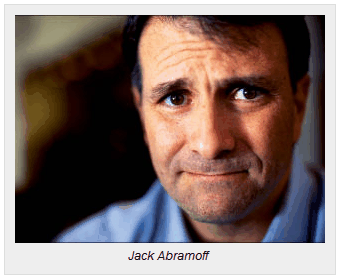
ScreenHunter_08 Jan. 04 13.52I met Abramoff three weeks ago at an event at Harvard Law School. (He was there to discuss his experience in Washington with Lawrence Lessig in a cool new forum called “In the Dock.”). As he entered the room, a funny silence overcame the room. It was as if the entire audience was simultaneously answering the question we’d all been chewing over: how to demonstrate our distance and disapproval while maintaining the decorum appropriate to the setting? Sure, we’ve filled a large auditorium on a weeknight to hear what this guy has to say, but he’s not getting any damn applause.

But over the next hour and a half, the strangest thing happened – Abramoff won over the crowd. He didn’t try to defend himself at all. Instead, he was almost preternaturally humble, telling in-your-face stories about the naked corruption he’d been a part of. It was all very matter-of-fact: I was able to do these things because I wanted to win, and because everyone did it, and because I didn’t recognize some basic ethical rules. And then I went to prison and had some insights that all of you probably take for granted.

As the event went along, the handful of stone-throwers in the audience seemed more and more out of place. Someone would ask a barbed question – basically, How can you be such a giant asshole? – and you could feel the crowd sigh. He knows, buddy.

By the end, I liked him.

More here.

New year, new science

From Nature:

RobotRobots, brains or graphene?

Six visionary research proposals will vie for huge grants from the European Commission’s Future and Emerging Technologies Flagship scheme. The two winning projects, to be announced in the latter half of the year, will each receive €1 billion (US$1.3 billion) over the next decade. In the running are projects on graphene, the promising new form of carbon; robot companions for the lonely; planetary-scale modelling of human activities and their environmental impact; autonomous energy-scavenging sensors; ways to apply research data more efficiently in health care; and a supercomputer simulation of the brain.

A useful synthetic genome

Synthetic biologists can build entire genomes from scratch, working from natural models, and they can also rewire the genetic circuitry of living things. But so far, no one has united the two approaches: Craig Venter’s synthetic genome of 2010 was cribbed wholesale from a bacterium and contained no new genetic circuitry beyond a DNA watermark. Might 2012 see the first really useful artificial genome?

More here.

The ABCs of 2012

Randy Rieland in Smithsonian:

Electric-car-abcs-2012It’s customary this time of year to write paeans to the past 12 months and get all mushy about things you’d pretty much forgotten. But we don’t need that, right? We’re all forward-thinkers here, aren’t we? So I’ve created an alphabetical list of things you’ll likely hear about more often in the months ahead. At the very least, you’ll have some new words to drop into conversations at the New Year’s Eve party to show how much you’re already plugged into next year. Here you go, the ABC’s of 2012 (Part I):

Augmented reality: Sure, it’s been around awhile, dating back to when yellow ”first-down” lines were first overlaid on football fields for games on TV. But using apps to layer virtual information over a real-world environment—think reviews that pop up on your screen when you focus your phone on the restaurant–is about to go mainstream. Coming soon: Google Goggles, glasses which will give the person wearing them all kinds of info about what they’re looking at.

Biometrics: There are so many things besides your sparkling wit that make you who you are–your DNA, iris scans, voice patterns or facial features—and the science of using them to identify you is getting more and more James Bondian. Now IBM is predicting that within a few years, we won’t need passwords, even at the ATM.

Electric cars: The truth is, there’s been nowhere near an electric car boom. So far Nissan has sold only 20,000 of its all-electric Leafs worldwide and Chevy fell short of its goal of selling 10,000 of its hybrid plug-in Volts this year. But Ford, Honda and Toyota all plan to launch electric vehicles in 2012 and Nissan announced this fall that, along with scientists at Kansai University in Japan, it had developed the technology to fully charge an electric car in only 10 minutes.

More here.

Tuesday, January 3, 2012

Richard Dawkins’s Afterword in Lawrence Krauss’s A Universe From Nothing

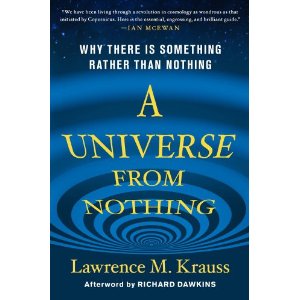
51PmTWxG57L._SL500_AA300_From Dawkins's website (pdf here):

Nothing expands the mind like the expanding universe. The music of the spheres is a nursery rhyme, a jingle to set against the majestic chords of the Symphonie Galactica. Changing the metaphor and the dimension, the dusts of centuries, the mists of what we presume to call “ancient” history, are soon blown off by the steady, eroding winds of geological ages. Even the age of the universe, accurate—so Lawrence Krauss assures us—to the fourth signi!cant !gure at 13.72 billion years, is dwarfed by the trillennia that are to come.

But Krauss’s vision of the cosmology of the remote future is paradoxical and frightening. Scienti!c progress is likely to go into reverse. We naturally think that, if there are cosmologists in the year 2 trillion “#, their vision of the universe will be expanded over ours. Not so—and this is one of the many shattering conclusions I take away on closing this book. Give or take a few billion years, ours is a very propitious time to be a cosmologist. Two trillion years hence, the universe will have expanded so far that all galaxies but the cosmologist’s own (whichever one it happens to be) will have receded behind an Einsteinian horizon so absolute, so inviolable, that they are not only invisible but beyond all possibility of leaving a trace, however indirect. They might as well never have existed. Every trace of the Big Bang will most likely have gone, forever and beyond recovery. The cosmologists of the future will be cut off from their past, and from their situation, in a way that we are not.

India Fares Poorly in Global Learning Study

52a47824-2a78-11e1-a10a-000b5dabf613Prashant K. Nanda in Live Mint (via Marginal Revolution, where Tyler Cowen offers some thoughts on the results):

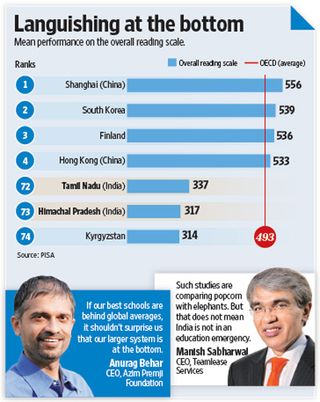
A global study of learning standards in 74 countries has ranked India all but at the bottom, sounding a wake-up call for the country’s education system. China came out on top.

It was the first time that India participated in the Programme for International Student Assessment (PISA), coordinated by the Paris-based Organisation for Economic Co-operation and Development (OECD). India’s participation was in a pilot project, confined to schools from Tamil Nadu and Himachal Pradesh.

The findings are significant because they come at a time when India is making a big push in education and improving the skills of its workforce. If the results from the two states hold good for the rest of the country, India’s long-term competitiveness may be in question.

Tamil Nadu and Himachal Pradesh traditionally rank high on human development parameters and are considered to be among India’s more progressive states. The India Human Development Report 2011, prepared by the Institute of Applied Manpower Research (IAMR), categorized them as “median” states, putting them significantly ahead of the national average. IAMR is an autonomous arm of the Planning Commission.

For literacy, Himachal Pradesh ranked 4 and Tamil Nadu 11 in the National Family Health Survey released in 2007.

Yet, in the PISA study, Tamil Nadu ranked 72 and Himachal Pradesh 73, just ahead of Kyrgyzstan in mathematics and overall reading skills. The eastern Chinese metropolis of Shanghai topped the PISA rankings in all three categories—overall reading skills, mathematical and scientific literacy.