the Good and the True

Sartre-che

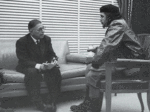
Alain Badiou is the latest in the line of French philosophy professors who have had global greatness thrust upon them: 25 of his books have appeared in English since 1999, along with dozens of works of eulogy and exposition. Badiou, now in his seventies, still hankers for “the truth of May ’68,” and refers to himself, in a rare flash of humour, as “the last communist.” But in one respect at least, he defies the stereotype: he is a Mr Valiant-for-Truth, a believer in invariant eternal verities, and a born-again Platonist, committed to philosophy as “the discipline of the concept,” and mathematics as the revelation of reality. He is thus an implacable opponent of all the language-obsessed relativisms which, in his opinion, have sapped the vigour of the west from the pre-Socratics to the present. If all this has passed you by, you may be tempted by the latest outing for Badiou in English: a collection of essays and reviews from the past 40 years, surveying French philosophy since the salad days of Sartre (The Adventure of French Philosophy, Verso). But Badiou’s reverence for philosophy as a “universal aim of reason” may keep getting in your way. Back in the 1970s he denounced the whole spectrum of French philosophers—from “anarcho-desirers” at one end to renegade left-opportunists at the other—as “charlatans” and “bourgeois impostors,” and age has not cooled his vehemence: throughout this book he is to be observed dissing his colleagues from a very great height.

more from Jonathan Rée at Prospect Magazine here.
library music

Article_zoladz

Library music (sometimes referred to as “production music” or “stock music”) generally refers to music that has been composed and recorded for commercial purposes and which is licensed not through the composer but the library for which it has been recorded. This means it is much easier and cheaper to use in a movie or TV show than a hit song, which requires copyright clearance from the songwriter and record label, and, in some cases, separate clearances depending on the countries in which the work will be screened. Library music cuts out the middleman, but it also means that most of it can be licensed to any number of projects, so occasionally while scanning through the Killer Tracks archives I’d get this uncanny “Where have I heard that before?” twinge, until I realized it was from, say, a local furniture commercial, or maybe the corporate-diversity video my colleagues and I sat through last week. For anyone who keeps up with pop culture, browsing through certain corners of the Killer Tracks catalog is like traipsing through a bizarre shadow world full of easily identifiable doppelgängers.

more from Lindsay Zoladz at The Believer here.

Monday, July 2, 2012

Perceptions

Joe-Biel_106

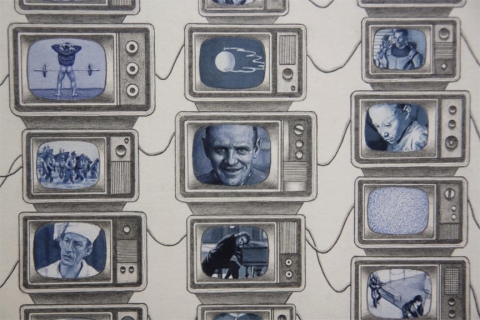
Joe Biel. Veil. (Work in Progress) – section of 12 foot wide wall.

And further detail:

Joe-Biel_110

“Leah Ollman wrote in the Los Angeles Times about Joe Biel’s panoramic drawing of 1,124 tiny (from a thumbnail to a postage stamp) televisions — each TV set with a meticulously rendered image on-screen. The drawing stretches 12 feet across the wall. Drawn from the artist’s collection of more than 5,000 images, the range of subjects span from a glimpse of Elvis to a Velázquez portrait — from Stalin to Dorothy’s ruby slippers. The banal and generic images are deliberately mixed with the iconic and personally significant.”

Morte here and here.

Sunday, July 1, 2012

Physics heavies, including Peter Higgs, invited to CERN press conference on Wednesday, leading to widespread excitement that the Higgs Boson has been definitively discovered

Rob Cooper in the Daily Mail:

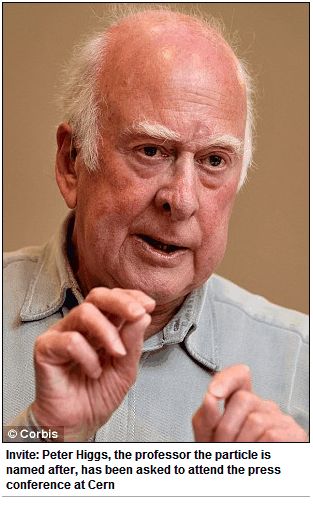
ScreenHunter_10 Jul. 02 14.05Peter Higgs, the Edinburgh University emeritus professor of physics that the particle is named after, is among those who have been called to the press conference in Switzerland.

The management at Cern want the two teams of scientists to reach the 'five sigma' level of certainty with their results – so they are 99.99995 per cent sure – such is the significance of the results.

Tom Kibble, 79, the emeritus professor of physics at Imperial College London, has also been invited but is unable to attend.

He told the Sunday Times: 'My guess is that is must be a pretty positive result for them to be asking us out there.'

The Higgs boson is regarded as the key to understanding the universe. Physicists say its job is to give the particles that make up atoms their mass.

Without this mass, these particles would zip though the cosmos at the speed of light, unable to bind together to form the atoms that make up everything in the universe, from planets to people.

The collider, housed in an 18-mile tunnel buried deep underground near the French-Swiss border, smashes beams of protons – sub-atomic particles – together at close to the speed of light, recreating the conditions that existed a fraction of a second after the Big Bang.

If the physicists’ theory is correct, a few Higgs bosons should be created in every trillion collisions, before rapidly decaying.

More here. More about the Higgs here, here, and here.

“Miss Holocaust Survivor” – A Bizarre Celebration of Beauty

Samira Shackle in New Statesman – read it to believe it:

HolocaustpageantSo a rather unusual beauty pageant in Israel this week has caused some controversy. Fourteen women, aged between 74 and 97, competed for the title of “Miss Holocaust Survivor”. Whittled down from 300 entrants, each of the women had survived the horrors of World War II.

Certainly, it jars to think of judging ageing women who have endured so much on the basis of their appearance. Critics said that the contest was macabre and offensive, while the cosmetics company recruited to dress the women for the pageant was accused of using the survivors for a cheap marketing stunt. Pageant organisers Shimon Sabag responded that it was a “celebration of life” and that just ten per cent depended on appearance, with women being judged also on their stories of survival and their contribution to their local communities.

More here.

Failed Index

A Rebuttal to Foreign Policy's Failed States Index for 2012:

Failed statesWe at Africa is a Country think Foreign Policy and the Fund for Peace should either radically rethink the Failed States Index, which they publish in collaboration each year, or abandon it altogether. We just can't take it seriously: It's a failed index.

This year, pro forma, almost the entire African continent shows up on the Failed States map in the guiltiest shade of red. The accusation is that with a handful of exceptions, African states are failing in 2012. But what does this tell us? What does it actually mean? Frankly, we have no idea. The index is so flawed in its conception, so incoherent in its structuring criteria, and so misleading in its presentation that from the perspective of those who live or work in those places condemned as failures, it's difficult to receive the ranking as anything more than a predictable annual canard issued from Washington, D.C. against non-Western — and particularly African — nations.

…The golden principle by which this muddle is to be marshaled oh-so-objectively into a grand spectrum of state failure coefficients is apparently the idea of “stability.” But is it really? Well, if you're an Arab Spring country, then yes, it's the “instability” of revolution or popular revolt that has put you in the red this year. Sorry about that. But if you're North Korea (the paradigmatic failed state in the U.S. imagination — hence why Zimbabwe is often branded “Africa's North Korea”), it's because you're far too stable. If stability is the key to all this, and yet there's an imperative for places like North Korea still to be ranked as failures, then we're in trouble. The cart has long ago overtaken the horse. It would be very difficult indeed to conceive of a more stable form of rule than having power descend smoothly down three generations of the same family over six decades and more (perhaps the Bushes will pull off something like this one day).

Read the rest here.

My Dear Governess: the Letters of Edith Wharton to Anna Bahlmann

From New Statesman:

EdithAround 1908, Henry James wrote to a young man he knew: “You have made friends with Edith Wharton. I congratulate you. You may find her difficult, but you will never find her stupid and you will never find her mean.” This quotation appears in most Wharton biographies and many of James and now returns in this volume of letters edited by Irene Goldman-Price. (Goldman-Price somewhat surprisingly chooses to quote from Percy Lubbock’s ­version of the letter in his Portrait of Edith Wharton (1947), which changes the final clause to: “You will find nothing stupid in her and nothing small” – Lubbock was presumably quoting from memory.) Readers interested in Wharton’s very interesting life do not lack for opportunities to learn about her: she wrote an autobiography, A Backward Glance, in 1934; she has been the subject of three major biographies in the past 40 years; and a selection of her voluminous correspondence appeared in 1989. Wharton led an increasingly public existence as the grande dame of American letters in the first half of the 20th century but documentation of her early years has been patchy. To a great extent, biographers have had to rely on A Backward Glance, in which she describes growing up in the “old New York” of the 1870s and 1880s.

Then, in 2009, an unexpected treasure trove appeared at auction: Anna Catherine Bahl­mann, who became Wharton’s governess in 1874 and was her companion and secretary until Bahlmann’s death in 1916, had kept all 135 of Wharton’s letters to her over 40 years. No one else knew of the letters’ existence and the archive is of real significance to Wharton scholarship. The majority of the Bahlmann correspondence was written before 1900, the year that Wharton’s first novel was published.

More here.

A Quiet Revolution by Leila Ahmed

From The Guardian:

An-Egyptian-woman-in-full-007During the first half of the 20th century, millions of Muslim women decided to abandon the head coverings their mothers had used; in the second half of the century, millions of Muslim women resumed wearing the veil. How and why these fluctuations of personal habit affected so many across the Muslim world is the question Leila Ahmed sets herself. She focuses on Egypt, which was a key influence in both the unveiling and the veiling, to trace the many meanings which this piece of cloth has acquired. It's an acute study of how issues of political power and empire interact with women's own claims to autonomy within families and communities. Ahmed beds her analysis into the wider political currents of Egypt without ever losing sight of women's own interpretations of what they were doing and why.

What adds force to the analysis is the sense that the book has been a journey of personal discovery for Ahmed, a Harvard academic. She grew up in Cairo in the 1940s, and was raised by a generation of women who never wore the veil; she absorbed from them the assumption that the veil was backward, a restriction of female autonomy. Like many Muslim women of her generation, the veil's reappearance has been shocking, unexpected and regarded as a step backwards. Writing the book has forced her to reassess such assumptions, and come to a new, more positive understanding of the veil.

More here.

Laughter

What is laughter? What is laughter?

It is God waking up! O it is God waking up!

It is the sun poking its sweet head out

From behind a cloud

You have been carrying too long,

Veiling your eyes and heart.

It is Light breaking ground for a great Structure

That is your Real body – called Truth.

It is happiness applauding itself and then taking flight

To embrace everyone and everything in this world.

Laughter is the polestar

Held in the sky by our Beloved,

Who eternally says,

“Yes, dear ones, come this way,

Come this way towards Me and Love!

Come with your tender mouths moving

And your beautiful tongues conducting songs

And with your movements – your magic movements

Of hands and feet and glands and cells – Dancing!

Know that to God's Eye,

All movement is a Wondrous Language,

And Music – such exquisite, wild Music!”

O what is laughter, Hafiz?

What is this precious love and laughter

Budding in our hearts?

It is the glorious sound

Of a soul waking up!

by Hafiz
from I Heard God Laughing – Renderings
of Hafiz by Daniel Ladinsky

Is Family Dinner Overrated?

From Ann Meier and Kelly Musick in the NYTimes:

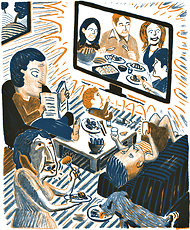
FamilydinnerDozens of studies in the past decade have found that teenagers who regularly eat dinner with their families are healthier, happier, do better in school and engage in fewer risky behaviors than teenagers who don’t regularly eat family dinners. These findings have helped give dinnertime an almost magical aura and have led to no small amount of stress and guilt among busy moms and dads.

But does eating together really make for better-adjusted kids? Or is it just that families that can pull off a regular dinner also tend to have other things (perhaps more money, or more time) that themselves improve child well-being?

More here.

Higgs boson rumours fly as Cern prepares to announce latest results

Alok Jha in The Guardian:

Simulated-collision-of-pr-008As soon as scientists at Cern revealed that they would host a seminar on 4 July to announce the latest results from its two main Large Hadron Collider (LHC) experiments, Atlas and CMS, physicists and bloggers started guessing. Would they announce the long-awaited discovery of the Higgs boson, a find that would be sure to trigger a raft of Nobel prizes and launch a new era of physics?

In December last year, Cern scientists glimpsed something that looked like it might be a Higgs boson in their data, but the results were not conclusive enough to be formally called a discovery. But now hopes are high.

“We now have more than double the data we had last year,” said Sergio Bertolucci, Cern's director for research and computing. “That should be enough to see whether the trends we were seeing in the 2011 data are still there, or whether they've gone away. It's a very exciting time.”

Even if the scientists next week report the signal for a new type of particle, it will take time to convince the scientific community that it is indeed the Higgs boson, or whether it is something else, perhaps something even more exotic that opens the door to new theories of physics.

More here.

The case for a world republic

Tad Daley in Bulletin of the Atomic Scientists:

0804756325Lawrence Wittner's 2009 book, Confronting the Bomb: A Short History of the World Nuclear Disarmament Movement, has an overarching message that will surprise even nuclear policy experts, because Wittner starts with an incontrovertible historical fact almost wholly forgotten today: For several years after Hiroshima, the ultimate aspiration of the disarmament crowd was not just to eliminate nuclear weapons, but to create a federal republic of the world to control them. Though world government did not come to pass, the movement had a vital impact, from the Truman administration's first major nuclear initiatives through the Reagan years. Is democratic federal world government desirable and achievable? If not, is there an alternative world order that might eliminate war and standing militaries from the human condition? These sorts of questions are conspicuous only by their complete absence from the contemporary policy debate.

More here.

The Ultimate Counterfeiter Isn’t a Crook—He’s an Artist

David Wolman in Wired:

Ff_counterfeiter_fOn a bright May afternoon in 2007, a German artist and printmaker named Hans-Jürgen Kuhl took a seat at an outdoor café directly opposite the colossal facade of the Cologne Cathedral. He ordered an espresso and a slice of plum cake, lit a Lucky Strike, and watched for the buyer. She was due any minute. Kuhl, a lanky 65-year-old, had to remind himself that he was in no rush. He’d sold plenty of artwork over the years, but this batch was altogether different. He needed to be patient.

Tourists milled about the platz in front of the cathedral, Germany’s most visited landmark, craning their necks to snap pictures of the impossibly intricate spires jutting toward the heavens. Kuhl knew those spires well. He had grown up in Cologne and painted the majestic cathedral countless times.

On the other side of a low brick wall surrounding the café, Kuhl finally spotted her. Tall, blond, and trim, Susann Falkenthal looked about 30. As was the case during their previous meetings, she wore practical shoes, an unremarkable blouse and pair of pants, and little makeup. Kuhl thought her plain look was something of a contradiction for a businesswoman who drove a black BMW convertible, but no matter.

More here.

Saturday, June 30, 2012

The Perfect Listen

Marc Hirsh on one of his music listening rituals, over at NPR:

FionaappleBut for all the romanticizing of the first time we hear an album or a song, that's almost never the moment of its crucial impact. That's not really how music works, not if it can actually hold up beyond that first listen. Unlike books, movies or plays (and television, to a lesser extent), recorded music is consumed repetitively. It's usually anywhere between the second and fifth listen that fragments that maybe weren't evident on first glance suddenly come at you or your brain makes a connection that could only have been made indirectly. That's when a song start to mean something to you.

Of course, there's something to be said about hearing a song and instantly connecting to it; that experience is just as valid as any, and it's certainly happened to me countless times. But that's precisely an experience, a one-off. The songs that are important to us are more like objects or possessions. They aren't bound by any one moment but instead continue to exist as time trundles ahead.

More here.

Super-Dreams of an Alternate World Order

01COMICS2-popup-v2Manohla Dargis and A. O. Scott discuss the meaning of superhero movies, in the NYT:

MANOHLA DARGIS On one level the allure of comic book movies is obvious, because, among other attractions, they tap into deeply rooted national myths, including that of American Eden (Superman’s Smallville); the Western hero (who’s separate from the world and also its savior); and American exceptionalism (that this country is different from all others because of its mission to make “the world safe for democracy,” as Woodrow Wilson and, I believe, Iron Man, both put it). Both Depression babies, Superman and Batman, were initially hard-boiled types, and it’s worth remembering that the DC in DC Comics was for Detective Comics. Since then the suits have largely remained the same even as the figures wearing them have changed with their times. Every age has the superhero it wants, needs or deserves.

Comic book movies are also fun (except when they’re not) and often easy viewing (except when they make your head hurt). They’re also blunt: A guy in a unitard pummels another guy — pow! — and saves the day, the girl and the studio. I like some comic-book movies very much, dislike others. But as a film lover I am frustrated by how the current system of flooding theaters with the same handful of titles limits my choices. (According to boxofficemojo.com “The Avengers” opened on 4,349 screens in the United States and Canada, close to 1 in 10.) The success of these movies also shores up a false market rationale that’s used to justify blockbusters in general: that is, these movies make money, therefore people like them; people like them, therefore these movies are made.

SCOTT And yet these stories do have some appeal, beyond the familiarity of the characters and the relentlessness of the marketing campaigns. As you suggest, they strike mythic, archetypal chords, and cater to a persistent hunger for large-scale, accessible narratives of good and evil.

It’s telling that Hollywood placed a big bet on superheroes at a time when two of its traditional heroic genres — the western and the war movie — were in eclipse, partly because they seemed ideologically out of kilter with the times.

A President Speaks Out on Immigration

WilsonNo doubt you have been disappointed in some of us. Some of us are very disappointing. No doubt you have found that justice in the United States goes only with a pure heart and a right purpose, as it does everywhere else in the world. No doubt what you have found here did not seem touched for you, after all, with the complete beauty of the ideal which you had conceived beforehand. But remember this: If we had grown at all poor in the ideal, you brought some of it with you. … And if some of us have forgotten what America believed in, you, at any rate, imported in your own hearts a renewal of the belief. That is the reason that I, for one, make you welcome. … You dreamed dreams of what America was to be, and I hope you brought the dreams with you. No man that does not see visions will ever realize any high hope or undertake any high enterprise. Just because you brought dreams with you, America is more likely to realize dreams such as you brought. You are enriching us if you came expecting us to be better than we are.

—Woodrow Wilson, to 4,000 newly naturalized citizens, Philadelphia, May 10, 1915

Read the backstory by Patricia O'Toole at The American Scholar.

The Secret History of the Chief Justice’s Obamacare Decision

John Fabian Witt in Balkinization:

220px-BrandeislThe story begins in 1933, when depression-fueled unemployment rates hit an all-time high of 25 percent. Progressive reformers, including Wisconsin’s influential husband-and-wife reformers Elizabeth and Paul Raushenbush, were desperately casting about for a constitutional basis for national unemployment insurance. Action at the state level was paralyzed because no one state seemed able to adopt an expensive insurance plan without driving employers into neighboring states. But action at the federal level seemed impossible, too, because the conservative Supreme Court seemed unlikely to allow the Congress to enact a comprehensive unemployment system as a regulation of interstate commerce.

That’s where Brandeis comes in. Elizabeth was the justice’s daughter, and when she and her husband visited with him in his summer cottage in Massachusetts, Brandeis suggested a novel solution to the constitutional dilemma: the tax power, he told them, would offer a constitutionally sound footing for the vast social insurance system they were contemplating.

Four years later, Brandeis was a decisive vote in the sharply divided 5-4 decision in Stewart Machine Co. v. Davis, upholding the unemployment insurance provisions of the Social Security Act over the dissent of the four conservative justices, who were known collectively as the “Four Horsemen of the Apocalypse.” Brandeis’s tax theory had become the foundation of the new American social insurance state.

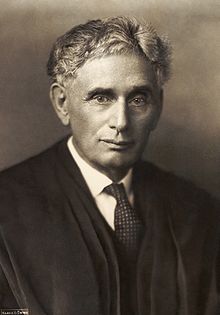
More here. [Photo shows Louis Brandeis.]