More Splintered Than Common Sense

As a layman, I would now say, I think we have it. It’s an historic milestone today.
I think we can all be proud and happy. —CERN director-general Rolf-Dieter Heuer,
upon discovery of the long sought-after Higgs Boson, 4/7/2012

Having heard hints
of a never-before-seen particle
my day becomes new
the blue day is further fractured

What were small thoughts become
more pint-sized then the nonsense
of politicians: smaller even
than the bits of stained tile mosaic
under my feet beneath
a urinal

I’m told this is the much-sought-after
Higgs boson I’ve been chasing
my whole life, looking for it between
the pillows of my couch where I
often find keys and nickels or dimes.
Hope surged when I heard the news
my tomatoes perked green
their leaves and tiny blossoms
pulling-in new knowledge
and light

Scientists muse this particle
could be a new force of nature,
beyond sex perhaps;
maybe greater than greed

Who knows what new brick of the cosmos
they’ve found in their accelerator
in unexpected bumps in jets
of colliding particles noted
while they sipped Starbucks
as the white dust of a sugared torus
settled upon the lapels of their lab coats
and the macro-world fragmented
simultaneously with the micro
into something even more splintered
than common sense
.

by Jim Culleny, 4/7/12
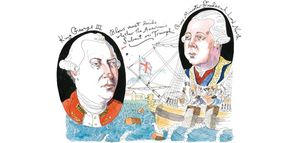
Myths of the American Revolution

John Ferling in Smithsonian:

MythWe think we know the Revolutionary War. After all, the American Revolution and the war that accompanied it not only determined the nation we would become but also continue to define who we are. The Declaration of Independence, the Midnight Ride, Valley Forge—the whole glorious chronicle of the colonists’ rebellion against tyranny is in the American DNA. Often it is the Revolution that is a child’s first encounter with history. Yet much of what we know is not entirely true. Perhaps more than any defining moment in American history, the War of Independence is swathed in beliefs not borne out by the facts. Here, in order to form a more perfect understanding, the most significant myths of the Revolutionary War are reassessed.

I. Great Britain Did Not Know What It Was Getting Into

In the course of England’s long and unsuccessful attempt to crush the American Revolution, the myth arose that its government, under Prime Minister Frederick, Lord North, had acted in haste. Accusations circulating at the time—later to become conventional wisdom—held that the nation’s political leaders had failed to comprehend the gravity of the challenge. Actually, the British cabinet, made up of nearly a score of ministers, first considered resorting to military might as early as January 1774, when word of the Boston Tea Party reached London. (Recall that on December 16, 1773, protesters had boarded British vessels in Boston Harbor and destroyed cargoes of tea, rather than pay a tax imposed by Parliament.) Contrary to popular belief both then and now, Lord North’s government did not respond impulsively to the news. Throughout early 1774, the prime minister and his cabinet engaged in lengthy debate on whether coercive actions would lead to war. A second question was considered as well: Could Britain win such a war?

More here.

Wednesday Poem

The Page is a Landscape

I place a few shrubs in the south, (close
to my chest). Further north on a random
white hill, a young woman from the past
sits and plucks petals
from a daisy she picked very near where
the pen touches now.

It’s not easy to contain all one sees. The eye-
fan trembles from strain
and sun. The greatest temptation
is to abandon everything and slide into silence
like a dune, toward oblivion
and I would have unless I had known
the page would not disappear.

This is how we live. Dark
or discovered, by turns. You, me, the bastard
page, beloved, a reminder not to leave,
and the young woman too (grown, meanwhile,
and more beautiful) who has finished plucking flower petals
and floats gently now
between the lines –

her arms spread wide, hair
breathing in the blue afternoon light.
Don’t worry. She
stays.

by Lyor Shternberg
from The Page is a Landscape
publisher: Hakibbutz Hameuchad, Tel Aviv, 2004
translation: Lisa Katz
first published on Poetry International, 2012

The longest and most expensive hunt in the history of science

Adam Mann in Wired:

AtlasginterPrepare the fireworks: The discovery of the Higgs boson is finally here. Early in the morning on July 4, physicists with the Large Hadron Collider at CERN announced they have found a new particle that behaves similarly to what is expected from the Higgs.

“As a layman, I would now say, I think we have it,” said CERN director-general Rolf-Dieter Heuer. “It’s a historic milestone today. I think we can all be proud, all be happy.” Both CMS and ATLAS, the two main LHC Higgs-hunting experiments, are reporting a boson that has Higgs-like properties at a mass of 125 gigaelectronvolts (GeV) with a 5-sigma significance, meaning they are 99.999 percent confident of its existence.

Though CERN scientists are making sure to be cautious about over-interpreting their data, the results are impressive and historic, and today will likely go down as the day the Higgs discovery was announced.

First hypothesized in the 1960s, the Higgs boson is the final piece of the Standard Model, the physics framework explaining the interactions of all known subatomic particles and forces. The Higgs has been the subject of an extensive two-decade search, first at the European Large Electron-Positron Collider, then the Tevatron at Fermilab in Illinois, and finally at the LHC. Finding the Higgs within the predicted energy range is a major vindication for the Standard Model.

“I never expected this to happen in my lifetime and shall be asking my family to put some champagne in the fridge,” physicist Peter Higgs, the particle’s namesake who first theorized the existence of the particle, said in a statement.

More here. The official press release from CERN is here.

the boson man

_57377272_013519349-1

Professor Higgs has something of a reputation for being a recluse. It’s undeserved. In person he’s affable and approachable. He lives quietly in Edinburgh’s New Town but can often be spotted in the capital’s concert halls and museums. He’s in his eighties now, a grandfather, and retired from his role as Professor Emeritus at Edinburgh University. As such it’s not unreasonable if he chooses to spend most of his time out of the public eye. Professor Peter Higgs inside the Large Hadron Collider tunnel at CERN Professor Peter Higgs inside the Large Hadron Collider tunnel at CERN, Geneva A colleague screens his emails, of which there are plenty. Some come from present day theoretical physicists, others from non-scientists with – to put it diplomatically – unconventional theories on life, the Universe and everything. Also to be filtered: dozens of interview requests from the world’s media. He accepts only a few because it would be impossible to accept them all.

more from Ken Macdonald at the BBC here.

chatting with László

Krasznahorkai-interview

I’m personally involved in the apocalypse… It’s interesting how your relationship to that changes in the course of your life. You think about it most when you’re young, particularly in connection with death, because you still have a certain courage that you’re going to lose when your own death is getting closer. Later you’re just afraid. When I was young, I didn’t feel the sanctity of birth. I tended to consider birth as the starting point of a journey toward failure, and I’d sadly look out the window for days on end into this grey light that was all that had been given to me. Anything that could arouse compassion had a great impact on me. I was particularly responsive to those aspects of reality and the arts that reflected sadness, the unbearable, the tragic. And I didn’t know what to do with anything positive or joyful. Happiness bothered me.

more from an interview with László Krasznahorkai at The Quarterly Conversation here.

perry anderson on gandhi

Mahatma-gandhi-pictures

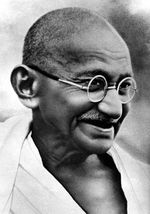
The composition of Gandhi’s faith, Tidrick has shown, was born of a cross between a Jain-inflected Hindu orthodoxy and late Victorian psychomancy, the world of Madame Blavatsky, theosophy, the planchette and the Esoteric Christian Union. The two were not unconnected, as garbled ideas from the former – karma, reincarnation, ascetic self-perfection, fusion of the soul with the divine – found occult form in the latter. Little acquainted with the Hindu canon itself in his early years, Gandhi reshaped it through the medium of Western spiritualisms of the period. His one aim in life, he decided, was to attain moksha: that state of perfection in which the cycle of rebirth comes to an end and the soul accedes to ultimate union with God. ‘I am striving for the Kingdom of Heaven, which is moksha,’ he wrote, ‘in this very existence.’ The path towards it was ‘crucifixion of the flesh’, without which it was impossible to ‘see God face to face’ and become one with him. But if such perfection could be attained, the divine would walk on earth, for ‘there is no point in trying to know the difference between a perfect man and God.’ Then there would be no limit to his command of his countrymen: ‘When I am a perfect being, I have simply to say the word and the nation will listen.’

more from Perry Anderson at the LRB here.

Sean Carroll is Live-Blogging the Higgs Seminar from CERN

Sean is at CERN right now. The seminar has started and you can follow what's happening live here.

You can also watch the live webcast directly from the seminar here. (It's quite technical.)

UPDATE: Here is the last part of the live-blogging (local Geneva time given here):

10:40 am (Sean): Personal editorializing by me: we’ve found the Higgs, or at least a Higgs. Still can’t be sure that it’s just the vanilla Standard Model Higgs. The discrepancies aren’t quite strong enough to be sure that they really represent beyond-Standard-Model physics… but it’s a strong possibility.

Fortunately, we have a great accelerator working at full speed, and much more data to come! A proud moment for everyone who has worked to get us to this point.

10:37 am (Mark): So we have a five-sigma result from ATLAS as well! This was well-worth getting up for, if only to take part, at great distance, in the joyous applause at this slide.

10:38 am (John): BOTH experiments have a significantly enhanced rate for gamma gamma. My raw impression is that this is not very Standard Model like at all…this is the most important thing I learned tonight, without question.

10:43 am (Sean): Fabiola thanks Nature for putting the Higgs where the LHC could find it.

At the end of her talk, now there’s even applause in the press room!

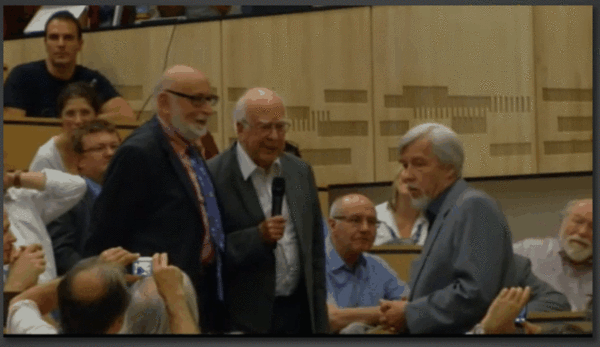
10:46 am (Mark): Peter Higgs is visibly moved at the final results. I hope people understand, and perhaps this helps make clear, how invested scientists are in this work.

10:47 am (Sean): Not often you get to see history made.

It's official: they have it!

Here is a screen shot of Peter Higgs saying a few words at the end of the seminar:

ScreenHunter_18 Jul. 04 10.56

Jonathan Krohn: CPAC’s Boy Wonder Swings Left

From Politico:

JkrohnJonathan Krohn took the political world by storm at 2009’s Conservative Political Action Conference when, at just 13 years old, he delivered an impromptu rallying cry for conservatism that became a viral hit and had some pegging him as a future star of the Republican Party.

Now 17, Krohn — who went on to write a book, “Defining Conservatism,” that was blurbed by the likes of Newt Gingrich and Bill Bennett — still watches that speech from time to time, but it mostly makes him cringe because, well, he’s not a conservative anymore.

“I think it was naive,” Krohn now says of the speech. “It’s a 13-year-old kid saying stuff that he had heard for a long time.… I live in Georgia. We’re inundated with conservative talk in Georgia.… The speech was something that a 13-year-old does. You haven’t formed all your opinions. You’re really defeating yourself if you think you have all of your ideas in your head when you were 12 or 13. It’s impossible. You haven’t done enough.”

More here.

Tuesday, July 3, 2012

Ladies and Gentlemen, the Higgs Boson has been found!

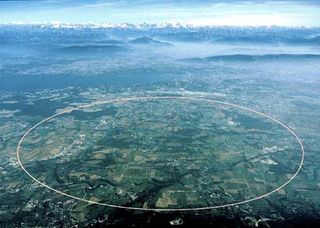
Cern pictureI know that I should probably not be doing this but I am too excited not to: I have it on very good authority from a prominent experimental physicist in the middle of the action that CERN will indeed be announcing the discovery of the Higgs Boson tomorrow in Geneva. Here is how my “Deep Throat” contact puts it:

It's 5 sigma more or less, and I am sure there will be some debate about the semantics of calling it a “discovery” or not but more or less it is a discovery…it's there! Probably the most boring and exciting moment in physics…

How confident am I in my confidant? Let's put it this way: if this turns out to be a “Dewey Defeats Truman” moment for 3QD, I will take on the responsibility of personally assassinating my source! 🙂 And, yes, I have permission from her/him to post this.

We will have much more about all this tomorrow I am sure. What an exciting moment!

What to Make of Finnegans Wake?

Michael Chabon in the New York Review of Books:

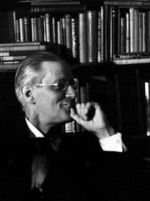
ScreenHunter_13 Jul. 03 20.46Like many admirers of the work of James Joyce, I had imposed strict terms on that admiration, and around the work I had drawn a clear ambit, beyond which I was unprepared to stray. Ulysses and “The Dead”: crucial works, without which life was something seen through a sheet of wax paper, handled with gloves of thick batting, overheard through a drinking glass pressed to a wall. Between them those two works managed to say everything a pitying heart and a pitiless intellect could say about death and sex and love and literature, loss and desire, friendship and animosity, talk and silence, mourning and dread. Then there were “Araby,” “A Little Cloud,” and “Ivy Day in the Committee Room,” each a masterpiece, endlessly rereadable, from which I had learned so much about short stories and their deceptive power; one can learn a lot from all the stories in Dubliners, even the sketchier ones: about point of view and the construction of scene, about the myth of Charles Parnell and horse racing in Ireland, about the pain of grief and of missed chances.

Beyond Dubliners there was the unlovable A Portrait of the Artist as a Young Man, which starts well, charting bold, clear routes, like “Araby,” through the trackless waters of childhood, then fouls its rotors in a dense kelpy snarl of cathected horniness, late-Victorian aesthetics, and the Jesuitical cleverness that, even in Ulysses, wearies the most true-hearted lover of Joyce. A stamp in the passport, Portrait, a place I must visit without ever feeling it necessary to return, though I might want to wander out now and then to drop in on Joyce’s poetry, roughly contemporary with the first novel, those curious “pomes,” wearing their spats and dandyish nosegays, occasionally taking up a putative lute to croon promises of theoretical love to unconvincing maidens in the windows of canvas-flat donjons.

After that I came up against the safety perimeter, beyond which there lurked, hulking, chimerical, gibbering to itself in an outlandish tongue, a frightening beast out of legend.

More here.

Is Philosophy Literature?

Jim Holt in the New York Times:

ScreenHunter_12 Jul. 03 20.42Now let me narrow my query: Does anybody read analyticphilosophy for pleasure? Is this kind of philosophy literature? Here you might say, “Certainly not!” Or you might say, “What the heck is analytic philosophy?”

Allow me to address the latter reply first. “Analytic” philosophy is the kind that is practiced these days by the vast majority of professors in philosophy departments throughout the English-speaking world. It’s reputed to be rather dry and technical — long on logical rigor, short on lyrical profundity. Analytic philosophy got its start in Cambridge in the first decade of the 20th century, when Bertrand Russell and G.E. Moore revolted against the rather foggy continental idealism prevailing among English philosophers at the time. Under their influence, and that of Ludwig Wittgenstein (who arrived in Cambridge in 1912 to study with Russell), philosophers came to see their task as consisting not in grand metaphysical system-building, but in the painstaking analysis of language. This, they thought, would enable them to lay bare the logical structure of reality and to put all the old philosophical perplexities to rest.

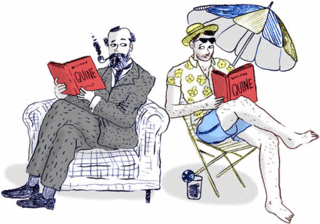
Today, analytic philosophy has a broader scope than it used to. (Many of its qualities were examined in a previous post in this series by Gary Gutting, “Bridging the Analytic-Continental Divide.”) It’s less obsessed with dissecting language; it’s more continuous with the sciences. (This is partly due to the American philosopher Willard Quine, who argued that language really has no fixed system of meanings for philosophers to analyze.) Yet whether they are concerned with the nature of consciousness, of space-time or of the good life, analytic philosophers continue to lay heavy stress on logical rigor in their writings.

More here.

Semicolons: A Love Story

Ben Dolnick in the New York Times:

ScreenHunter_11 Jul. 03 13.50When I was a teenager, newly fixated on becoming a writer, I came across a piece of advice from Kurt Vonnegut that affected me like an ice cube down the back of my shirt.

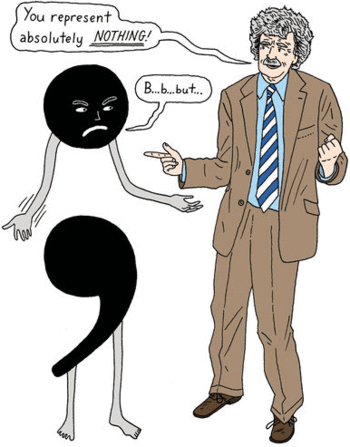
“Do not use semicolons,” he said. “They are transvestite hermaphrodites representing absolutely nothing. All they do is show you’ve been to college.”

At the time I was less struck by the cranky, casual bigotry of the statement (a great deal of Vonnegut’s advice sounds as if it was rasped between grandfatherly coughing fits) than by the thrilling starkness of the prohibition. A writer was simply not to use semicolons. Ever.

At that point I’d written a number of not very good short stories over which I’d sprinkled semicolons (along with inapt adjectives and “symbolic” character names) like the wishful seasonings of an amateur cook. Now I would have, if it had been physically possible, scrubbed the accursed symbol from my keyboard and never thought about semicolons again, except to harrumph cruelly when I witnessed other, lesser writers succumbing to this particular form of misguidedness.

Advice from Vonnegut was not, to me, just any advice. To say that he was my literary hero doesn’t quite capture the intensity of the worship and obsession I heaped upon him.

More here.

Magic and the machine

Via Al Jazeera, Lewis Lapham's introductory essay for “Magic Shows,” the Summer 2012 issue of Lapham's Quarterly:

MagicAs between the natural and the supernatural, I've never been much good at drawing firm distinctions. I know myself to be orbiting the sun at the speed of 65,000 miles per hour, but I can't shake free of the impression shared by Pope Urban VIII, who in 1633 informed Galileo that the earth doesn't move. So also the desk over which I bend to write, seemingly a solid mass of wood – but in point of fact a restless flux of atoms bubbling in a cauldron equivalent to the one attended by the witches in Macbeth.

Nor do I separate the reality from the virtual reality when conversing with the airy spirits in a mobile phone, or while gazing into the wizard's mirror of a television screen. What once was sorcery maybe now is science, but the wonders technological of which I find myself in full possession, among them indoor plumbing and electric light, I incline to regard as demonstrations magical.

This inclination apparently is what constitutes a proof of being human, a faculty like the possession of language that distinguishes man from insect, guinea hen and ape. In the beginning was the word, and with it the powers of enchantment. I take my cue from Christopher Marlowe's tragical drama Doctor Faustus because his dreams of “profit and delight/Of power, of honour, of omnipotence”, are the stuff that America is made of, as was both the consequence to be expected and the consummation devoutly to be wished when America was formed in the alembic of the Elizabethan imagination. Marlowe was present at the creation, as were William Shakespeare, the navigators Martin Frobisher and Francis Drake and the Lord Chancellor Francis Bacon, envisioning a utopian New Atlantis on the coast of Virginia…

Literature in the Oil Age: A Review of Goat Days

From Chapati Mystery:

The age of oil has produced unprecedented scales of human confinement and brutality. At the same time, people are traveling faster, and in larger groups than ever before: migration to the Gulf following the oil boom of the 1970s is a case in point. There are currently some fifteen million migrant workers in the Gulf, hailing mostly from Asian, African, and Arab countries. The number of South Asian migrant laborers rose substantially in the 1990s, filling in for the displacements of Arab workers caused by the 1991 Gulf War. There are two and a half million migrant workers from Kerala alone, who annually send home sums amounting to 15% of total remittances to India. Migrant workers spend years away from their families, work for extremely low wages, subsist in poor living conditions, and have their passports held by employers in places with virtually no enforceable labor laws. Their experiences have yet to be voiced within literature in as gripping an account as Benyamin’s novel Goat Days, forthcoming in English. Based on a true story, the novel has become a bestseller in the original Malayalam (Aadujivitam), winning the Kerala Sahitya Academy award. Benyamin, Benny Daniel’s pen name, is a Keralite who has lived in Bahrain since 1992.

There is a tremendous dearth of literature which un-cover the cultures born out of oil encounters. And, although migration to the Gulf constitutes the exemplary South Asian diaspora of our times, no other novel—none available in English, that is—has cast the migrant Gulf worker as its principal character. Benyamin does so by weaving rich descriptions of the protagonist’s surroundings with a robust interior monologue. The narrator is Najeeb, a modest sand-miner from Kerala who travels to Riyadh via Bombay in the 1990s with the dream of earning his fortunes, only to become enslaved for over three years in the desert interior of Saudi Arabia on a goat farm (masara) at the mercy of a cruel boss (arbab). It is a novel of multiple crossings: from South India to the Gulf, from Riyadh to rural Saudi Arabia, and from dreams of economic betterment to impoverished disillusionment. But at the heart of Goat Days is the journey Najeeb makes from slavery to freedom, including a perilous desert trek. The novel is about the many dangers Najeeb faces in his struggle for emancipation.

More here.

How to Make Optimism Work for You

Jane Brody in The New York Times:

OpMy recent column on optimism drew hundreds of comments from readers who testified to the value of living life as a glass half full. But one in particular — from a 90-year-old man living in Calabasas, Calif. — was especially telling. The reader, William Richmond, wrote that a phrase in the column, “Fake it until you make it,” summed up his long and very successful life.

His approach to life could serve as a battle plan for the millions of recent college graduates now searching for work in an unforgiving job market, as well as for older adults trying to re-enter the workplace after a long hiatus and those who lost jobs and must now reinvent themselves. In 1946, after serving nearly four years as a fighter pilot in the Marine Corps, Mr. Richmond said he returned to civilian life “certain I could conquer anything I went after.” After all, he’d managed to fly solo and safely land a Piper Cub after just six hours of training, then spent the next year learning to be a pilot. “Do it, then learn how — I guess if it’s good enough for the Marines…,” he wrote. Mr. Richmond loved jazz and, having been handed a drum to play in his middle school band in Rockford, Ill., he decided to go to Los Angeles to become a professional musician. “I wasn’t very good, but I could keep pretty good time and could look like I knew what I was doing,” he wrote. “In a few months I actually got a job in a downtown bar and in due time was playing in a big band.” But recognizing his musical limitations, he then enrolled in a music college to learn how to be a professional drummer, after which he worked almost nonstop for 15 years in big-name bands, playing for singers like Peggy Lee, Ella Fitzgerald and Frank Sinatra — and finally for Jerry Lewis. Noting Mr. Richmond’s ability to make people laugh, Mr. Lewis asked him up to write jokes, then a movie, “The Ladies Man” (1961), which was a success even though his collaborator, Mel Brooks, quit early on, leaving Mr. Richmond, a complete novice, to write it. After taking a class in screenwriting, Mr. Richmond wrote six more movies for Mr. Lewis, and followed that with 30 years as a professional comedy writer on countless TV shows before retiring at age 73. “The important thing,” Mr. Richmond said in an interview, “is to visualize what you want and go after it. Be ready for an opening — serendipity — all the time.”

More here.

Tuesday Poem

Rite of Spring

So winter closed its fist
And got it stuck in the pump.
The plunger froze up a lump

In its throat, ice founding itself
Upon iron. The handle
Paralysed at an angle.

Then the twisting of wheat straw
into ropes, lapping them tight
Round stem and snout, then a light

That sent the pump up in a flame
It cooled, we lifted her latch,
Her entrance was wet, and she came.

by Seamus Heaney

Mourning Shamir

From Mondoweiss:

ShamirIf an interdependent empowerment is our goal, we need to seriously ask ourselves whether that goal can be reached with a Jewish state or if such a state permanently impedes that possibility. Today Israel and Jews in general are further away from an interdependent empowerment than at any time in the post-Holocaust era. Moreover, without a deep and material Jewish solidarity with a Palestinian future there is little chance for a collective or even individual ethical life as Jews.

Yitzhak Shamir should be remembered for impeding a Jewish ethical future. The first Palestinian intifada, which Shamir ordered crushed, may have represented the last chance for reaching across the Israel/Palestinian divide. Or was it the very formation of the state of Israel which Shamir helped birth?

More here.

from lou to delmore

Delmore-schwartz-1

You wore the letter from T.S. Eliot next to your heart. His praise of In Dreams. Would that you could have stopped that wedding.* No good will come of this!!! You were right. You begged us—Please don’t let them bury me next to my mother. Have a party to celebrate moving from this world hopefully to a better one. And you Lou—I swear—and you know if anyone could I could—you Lou must never write for money or I will haunt you. I’d given him a short story. He gave me a B. I was so hurt and ashamed. Why haunt talentless me? I was the walker for “The Heavy Bear Who Goes With Me.” To literary cocktails. He hated them. And I was put in charge. Some drinks later—his shirt undone—one tail front right hanging—tie skewed, fly unzipped. O Delmore. You were so beautiful. Named for a silent movie star dancer Frank Delmore. O Delmore—the scar from dueling with Nietzsche.

more from Lou Reed at Poetry here.