The Insidious Legacy of the “Andy Griffith Show” Theme

David Hajdu in The New Republic:

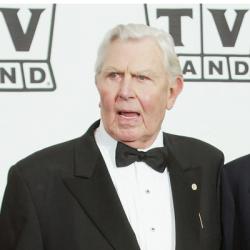
Andy Griffith2I’m not blaming Andy Griffith—not the actor, who died this week in his home state of North Carolina at 86, the age he has always seemed to me. It’s not his fault that the theme song to The Andy Griffith Show had the impact that it had on me—and, I presume, on others who found themselves watching the series at some point during in its eight-year network run in the 1960s or in its perpetual cycle of cable reruns. The tune is, without question, one of the catchiest trifles ever composed for commercial consumption. It’s bouncy and swinging, with an angular, syncopated melody. In the canonical rendition for the opening and closing credits of the show, the tune is whistled (probably by Fed Lowery, who whistled professionally for the Hollywood studios, perhaps by the song’s composer Earl Hagen) over accompaniment by a spare little guitar-based rhythm section. There were actually two versions, slightly different—the original had a bit more snap—done for the original black-and-white credits and the later color credits (and it’s possible that Lowery and Hagen each did one of them).

More here.

Saturday, July 7, 2012

The Scandal of Empire: India and the Creation of Imperial Britain

Michael Dodson in Reviews in History:

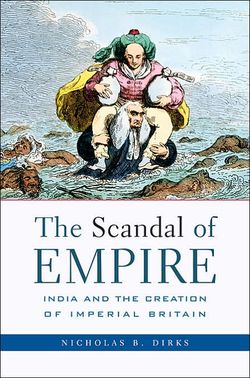
EmpirescandalDirks principal argument in Scandal is two-fold. First, he asserts that to say ‘empire was a scandal’ is to tell only part of the story, for scandal was not incidental to British imperialism (or, for that matter, was not to be associated with only a few individuals), but rather scandal was central to empire, as it ultimately served as the ‘crucible in which both imperial and capitalist expansion was forged’ (p. 8). Moreover, through the ‘moral spectacle’ of the impeachment trial, this public addressing of scandal helped to convert Britain’s presence in India to a perception of legitimate sovereignty, producing the conditions for empire’s success and ‘its transformation into a patriotic enterprise’ (p. 125). Thus, Dirks argues, from the 1790s onwards, thanks in large part to Edmund Burke’s machinations, scandal was no longer to be associated with British imperial rule, but with Indian socio-cultural forms (sati, thagi, female infanticide, etc.). Second, Dirks asserts that scandal, so central to imperial beginnings, has very often ‘been either laundered or converted into narratives of imperial, nationalist, and capitalist triumph’ (p. 25). In other words, Dirks argues that ‘scandal’, in itself, has largely been absent from the multitude of historical accounts written about the Company’s expansion in India (here he invokes, not for the first time in his work, John Seeley’s 1883 claim that empire was acquired in a ‘fit of absence of mind’ as his genre-defining historiographical foe). Dirks seeks unambiguously to reassert the connection.

More here.

Quite Likely the Worst Job Ever

By Mike Dash at Smithsonian's Past Imperfect blog:

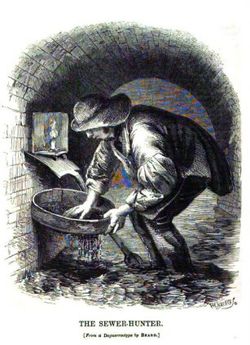
Sewer hunterOut of sight and all too often out of mind, the working people of the British capital nonetheless managed to conjure livings for themselves in extraordinary ways. Our guide to the enduring oddity of many mid-Victorian occupations is Henry Mayhew, whose monumental four-volume study of London Labour and the London Poor remains one of the classics of working-class history. Mayhew–whom we last met a year ago,describing the lives of London peddlers of this period–was a pioneering journalist-cum-sociologist who interviewed representatives of hundreds of eye-openingly odd trades, jotting down every detail of their lives in their own words to compile a vivid, panoramic overview of everyday life in the mid-Victorian city.

Among Mayhew’s more memorable meetings were encounters with the “bone grubber,” the “Hindoo tract seller,” an eight-year-old girl watercress-seller and the “pure finder,” whose surprisingly sought-after job was picking up dog mess and selling it to tanners, who then used it to cure leather. None of his subjects, though, aroused more fascination–or greater disgust–among his readers than the men who made it their living by forcing entry into London’s sewers at low tide and wandering through them, sometimes for miles, searching out and collecting the miscellaneous scraps washed down from the streets above: bones, fragments of rope, miscellaneous bits of metal, silver cutlery and–if they were lucky–coins dropped in the streets above and swept into the gutters.

Read more here.

the most obstinate man in Venice

2842d8b4-c71c-11e1-95ea-00144feabdc0

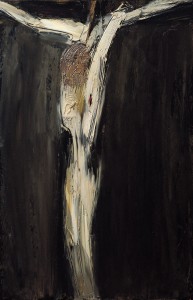
Titian is a magnificent, perplexing, near-impossible biographical subject. This is the first Life since 1877, and uses unpublished material amassed over decades by Titian scholar Charles Hope. But even with these fresh sources, and using her own background as a historian of Venice, Hale struggles against the odds. Almost nothing is recorded of Titian’s personal life – we don’t know the name of his second wife, or the date when a beloved daughter predeceased him. The only certain self-portraits depict a thin-faced old man with a white beard, in opulent black, wearing a gold chain – every inch the establishment figure. Yet Titian’s radically expressive, vigorous, direct works, delivering what Hale calls “the shock of recognition that we are looking at a kind of truth that few other painters have communicated”, urge psychological speculation. And he lived so long, and changed his style so remarkably – from the radiant, minutely realised early masterpieces such as the Villa Borghese’s “Sacred and Profane Love” and the National Gallery’s “Bacchus and Ariadne”, to the tonally rich, freely painted mature oeuvre (“Danaë”, “Diana and Actaeon”), then the final tragic visions – that it is hard for a viewer today not to read in those transformations resistance to the status quo and inner turmoil.

more from Jackie Wullschlager at the FT here.

why does the world exist?

600

That question — “Why is there something rather than nothing?” — occupies the center of Holt’s book, which is by turns a philosophical and scientific inquiry, written through a broadly personal lens. Beginning with his discovery of this “ultimate why question” as a teenager reading Heidegger, Holt frames his investigation as a series of conversations with luminaries from the academic and cultural worlds. In these pages, we meet Sir Roger Penrose, who in 1970 with Stephen Hawking showed that the Big Bang “must have been a singularity” — a self-contained event with no deterministic cause. We hear from Nobel physics laureate Steven Weinberg and novelist John Updike, University of Pittsburgh philosopher Adolf Grünbaum and theologian Richard Swinburne. The subjects share a curiosity, a quality of engagement, in the face of everything they cannot know. What Holt is asking, after all, is unanswerable, which means that any response, even the most nuanced, must be conditional in the most fundamental sense. “Would the search prove futile?” the author wonders after visiting Weinberg in Austin, where he teaches at the University of Texas. “Perhaps. But that made it all the more noble, in a Sisyphean way.”

more from David L. Ulin at the LA Times here.

Little America: The War Within the War for Afghanistan

From The Guardian:

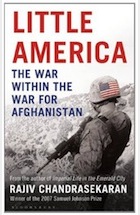
Little-America-The-War-withiSo what went wrong? First of all, winning in Afghanistan, however defined, was never going to be easy. The international effort there came at the end of a long series of increasingly ambitious – and even sometimes successful – “liberal humanitarian” interventions. It was a period of extraordinary hubris – and great trauma after the 9/11 attacks. Together this bred a toxic mix of astonishing overconfidence and deep insecurity. Then came the distraction of Iraq. Chandrasekaran suggests – and some military historians might disagree – that Afghanistan is “by far the most complicated war the USA has ever prosecuted”. The superlative here might be challenged by many historians but that the conflict was a tough challenge is without doubt. America, however, could not meet it, he argues. Chandrasekaran's indictment is savage. “Too few generals recognised that surging forces could be counterproductive… Too few soldiers were ordered to leave their air-conditioned bases and live among the people in fly-infested villages. Too few diplomats invested the effort to understand the languages and cultures of the places in which they were stationed. Too few development experts were interested in anything other than making a buck. Too few officials in Washington were willing to assume the risks necessary to forge a lasting peace… Generals and diplomats were too ambitious and arrogant. Uniformed and civilian bureaucracies were rife with internal rivalries. Our development experts were inept. Our leaders were distracted.” The result, inevitably, was that “the good war… turned bad”.

And if, after reading this, any Europeans are feeling smug, they shouldn't. Where they are mentioned at all, allies are portrayed as incompetent, feckless, cowardly or complacent. The British, whose ineffectual attempts to secure Helmand province and appalling relations with both local communities and the Americans are described in painful detail, come out particularly badly. Though not, it must be said, as badly as the Pakistani security establishment, whose strategically critical support, passive and active, for the insurgents was apparently not fully understood by US military planners until only very recently. There are now thousands of books on this most recent Afghan conflict, ranging from airport thrillers to specialist study. Many books are extremely good, some are very bad. Little America is powerful and important and should be read by anyone interested in this ongoing and deeply depressing war, particularly those waiting for helicopters or eating Hot Tamales in Bagram.

More here.

Man of Action

James Parker in New York Times:

“Superman!” gasps Lois Lane, freshly scooped from beneath the nodding carbines of a South American firing squad. “Right!” says the boxy blue-and-red figure who holds her in his arms. “And still playing the role of gallant rescuer!” His mouth is set in a kind of grimace, but with dimples. Is he frowning? Tautly grinning? And what can he mean by “still playing the role”? This is only the second Superman comic ever, from July 1938, and already our hero — caped and airborne, with Lois coiled against his unbreachable bosom — is carrying a freight of super-irony.

Then again, as we learn from “Superman,” Larry Tye’s exhaustive and engaging book, irony attends every phase of this story. Superman’s creators — Jerry Siegel (writing) and Joe Shuster (drawing) — were a pair of Cleveland geeks whose underdoggery was purer almost than the ­alpha-male prowess of the pulp heroes they adored: Tarzan, Hugo Danner, Clark (Doc) Savage Jr. and so on. Both the sons of immigrant Jewish tailors, Siegel and Shuster were uncool, and they were girl-less. They had no money. Shuster, the artist, was horribly nearsighted. And how they toiled, through lost nights of teenage-­dom, at their secret weapon: their made-up ultrabeing, their hero to out-hero them all. First, in a misfire, he was naughty (a mind-reading tramp called “the Super-Man”), then he was good. Then very good. At last, on what Tye calls “a hot summer night of divinelike inspiration,” it happened: the elements fused, and the 19-year-old Siegel, scribbling madly in his bathroom, came up with the doomed planet Krypton, Lois Lane, Clark Kent the mild-mannered reporter. . . .

More here.

Viral Marketing: What’s Stopping Men From Getting The HPV Vaccine

Via Good:

HpvThe truth is that most young men don’t know about the risks of HPV—and their options for preventing it—because our culture’s sexual awkwardness distorts corporate, government, and even scientific decision-making. In the mid-2000s, before the vaccination was marketed to the public, the CDC conducted extensive focus group research to ascertain the American public knowledge of, and attitude toward, HPV. “Current focus-group findings revealed that STD-associated stigma served as a barrier to HPV-vaccine acceptability,” the researchers found. “[E]xperts…cautioned strongly against focusing primarily on the sexually transmitted nature of HPV…which can be stigmatizing and detract from the more important public health concern of cervical cancer.”

Merck took note. The results can be seen in the company’s initial “One Less” advertising campaign, which used images of jump-roping school girls to advocate the vaccination use for girls ages 9 to 26. Any mention of sexual transmission, genital warts, male victims, and non-cervical HPV-linked cancers are noticeably absent.

More here.

How Crisis Mapping Saved Lives in Haiti

Patrick Meier in National Geographic:

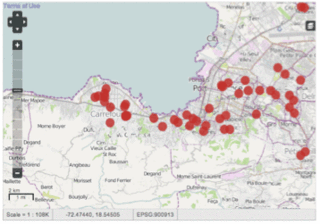
ScreenHunter_27 Jul. 07 10.38The National Geographic Society has a long history of crisis mapping disasters. But what happened in Haiti on January 12, 2010 would forever change the very concept of a crisis map. A devastating earthquake struck the country’s capital that Tuesday afternoon. I was overwhelmed with emotions when I heard the news just an hour later. Over 100,000 people were feared dead. Some very close friends of mine were doing research in Port-au-Prince at the time and I had no idea whether they had survived the earthquake. So I launched a live crisis map of Haiti. But this was an emotional reaction rather than a calculated plan with a detailed strategy. I was in shock and felt the need to do something, anything. It was only after midnight that I finally got an SMS reply from my friends. They had narrowly escaped a collapsing building. But many, many others were not near as lucky. I continued mapping.

This is what the map looked liked after midnight on January 13th. What was I mapping exactly? Tweets. I had found a dozen Haitians tweeting live from Port-au-Prince shortly after the earthquake…

I was using the Ushahidi platform, a free and open source mapping technology from Africa. Think of Ushahidi, which means “witness” in Swahili, as a multi-media inbox connected to a live map. I added these Twitter users to my inbox and began mapping the most urgent Tweets (those that had enough geographic information to be mapped). The following night, several friends joined me in the living room of my dorm to help map Haiti’s needs.

More here. [Thanks to Kris Kotarski.]

I like words

From Letters of Note:

When copywriter Robert Pirosh landed in Hollywood in 1934, eager to become a screenwriter, he wrote and sent the following letter to all the directors, producers, and studio executives he could think of. The approach worked, and after securing three interviews he took a job as a junior writer with MGM.

Pirosh went on to write for the Marx Brothers, and in 1949 won an Academy Award for his Battleground script.

Dear Sir:

I like words. I like fat buttery words, such as ooze, turpitude, glutinous, toady. I like solemn, angular, creaky words, such as straitlaced, cantankerous, pecunious, valedictory. I like spurious, black-is-white words, such as mortician, liquidate, tonsorial, demi-monde. I like suave “V” words, such as Svengali, svelte, bravura, verve. I like crunchy, brittle, crackly words, such as splinter, grapple, jostle, crusty. I like sullen, crabbed, scowling words, such as skulk, glower, scabby, churl. I like Oh-Heavens, my-gracious, land's-sake words, such as tricksy, tucker, genteel, horrid. I like elegant, flowery words, such as estivate, peregrinate, elysium, halcyon. I like wormy, squirmy, mealy words, such as crawl, blubber, squeal, drip. I like sniggly, chuckling words, such as cowlick, gurgle, bubble and burp.

I like the word screenwriter better than copywriter, so I decided to quit my job in a New York advertising agency and try my luck in Hollywood, but before taking the plunge I went to Europe for a year of study, contemplation and horsing around.

I have just returned and I still like words.

May I have a few with you?

Robert Pirosh
385 Madison Avenue
Room 610
New York
Eldorado 5-6024

Friday, July 6, 2012

Sex abuse and the study of religion

By Kathryn Lofton, via The Immanent Frame:

AbuseWhat I want to tackle, immediately, is the fraught relationship between effect and affect in this subject for those of us who seek to interpret it. It is difficult to write or think about sex abuse without being affected by its circulating effects, without feeling that the very practices of academic analysis do something suffocating to its experience. To think about sex abuse in an academic context could suggest that we might wish to think away its awfulness; to write about sex abuse could suggest that we seek to argue away its visceral trauma.

Scholarly practice replies to such worry with bravado, assuming that our studied neutrality will offer fair view to every contributing party. Yet this is the very neutrality that so troubles subjects of our analysis, since it suggests that everyone deserves understanding, regardless of their actions. This is a perspective to which few victims of such violence can accede.

Even if we bracket the voice of such victims in our academic work, we cannot imagine that we have bracketed their call for judgment upon their perpetrators. To be sure, scholars sometimes imagine that a responsible account is an account that withholds judgment. “I just try to explain what happened,” one historian tells me. “I don’t judge what they did.” This is an evasion of responsibility; interpretation is judgment. We cannot imagine that our default to historicism will spare us our job as arbiters. We are always in the story, no matter our attempt to abstract ourselves from it through various modes of scientism, humanist and otherwise. “For even a world equation that contained everything, so that the observer of the system would also be included in the equations, would still assume the existence of a physicist who, as the calculator, would not be an object calculated,” Hans Georg Gadamer writes, concluding, “Each science, as a science, has in advance projected a field of objects such that to know them is to govern them.” To know them is to govern them. This is the struggling work of all scholarship: to acknowledge that its very free enactment by a solo thinker is also a practice of governance with others. How do we do this? How do we do this especially in cases where our subjects have already been governed in abusive ways?

Read more here.

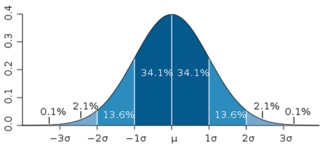
So do the 5-sigma Higgs-like particle results imply that scientists are 99.99994 percent sure that they’ve found the Higgs boson? Not exactly.

From Physics Central:

ScreenHunter_26 Jul. 06 13.51Although statistical significance can be a good guideline for many physics experiments, scientists can't base their results solely on these benchmarks. In fact, other errors can creep into the data and contaminate entire datasets, even very promising ones.

Remember when neutrinos were supposedly traveling faster than light late last year? That result reached a six-sigma level of confidence – even higher than the 5-sigma level convention required for new particle discoveries. But we learned earlier this year that neutrinos indeed obey the universal speed limit, so what went wrong?

Most crucially, the faster-than-light neutrino experiment suffered from a systematic error that affected all of the data; faulty cables consistently gave the researchers bad readings. No matter how many times physicists repeated the experiments, they would get the same yet inaccurate results.

This situation is akin to measuring someone's height with a meter stick that is several inches longer than it should be. Even if you take hundreds of measurements and average all of the tiny human errors and approximations, you'll never avoid the fact that your meter stick is giving you consistently bad results.

So how do scientists make sure they avoid this problem when statistical analyses can't account for it? Part of the answer is using independent experiments, like CMS and ATLAS, because systematic errors are less likely to affect experiments with different designs.

This is part of the reason why scientists are so excited about the recent results. Scientists are seeing not only very high sigma bumps in the data but also similar bumps from two independent experiments.

More here.

Why is Nobody Freaking Out About the LIBOR Banking Scandal?

Matt Taibbi at Rolling Stone:

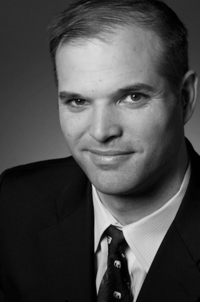
Matt-taibbiThe LIBOR manipulation story has exploded into a major scandal overseas. The CEO of Barclays, Bob Diamond, has resigned in disgrace; his was the first of what will undoubtedly be many major banks to walk the regulatory plank for fixing the interbank exchange rate. The Labor party is demanding a sweeping criminal investigation. Mervyn King, Governor of the Bank of England,responded the way a real public official should (i.e. not like Ben Bernanke), blasting the banks:

It is time to do something about the banking system…Many people in the banking industry are hardworking and feel badly let down by some of their colleagues and leaders. It goes to the culture and the structure of banks: the excessive compensation, the shoddy treatment of customers, the deceitful manipulation of a key interest rate, and today, news of yet another mis-selling scandal.

The furor is over revelations that Barclays, the Royal Bank of Scotland, and other banks were monkeying with at least $10 trillion in loans (The Wall Street Journal is calculating that that LIBOR affects $800 trillion worth of contracts).

The banks gamed LIBOR for two semi-overlapping reasons. As noted here last week, there were instances of Barclays traders badgering the LIBOR submitters to “push down” rates in order to fatten their immediate bottom lines, depending on what they were trading or holding that day. They also apparently rigged LIBOR downward in order to produce a general appearance of better health, essentially tweaking their credit scores a few ticks upward.

More here. See also: “LIBOR Banking Scandal Deepens” here.

Thank you for killing my novel

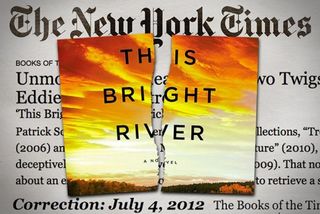
The New York Times panned my book, then had to correct the review to fix all their errors. So why am I not angry?

Patrick Somerville in Salon:

Correctionrect-460x307Last Sunday night I spent a good five minutes lying facedown on my couch, my head pressed into the crack between our old tan cushions, my arms pinned awkwardly under my chest, emitting a sequence of guttural moaning noises as my wife silently read Janet Maslin’s newly posted New York Times review of my novel, “This Bright River,” and then – after some gasps and one very disconcerting, empathy-laden, “Oh no” – attempted to describe the review’s contents aloud. I’d only been able to read the headline.

“It’s not positive,” she began firmly, and I pressed my head deeper into the couch, trying to get to its springs and asphyxiate. My wife, the sole adult member of our family, paraphrased the review: “Lack of purposefulness” was the first representative phrase she picked, and she next moved on to “jerry-built,” “desperate measure” and finally circled back around to “soggy.”

“No,” I said. “It does not say soggy.”

“It says soggy,” she repeated. “It does say soggy.”

As I am an atheist, I made noises directed at no one and nothing. I then, without removing my face from the couch-hole, picked up a throw pillow and gently placed it on the floor, blind.

My wife said nothing. It was 90 degrees in our living room, and the fan oscillated gloomily. Our cat, pleased, sensing a complicated kind of emotional dissolution in the works, jumped onto my back and sat down.

More here.

Stephen Wolfram: “I Like to Build Alien Artifacts”

From The European:

Wolfram

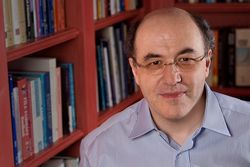
Stephen Wolfram is the brain behind the “Mathematica” software and the semantic knowledge engine “WolframAlpha”. He studied at Oxford and at the California Institute of Technology, where he received a Ph.D. in particle physics at age 20. Wolfram is the recipient of a MacArthur “genius grant”, a regular TED speaker, and the author of “A New Kind of Science”, which examines the linkages between artificial and natural computation.

The European: What’s the difference between a search engine like Google, and a computational knowledge engine like WolframAlpha?
Wolfram: With a search engine, you type in a keyword and try to find the best matches. It’s like walking into a library and being handed the ten best books about a topic. What we are trying to do with WolframAlpha is to create custom-created reports to answer specific questions. We are computing answers – even if nobody has ever asked that question before, maybe we can work out a report that answers it. It takes human experts to do that, and that is something that the search engine crowd is often skeptical about. They say that something is only good when it is based on a good algorithm and infinitely scalable. But we are interested in encapsulating the world’s knowledge, not in scalability. Wikipedia is basically a container for random texts written by random people at random times. We can surely do better than that, especially if we want to build something that has different layers and relies on good information. The actual data that we have inside of Wolfram Alpha is now roughly comparable to the textual content of the internet, and much of it comes from primary data sources that are not available online. I find it quite interesting that Google’s search division recently changed its name to “knowledge division.” Sergey Brin used to be an intern with us before he co-founded Google. We have had many good discussions, and I like to think that the name change came out of those.

…The European: Is that your purpose, to think about human progress?
Wolfram: I suppose my crazy way of expressing a purpose is to say that I like to build alien artifacts. I like building things that nobody expected to be built, and I’m not really excited by the idea of taking something that already exists and making it slightly better. That’s somewhat egotistical because I can say, ‘this would not have happened without me.’ It often starts with a very broad idea or project and then leads me to drill down to the essential point, to the golden nugget that might be at the core of an idea. That’s what I like.

More here.

Higgs’ big loser: Why Stephen Hawking is such a bad gambler

From MSNBC:

BosonWhen it comes to betting on cosmic outcomes like the discovery of the Higgs boson, British physicist Stephen Hawking is a three-time loser. But there's a good reason for that. Hawking's latest loss was to Gordon Kane, a theoretical physicist at the University of Michigan who worked out some of the ways that the Higgs boson could be detected in a particle-smasher like the Large Hadron Collider. About 10 years ago, Kane was discussing some of the issues while he and Hawking were together at a physics conference. “Stephen interrupted, and said he would like to bet me that there was no Higgs boson,” Kane recalled today. It took a while to work out the conditions of the $100 bet, and at one point things looked so dim for the search that Kane sent Hawking a check, according to The Detroit News. But this week, when researchers at the LHC announced that a subatomic particle matching the Higgs boson's general description had been discovered, it was Hawking's turn to concede the bet. “It seems I have just lost $100,” he told the BBC's Pallab Ghosh.

This isn't the first time Hawking has lost a small-stakes, high-profile bet on a scientific proposition. Back in 1975, he bet Caltech physicist Kip Thorne that there was no black hole at the center of the X-ray source known as Cygnus X-1. By 1998, he conceded that the black hole was there, and got Thorne a year's subscription to Penthouse magazine as a payoff. In 1997, Thorne and Hawking bet Caltech's John Preskill that information is completely lost when something falls into a black hole. But in 2004, Hawking changed his mind and said that information could conceivably leak out of a black hole. Hawking paid up by sending Preskill the repository of information he requested: a baseball encyclopedia. At last report, Thorne had not yet conceded. There's another wager still pending: Hawking is betting that primordial gravitational waves will be detected, resulting in the confirmation of inflationary big-bang theory. The Perimeter Institute's Neil Turok, a proponent of the cyclic model of cosmic origins, is betting against him. “If these gravitational waves are seen, they will instantly disprove our model,” Turok told Cambridge professor Alan Macfarlane. The terms of the bet, however, are still under negotiation.

So, as far as we know, Hawking is 0-for-3, with one bet still up in the air. That led the BBC's Ghosh to joke today in a Twitter update that “research effort could be saved if we knew what other bets Prof. Hawking has placed and assume he'll lose.”

More here.

Friday Poem

Looking Around, Believing

How strange that we can begin at any time. With two feet we get down the street. With a hand we undo the rose. With an eye we lift up the peach tree And hold it up to the wind — white blossoms At our feet. Like today. I started In the yard with my daughter, With my wife poking at a potted geranium, And now I am walking down the street, Amazed that the sun is only so high, Just over the roof, and a child Is singing through a rolled newspaper And a terrier is leaping like a flea And at the bakery I pass, a palm, Like a suctioning starfish, is pressed To the window. We're keeping busy — This way, that way, we're making shadows Where sunlight was, making words Where there was only noise in the trees.

by Gary Soto
from New and Selected Poems by Gary Soto
Chronicle Books, 1995