reading Merwin

WS-Merwin

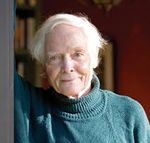
Much of today’s contemporary poets focus on the minutiae of mundane life, which still acts as a needed corrective to the often highfalutin conceptual, or melodramatic poetry of yore. However, as often happens when a culture reacts to an overbearing style, it attempts to negate it completely. Consequently, we go overboard in our zealousness so that we dismiss even the more redemptive parts of a previous style. Think of Walt Whitman; if someone attempted to write his poetry today, even anything close to his confident, prophetic, spiritual and nature obsessed poetry we would think of them as naive, childish, arrogant and perhaps, slightly insane. I miss this though. I want a poet unafraid to shed their cynicism, to let go of our collective fear appearing stupid, or incorrect, to explore realms that we cannot see, or feel, or quantify besides our obsession with love and self-awareness. Merwin’s translations and choices speak to a poet acutely attuned to these less prominent voices in today’s culture. A poet who collects the desiccated bones of discarded themes and forms and reinvigorates them for the contemporary mind.

more from Joe Winkler at The Rumpus here.
in istanbul

4605610041_7328691da0_z_0

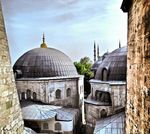
In 1453, when the Ottoman Empire captured Constantinople, Sultan Mehmed II ordered some changes to the city’s eastern Orthodox cathedral, the Hagia Sophia: the altar was swapped out for a minbar, the platform from which the imam addresses the congregation; and four slender minarets were added, among other things. For nearly 500 years the Hagia Sophia was a mosque, becoming, in 1931, a secular museum that enchantingly reveals layers of religious history, art, and architecture. Today the purple porphyry marble from Egypt glows richly; the Byzantine golden dome displays Islamic geometric adornments; and mosaics of the Virgin Mary sparkle up high. To better show off its wonders, the museum’s upper gallery hosts a permanent exhibition of images by Turkish architectural photographer Ahmet Ertug. In these carefully lit photos, the tiny tiles of the Virgin’s face and robes can be easily discerned. A museum within the museum.

more from Jennifer Acker at The Common here.

History slips sideways

Agha_malley_1-110812_jpg_470x631_q85

Amid chaos and uncertainty, the Islamists alone offer a familiar, authentic vision for the future. They might fail or falter, but who will pick up the mantle? Liberal forces have a weak lineage, slim popular support, and hardly any organizational weight. Remnants of the old regime are familiar with the ways of power yet they seem drained and exhausted. If instability spreads, if economic distress deepens, they could benefit from a wave of nostalgia. But they face long odds, bereft of an argument other than that things used to be bad, but now are worse. That leaves an assortment of nationalists, anti-imperialists, old-fashioned leftists, and Nasserites. Theirs was the sole legitimate ideology in the Arab world, invoked by those who fought colonialism and by those who replaced the colonial powers. Similar ideas have been invoked too, unwittingly but unmistakably, by the demonstrators and protesters of these past months who spoke of dignity, independence, and social justice, and thus borrowed from the same ideological lexicon as those they eventually ousted.

more from Hussein Agha and Robert Malley at the LRB here.

True Blue Stands Out in an Earthy Crowd

Natalie Angier in The New York Times:

BlueFor the French Fauvist painter and color gourmand Raoul Dufy, blue was the only color with enough strength of character to remain blue “in all its tones.” Darkened red looks brown and whitened red turns pink, Dufy said, while yellow blackens with shading and fades away in the light. But blue can be brightened or dimmed, the artist said, and “it will always stay blue.” Scientists, too, have lately been bullish on blue, captivated by its optical purity, complexity and metaphorical fluency. They’re exploring the physics and chemistry of blueness in nature, the evolution of blue ornaments and blue come-ons, and the sheer brazenness of being blue when most earthly life forms opt for earthy raiments of beige, ruddy or taupe.

One research team recently reported the structural analysis of a small, dazzlingly blue fruit from the African Pollia condensata plant that may well be the brightest terrestrial object in nature. Another group working in the central Congo basin announced the discovery of a new species of monkey, a rare event in mammalogy. Rarer still is the noteworthiest trait of the monkey, called the lesula: a patch of brilliant blue skin on the male’s buttocks and scrotal area that stands out from the surrounding fur like neon underpants. Still other researchers are tracing the history of blue pigments in human culture, and the role those pigments have played in shaping our notions of virtue, authority, divinity and social class. “Blue pigments played an outstanding role in human development,” said Heinz Berke, an emeritus professor of chemistry at the University of Zurich. For some cultures, he said, they were as valuable as gold.

More here.

The Architecture of Evil

Roger Forsgren in The New Atlantis:

For the commission to do a great building, I would have sold my soul like Faust. Now I had found my Mephistopheles. He seemed no less engaging than Goethe’s.

—Albert Speer

Someone designed the furnaces of the Nazi death camps. Someone measured the size and weight of a human corpse to determine how many could be stacked and efficiently incinerated within a crematorium. Someone sketched out on a drafting table the decontamination showers, complete with the fake hot-water spigots used to lull and deceive doomed prisoners. Someone, very well educated, designed the rooftop openings and considered their optimum placement for the cyanide pellets to be dropped among the naked, helpless men, women, and children below. This person was an engineer, an architect, or a technician. This person went home at night, perhaps laughed and played with his children, went to church on Sunday, and kissed his wife goodbye each morning.

The technical professions occupy a unique place in modern society. Engineers and architects possess skills most others lack — skills that allow them to transform dreams of design into reality. Engineers can convert a dry, infertile valley into farmland by constructing a dam to provide irrigation; they have made man fly; and architects have constructed buildings that reach thousands of feet into the sky. But these same technical gifts alone, in the absence of a sense of morality and a capacity for critical thought and judgment, can also make reality of nightmares. Ferdinand Porsche, the engineer who designed the Volkswagen — an automobile that revolutionized personal travel for the common man — also designed a terrifying battle tank that helped kill millions of Russians on the Eastern Front. Wernher von Braun, who would later design the Saturn V rocket that brought American astronauts to the Moon, designed the V-2 rockets with which the Nazis terrorized Antwerp and London in the waning months of the Second World War.

Few men better exemplify this danger than Albert Speer, Adolf Hitler’s chief architect.

More here.

Why can’t we talk to the animals?

Ben Ambridge at the blog of the Welcome Trust:

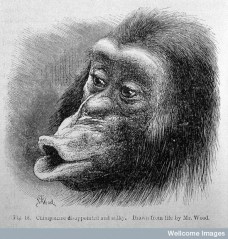
Disappointed-and-sulkyPreviously it was thought that the magical ability which non-human species lack is the understanding that words can be put together in different orders to express different meanings. There’s a saying in journalism: Dog Bites Man isn’t news, but Man Bites Dog is. It makes sense only because we understand that the order of the words tells us who’s doing the biting and who’s getting bitten.

However, a few species have actually passed this test. On the comprehension front, we have Phoenix and Akeakamai, two dolphins studied at the University of Hawaii, who were taught a language in which the ‘words’ were different whistle sounds played by the trainer (and chosen to approximate dolphins’ own calls). The dolphins understood that, for example, “put the pipe on the hoop” and “put the hoop on the pipe” meant different things and were able to respond accordingly, even when the exact sentence hadn’t been presented before. Some apes, such as Kanzi, a bonobo raised in Atlanta, have passed a similar test although debate continues as to whether or not they can combine words – in this case hand signs – in their own communication (watch the 2011 film Project Nim to see this controversy played out).

The finding that some species do seem to appreciate the powerful combinatorial properties of language serves only to deepen the mystery. If these animals are so smart, why aren’t they explaining what it’s like to be a chimpanzee, or at least politely asking to be let out of the cage? Tomasello’s answer is that what they just don’t seem to get is that language is fundamentally cooperative, almost altruistic, in nature. You understand that, if I say something to you (“Look, there’s your boss”), I’m doing so because I believe you will find it useful or interesting. Tomasello’s big idea is that this idea of doing something for the benefit of someone else is completely alien to other species.

More here.

From Particles to People: The Laws of Nature and the Meaning of Life

Sean Carroll introduces his fascinating and brilliant talk at TAM (do watch the video) in Cosmic Variance:

That’s the charmingly grandiose title of a talk I gave at The Amazing Meeting this past July, now available online. I hope that the basic message comes through, although the YouTube comments indicate that the nitpicking has already begun in earnest. There’s a rather lot of material to squeeze into half an hour, so some parts are going to be sketchy.

There are actually three points I try to hit here. The first is that the laws of physics underlying everyday life are completely understood. There is an enormous amount that we don’t know about how the world works, but we actually do know the basic rules underlying atoms and their interactions — enough to rule out telekinesis, life after death, and so on. The second point is that those laws are dysteleological — they describe a universe without intrinsic meaning or purpose, just one that moves from moment to moment.

The third point — the important one, and the most subtle — is that the absence of meaning “out there in the universe” does not mean that people can’t live meaningful lives. Far from it. It simply means that whatever meaning our lives might have must be created by us, not given to us by the natural or supernatural world. There is one world that exists, but many ways to talk about; many stories we can imagine telling about that world and our place within it, without succumbing to the temptation to ignore the laws of nature. That’s the hard part of living life in a natural world, and we need to summon the courage to face up to the challenge.

What Can You Really Know?

Freeman Dyson in the New York Review of Books:

Dyson_2-110812_jpg_230x1041_q85Jim Holt’s Why Does the World Exist?: An Existential Detective Story is a portrait gallery of leading modern philosophers. He visited each of them in turn, warning them in advance that he was coming to discuss with them a single question: “Why is there something rather than nothing?” He reports their reactions to this question, and embellishes their words with descriptions of their habits and personalities. Their answers give us vivid glimpses of the speakers but do not solve the riddle of existence.

The philosophers are more interesting than the philosophy. Most of them are eccentric characters who have risen to the top of their profession. They think their deep thoughts in places of unusual beauty such as Paris and Oxford. They are heirs to an ancient tradition of academic hierarchy, in which disciples sat at the feet of sages, and sages enlightened disciples with Delphic utterances. The universities of Paris and Oxford have maintained this tradition for eight hundred years. The great world religions have maintained it even longer. Universities and religions are the most durable of human institutions.

According to Holt, the two most influential philosophers of the twentieth century were Martin Heidegger and Ludwig Wittgenstein, Heidegger supreme in continental Europe, Wittgenstein in the English-speaking world.

More here.

Monday, October 22, 2012

Sunday, October 21, 2012

Trick or Truth?

J. Hoberman in the New York Review of Books:

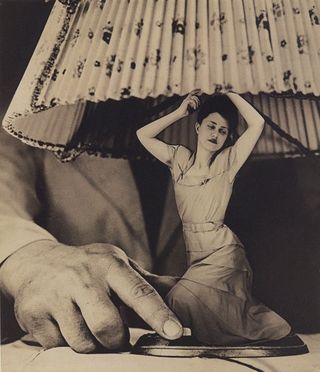
Lampshade_jpg_470x2277_q85“Every photograph is a fake from start to finish,” the photographer Edward Steichen asserted in the first issue of Camera Work in 1903. In what amounts to a backhanded defense of photography as art, Steichen explained that “a purely impersonal, unmanipulated photograph” was “practically impossible.” A year later, he would print The Pond-Moonrise—a sylvan pond contemplated through a heavy curtain of atmosphere, realized through layers of pigment, the application of a blue wash, and an enhanced (or introduced) slice of lunar radiance.

Is photography a way of documenting the world that has an inherent “truth-claim” on the real? Or is it, as Steichen suggested, essentially graphic, a technique for creating a certain kind of image? “Faking It: Manipulated Photography Before Photoshop,” an exhibition now up at the Metropolitan Museum of Art (later traveling to the National Gallery and Houston’s Museum of Fine Art), makes a vigorous case for understanding the medium as Steichen did. The argument is amplified in the accompanying catalogue written by curator Mia Fineman, who, in effect, proposes a new truth-claim of her own: “Photography’s veracity has less to do with essential qualities of the medium than with what people think and say about it.”

According to Fineman, photography has been artificially enhanced almost from its advent in 1839. “Especially in the early days of the medium, producing a realistic-looking photograph often required a healthy dose of artful trickery,” she writes. Moreover, the familiar insistence on photographic objectivity is itself something that derives from the early twentieth-century emergence of photojournalism and social documentary—and also, we might add, of motion pictures. In that sense, photography is pre-modern as well as postmodern.

More here.

My 6,128 Favorite Books

Joe Queenan in the Wall Street Journal:

RV-AI510A_QUEEN_DV_20121019192059I started borrowing books from a roving Quaker City bookmobile when I was 7 years old. Things quickly got out of hand. Before I knew it I was borrowing every book about the Romans, every book about the Apaches, every book about the spindly third-string quarterback who comes off the bench in the fourth quarter to bail out his team. I had no way of knowing it at the time, but what started out as a harmless juvenile pastime soon turned into a lifelong personality disorder.

Fifty-five years later, with at least 6,128 books under my belt, I still organize my daily life—such as it is—around reading. As a result, decades go by without my windows getting washed.

My reading habits sometimes get a bit loopy. I often read dozens of books simultaneously. I start a book in 1978 and finish it 34 years later, without enjoying a single minute of the enterprise. I absolutely refuse to read books that critics describe as “luminous” or “incandescent.” I never read books in which the hero went to private school or roots for the New York Yankees. I once spent a year reading nothing but short books. I spent another year vowing to read nothing but books I picked off the library shelves with my eyes closed. The results were not pretty.

More here. [Thanks to Fawzia Naqvi.]

The Inner Life of Quarks

Don Lincoln in Scientific American:

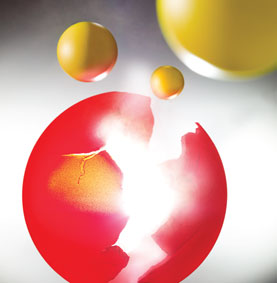
The-inner-life-of-quarks_2The Standard Model is one of the most strikingly successful theories ever devised. In essence, it postulates that two classes of indivisible matter particles exist: quarks and leptons. Quarks of various kinds compose protons and neutrons, and the most familiar lepton is the electron. The right mix of quarks and leptons can make up any atom and, by extension, any of the different types of matter in the universe. These constituents of matter are bound together by four forces—two familiar ones, gravity and electromagnetism, and the less familiar strong and weak nuclear forces. The exchange of one or more particles known as bosons mediates the latter three forces, but all attempts to treat gravity in the microrealm have failed.

The Standard Model leaves other questions unanswered as well, such as: Why do we have four forces and not some other number? And why are there two types of fundamental particles rather than just a single one that handles everything?

These are intriguing problems. Nevertheless, for a long time now a different puzzle has captured my attention and that of many other physicists. The Standard Model views quarks and leptons as indivisible. Astoundingly, though, various clues imply that they are instead built of still smaller components.

More here.

Salt Lake Tribune Endorsement: Too Many Mitts

From the Salt Lake Tribune:

ScreenHunter_07 Oct. 21 16.37To claim, as Romney does, that he would offset his tax and spending cuts (except for billions more for the military) by doing away with tax deductions and exemptions is utterly meaningless without identifying which and how many would get the ax. Absent those specifics, his promise of a balanced budget simply does not pencil out.

If this portrait of a Romney willing to say anything to get elected seems harsh, we need only revisit his branding of 47 percent of Americans as freeloaders who pay no taxes, yet feel victimized and entitled to government assistance. His job, he told a group of wealthy donors, “is not to worry about those people. I’ll never convince them they should take personal responsibility and care for their lives.”

Where, we ask, is the pragmatic, inclusive Romney, the Massachusetts governor who left the state with a model health care plan in place, the Romney who led Utah to Olympic glory? That Romney skedaddled and is nowhere to be found.

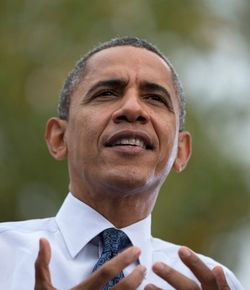
And what of the president Romney would replace? For four years, President Barack Obama has attempted, with varying degrees of success, to pull the nation out of its worst financial meltdown since the Great Depression, a deepening crisis he inherited the day he took office.

In the first months of his presidency, Obama acted decisively to stimulate the economy. His leadership was essential to passage of the badly needed American Recovery and Reinvestment Act. Though Republicans criticize the stimulus for failing to create jobs, it clearly helped stop the hemorrhaging of public sector jobs. The Utah Legislature used hundreds of millions in stimulus funds to plug holes in the state’s budget.

More here.

Humor Contest winners announced

From The Washington Post:

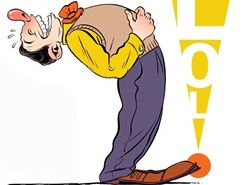
Humor%20copyThrowing a humor contest is like throwing a party: Immediately after you send the invitations, you start fretting about whether anyone will come. We needn’t have worried. After we launched the WP Magazine Humor Contest in July, a thousand people took fingers to keyboards (and pens to paper — there are eight Luddites still out there) and entered memoirs. More than a thousand tweeted jokes to us, and 156 sent photos.

Memoir winner: A Stroke of Luck?

It must be hard to feel like a winner when you grow up with the name Homer. But my dad, Homer — son of Greek immigrants and whose brother was Aristotle — always felt like a winner. When you always see the good side of things, I guess you do feel like a winner — and he always saw the positive in everything. Whatever we had, it was the best. Whatever deal he made in his real estate career, it was the best deal around. It’s a great way to grow up and a great way to live. But when he had a stroke while we were vacationing in Ocean City when he was 75, it was hard to see the positive.

He woke up one morning and couldn’t talk.
More here.

Scientists read dreams

From Nature:

SleepScientists have learned how to discover what you are dreaming about while you sleep. A team of researchers led by Yukiyasu Kamitani of the ATR Computational Neuroscience Laboratories in Kyoto, Japan, used functional neuroimaging to scan the brains of three people as they slept, simultaneously recording their brain waves using electroencephalography (EEG). The researchers woke the participants whenever they detected the pattern of brain waves associated with sleep onset, asked them what they had just dreamed about, and then asked them to go back to sleep. This was done in three-hour blocks, and repeated between seven and ten times, on different days, for each participant. During each block, participants were woken up ten times per hour. Each volunteer reported having visual dreams six or seven times every hour, giving the researchers a total of around 200 dream reports. Most of the dreams reflected everyday experiences, but some contained unusual content, such as talking to a famous actor. The researchers extracted key words from the participants’ verbal reports, and picked 20 categories — such as 'car', 'male', 'female', and 'computer' — that appeared most frequently in their dream reports. Kamitani and his colleagues then selected photos representing each category, scanned the participants’ brains again while they viewed the images, and compared brain activity patterns with those recorded just before the participants were woken up.

“We built a model to predict whether each category of content was present in the dreams,” says Kamitani. “By analysing the brain activity during the nine seconds before we woke the subjects, we could predict whether a man is in the dream or not, for instance, with an accuracy of 75–80%.”

More here.

Sunday Poem

Listening to Sun Ra, Birds Convene Outside my Window

A friend of mine likes to chide me
for what he calls my bourgeois proclivity
to listen only to music played in time.

So each time this afternoon I’ve put on
volume one of The Heliocentric Worlds
by Sun Ra, I’ve thought of that friend,

and wondered whether he would let this
qualify as sufficiently experimental,
though it isn’t the full recorded chaos

he often argues is the only moral
kind of music left. A silly pretense
of his, but one I can’t help sometimes

measuring myself against. And, I admit,
though there are stretches of incoherence
on this record that try my patience,

I can usually find a definite plotting,
particularly the sections where the bass
begins a walking line the other instruments

organize themselves around; making what
Sun Ra, in his own way chiding one critic’s
attempt to classify his compositions

as free jazz, more accurately dubbed
“phre” jazz: the ph signifying the definite
article, and though I don’t know how

in English to make that claim cohere,
it’s an assertion I’ll grant Sun Ra
not just because he may have meant

the definite article of some form of speech
not yet part of human understanding,
but also because it imbues everything

in his songs with purpose. There in the word,
Ra said, indicates the sun, so that his music
is the music of the sun. And really,

Read more »

Saturday, October 20, 2012

cigarettes

Cigarettes-mathews

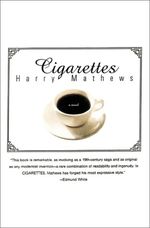
The characters in Cigarettes aren’t even going mad—a not-infrequent narrative terminus for Mathews’s manikins—save for the luckless, wonderful, hyperthyroidic Phoebe. And though there are enthusiasms in the book that verge upon the eccentric, these are pursued, so to speak, with sanity . . . Baron Charlus more than Casper Gutman (or Baron Charlus seeking an assignation with Casper Gutman). The characters of Cigarettes do not, by and large, allow whatever abstract systems they may have applied to their thoughts or habits or desires (a specialized vocabulary, a system of classification, installed out of a desire for order, or simply by whim) to impinge on their waking lives, crowding out the everyday situations that they had sought to improve. The opposite, in fact, obtains in Cigarettes. Idées fixes consume themselves here, leaving their survivors outside desire. In literary terms, by the end of the book, these personalities are no longer plotted. Though age and ill health and obsession take their toll on many, and our narrator must contend at last with a virtual army of what he calls the living dead—the shades with which our memories populate the world—the arc of the book is clear: It moves from moneyed decay—a “gabled house” looming over the reader-carrion “like a buzzard”—toward the astounding coda of “the immortal presence of that original and heroic actor who saw that the world had been given to him to play in without remorse or fear.”

more from Jeremy M. Davies at the Quarterly Conversation here.