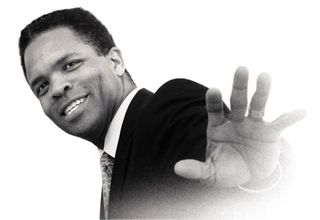
Jr.: Who Thwarted the Ambitions of Jesse Jackson’s Son?

Jessejackson121105_1_560

Jason Zengerle in NY Magazine:

Four years ago, in the fading light of a chilly December afternoon, Jesse Louis Jackson Jr. arrived at a Chicago office building for the most important meeting of his political life. As the eldest son of the Reverend Jesse L. Jackson, Jesse Jr. was no stranger to high-powered summitry. When Jackson was an infant, Martin Luther King Jr. paid visits to his family’s tiny apartment; as a teenager, he accompanied his father to meet with presidents in the Oval Office; by the time he was a young man, and a key adviser to “Reverend” (as he often addressed his father), he was traveling the globe for encounters with Fidel Castro and Nelson Mandela. Now, as the representative for Illinois’s Second Congressional District, Jackson was a political player in his own right—someone whose time was in demand by any number of powerful people, including Barack Obama, who’d tapped Jackson as a co-chair for both his 2004 Senate bid and his just-concluded presidential campaign.

The man with whom Jackson was meeting that afternoon was not a world-historical figure. Illinois governor Rod Blagojevich was under federal investigation for corruption, and a recent poll had put his approval rating at 13 percent. And yet, as far as Jackson was concerned, Blagojevich was a political titan. It was his job to appoint the person who would fill Obama’s Senate seat—an appointment Jackson desperately coveted. Although he was just 43 years old, he had already spent thirteen years in Congress and was itching to move on to bigger things. “I grew up wanting to be just like Dad,” Jackson once said. “Dad wanted to be president.” He’d flirted with runs for U.S. senator and Chicago mayor as possible stepping-stones and was determined not to lose this opportunity. “He’d watched all these people whom he had helped pass him by, especially Barack,” Delmarie Cobb, a Chicago political consultant and a former Jackson adviser, says. “And he was like, ‘Wait a minute, I’ve got to do something!’”

Tuesday Poem

It Cannot Stay

I was once told the gold in life can not stay
That just like the harvest moon, it can not stay

That while night shall always give birth to day
We should not dream of light, it can not stay

Rage, Rage against the dying of the light, the old sages say
But why battle against fate, even it can not stay

And we abhor the moon and what in darkness may lay
But our fears will leave soon, it can not stay

We hope and pray for heroes to keep our nightmares at bay
But even heroes die, they can not stay

And you, Little Bear, whose pains are all that light the way
Even Bears have faltering strength, but the sputter can not stay

by Nick Yuknalis

Is “Portrait of a Lady” by Henry James a great American novel?

From New Statesman:

HenryHenry James once defined criticism as the mind “reaching out for the reasons of its interest”, a process that he deemed “the very education of our imaginative life”. Michael Gorra doesn’t include this quotation in Portrait of a Novel but it is an apt description of the book he has written about James’s The Portrait of a Lady (1881). For many readers, Portrait is the greatest of James’s many masterpieces. It was indisputably the pivot on which his fiction turned toward the problem that would absorb him for the rest of his life, the problem of consciousness. It is the novel that defined psychological interiority as drama, forever changing our ideas about what fiction can do. In particular, its famous 42nd chapter, in which Isabel Archer discovers that instead of “affronting her destiny”, as she hoped, her destiny has affronted her, must, as Gorra argues, stand “as one of James’s greatest achievements and a turning point in the history of the novel”.

I expect that mine will prove a minority perspective on Gorra’s marvellous portrait of Portrait, for I read it while in the final stages of revising my own book about the genesis of an American masterpiece, in my case F Scott Fitzgerald’s The Great Gatsby. Unearthing the roots of a classic novel is a (comparatively) novel way for the critic to reach out for the reasons of our own interests, to explore the education of our imaginative life. For Gorra, it provides an opportunity to reframe The Portrait of a Lady against the background of James’s life and art, his ideas about consciousness, desire and autonomy and his role in the invention of American literature. Like Gorra, I am also drawing on biography, correspondence, history and literary criticism to discover the origins of great fiction.

More here.

To Birds, Storm Survival Is Only Natural

Natalie Angier in The New York Times:

BirdsIn the wake of Hurricane Sandy and the spiteful me-too northeaster, much of the East Coast looked so battered and flooded, so strewed with toppled trees and stripped of dunes and beaches, that many observers feared the worst. Any day now, surely, the wildlife corpses would start showing up — especially birds, for who likelier to pay when a sky turns rogue than the ones who act as if they own it? Yet biologists studying the hurricane’s aftermath say there is remarkably little evidence that birds, or any other countable, charismatic fauna for that matter, have suffered the sort of mass casualties seen in environmental disasters like the BP oil spill of 2010, when thousands of oil-slicked seabirds washed ashore, unable to fly, feed or stay warm. “With an oil spill, the mortality is way more direct and evident,” said Andrew Farnsworth, a scientist at the Cornell Lab of Ornithology. “And though it’s possible that thousands of birds were slammed into the ocean by this storm and we’ll never know about it, my gut tells me that didn’t happen.”

To the contrary, scientists said, powerful new satellite tracking studies of birds on the wing — including one that coincided with the height of Hurricane Sandy’s fury — reveal birds as the supreme masters of extreme weather management, able to skirt deftly around gale-force winds, correct course after being blown horribly astray, or even use a hurricane as a kind of slingshot to propel themselves forward at hyperspeed.

More here.

Monday, November 12, 2012

Sunday, November 11, 2012

The Poetry of Miraji

Geeta Patel in Dawn:

Miraji204112012_cmyMiraji was very young when he wrote many of his essays on poetry that he could have encountered only through such “travels”; some of them, collected in Mashriq-o-Maghrib ke Naghmain, were composed when he was 18 years old. So from the inception of his first forays into writing the lovely nazms, geets and ghazals for which he became famous, he translated. And these translations were seminal for him as a poet.

A few poets have acknowledged how important translation is for their own composition. Perhaps Rilke in his ninth elegy alluded to the centrality of translation. Johann Wolfgang von Goethe, moved by the Sanskrit play Shakuntala and the profound lines of Hafez, sought out translation as inspiration for cycles of lyric. Kenneth Rexroth, in his essay “The Poet as Translator,” characterised translation as a kind of going beyond oneself in the act of voicing someone else’s lyric: “The translation of poetry into poetry is an act of sympathy — the identification of another person with oneself, the transference of his utterance to one’s own utterance … to transmit it back into one’s own idiom with maximum viability.” But Rexroth ventures further than this when, in discussing the British poet HD’s translations from ancient Greek, he calls her process and her verse “the story of her own possession by the ghost of Meleager”. For Rexroth the skimpiest understanding of translation is the common one: translation as a process of turning a text from one language into a text in another. Here the translator is almost absent, treated as a transparent funnel or conduit who enables what is most important — the new text. And usually what people look for when they think of translation in this way is fidelity, how close the translation is to the original. Rexroth brings the translator back into view, not just as someone who has to feel their way into the original by overcoming a self, but as someone who, in the process of translation, is taken over by the words that they are translating. They become something or someone else, and the two languages in their hands absorb these transformations. To explain the place of translation in Miraji’s life and work I would go even further. Adrienne Rich, in the United States, comes the closest to exemplifying what I want to say. Her poetic voice changed after she worked on Ghalib and she found in ghazal a form of lyric that made it more possible for her to enunciate love as loss. Miraji sought after different kinds of speaking when he translated; these then became his voice. But he also became another person through translation. And I am not sure how many poets have, like Miraji, held onto the spaces between translation and composition, composition and reading, reading and translation, as though they were as necessary as breath.

More here.

WHAT DO ANIMALS WANT?

Marian Stamp Dawkins in Edge:

Bk_444_dawkinsm630The questions I'm asking myself are really about how much we really know about animal consciousness. A lot of people think we do, or think that we don't need scientific evidence. It really began to worry me that people were basing their arguments on something that we really can't know about at all. One of the questions I asked myself was: how much do we really know? And is what we know the best basis for arguing for animal welfare? I've been thinking hard about that, and I came to the conclusion that the hard problem of consciousness is actually very hard. It's still there, and we kid ourselves if we think we've solved it. Therefore, to base the whole argument of animal welfare and the ethical way we treat animals on something as nebulous as having solved the hard problem of consciousness seemed to be a really bad thing. Not at all a good thing for animals. I was interested in trying to find other arguments to support animal welfare; reasons why people should take notice of animals that didn't rest on having solved the hard problem of consciousness.

It seemed to me that if you think about human beings, the way to get them to change their behavior is to show them that their own self-interest lies in doing something. For example, if you argue that animal welfare improves human health, improves the health of their children, it gives them better food, it gives them better quality of life. Those arguments may actually be much more powerful for people who aren't already convinced about animal welfare than trying to use an argument based on animal consciousness, when really we haven't got the good basis for it that some people would like to think we have.

More here.

Romney Is President

Maureen Dowd in The New York Times:

Dowd_New-articleInlineIT makes sense that Mitt Romney and his advisers are still gobsmacked by the fact that they’re not commandeering the West Wing. (Though, as “The Daily Show” correspondent John Oliver jested, the White House might have been one of the smaller houses Romney ever lived in.) Team Romney has every reason to be shellshocked. Its candidate, after all, resoundingly won the election of the country he was wooing. Mitt Romney is the president of white male America. Maybe the group can retreat to a man cave in a Whiter House, with mahogany paneling, brown leather Chesterfields, a moose head over the fireplace, an elevator for the presidential limo, and one of those men’s club signs on the phone that reads: “Telephone Tips: ‘Just Left,’ 25 cents; ‘On His Way,’ 50 cents; ‘Not here,’ $1; ‘Who?’ $5.” In its delusional death spiral, the white male patriarchy was so hard core, so redolent of country clubs and Cadillacs, it made little effort not to alienate women. The election had the largest gender gap in the history of the Gallup poll, with Obama winning the vote of single women by 36 percentage points.

As W.’s former aide Karen Hughes put it in Politico on Friday, “If another Republican man says anything about rape other than it is a horrific, violent crime, I want to personally cut out his tongue.” Some Republicans conceded they were “a ‘Mad Men’ party in a ‘Modern Family’ world” (although “Mad Men” seems too louche for a candidate who doesn’t drink or smoke and who apparently dated only one woman). They also acknowledged that Romney’s strategists ran a 20th-century campaign against David Plouffe’s 21st-century one. But the truth is, Romney was an unpalatable candidate. And shocking as it may seem, his strategists weren’t blowing smoke when they said they were going to win; they were just clueless.

More here.

Freedom & Diversity: A Liberal Pentagram for Living Together

Gartonash_1-112212_jpg_230x1357_q85

Timothy Garton Ash in the NYRB:

“Multiculturalism” has become a term of wholly uncertain meaning. Does it refer to a social reality? A set of policies? A normative theory? An ideology? Last year, I served on a Council of Europe working group with members from eight other European countries. We found that the word meant something different, and usually confused, in every country.

Some, though not all, of the policies described as “multiculturalism” over the last thirty years have had deeply illiberal consequences. They have allowed the development of “parallel societies” or “subsidized isolation.” Self-appointed community leaders have used public funds to reinforce cultural norms that would be unacceptable in the wider society, especially in relation to women. This has come close to official endorsement of cultural and moral relativism. A perverse effect has been to disempower the voices of the more liberal, secular, and critical minority within such ethnically or culturally defined minorities.

If, therefore, you want to elaborate a version of multiculturalism that is genuinely compatible with liberalism, as some distinguished political theorists do, you have to spend pages hedging the term about with clarifications and qualifications. By the time you have finished doing that, the justification for a separate new “ism” has evaporated. Why not simply talk about the form of modern liberalism suited—meaning also, developed and adapted—to the conditions of a contemporary, multicultural society?

When understandings of liberalism were expanded to embrace equal liberty under law for people of all social classes, it was not thought necessary to speak of “multiclassism”; nor, when extended to those of all skin colors, “multicolorism”; nor again, when to those of all genders and sexualities, “multigenderism” or “multisexualitism.” Painful though this will be to those who have expended their academic careers on multiculturalism, the term should be consigned to the conceptual dustbin of history.

In Sentencing Criminals, Is Norway Too Soft? Or Are We Too Harsh?

Finland prison

Liliana Segura in The Nation:

It’s not very often the concept of restorative justice gets much play outside scholarly publications or reformist criminal justice circles, so first, some credit for Max Fisher at The Atlantic for giving it an earnest look last week. In seeking to explain Norway’s seemingly measly twenty-one-year sentence for remorseless, mass-murdering white supremacist Anders Breivik—a sentence that is certain to be extended to last the rest of his life—Fisher casts a critical eye on the underlying philosophy that animates that country’s sentencing practices, finding it to be “radically different” from what we’re used to in the United States. When it comes to criminal sentencing, he notes, the United States favors a retributive model—in which an offender must be duly punished for his crimes—over a restorative model that “emphasizes healing: for the victims, for the society, and, yes, for the criminal him or herself.”

“I don’t have an answer for which is better,” he says at the outset, acknowledging that his own sense of outrage over Breivik’s sentence—like that of many Americans—“hints at not just how different the two systems are, but how deeply we may have come to internalize our understanding of justice, which, whatever its merits, doesn’t seem to be as universally applied as we might think.”

This is true, and a promising place to start. The United States is uniquely punitive when it comes to sentencing compared to much of the rest of the world, whether the crime is murder or drug possession. Putting aside the death penalty, which lands us in dubious international company, in countries with life sentences on the books, prisoners are often eligible for release after a few decades. “Mexico will not extradite defendants who face sentences of life without parole,” the New York Times’s Adam Liptak noted in 2005 (Most of Latin America has no such sentence). “And when Mehmet Ali Agca, the Turkish gunman who tried to kill Pope John Paul II in 1981, was pardoned in 2000, an Italian judge remarked, ‘No one stays 20 years in prison.’ ”

The same article quoted Yale law professor James Q. Whitman, author of a book comparing US sentencing with Europe. “Western Europeans regard 10 or 12 years as an extremely long term, even for offenders sentenced in theory to life,” he said. Today, there are more than 41,000 people serving life without parole in the United States compared to fifty-nine in Australia, forty-one in England and thirty-seven in the Netherlands.

It’s Been a Tough Week for Hidden Variable Theories

Delayed_choice_experiment

Shaun Maguire in Quantum Frontiers:

The RSS subscriptions which populate my Google Reader mainly fall into two categories: scientific and other. Sometimes patterns emerge when superimposing these disparate fields onto the same photo-detection plate (my brain.) Today, it became abundantly clear that it’s been a tough week for hidden variable theories.

Let me explain. Hidden variable theories were proposed by physicists in an attempt to explain the ‘indeterminism’ which seems to arise in quantum mechanics, and especially in the double-slit experiment. This probably means nothing to many of you, so let me explain further: the hidden variables in Tuesday’s election weren’t enough to trump Nate Silver’s incredibly accurate predictions based upon statistics and data (hidden variables in Tuesday’s election include: “momentum,” “the opinions of undecided voters,” and “pundit’s hunches.”) This isn’t to say that there weren’t hidden variables at play — clearly the statistical models used weren’t fully complete and will someday be improved upon — but hidden variables alone weren’t the dominant influence. Indeed, Barack Obama was re-elected for a second term. However, happy as I was to see statistics trump hunches, the point of this post is not to wax political, but rather to describe the recent failure of hidden variable theories in an arena more appropriate for this blog: quantum experiments.

The November 2nd issue of Science had two independent papers describing the results of recent delayed-choice experiments. The goal of these papers was to rule out hidden variable theories as an explanation for aspects of quantum mechanics.

Was Nate Silver the Most Accurate 2012 Election Pundit?

Nate-Silver

Over at Center for Applied Rationality, Luke with Gwern Branwen:

Obama may have won the presidency on election night, but pundit Nate Silver won the internet by correctly predicting presidential race outcomes in every state plus the District of Columbia — a perfect 51/51 score.

Now the interwebs are abuzz with Nate Silver praise. Gawker proclaims him “America’s Chief Wizard.” Gizmodo humorously offers 25 Nate Silver Facts (sample: “Nate Silver’s computer has no “backspace” button; Nate Silver doesn’t make mistakes”). IsNateSilverAWitch.com concludes: “Probably.”

Was Silver simply lucky? Probably not. In the 2008 elections he scored 50/51, missing only Indiana, which went to Obama by a mere 1%.

How does he do it? In his CFAR-recommended book The Signal and the Noise: Why So Many Predictions Fail, but Some Don’t, Silver reveals that his “secret” is bothering to obey the laws of probability theory rather than predicting things from his gut.

An understanding of probability can help us see what Silver’s critics got wrong. For example, Brandon Gaylord wrote:

Silver… confuses his polling averages with an opaque weighting process… and the inclusion of all polls no matter how insignificant – or wrong – they may be. For example, the poll that recently helped put Obama ahead in Virginia was an Old Dominion poll that showed Obama up by seven points. The only problem is that the poll was in the field for 28 days – half of which were before the first Presidential debate. Granted, Silver gave it his weakest weighting, but its inclusion in his model is baffling.

Actually, what Silver did is exactly right according to probability theory. Each state poll provided some evidence about who would win that state, but some polls — for example those which had been accurate in the past — provided more evidence than others. Even the Old Dominion poll provided some evidence, just not very much — which is why Silver gave it “his weakest weighting.” Silver’s “opaque weighting process” was really just a straightforward application of probability theory. (In particular, it was an application of Bayes’ Theorem.)

The Online Funeral

Evan Selinger in the Huffington Post:

ScreenHunter_27 Nov. 11 17.24My grandfather died on Halloween. Thanks to Hurricane Sandy, none of the New York family members could attend the funeral in Massachusetts. Fortunately, another option became available: The ceremony was streamed online, and so my wife, daughter and I gathered around a laptop in our living room to watch the live webcast.

The rabbi began by giving technology center stage, poignantly acknowledging that the virtual participants played an important role in honoring the deceased's memory. After that, technology receded into the background for the Massachusetts crowd. My grandmother looked like a bereaved widow. Online coverage didn't affect her demeanor — or anyone else's.

At my house, however, things were different. The technology raised all sorts of problems and questions.

For starters, there was the initial hurdle of gaining access to the webcast. A password was needed, and we were initially sent the wrong one. After conceding the mistake, the woman in charge of the set-up said that we could just catch the archived footage later on. She was trying to be helpful, but the digital convenience of it all felt completely out of place, as if we were making plans to watch a favorite sitcom later on DVR.

Once the technical difficulty got resolved, we confronted a host of unfamiliar issues of protocol and decorum. Rory, my six-year-old daughter, wanted to know if she could eat while watching.

More here.

Science Journalism and the Inner Swine Dog

Jalees Rahman in SciLogs:

Cogito_Innerer_Schweinehund_Bonn-224x300A search of the PubMed database, which indexes scholarly biomedical articles, reveals that 997,508 articles were published in the year 2011, which amounts to roughly 2,700 articles per day. Since the database does not include all published biomedical research articles, the actual number of published biomedical papers is probably even higher. Most biomedical researchers work in defined research areas, so perhaps only 1% of the published articles may be relevant for their research. As an example, the major focus of my research is the biology of stem cells, so I narrowed down the PubMed search to articles containing the expression “stem cells”. I found that 14291 “stem cells” articles were published in 2011, which translates to an average of 39 articles per day (assuming that one reads scientific papers on week-ends and during vacations, which is probably true for most scientists). Many researchers also tend to have two or three areas of interest, which further increases the number of articles one needs to read.

Needless to say, it has become impossible for researchers to read all the articles published in their fields of interest, because if they did that, they would not have any time left to conduct experiments of their own. To avoid drowning in the information overload, researchers have developed multiple strategies how to survive and navigate their way through all this published data.

More here.

Sunday Poem

Romeo and Juliet
—excerpt, Scene III

The grey-eyed morn smiles on the frowning night,
Chequering the eastern clouds with streaks of light,
And flecked darkness like a drunkard reels
From forth day's path and Titan's fiery wheels:
Now, ere the sun advance his burning eye,
The day to cheer and night's dank dew to dry,
I must up-fill this osier cage of ours
With baleful weeds and precious-juiced flowers.
The earth that's nature's mother is her tomb;
What is her burying grave that is her womb,
And from her womb children of divers kind
We sucking on her natural bosom find,
Many for many virtues excellent,
None but for some and yet all different.
O, mickle is the powerful grace that lies
In herbs, plants, stones, and their true qualities:
For nought so vile that on the earth doth live
But to the earth some special good doth give,
Nor aught so good but strain'd from that fair use
Revolts from true birth, stumbling on abuse:
Virtue itself turns vice, being misapplied;
And vice sometimes by action dignified.
Within the infant rind of this small flower
Poison hath residence and medicine power:
For this, being smelt, with that part cheers each part;
Being tasted, slays all senses with the heart.

William Shakespeare

Saturday, November 10, 2012

Tulsi Gabbard, Hawaii Democrat, Poised To Be Elected First Hindu In Congress

R-TULSI-GABBARD-CONGRESS-large570

Omar Sacirbey in The Huffington Post:

Hindu Americans have run America's major companies and universities, won Nobel prizes and Olympic gold medals, directed blockbuster movies, and even flown into space. But one profession has so far been out of reach: Member of Congress.

That may change next week in Hawaii's 2nd congressional district, where Democrat Tulsi Gabbard is poised to win an out-of-nowhere bid over Republican opponent Kawika Crowley. Gabbard was leading Crowley 70 percent to 18 percent, according to an Oct. 12 poll by the Honolulu Civil Beat.

The heavily Democratic district also elected one of two Buddhists to have ever served in Congress, Mazie Hirono, who won her seat in 2006 but is now running for the U.S. Senate.

Gabbard, 31, was born in American Samoa to a Catholic father and a Hindu mother, and moved to Hawaii when she was 2. In 2002, at age 21, she was elected to the Hawaii state legislature.

The next year, she joined the Hawaii National Guard, and in 2004 was deployed to Baghdad as a medical operations specialist. After completing officers' training she deployed to Kuwait in 2008 to train the country's counter-terrorism units.

Not everyone would welcome a Hindu into Congress. When self-proclaimed “Hindu statesman” Rajan Zed was asked to open the Senate with a prayer in 2007, the American Family Association called the prayer “gross idolatry” and urged members to protest; three protesters from the fundamentalist group Operation Save America interrupted the prayer with shouts from the gallery.

Then-Rep. Bill Sali, R-Idaho, said the prayer and Congress' first Muslim member “are not what was envisioned by the Founding Fathers.” Former presidential candidate Rick Santorum told supporters this summer that equality was a uniquely Judeo-Christian concept that “doesn't come from the East and Eastern religions.” Crowley, in an interview with CNN.com, said Gabbard's faith was incompatible with the Constitution.

Meaningful Words Without Sense, & Other Revolutions

Pyke-Philosophers_0005

Richard Marshall interviews Jerry Fodor in 3:AM Magazine:

3:AM: Your recent incursion into the Darwin wars caught some people by surprise but really it shouldn’t have. You basically were arguing the same case against a version of natural selection that you used against behaviourism weren’t you? The pesky intension/intention distinction was something you realised lay at the heart of a hidden piece of fallacious thinking in the Darwinian camp and although disguised it was a potentially devastating element. Can you say why the mechanism for natural selection used by Darwinists is flawed?

JF: That’s easy. Darwinism doesn’t have a mechanism for natural selection; in particular, the `theory of natural selection’ doesn’t provide one. That was the main theme of Piatelli and my book What Darwin Got Wrong. Darwin, like Skinner, is a `black box’ theorist; both insist that the non-random variables in explanations of biological traits are environmental .In consequence, Darwin is left with the hopeless problem, of (which the `linkage’ of traits is a parade example) how environmental variables could account for the effects of a creatures internal organisation in determining its phenotype. Hence the familiar loose talk about `Mother Nature’s role in guiding trait selection. Dawkins (among others) keeps assuring us that such talk is metaphorical. But he never does explain how to cash the metaphor. Skinner’s problem is exactly the same, except he’s interested not in innate phenotypes but in acquired `behavioral repertoires’.