
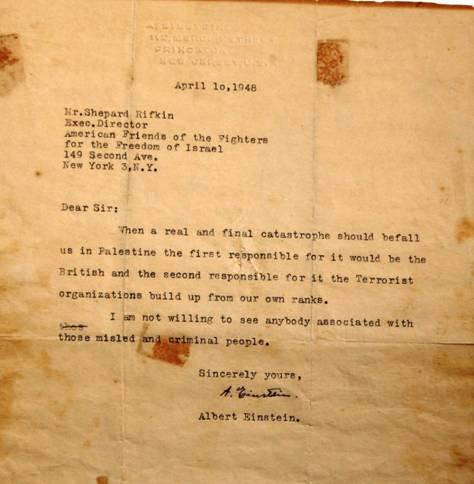
More here.
Category: Recommended Reading
Sunday, November 18, 2012
Goodbye, Frustration: Philip Roth on Retirement
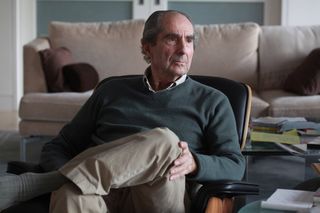
Charles McGrath in the NYT:
To his friends the notion of Mr. Roth not writing is like Mr. Roth not breathing. It sometimes seemed as if writing were all he did. He worked alone for weeks at a time at his house in Connecticut, reporting every morning to a nearby studio where he wrote standing up, and often going back there in the evening. At an age when most novelists slow down, he got a second wind and wrote some of his best books: “Sabbath’s Theater,” “American Pastoral,” “The Human Stain” and “The Plot Against America.” Well into his 70s, the books, though shorter, came uninterruptedly, practically one a year.
But over the course of a three-hour interview — his last, he said — Mr. Roth seemed cheerful, relaxed and at peace with himself and his decision, which was first announced last month in the French magazine Les InRocks. He joked and reminisced, talked about writers and writing, and looked back at his career with apparent satisfaction and few regrets. Last spring he appointed Blake Bailey as his biographer and has been working closely with him ever since.
Mr. Roth said he actually made the decision to stop writing in 2010, a few months after finishing his novel “Nemesis,”about a 1944 polio epidemic in his hometown, Newark.
“I didn’t say anything about it because I wanted to be sure it was true,” he said. “I thought, ‘Wait a minute, don’t announce your retirement and then come out of it.’ I’m not Frank Sinatra. So I didn’t say anything to anyone, just to see if it was so.”
The Mind Report: On the Psychology of Cheating and Lying
Bal Thackeray’s Poisonous Legacies
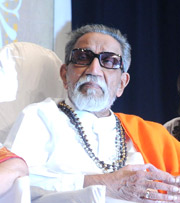
Sanyasi over at Chapati Mystery:
The Indian media prides itself on its independence, its critical eye, its ability to speak truth to power. Indian celebrities fancy themselves socially responsible intellectuals. Indian politicians routinely remind the world of the glorious vibrancy and dynamism of the “world’s largest democracy.” But neither the conventions of in-house obituary boilerplate nor the pithy wisdom of the tweets emanating from the finest minds in Indian media, celebrityhood, and politics have spoken today in any honest way about Thackeray’s role in one of most disgraceful episodes in the history of independent India–the pogrom against Bombay’s Muslim communities in 1992 and 1993. When they have pointed to Thackeray’s involvement, they have refused to ask the difficult but obvious questions that follow; questions about justice, rights, accountability, and rule of law, but also about tolerance, coexistence, and our responsibility to our fellow citizens.
The list of those participating in what can only be called a soft-pedaling of Bal Thackeray’s legacy, through this Fox News style “Fair and Balanced” approach, is a veritable who’s who of contemporary Indian political, social, and cultural life. The President and Prime Minister of India; politicians across parties; Sachin Tendulkar, Harbhajan Singh and other cricketers; any number of Bollywood actors, directors, and producers who queued up to meet him as he lay on his deathbed; and reputed journalists like Rajdeep Sardesai, Barkha Dutt, and Vir Sanghvi.
This is the real legacy of Bal Thackeray. To make political violence so routine that it ceases to outrage. To make the strategy of scapegoating and targeting particular ethnic, religious, or political groups part of the calculus of everyday politics. To make fear and intimidation a legitimate, accepted part of political leadership. And to constantly remind any potential critic, in media or otherwise, of the threat of violent reprisal for saying something that Thackeray and his thugs might not appreciate.
Ali: fear eats the soul
girlfriend in a coma
For Esme With Love and Squalor
Sunday Poem
Subways in Europe
I ride out into nowhere on the Paris blue line
because it is Paris after all, and riding is being
anywhere else but home on a bus out West.
There are people who think riding the subways
of Europe is only a way to get around, to work
or the theater, to a bookstore, or some place
like a destination, with a purpose, a goal. But
I ride for the pleasure of the displacement,
distance grows in me like a nervous worm.
No one rides the subways here just for the ride.
They believe in destiny. I ride through factory towns
on the outskirts of cities, through neighborhoods
where the incomprehensible graffiti screams, words
whipped up out of a maelstrom of urban languages,
ride through subsistence gardens planted along tracks
that feed those who cannot ride the subways
for pleasure. It is a time machine, this subway,
journeying back into the world’s fine, forgotten
ancestry. It’s a spider that feeds on my desire
for the oldest forms of communion.
.
by George Moore
from Drafthorse, Winter 2012
Stop pretending the US is an uninvolved, helpless party in the Israeli assault on Gaza
Glenn Greenwald in The Guardian:
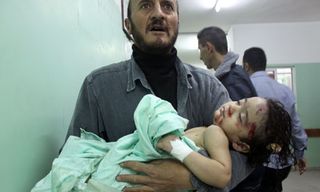
Literally each day since the latest attacks began, the Obama administration has expressed its unqualified support for Israel's behavior. Just two days before the latest Israeli air attacks began, Obama toldPalestinian Prime Minister Mahmud Abbas “that his administration opposes a Palestinian bid for non-state membership of the UN”. Both the US Senate and House have already passed resolutions unequivocally supporting Israel, thus earning the ultimate DC reward: the head-pat from Aipac, which “praised the extraordinary show of support by the Senate for Israel's struggle against terrorist attacks on its citizens”. More bipartisan Congressional cheerleading is certain to come as the attacks continue, no matter how much more brutal they become.
More here.
Unfortunately, it was paradise
Lars Haberg in lensculture:
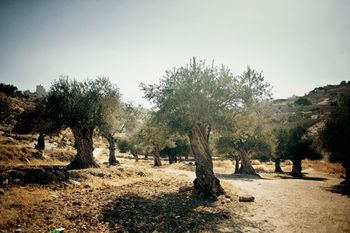
Eventually this project is not only about Palestine. Making stories about the occupation is impossible without portraying Israel from a West Bank Palestinian perspective. I want to communicate the occupation’s impact on daily life. To understand this is crucial to be able to understand Palestine. And I think it is impossible to make any sense out of this conflict without understanding the people and the communities that are mentally and physically affected. Palestine is one of those two communities.
Picture: Since 2001, Israel through its military and settlers in the West Bank and Gaza, has uprooted, burnt and destroyed more than 548,000 olive trees that belong to Palestinians. The uprooting of the ancient olive trees, as a byproduct of war, has had tremendous effects on the Palestinian agriculture, economy, and identity.
More here.
Ray Kurzweil’s Dubious New Theory of Mind
From The New Yorker:
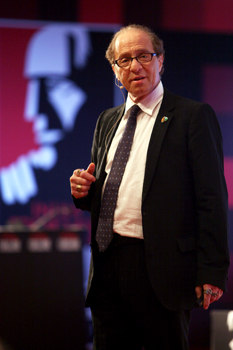
Which Kurzweil shows up to explain the mind? The brilliant inventor and autodidact or the man who has written one book on diets and another on immortality?
More here.
Saturday, November 17, 2012
making sense of oppenheimer

Robert Oppenheimer, the American theoretical physicist and “father of the atomic bomb”, continues to be hailed as one of the towering figures in 20th-century science. Friend and colleague of the great names in theoretical physics, and charismatic leader of outstanding teams of researchers at Caltech, Berkeley and finally Princeton, he was a man whose huge intellectual curiosity and energy also embraced literature, poetry and philosophy. Thousands of pages of biography have been devoted to this complicated and controversial figure since his early death from throat cancer in 1967. Yet Oppenheimer remains an enigma, “an endlessly, maddeningly and intriguingly baffling man”, as Ray Monk wrote in 2004, reviewing Jeremy Bernstein’s perceptive memoir Oppenheimer: Portrait of an Enigma. Now, in Inside the Centre: The Life of J. Robert Oppenheimer, the much-lauded biographer Monk has himself taken on the task of trying to make sense of him.
more from Lisa Jardine at the FT here.
calasso’s baudelaire
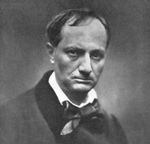
“Modernity: a word that emerges and rebounds between Gautier and Baudelaire in the space of a little more than 10 years . . . between 1852 and 1863. And this was always done with caution, with the awareness of introducing an alien notion into the language. Gautier, 1855: ‘Modernity. Does this noun exist? The sentiment it expresses is so recent that the word may very well not be in the dictionaries.’ Baudelaire, 1863: ‘He is looking for that something we shall be allowed to call modernity; since there isn’t a better word to express the idea in question.’ But what was this idea . . . so recent and feeble . . . made of? The malicious Jean Rousseau immediately declared it was made up of bibelots and female bodies. Arthur Stevens responded to him in defense of Baudelaire, defined on the occasion for the first time as ‘he who is the inventor, I believe, of this word modernity.’ Through painting and frivolity, modernity burst into the dictionary. But it was destined to remain and spread, following progressive campaigns of conquest, accompanied by devastation. Soon no one would remember these frivolous and modest beginnings. In Baudelaire, however, the word remained enfolded as in a mist of perfume and face powder.”
more from John Simon at the NY Times here.
Katherine Boo’s “Behind the Beautiful Forevers”
Katherine Boo's Behind the Beautiful Forevers won the National Book Award on Wednesday. Here's a review by Anis Shivani in the Huffington Post:
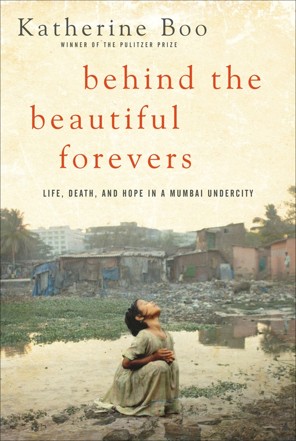
Earlier in the year when I read the book, I hoped it would be in line for the major awards. I was impressed with the way Boo keeps herself out of the narrative, giving us a no-holds-barred dramatization of life in the slums, without any element of romanticization or exoticization. Boo is a staff writer for the New Yorker, married to the Indian academic Sunil Khilnani, and has previously written about poor communities in the U.S. There isn't a single jarring note as she transitions to reporting about Annawadi.
Boo's is not the only recent book in this genre. While the dominant impression from neoliberal propagandists like Thomas Friedman is that of an aspiring hegemon with a thriving middle class of more than 300 million people, and growing more powerful by the day, more honest writers have been presenting a mixed picture of the winners and losers resulting from India's high-stakes economic liberalization, a regime the country has been doggedly pursuing since the early 1990s.
More here.
Yes, the Gulf monarchs are in trouble
Christopher M. Davidson in Foreign Policy:
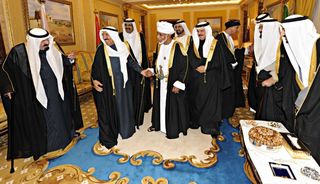
These six monarchies — Saudi Arabia, the United Arab Emirates (UAE), Kuwait, Bahrain, Qatar, and Oman — have faced down a number of different opposition movements over the years. However, for the most part, these movements have not been broad-based and have tended to represent only narrow sections of the indigenous populations. Moreover, given their various internal and external survival strategies — including distributive economic systems and overseas soft power accumulation — the incumbent regimes have generally been in strong, confident positions, and have usually been able to placate or sideline any opposition before it could gain too much traction. In most cases the Gulf monarchies have also been very effective at demonizing opponents, either branding them as foreign-backed fifth columns, as religious fundamentalists, or even as terrorists. In turn this has allowed rulers and their governments to portray themselves to the majority of citizens and most international observers as safe, reliable upholders of the status quo, and thus far preferable to any dangerous and unpredictable alternatives. Significantly, when modernizing forces have begun to impact their populations — often improving communications between citizens or their access to education — the Gulf monarchies have been effective at co-option, often bringing such forces under the umbrella of the state or members of ruling families, and thus managing to apply a mosaic model of traditional loyalties alongside modernization even in the first few years of the 21st century.
More recently, however, powerful opposition movements have emerged that have proved less easy to contain.
More here.
Roddy Doyle – The Spire
[Thanks to Amitava Kumar.]
Bal Thackeray, 1926-2012
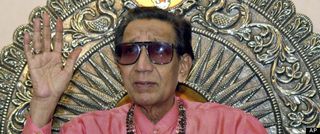
Bal Thackeray, head of the Shiv Sena, is dead. Rajesh Shah in the Huffington Post:
Throughout his political career Thackeray was a powerful, rabble-rousing orator who routinely sanctioned the use of violence to propagate his political views. He was arrested at least twice for his for inflammatory speeches and writing.
His extreme regional and religious parochialism led him to advocate Hindu suicide bombers and planting bombs in Muslim neighborhoods to “protect the nation and all Hindus.”
His followers often attacked and rampaged through the offices of media houses that he claimed were anti-Maharashtrian and anti-Hindu and threatened to dig up cricket pitches ahead of matches between largely Hindu India and its Muslim-majority neighbor Pakistan.
Even though the Shiv Sena's political grip over Mumbai – its longtime power base – has been waning over the last decade, it still commands tens of thousands of violent followers.
The slight, bespectacled leader often appeared in front of his supporters seated on a silver throne-like chair, a gift from party workers.
In the early 1990s he led a successful campaign to drop what he called the colonially tainted name Bombay – a Portuguese derivation of “beautiful bay” – and replace it with Mumbai, after the local Marathi language name for a Hindu goddess. The city is the capital of Maharashtra state.
His supporters continued to sporadically threaten violence against places and institutions that held on to the old name like the Bombay Stock Exchange, the Bombay High Court, the elite Bombay Scottish School and countless restaurants, shops and offices.
Here is an article on Thackeray's role in the 1992-1993 Bombay riots.
Top Ten Myths about Israeli Attack on Gaza
Juan Cole in Informed Comment:
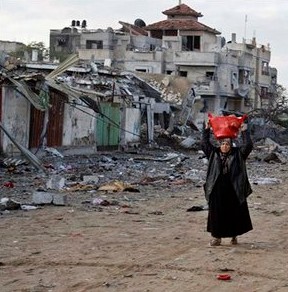
2. Actions such as the assault on Gaza can achieve no genuine long-term strategic purpose. They are being launched to ensure that Jewish-Israelis are the first to exploit key resources. Rattling sabers at the Palestinians creates a pretext for further land-grabs and colonies on Palestinian land. That is, the military action against the people of Gaza is a diversion tactic; the real goal is Great Israeli, an assertion of Israeli sovereignty over all the territory once held by the British Mandate of Palestine.
3. Israeli hawks represent their war of aggression as in ‘self-defense.’ But Israel’s chief rabbi admitted on camera that that the Gaza attack actually ‘had something to do with Iran.’
More here.
Saturday Poem
The Ante
—First Workshop
.
A few sonnets about nature and the Greek gods.
Many free-verse poems in all lowercase letters.
Huey wrote of madness, Maddox of possums.
John played the sadness of empty stadiums.
Two berets, one silver-tipped cane, tweedy blazers.
In most Natalie poems, she took off her clothes.
The year of the Tet offensive. Wallace in Montgomery.
We read James Wright, Richard Wilbur, Anne Sexton.
One Friday an ex-guidance counselor from Jasper
leapt through the window of a cafeteria, shouting
“I am the son of Jesus Christ! Behold the rapture!”
Tiger mothers will disagree, but you can’t manufacture a prodigy
From New Statesman:

…Anyone who has observed parents in the elite pockets of London or New York will have witnessed the hysteria attached to early achievement. It is as wrong as it is terrifying. The biologist E O Wilson was asked what represented the greatest hindrance to the development of children; his answer was the “soccer mom” and her list of after-school clubs and activities. Obsession with how well your child is doing at the age of three and a half has been compounded by pop science books promising the secret of nurturing greatness. The genre tells us nothing about genius but a great deal about ourselves. In a phony meritocracy, genius must be reduced to a formula that is open to anyone. It cannot be acknowledged unless it can be domesticated and commodified.
Cherry-picking is the preferred methodology favoured by authors determined to “decode” genius and to uncover a template for future greatness. Well, let’s cherry-pick two examples that demonstrate the problem with cherry-picking. Until very recently, the pre-eminent rivalry in men’s tennis was between Rafael Nadal and Roger Federer. It is one of the greatest rivalries in sports history. Here is the crucial point: though both men were exceptional young players, the learning environment in which they grew up could not have been more different. Nadal’s parents effectively ceded Rafa’s tennis upbringing to his father’s brother, Toni. Uncle Toni was brutally tough, pushing Rafa to the limits of his physical and mental capacity. Even now, despite being an 11-time Grand Slam winner, Nadal plays with a hounded intensity, as if fearful that he will be punished if he ever stops chasing down lost causes. When Rafa was growing up, as John Carlin’s authorised biography describes, the rest of the family worried deeply that Toni might be damaging the teenager: “In the case of Rafa’s mother, [bemusement] occasionally gave way to anger . . . His godfather went so far as to say that what Toni was doing to the child amounted to ‘mental cruelty’.” There is no escaping the logic that Nadal’s education was an enormous risk. The uncle gambled that his nephew could withstand extraordinary pressure. Rafa could easily have been crushed. That the risk ended in success does not prove it was not a risk. Compare the story of Federer, who has won 17 Grand Slam titles. A passage in Jon Wert – heim’s book Strokes of Genius summarised the influence of Federer’s family: “His parents weren’t pushy; if anything, they were ‘pully’. If they nudged him at all, it was to stop taking tennis so seriously. Instead of supplementing God-given talent with burning ambition and intense training, the Federers stressed fun. Instead of suggesting to their son that he was special, the Federers took pains to treat Roger no differently from their daughter, Diana.” The Nadals pushed the boundaries; the Federers provided a “relentless onslaught of the normal”. In terms of nurturing winners, the two opposite approaches have been roughly equally vindicated. In human terms, both men are widely admired. There is no “right” approach. It depends on the character of the child.
More here.