
Category: Recommended Reading
Tuesday, November 6, 2012
Why 40 percent of Americans won’t vote
From MSNBC:
Voting inconvenient
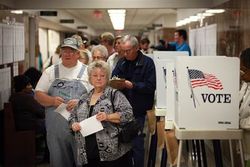
“Part of the issue is we have too much democracy,” McDonald said. “We're just voting a lot in the U.S.” With state, local and national races, as well as mid-term elections, most Americans have a chance to cast a ballot about once every year. Other Western democracies may only have an election every five years, McDonald told LiveScience. That frequency makes voting a hassle, he said.
More here.
Are your political views hardwired
From Smithsonian:
Right brain, left brain
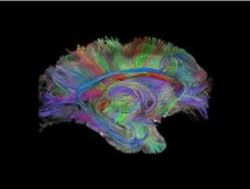
The latest research came out last week, a study at the University of South Carolina that concluded that the brains of self-identified Democrats and Republicans aren’t hard-wired the same. Specifically, the scientists found more neural activity in areas of the brain believed to be linked with broad social connectedness in Democrats (friends, the world at-large) and more activity in areas linked with tight social connectedness in the Republicans (family, country). This was in line with what previous studies have suggested, that people who say they’re Democrats tend to take a more global view on issues while those who call themselves Republicans tend to see things through more of an American filter. But the findings also ran counter to previous research suggesting Democrats are, by biological nature, more empathetic souls than Republicans. Not so, according to the South Carolina study; it’s just that Republicans are more likely to focus their empathy on family members or people they know.
More here.
How Other Animals Choose Their Leaders
You think our elections are tough? Tell it to the wolves.
Rob Dunn in Slate:
The idea that ants, honeybees, or other social animals might do a thing or two better than we do is ancient. The Bible, Torah, and Quran all invoke insect societies. In the Amazon, Kayapo children were once advised to follow the brave, social ways of the ant (and to eschew the more vulgar ways of the termite).
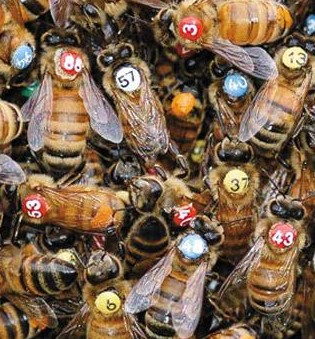
Most recently, Cornell University entomologist Tom Seeley has written a lovely and compelling book titled Honeybee Democracy which suggests we turn to the bees to see how they make decisions. Thanks to the work of Seeley and his collaborators, it is now clear that honeybee hives really are democratic. When it’s time to look for a new nest, options are weighted by the evaluations of many different bees about a site’s qualities—its size, its humidity, the density of surrounding flowers. Individual bees vote with dances, and when the number of dances in favor of some particular site is high enough, the masses are swayed. Together, citizen bees choose, if not perfection, the best possible option.
More here.
Election Preview from n + 1
Mark Greif in n + 1:
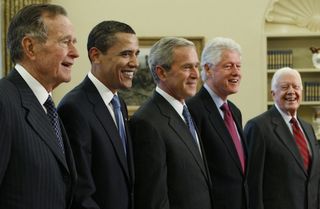
More here by Greif as well as others. [Scroll down to continue reading the piece by Mark Greif.]
Correcting the math of journalists in Ohio
Robert Wright in The Atlantic:
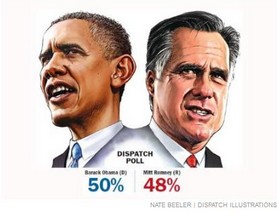
That wording suggests that Obama's two-point edge has no meaning. And that's a common way for journalists to interpret results that fall within the “margin of error.” For example, in September a conservative columnist in the New York Post asserted that Obama's lead in state polls didn't matter because the “polls separating the two candidates are within the margin of error — meaning that there is no statistical difference in support between Obama and Romney.”
Explaining why it's wrong to say there's “no statistical difference” in such cases will take a couple of paragraphs, so please bear with me (unless you recently took a stats course, in which case you can skip these paragraphs if not more).
Here's what pollsters never tell you, except maybe in the fine print: When they say there's a margin of error of X, they don't mean there's no chance whatsoever that the poll is off by more than X. Typically, their margin-of-error calculations are based on a confidence level of 95 percent, which means the chances of the poll being off by more than X are 5 percent.
In the Columbus Dispatch poll, X was 2.2. So if the poll had found Obama was ahead by 2.21 points, the finding would have been “outside the margin of error” and thus treated with great respect — but the fact is that there would still have been a 5 percent chance that, in the actual voting population, Romney was ahead. (I'm assuming the Dispatch followed convention and used the 95 percent confidence threshold in calculating its margin of error — see postscript below.) The flip side of this coin is that the Obama lead of 2 points in the poll, though less than the margin of error of 2.2 points, is by no means devoid of significance. If you did the math — which, many years after taking quantitative analysis in college, I lack the brain cells to do precisely — you'd find that there's a probability of somewhere in the neighborhood of 90 percent that Obama is ahead in the voting population as a whole.
More here.
Pakistani Power Play
If the United States wants to curb terrorism and nuclear proliferation, it needs to fundamentally rethink its relationship with Pakistan.
C. Christine Fair in Foreign Policy:
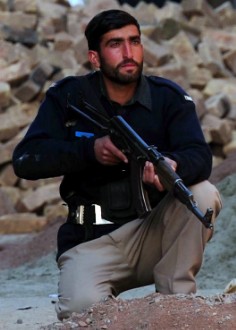
The self-proclaimed “land of the pure” has used Islamist militants as tools of foreign policy since its earliest days of independence. In the fall of 1947, tribal marauders from Pakistan's Pashtun areas, benefiting from extensive government support, rushed into the princely state of Kashmir in hopes of seizing it for Pakistan. Leaders of the newborn Pakistani state feared that the king of the Muslim-dominant state of Kashmir would seek independence or agree to join India. The strategy triggered the very event Islamabad was trying to prevent: The king, watching with apprehension as his own security forces failed to stave off the attackers, sought India's help. India agreed to come to his aid, provided that the maharaja join India's dominion. Indian troops thus joined the fight to defend its newly acquired territory. The eventual ceasefire left the princely state divided between the dominions of India and Pakistan.
To wrest all of Kashmir from India, Pakistan has since then raised and nurtured numerous Islamist militant groups. In 1989, an indigenous insurgency erupted in Kashmir in response to gross Indian malfeasance. Pakistan swiftly took advantage of the surge of so-called mujahideen who had trained in Afghanistan fighting the Soviets. Pakistan's “foreign” militants overtook the Kashmiri insurgency. By the mid-1990s, the violence in the valley was mostly conducted by Pakistani terrorists — predominantly ethnic Punjabis — ostensibly on behalf of Kashmiris.
More here.
David Byrne Speaking and Singing
And also a song from David Byrne and St. Vincent's new album (which I highly recommend buying–have been listening to it non-stop for some time now) Love This Giant:
money, art

In the Gilded Age, many of the banks that have recently played important and devastating roles in our financial life—Goldman Sachs, JPMorgan, Lehman Brothers—were guided by men who had a passion for painting. J. P. Morgan’s collection was legendary. Paul Sachs, an early partner at the family firm, left banking to become a specialist in Italian Renaissance art, and to found the program in curatorial studies at Harvard. Robert Lehman and his father, Philip Lehman, each of whom ran Lehman Brothers, together assembled one of the great collections of Florentine and Sienese art outside Italy. Even the bank established to bail these other banks out, the Federal Reserve, had at its inception Paul Warburg. Warburg, often referred to as the “father” of the Federal Reserve, was the brother of Aby Warburg, one of the greatest scholars of the Italian Renaissance. In much the same way that aptitudes for math and music seem to descend together in families, so do there seem to be lineages for those gifted in the representation of value: the bankers and the painters. Not only did Gilded Age bankers study and collect art, their financial inventions were structurally quite like those of painters working at the same time. In particular, the financiers, as was true of Cézanne and his followers among the cubists, were interested in new representations of the future.
more from Rachel Cohen at The Believer here.
The Crushing of Eastern Europe
When the Red Army reached Poland, in the summer of 1944, it waited on the banks of the Vistula, just outside Warsaw, while the S.S., under the direction of Heinrich Himmler, killed fifteen thousand Polish partisans, who had staged an armed uprising, and more than two hundred thousand civilians. At the end of the fighting, half a million Poles were sent to camps, and the rest were deported as slave laborers to Germany. On Hitler’s orders, the city was razed. When the Red Army finally entered Warsaw, in January, 1945, the streets were filled with dead bodies. No one living remained. Except in Bulgaria, which has cultural ties to Russia, Soviet soldiers not only looted but raped, almost systematically, in the countries they passed through. In eastern Germany alone, up to two million women are believed to have been raped by Soviet soldiers. But, apart from complaining about Stalin’s refusal to come to the aid of the Warsaw Poles, Britain and the United States did nothing to stop the pillage of Eastern Europe.
more from Louis Menand at The New Yorker here.
a relatively clean story

Science and its practical consort Engineering mostly come out of this week with enhanced reputations. For some years now, various researchers have been predicting that such a trauma was not just possible but almost certain, as we raised the temperature and with it the level of the sea—just this past summer, for instance, scientists demonstrated that seas were rising faster near the northeast United States (for reasons having to do with alterations to the Gulf Stream) than almost anyplace on the planet. They had described, in the long run, the loaded gun, right down to a set of documents describing the precise risk to the New York subway system. As nature pulled the trigger in mid-October, when a tropical wave left Africa and moved into the Atlantic and began to spin, scientists were able to do the short-term work of hurricane forecasting with almost eerie precision. Days before Sandy came ashore we not only knew approximately where it would go, but that its barometric pressure would drop below previous records and hence that its gushing surge would set new marks. The computer models dealt with the weird hybrid nature of the storm—a tropical cyclone hitting a blocking front—with real aplomb; it was a bravura performance.
more from Bill McKibben at the NYRB here.
Tuesday Poem
Bait Goat
There is a
distance where
magnets pull,
we feel, having
held them
back. Likewise
there is a
distance where
words attract.
Set one out
like a bait goat
and wait and
seven others
will approach.
But watch out:
roving packs can
pull your word
away. You
find your stake
yanked and some
rough bunch
to thank.
.
by Kay Ryan
from Poetry, Vol. 192, No. 5
A bad few weeks for girls’ schools in Pakistan
From New Statesman:
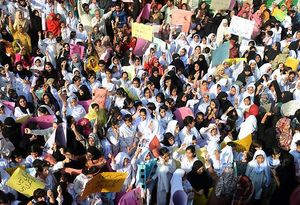
Blasphemy is an extremely inflammatory issue in Pakistan. Insulting the Prophet or the Quran can carry the death penalty, while even the suggestion that blasphemy has taken place is enough to trigger violent outburst of public anger. Not a single newspaper has specified exactly what the alleged blasphemy is – indeed, to do so could lead to fresh charges being directed at the publishers. On this basis, accusers can even refuse to repeat the blasphemy in court, leading to a situation that would be farcical were it not so dangerous. The light burden of proof means that the law is often used to settle scores – indeed, it has been suggested that this charge could be a plot against the school, which is one of the most successful in Lahore. The complaint was lodged by Abdullah Saqib, the vice principal of Jamia Kareemia Sadidia, a religious school in the same area. Possible conspiracies aside, what does this incident tell us? First of all, women and girls are ready to defend their right to be educated. Following the violence of the mob reaction, around 2,000 students, parents and teachers took to the streets on Saturday to demand that the school reopen. The crowd, predominantly made up of teenage girls, carried placards and chanted slogans including “release our principal”. Just like the reaction to the Malala shooting, this demonstrates that society is not willing to compromise on its right to educate its daughters, whether the threat is coming from armed militants or from an angry mob.
Secondly, it shows that the tide has not turned against blasphemy laws.
More here.
Blind mole rats may hold key to cancer
From Nature:
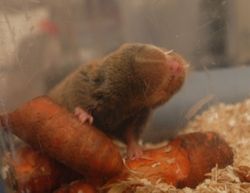
Three years ago, Gorbunova was involved in another study that described the unusual way in which the cells of the naked mole rat behave in the lab2. The authors say that this hints at how the rats resist cancer. When cells from most animals are grown in a culture dish, they divide until they form a single layer of cells covering the base of the dish. At this point, healthy cells stop dividing, whereas cancerous ones continue. But the cells of naked mole rats behave as if they are 'claustrophobic', ceasing to divide much sooner than cells from other species. “We thought the blind-mole-rat cells would use the same mechanism as those of naked mole rats,” says Gorbunova, “so the fact that they do not was a big surprise”. Rather than ceasing to divide, the cells of blind mole rats reach a point at which they die en masse in a bout of cell suicide that Gorbunova and her co-authors call “concerted cell death”. This seems to be triggered by the collective release of a signalling molecule called interferon-beta, although what causes this is unclear. “The cells have some way of sensing when they are overproliferating, but we still don’t know precisely how they sense that,” Gorbunova says. “This is what we need to find out next, because it could provide some clue as to how we could activate the same process in human cells.”
More here.
Monday, November 5, 2012
Perceptions
In sympathy and solidarity with all those on the eastern seaboard who have suffered at the hand of last week's superstorm, including the many flooded art galleries in Chelsea, there is no art post today.
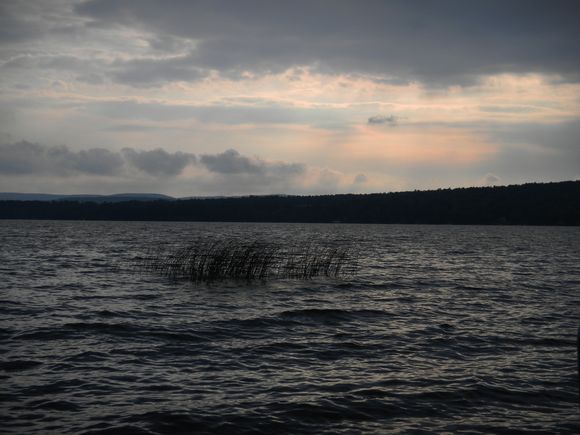
Tip-o-the-hat to Lauren Shaw, who will recognize this photograph of water as we love it.
Sunday, November 4, 2012
Seeing what isn’t there
From Salon:
Sacks, on the other hand, has always been fascinated by outliers. It’s his professed belief that the underlying structures and functions of the brain can be most captivatingly glimpsed in the experiences of the man who mistook his wife for a hat and the man who kicked his own leg out of bed. This approach, not incidentally, also makes for much better stories than, say, descriptions of studies in which college students were asked to memorize numbers under trying circumstances. There’s an aura of self-help surrounding most popular neuroscience books today, with all the banality that term implies. What the Sacks style lacks in personal applicability it makes up for in marvels. So much so, in fact, that filmmaker Wes Anderson offered a parody version of Sacks in “The Royal Tenenbaums”: a shrink, played by Bill Murray, whose career is built on exhibiting his clients’ freakishness to the public.
More here.
Beautiful physics: Tying knots in light
From PhysOrg:
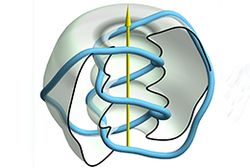
“Apart from their curiosity value, what's really interesting and useful about these knots of darkness is that they show you what the power flow is doing,” Dr Desyatnikov said. “It is part of the incredible progress science is making in the field of optics, we're beginning to do things with light that would have once seemed impossible.” “The idea of a knot of light is something scientists have been exploring for years and a few groups have managed to achieve just that by precisely engineering laser beams with “artificial” or “hand-made” knots. But what we've been working on are models in which the knots spontaneously form on their own, just like those annoying knots that you always get in electrical cables. “However unlike electrical cables which love to form knots, light doesn't. Scientists have found that inducing knots to form in laser beams by introducing perturbations in the form of laser speckle only very rarely induces knots. “Our models suggest that you have to get the key parameters of the light in a certain range before you can easily tie the light in knots but once you do, the knots are virtually guaranteed,” he said.
More here.
A Campaign Map, Morphed By Money
Colm Tóibín: you have to be a terrible monster to write
With a mind as formidable as his features, Colm Tóibín is now firmly a part of Ireland’s literary landscape. It’s both a blessing and a curse.
Nigel Farndale in The Telegraph:

The 57-year-old author shows me a work-in-progress on his desk, written in longhand in a notebook. “I have to write a first draft with a fountain pen before I type it up as a second,” he explains. “John Lanchester and Philip Hensher do the same. I bumped into them the other night and we were all doing our pen talk.”
Tóibín talks in a strong but ponderous voice — which is, by the way, as Irish as whiskey with an “e”. The deliberation, he reckons, may be a compensation for a childhood stammer. He avoids starting sentences with hard consonants. In conversation with him you have to hold your nerve and not rush to fill the long silences, as he is probably half way through a thought.
“I was waiting to get money out of a machine last night,” he tells me, “and there were these two lads who were slightly drunk messing about in front of me in the queue. The cheekier one looked at me and said: ‘So you’re busy at the moment?’ I must have been looking quite severe and was about to say ‘Yes I am, and I want to get home’ when he added ‘with the writing?’ and I had to smile. I took out my ink pen, held it up and went ‘Yeah’.”
More here.
The Great Repudiation and the Return to Normalcy: Prospects for Obama’s Second Term
Anis Shivani in Big Think:
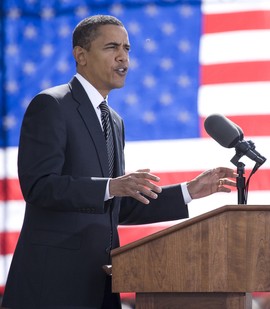
I assert this because before Mitt Romney chose the first debate to unveil his etch-a-sketch moment—very smart, because it left little time for the obvious deceit to be exposed, and because he’d already signaled his allegiance to the extreme right for much of the campaign—he was headed for a historic loss. If Romney has any chance in the election, it’s only because he’s temporarily assumed the posture of a Massachusetts moderate, a persona relatively low-information voters partly bought into, as he repudiated every single extremist policy position of his, both domestic and international, over the course of three debates.
Romney and the Republicans, it was clear by October 3, could not win on their terms; the Romney-Ryan agenda was dead in the water, if it was going to be presented for what it really was. Voucherization of Medicare is a loser, as is ending abortion in cases of rape and incest, or self-deportation for “illegals.”
More here.