The Science of Sizzle

From The New York Times:

“Which comes first, the stir-fry or the wok?” It may sound like a bad joke, but the answer holds the key to one of the world’s great cuisines. Bee Wilson’s supple, sometimes playful style in “Consider the Fork,” a history of the tools and techniques humans have invented to feed themselves, cleverly disguises her erudition in fields from archaeology and anthropology to food science. Only when you find yourself rattling off statistics at the dinner table will you realize how much information you’ve effortlessly absorbed. Wilson, an award-winning British food journalist and historian who contributes the “Kitchen Thinker” column to The Sunday Telegraph, is also, incidentally, the daughter of the biographer and novelist A. N. Wilson. Her fourth book (following histories of beekeeping, food scandals and the sandwich) proves she belongs in the company of Jane Grigson, one of the grandes dames of English food writing. Like Grigson’s, Wilson’s insouciant scholarship and companionable voice convince you she would be great fun to spend time with in the kitchen.

So, which does come first, the stir-fry or the wok? Wilson’s answer is, “Neither.” To solve the riddle, we have to take a step back and contemplate cooking fuel: firewood was scarce, and with a wok you could cook more quickly after chopping food into bite-size morsels with a tou, or Chinese cleaver. Chopsticks were also part of this “symbiosis.”

More here.
Friday, November 16, 2012

An important note to our readers

ScreenHunter_36 Nov. 16 20.01I really enjoy reading the comments at 3QD. The overwhelming majority of them are intelligent discussions of the subject at hand and often lead to spirited and useful conversations in the comments sections of posts. But (you knew a “but” was coming!) recently some commenters have started to abuse the privilege that we grant them to express their views in our space.

In the last two days I have banned several commenters from 3QD and sent warnings to several others and deleted their comments. In the last year or so, I have noticed an increasing abusiveness in the comments and there are certain repeat offenders. I want to put them on notice that I am now going to have a new very low tolerance for that sort of thing. I do not have the time to write explanations of why I am deleting a given comment each time I do it but as long as you engage the argument being made in the post in a respectful way and stay on topic and desist from ad hominem attacks against either the author or the 3QD editor who posted the item, we welcome your contribution to the discussion. If you make ad hominem attacks, use nasty language, are disrespectful, call the motives of the authors or editors into question, or stray outside the topic under discussion, your comment will be deleted and you may also be blocked from commenting permanently. And this will be done without any explanation to you. I do not have the time to engage in discussions with people about why I think they are jerks.

Some commenters have been personally abusive to me or insinuated ulterior motives on my part in my choice of posts and other 3QD editors have also been attacked as well as the authors of the articles we have posted. I used to tolerate this type of thing but I will not any longer. I just don’t see why we should allow people to call us names on our own website. You can disagree with me as much as you like but you cannot insult me or question my motives. I will do the same for you. One person (whose comment has been deleted) just today, for example, called Noam Chomsky a “clown” and a “buffoon”. What sort of person has the insane chutzpah to say such a thing? Needless to say, we will not be hearing from him again at 3QD. I have absolutely no patience for this kind of thing anymore. I’ve had it.

I encourage you to argue against the views (sometimes we don’t even agree with them, we just find them interesting) that we post but insist that you do it in a civilized manner.

To the vast majority of you who do not engage in boorish commenting behavior: thank you for all your stimulating thoughts and please keep engaged in the conversation here. I love hearing from you.

You can see our very simple comments policy here. Scolding over. 🙂

Respect Gandhi If You Will, Don’t Sentimentalise Him

Perry_anderson_20121112

Praful Bidwai interviews Perry Anderson in Outlook:

You’ve explained that one of the reasons why, instead of writing simply about contemporary India, you start by looking at the struggle for independence, was your shock at the reception of Kathryn Tidrick’s work on Gandhi, so thoroughly blanketed by silence that most Indians are unaware of its existence. Tidrick concentrates on the relationship between Gandhi’s self-perception as a world-saviour— his religious beliefs— and his politics. She doesn’t really explore his role as a mass leader and tactician of the independence struggle. How far is your own account of Gandhi, which many in India would regard as a savage criticism, based on hers?

Tidrick’s biography of Gandhi is an extraordinarily careful, calm and courageous work. Not just I, but any serious student of this historical figure, would have more to learn about his outlook from her work than from any other extant study of him —the vast majority of Gandhiana being, to one degree or another, hagiographic. The silence covering it in India is an intellectual scandal which reflects poorly on local opinion. The problem here is not, of course, confined to her work. More recently, the reception of Joseph Lelyveld’s much more superficial and not very political, but extremely respectful, book about Gandhi—it’s even entitled Great Soul—tells the same story. Because it dismantles some of the legends Gandhi propagated about his time in South Africa, we have his grandson complaining that it ‘belittles’ him. It’s only in this climate of deference that my treatment of Gandhi could be regarded as sacrilege. Actually, I single out not only his remarkable gifts as a leader, and his achievement in making Congress a mass party, but also his personal sincerity and selflessness—he did not want power for himself, as most politicians do. In his own way he was a great man.

But that does not exempt him from criticism. He was gripped by a set of regressive personal fixations and phobias, had a very limited intellectual formation, was impervious to rational argument, and entirely unaware of the damage he was doing to the national movement by suffusing it with Hindu pietism as he reconceived it. He is to be respected, with all his blindness. But there is no need to sentimentalize him. The complete latitude he gave himself to declare as truth whatever he happened to say at any time, and then change it from one day to the next, still as the word of God shining through him, set a disastrous example for his followers and admirers. Nowhere more so than in his inconsistencies on satyagraha itself. For when it suited him, he was perfectly willing to contemplate violence —not only to send Indian peasants to their death on the Somme in the service of their colonial masters, or applaud Indian bombers taking off to conquer Kashmir, but calmly to envisage communal slaughter—‘civil war’— in the subcontinent as preferable to expelling the British. As a historian, one has to take cool stock of all this, not skate over it as Gandhi’s apologists continually do.

from Herodotus to globalisation

201_arts_mazower

The basic intellectual problem is this: once you have defined the central issue of politics as the preservation of liberty within a political community, absolutism, fascism and religious fundamentalism can easily present themselves as phenomena of essentially negative interest. Yet fascism, for example, produced, in the writings of Carl Schmitt, a theorist of considerable power who provided a searing critique of parliamentary democracy. His definition of politics saw liberty as a distraction and revolved instead around the friend/foe distinction. One may disagree with this, but one has to take it seriously. Yet Ryan’s treatment of fascism and Nazism remains trapped within an older historiography that sees the most important thing about these movements as their irrationalism. Today most historians would regard their challenge to interwar liberalism as much more serious than this “irrationalism thesis” acknowledges. And as a result it seems downright odd to have a history of political thought that does not engage more fully with some of Schmitt’s ideas.

more from Mark Mazower at Prospect Magazine here.

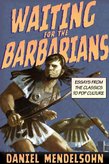
Waiting for the Barbarians

Cover00

Mendelsohn suffers from no such confusion about what he brings to the table. And, again unlike Sontag, he is neither a partisan nor an enthusiast. Five-thousand-word love letters require a kind of wild passion that seems foreign to Mendelsohn’s coolly intelligent prose. When he trumpets Sokurov, or Stendhal, or the underappreciated novelist Antonio Muñoz Molina, he actually becomes something of a bore. Give him a flaw to diagnose, on the other hand, a strange blemish on a heretofore sterling surface—say, the new confusion evident in The Stranger’s Child about whether its author, Alan Hollinghurst, stands with “the ‘queer’ outsiders or the establishment”—and Mendelsohn will solve it with Sherlockian élan, giving his answer the satisfying structure of a Conan Doyle story. Mixed reviews, in other hands often as dull as ditchwater, become intellectual detective stories, and Mendelsohn provides illuminating, elegant solutions.

more from David Haglund at Bookforum here.

simple enough for children, too difficult for grown-ups

P10_Warner_paper_L_306149m

The Grimm Brothers reproached their friends and fellow collectors, Achim von Arnim and Clemens Brentano, for altering the material they brought into print. In the Circular Letter Jacob Grimm sent out in l815, he began by asking correspondents to find songs and rhymes, but he moved on swiftly to the stories for which the Grimms have become the most widely read writers of fairy tales in the world. He specified “Local Legends [Sagen] not in verse, most especially both the various Nurses’ Tales and Children’s Tales [Ammen- und Kindermärchen] of giants, dwarves, monsters, kings’ sons and daughters spellbound and set free, devils, treasures and wishing objects, . . . Animal Fables in particular are to be noted . . .”. Philip Pullman’s half-century of tales includes a handful of the latter, cynical lessons in the world that fairy tales set out to refute with their “cunning and high spirits” (Walter Benjamin’s phrase), their improbable reversals of fate and happy endings. The Letter’s harvest was meagre, the Brothers’ richest sources remaining closer to hand in their own circle of family and friends, but its aims show the Brothers’ pioneering attempt at popular ethnography, around thirty years before the word “folklore” was introduced into English. The Grimms called what they were looking for “Folk Poesy”, and they stipulated that its origins must be unadulterated: “Above all”, Jacob wrote, “it is important that these items should be gathered faithfully and truly, without decoration and addition and with the greatest possible precision and detail, from the mouths of the story-tellers, where practicable in and with their own authentic words.”

more from Marina Warner at the TLS here.

The Agonies of Susan Rice: Gaza and the Negroponte Doctrine

Vijay Prasad in Jadaliyyah:

SusanricesusanIn the dark of night, on 14 November, the United Nations Security Council met to discuss Israel’s bombardment of Gaza. As elections in Israel are on the horizon, the Israeli Defense Force conducted an extra-judicial assassination of Hamas’ Ahmad Jabari, who only hours beforehand had received a draft of a permanent truce agreement with Israel (according to Nir Hasson at Haaretz). Jabari’s assassination was followed by a barrage by Israeli aircraft and warships. A few rockets were fired from Gaza, but these have had a negligible impact. The war on Gaza is not between two armed forces, even matched, each flying the flag of a country; it is a war between a major military power and a people that it has occupied, whose means of warfare used to be the suicide bomber and has now devolved to the erratic rockets (propelled by sugar and potassium nitrate, a fertilizer, and made deadly by TNT and urea nitrate, another fertilizer). Most of the rockets fired over the past two days have been intercepted by Israel’s sophisticated Iron Dome system. No such luck for the Palestinians, who have faced US-designed F16 jetfighters and Apache helicopters and have no defensive systems.

Morocco and Egypt, on behalf of the stateless Palestinians, hastened to the UN Security Council, wanting to stop the violence and condemn Israel for its disproportionate use of force. The Council’s President, India’s Hardeep Singh Puri said, “All the statements that I heard resonated with one message – that the violence has to stop. There has to be de-escalation.”

The United States defended Israel. Susan Rice put the onus on Hamas.

More here.

A Gaza Ground Invasion Will End Badly

Meir-Javedanfar-medium

Interesting political analysis from Meir Javedanfar, in The Times of Israel (via Hussein Ibissh):

By attacking Tel Aviv with its missiles, Hamas has crossed a major red line. No Israeli leader can ignore such an attack. The fact we have elections coming up in Israel makes it more difficult for the government to ignore today’s attack.

Tel Aviv is my city. I live here. It’s my home.

As much as I detest and condemn Hamas’s attack today, I am not sure how a massive ground invasion is going to solve the problem.

Why? because our officials are saying that “Israel won’t halt Gaza operation until Hamas begs for truce.” In terms of domestic politics, Hamas would loath to be seen as “begging” for peace. It would lose all legitimacy at home. That would mean holding our troops as well as the fate of our citizens hostage to Hamas’s domestic concerns. This must not be our exit strategy. If it is, then we are heading for an ending disaster as Hamas may prefer to engage Israel in a long drawn out guerrilla war in Gaza. This could sap the morale of our country while straining our relations with the international community.

Worst still, as my colleague Hossein Ibish points out in his interesting article, it could push Hamas and Morsi together. Lets not forget that when it comes to destroying Hamas tunnels, Morsi has done more than Mubarak did. Yes you read that right. Despite belonging to the Muslim Brotherhood organization, Morsi has actually made life for Hamas quite difficult.

Rolling Jubilee

Fg_logo

Yesterday marked the launch of Rolling Jubilee.

Strike Debt is an offshoot of Occupy Wall Street. First started in New York City, but inspired by movements around the globe, Strike Debt now has affiliates across the country. We believe people should not go into debt for basic necessities like education, healthcare and housing. Strike Debt initiatives like the Debt Resistors’ Operations Manual offer advice to all kinds of debtors about how to escape debt and how to join a growing collective resistance to the debt system. Our network has the goal of building a broad movement, with more effective ways of resisting debt, and with the ultimate goal of creating an alternative economy that benefits us all and not just the 1%.

How does it work?

Student debt has surpassed $1 trillion partly because it is one of the most protected forms of debt by federal law. Student debtors can rarely discharge their loans in bankruptcy and lenders have rights to garnish wages and social security payments. The vast majority of student loans have these federal guarantees. We cannot buy these loans because there is no secondary market. However, we believe it may be possible to buy private tuition debt of some sort that is not guaranteed by the federal government; Rolling Jubilee may attempt to purchase this kind of debt after doing further research.

Doug Henwood offers some critiques:

Call me old-fashioned, and I’m sure many have already done so, but I think that a discussion of those larger issues—stagnant wages, high unemployment, a crazy system of health care finance, madly expensive higher education—would lead inevitably to making demands on the state. (So too would debt relief: it would be a lot more powerful and effective if the Federal Reserve and the Treasury were buying bad debt and liberating debtors with their vast resources rather than a volunteer effort raising funds through Paypal.) And given the prominent role that anarchists and anarchism play in the Occupy movement, there’s not much inclination to make demands on the state. But what other institution in this society could raise the minimum wage, make it easier to organize unions, fund a Green New Deal to address climate change and create decent jobs, create a single-payer health care system, and provide universal free higher ed? The lack of those things in this very rich society contribute a lot to debt and deprivation. But that lack is not the product of a “debt system.”

Some of the critiques seem valid, but to quote Mark Blyth, “Why does everything have to be a panacea?” Also, see this NYT piece on the movement.

Wits and Wives

From Guardian:

Portrait-of-Samuel-Johnso-010We think we know where Johnson stood on women, so to speak, don't we? That crack about women preachers and dogs walking (“like a dog's walking on his hind legs. It is not done well; but you are surprised to find it done at all”). “Nature has given women so much power that the law has very wisely given them little,” is another one. In an argument about religion with one Mrs Knowles, Johnson got into quite a fury, and Boswell murmured an aside: “I never saw this mighty lion so chased before!” But, but … you should also know that Johnson was not so easily pinned down in anything, and certainly not as a misogynist. He entertained women's opinions to a greater degree than many of his contemporaries, and he certainly relished their company. His reputation for this had reached the ears of a young Mary Wollstonecraft, and Kate Chisholm begins her book with a short but well-imagined vignette of the occasion, when the future author of A Vindication of the Rights of Woman walked from Newington Green to Fleet Street to get some advice and conversation from the ill and ageing Johnson. She was a feminist avant la lettre; he was a Tory, if an unconventional one; yet it was to him that she turned at the beginning of her career.

There have been not only quite a few books about Johnson already, but a few about his relationship with women. The thing is, though, that most of the contemporary accounts are filtered through the perceptions, and the prejudices, of others. Boswell, our prime source, may well have been jealous of Mrs Thrale's friendship with Johnson; he even seemed to be jealous of his earlier marriage to Tetty (who, when they married, was old enough, at 46, to be his mother). As for modern works concentrating on this aspect of the great man's life and character, they can be either too academic, or not academic enough. Chisholm's book strikes a happy balance. It wasn't always a great deal of fun being a woman in the 18th century, even if you had somehow managed to evade convention and learn something more intellectually challenging than needlepoint. The deck was stacked against women in so many ways. Here's just one: when Elizabeth Carter brought out a translation of Epictetus it sold hugely and was widely praised – but the reviewers expressed either astonishment or disbelief that it had been written by a woman. (It's still in print, by the way; you can even get it in a Kindle edition. So there.) So the fact that Johnson had what we might as well call a coterie of female friends he could converse with on more or less equal terms was, if not extraordinary, certainly worth noting.

More here.

Friday Poem

The Tao Te Ching
—17 Not What Makes Tao Tick

The Tao flows everywhere
so everything is of it

uncreated

Every thing receives Tao’s work
but it claims nothing for itself

It feeds all worlds
but never enslaves them

The Tao and each thing
are merged

The heart of all things
are filled with Tao’s humility

Each thing comes and goes
from it and to it but

Tao endures
Call it great

But being great is not what makes
Tao tick which

…………….. makes it
…………….. great
.

by Lao Tzu
from An Understanding of the Tao Te Ching
by R. Bob

The unconscious brain can read — and even do math

From MSNBC:

MathIn a series of experiments at the Hebrew University of Jerusalem, more than 300 student participants were unconsciously exposed to words and equations through a research technique known as Continuous Flash Suppression (CFS). With this method, a static image appears in front of one eye while rapidly changing pictures flash in front of the other eye. The changing pictures dominate awareness at first, letting the still image register subliminally before popping into consciousness. In the first part of the study, one eye was presented with a static phrase or sentence, which was “masked” by changing colorful shapes flashing in front of the other eye. The students were instructed to press a button as soon as they became aware of the words. It usually took about a second, but negative phrases like “human trafficking” and jarring sentences such as “I ironed the coffee” typically registered quicker than positive expressions and more coherent phrases such as “I ironed clothes,” the study found. The researchers say these results suggest that the sentences were fully read and comprehended subconsciously, and certain phrases broke out of suppression faster because they were more surprising.

In the second part of the study, the scientists examined how the unconscious brain processes math problems. Using the CFS technique again, the researchers subliminally exposed the participants to three-digit equations, such as “9 − 3 − 4,” for two seconds or less. Then, the participants were shown a number (without CFS masking it) and told to say it out loud. The students were quicker to read aloud a number that was the right answer to the equation they had just subconsciously seen. For example, after being exposed to “9 − 3 − 4,” they were quicker to pronounce “2” than “3.” This suggests they subconsciously worked out the problem and had the answer on their lips. Other recent studies have shown that humans might be able to unconsciously perform tasks that have typically been associated with consciousness, such as learning and forming intuitions. The new study adds complex, rule-based operations to that list. Psychology researcher Ran Hassin, who was involved in the study, said the results suggest current theories about unconscious processes need to be revised.

More here.

Thursday, November 15, 2012

In Defense of Favoritism

Stephen T. Asma in the Chronicle of Higher Education:

5912-Fairness-CoverEvery parent has heard the f-word, fairness, intoned ad nauseam by their negotiating kids. My own son was an eloquent voice for egalitarianism, even before he could tie his shoes or tell time. Of course, it's not exactly universal equality that he and other kids are lobbying for, but something much more self-interested.

Kids learn early on that an honest declaration of “I'm not getting what I want” holds little persuasion for parents. So they quickly figure out how to mask their egocentric frustrations with the language of fairness. An appeal to an objective standard of fairness will at least buy some bargaining time for further negotiations. This is not entirely duplicitous on the part of the child, who is often legitimately confused and cannot easily distinguish his private sufferings from larger and clearer social imbalances.

Fairness, however, is not the be-all and end-all standard for justice, nor is it the best measure of our social lives. As a philosopher, I've noticed a tremendous amount of conceptual confusion in our use of fairness. And though we're hearing a lot of the language of fairness hurled around lately in political rhetoric, it often hinders real conversation and debate more than it helps. Most people, for example, assume that the opposite of fairness is selfishness, and since selfishness is manifestly terrible, no one but a hapless Ayn Rand devotee would be so foolish as to critique fairness. But the real opposite of fairness is favoritism—filial, tribal, nepotistic partiality—not egoistic selfishness. If that's true, then a lot of us—on the left and the right—are unwitting daily sinners against fairness. And that's not a bad thing.

More here.

Ten Things You Need to Know About Gaza

Mehdi Hasan in the Huffington Post:

1) “PRISON CAMP”

David Cameron once referred to Gaza as a “prison camp” and “some sort of open-air prison”. 1.7million Palestinians are crammed into just 140 square miles; Gaza is one of the most crowded places on earth.

Israel, despite withdrawing its troops and settlers from the Strip in 2005, continues to control its airspace, territorial waters and border crossings (with the exception, of course, of Gaza's land border with Egypt).

2) (UN)FAIR FIGHT

Remember: according to the Israeli human-rights group B'Tselem, in the last major conflict between Israel and Hamas – 'Operation Cast Lead' which kicked off in December 2008 – 762 Palestinian civilians were killed, including more than 300 children, compared to three (yes, three!) Israeli civilians.

We seem to be seeing a similar imbalance in bloodshed this time round: “More Palestinians were killed in Gaza [on Wednesday] than Israelis have been killed by projectile fire from Gaza in the past three years,” wrote Palestinian-American activist Yousef Munayyer on the Daily Beast website.

3) “COLLECTIVE PUNISHMENT”

Why do they hate us, ask ordinary Israelis? Well, Gaza has been under siege since January 2006, after its residents dared to elect a Hamas goverment in free and fair elections. The subsequent economic blockade imposed upon the Strip by the Israeli government at one stage prevented the residents of Gaza from importing, among other things, coriander, ginger, nutmeg and, even, newspapers.

Most international lawyers, as well as the International Committee of the Red Cross (ICRC), consider the blockade to be illegal under international humanitarian law; in 2009, a UN panel, led by distinguished South African judge and self-confessed Zionist Richard Goldstone, accused Israel of imposing “a blockade which amounted to collective punishment”.

More here.

The Global War on Terror shows no sign of coming to an end

Mark Danner in the New York Review of Books:

Amid the clamorous controversies of this election campaign, what strikes one here on the West Bank of the Jordan is the silences. Though the issue of Palestine promises to have a much more vital part in the volatile, populist politics of the Middle East’s new democracies—whose vulnerable governments actually must take some account of what moves ordinary people—here in Ramallah we have heard virtually nothing substantive about it, apart, that is, from Mitt Romney’s repeated charge that President Obama, presumably in extracting from Israel a hard-fought ten-month freeze on settlement building early on in his administration, had “thrown Israel under the bus.”

In fact, the West Bank is perhaps the place on the globe that has seen the least of President Obama’s promised “change you can believe in.” Nearly fifty years after Israel conquered the territories, its young soldiers are still on patrol, herding millions of Palestinians through and around an increasingly elaborate labyrinth of checkpoints, walls, and access roads, while Israeli settlers, now numbering in all more than half a million, flow over the hills, swelling their gated and fortified towns, creating one “fact on the ground” after another. Even as the land of the long-promised Palestinian state vanishes behind these barricades, the phrase “two-state solution” lives on, hovering like a ghost over the settlements, a remnant mirage of a permanently moribund “peace process” that has produced no agreement of consequence in twenty years, since the Oslo Accords vowed a Palestinian state would be declared no later than 1999.

More here.

On Art’s To-Do List: Climate Change

Andrew Russeth in the New York Observer:

ScreenHunter_33 Nov. 15 17.28Before Norwegian businessman Petter Olsen sent his version of Edvard Munch’s The Scream to the auction block at Sotheby’s New York in May, where it sold for $120 million, he spoke to the press about what he thought the work meant. At the time, Mr. Olsen’s pronouncements sounded, at least to me, a little bit off. The Scream, we’re all taught, is about existential angst, the individual crying out, alone in the universe, but Mr. Olsen, who’d lived with the work his entire life, had a more expansive view.

The Scream for me shows the horrifying moment when man realizes his impact on nature,” Mr. Olsen told the Financial Times, “and the irreversible changes that he has initiated, making the planet increasingly uninhabitable.” After last week’s storm, which killed more than 40 people in New York, destroyed homes, and damaged art, artist studios and galleries in Brooklyn and Chelsea, that reading of the painting seems painfully on point. Munch couldn’t have known about the coming climate change, but it’s all there in the work—in its original title (Scream of Nature) and in the sky and land that appear to undulate behind the bald figure.

Until visiting The Scream two weeks ago at the Museum of Modern Art, to which it has been loaned for six months by its new, anonymous owner, I had forgotten that it has three figures: besides the alarmed man who gets all of the attention, there is another man in a top hat, his head bowed as if in deep despair, and a third man, further in the distance, who stares out at the landscape, strangely unaware—or in denial—of the fact that the world is coming undone around him. Factoring in those other two, it’s easier to follow Mr. Olsen’s thinking: when it comes to the effects that humans are having on nature, most of us are the second or third person.

More here.

Another Israel-Gaza War?

Editorial from the New York Times:

ScreenHunter_32 Nov. 15 17.22Israel has a right to defend itself, but it’s hard to see how Wednesday’s operation could be the most effective way of advancing its long-term interests. It has provoked new waves of condemnation against Israel in Arab countries, including Egypt, whose cooperation is needed to enforce the 1979 peace treaty and support stability in Sinai.

The action also threatens to divert attention from what Prime Minister Benjamin Netanyahu has repeatedly described as Israel’s biggest security threat: Iran’s nuclear program.

Engaging in a full-scale ground war is especially risky. Israel’s last major military campaign in Gaza was a three-week blitz in 2008-09 that killed as many as 1,400 Palestinians, and it was widely condemned internationally. It did not solve the problem. Hamas remains in control in Gaza and has amassed even more missiles.

Some Israeli commentators have suggested that Mr. Netanyahu’s decision to order the operation is connected to elections in January.

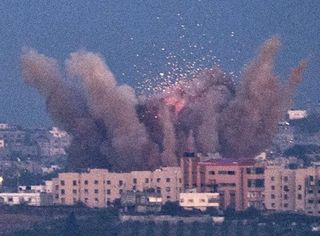
More here. [Photo from the Washington Post.]