Infinite Proofs: The Effects of Mathematics on David Foster Wallace

1353775765

Kyle McCarthy reviews David Foster Wallace's Everything and More, in the LA Review of Books:

TO THE EXTENT THAT HE WAS AT HOME anywhere, David Foster Wallace was at home in the world of math. As an undergraduate, he studied modal logic; Everything and More, his book on infinity, explained Georg Cantor’s work on set theory to a general audience, and Infinite Jest includes a two-page footnote that uses the Mean Value Theorem to determine the distribution of megatonnage among players in a nuclear fallout game.

But Wallace didn’t just talk about math. He structured his work with it. In a 1996Bookworm interview with Michael Silverblatt, Wallace explained that he modeledInfinite Jest after a Sierpinski Gasket, a type of fractal in which a triangle is infinitely subdivided into smaller triangles using the midpoint of its borders. Pressed by Silverblatt on why he chose such a formation, Wallace elaborated: “Its chaos is more on the surface; its bones are its beauty.”

Now, many people agree that Infinite Jest is a singular novel, sui generis, akin perhaps only to Moby-Dick in its originality, but the qualities that earn the book that praise — its grotesque hyperrealism, exuberant asides, and melding of academese and slang, its spikes and spurts of kindness and abjection — seem to have nothing to do with Wallace’s experimental use of fractals. Wallace’s genius lies in his guts, his encyclopedic imagination, his eyes and ears, but not, it appears, in his tricks with advanced math. And yet perhaps the fact that the casual reader remains oblivious to the Sierpinski Gasket is proof of its success. Traditional narrative structures — the Fichtean curve, Aristotle’s rising action — are designed to keep us engaged and organized, yet remain invisible; a well placed climax pops and hooks, even if we don’t notice its strategic placement. And as an organizing principle, the fractal has an intuitive logic: the best novels already have a fractionalized quality — each chapter, and indeed every paragraph and sentence, reproduce in miniature its central conflict and arc. Wallace’s comment to Silverblatt made me wonder if fractals, or some other mathematical pattern, might generate order from everyday experience without the ordinary contrivances of plot.

Rorty and the Democratic Power of the Novel

Voparil_200w

Christopher J. Voparil in Eurozine:

The context of Rorty's embrace of the novel within the development of his own thought is instructive for understanding his view of the distinctive power of this genre over others, including philosophy. As he fleshed out the political consequences of his sweeping philosophical critique in Philosophy and the Mirror of Nature, in the 1990s social and political concerns came to the forefront of his work in an unprecedented way. A central preoccupation of Rorty's was “how we treat people whom we think not worth understanding” – that is, those people whom “are not viewed as possible conversational partners”. The thesis I will argue is that Rorty's turn to the novel is part of an effort to bring excluded voices into what he called in the final section of Mirror, the “conversation of mankind”.

The primary thrust of Philosophy and the Mirror of Nature advocates a fundamental shift away from a conception of knowledge as accuracy of representation and towards an understanding of knowledge as conversation and social practice. The idea that conversation is “the ultimate context with which knowledge is to be understood” leads Rorty to a preoccupation with “conversation with strangers”, understood as those who fall outside our “sense of community based on the imagined possibility of conversation”. If, as Rorty claimed, “the community is the source of epistemic authority”, and, building on Wilfrid Sellars, “we can only come under epistemic rules when we have entered the community where the game governed by these rules is played,” then we attribute knowledge to beings “on the basis of their potential membership in this community”. To illustrate this point, Rorty gives the example of how we are more likely to get sentimental about “babies and the more attractive sorts of animal” as having feelings than, say, “flounders and spiders”. Likewise, we are more likely to care about koalas than pigs, he tells us, even though pigs rate higher on the intelligence scale, because “pigs don't writhe in quite the right humanoid way, and the pig's face is the wrong shape for the facial expressions which go with ordinary conversation”.

Derrida: A Biography

Derrida-A-Biography

Terry Eagleton reviews Benoît Peeters new book, in The Guardian:

In May 1992, the dons of Cambridge University filed into their parliament to vote on whether to award an honorary degree to the French philosopher Jacques Derrida, founder of so-called deconstruction. Despite a deftly managed smear campaign by the opposition, Derrida's supporters carried the day. It would be interesting to know how many of those who tried to block him in the name of rigorous scholarship had read a single book of his, or even a couple of articles.

The truth is that they did not need to. The word was abroad that this purveyor of fashionable French gobbledegook was a charlatan and a nihilist, a man who believed that anything could mean anything and that there was nothing in the world but writing. He was a corrupter of youth who had to be stopped in his tracks. As a teenager, Derrida had fantasised with some of his friends about blowing up their school with some explosives they had acquired. There were those in Cambridge who thought he was planning to do the same to western civilisation. He did, however, have an unlikely sympathiser. When the Duke of Edinburgh, chancellor of Cambridge University, presented Derrida with his degree in the year in which Charles and Diana separated, he murmured to him that deconstruction had begun to affect his own family too.

Deconstruction holds that nothing is ever entirely itself. There is a certain otherness lurking within every assured identity. It seizes on the out-of-place element in a system, and uses it to show how the system is never quite as stable as it imagines. There is something within any structure that is part of it but also escapes its logic. It comes as no surprise that the author of these ideas was a Sephardic Jew from colonial Algeria, half in and half out of French society. If his language was French, he could also speak the patois of working-class Arabs. He would later return to his home country as a conscript in the French army, a classic instance of divided identity.

Stalker is zen while Nostalghia is not

220px-Stalker_poster-OriginalMosfilmPoster-UsedUnderFairUsePolicy-183x300

Dyer himself says that the book is not a synopsis but an amplification of the film. Amplification towards what? Towards the metaphysical, of course. The book is philosophical in that it asks essential questions: what is film, what is literature, what am I, the writer? Nevertheless, Dyer’s approach is peculiar. He is not writing philosophy, he is not analyzing, and he is not even telling us the story of the film. “Literary anthropology” comes to mind, which does indeed exist. I know some self-critical and repentant philosophers (not all of them Germans) who have consciously turned towards that genre. Dyer himself mentions “Tarkovsky’s filmic archeology of the discarded” (p. 117) and I believe that this is exactly what Dyer is doing himself. The ruminating exploration of places draws us into Stalker, which is a film about a place (the Zone). Dyer retells this place with all its décor, colors, flickering lights, noises and smells. We might have seen the stone in the water, but Dyer lifts it up and tells us what is underneath. Finally, his anthropology of things brings us closer to the metaphysical meaning of the film (he does not identify the 1961 Peugeot 404 convertible, though).

more from Thorsten Botz-Bornstein at The Berlin Review of Books here.

thank god for uncle joe

160419068X.01.MZZZZZZZ

The most common criticism of Epstein I know is made more or less along these lines. He is, some would argue, a great prose stylist but not a very deep thinker, a septuagenarian poseur who has admittedly mastered euphony but whose prose leaves one feeling a bit cold. I have never found this to be the case. Like his mentor A.J. Liebling, Epstein dispenses real wisdom with what looks like insouciance but is really just old-fashioned agility. The most marked characteristic of his prose is a maddening subtlety that allows him to be breezy without sounding flippant, to appear learned without being pedantic, and, most strikingly, to be moral but never moralistic. His personality escapes the page with such force that, having read at least two horizontal feet of his books, one is almost tempted to think of him as a witty, fair-minded, loquacious uncle.

more from Matthew Walther at The Millions here.

mole

121203_r22883_p465

By that time, they were already beginning to think about Oaxaca, Mexico. Oaxaca, which is in the narrow part of southern Mexico that bends east toward Central America, is sometimes known as “the land of the seven moles”—a mole being a thick sauce made from as many as thirty ingredients, in a process so laborious that it puts most complicated Continental dishes into the category of Pop-Tart preparation by comparison. Having spent some time in Oaxaca many years ago, I knew that it also turns out an astonishing variety of the small treats Mexicans call antojitos—many of which consist of something in or on masa, the dough made from alkaline-treated corn kernels. Oaxaca is also known as a place where artisanal mescal thrives and tequila is spoken of as an inferior commercial tipple that might as well have been produced in the Coca-Cola bottling plant. In recent years, Oaxaca’s food scene, largely based on the traditional ingredients and methods of its indigenous people, has been celebrated by some icons of the American food world. Once Abigail and Brian decided on Oaxaca, I was quick to say that I would soon be visiting. “I’ll just give you a couple of months to find your way around,” I said to Abigail. “If you find your way around to a spot that serves a superior mole negro, all the better.”

more from Calvin Trillin at The New Yorker here.

Tuesday Poem

Become Becoming
.
Wait for evening.
Then you’ll be alone.
.
Wait for the playground to empty.
Then call out those companions from childhood:
.
The one who closed his eyes
and pretended to be invisible.
The one to whom you told every secret.
The one who made a world of any hiding place.
.
And don’t forget the one who listened in silence
while you wondered out loud:
.
Is the universe an empty mirror? A flowering tree?
Is the universe the sleep of a woman?
.
Wait for the sky’s last blue
(the color of your homesickness).
Then you’ll know the answer.
.
Wait for the air’s first old (that color of Amen).
Then you’ll spy the wind’ barefoot steps.
.
Then you’ll recall that story beginning
with a child who strays in the woods.
.
The search for him goes on in the growing
shadow of the clock.
.
And the face behind the clock’s face
is not his father’s face.
.
And the hands behind the clock’s hands
are not his mother’s hands.
.
All of Time began when you first answered
to the names your mother and father gave you.
.
Soon, those names will travel with the leaves.
Then, you can trade places with the wind.
.
Then you’ll remember your life
as a book of candles,
each page read by the light of its own burning.
.
.
by Li-Young Lee
from Behind My Eyes

The FP Top 100 Global Thinkers

From Foreign Policy:

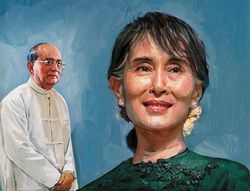
AUNG SAN SUU KYI, THEIN SEIN: For showing that change can happen anywhere, even in one of the world's most repressive states.

AungIn 2012, the hopes for the Arab Spring began fading into cynicism as the world watched Syria descend into civil war, while the region's nascent democracies struggled with their newfound freedom. But, meanwhile, one of the most remarkable and unexpected political reversals of our time has unfolded on the other side of the globe: Burma, long among the world's most repressive dictatorships, began to reform under the leadership of two very unlikely allies. For nearly 20 years, dissident Aung San Suu Kyi was sealed under house arrest by Burma's paranoid military junta, which had drawn an iron curtain over the country since 1962. Now she's a duly elected member of the country's parliament — and it's partly thanks to reformist President Thein Sein, a former general often described as an awkward, bookish bureaucrat. To the astonishment of many, Thein Sein began loosening restrictions on free speech and opening the economy after coming to power in 2011. This year, as the United States restored diplomatic ties with Burma (which the junta renamed Myanmar in 1989) and eased travel and economic sanctions, his government curbed censorship of the media and freed hundreds of political prisoners.

Aung San Suu Kyi, the soft-spoken, iconic political activist whom devotees call simply “the Lady,” may not seem like an obvious partner for Thein Sein, but she has become one by doing what few legends of her stature can: embracing the messy pragmatism of politics. Although Burma's struggles are far from over — she has warned that international investment has been too rapid, and ethnic violence is escalating — the willingness of both the Lady and the general to embrace short-term compromise and foster long-term reconciliation in what was only recently one of the world's most isolated countries is something to celebrate. Fittingly, Aung San Suu Kyi finally was able to accept her 1991 Nobel Peace Prize in June. She used the occasion to remind the world of those like her, who struggle in the most forlorn places: “To be forgotten too is to die a little. It is to lose some of the links that anchor us to the rest of humanity.” It is a sentiment still felt from Aleppo to Havana, Pyongyang to Tehran, but also, as Aung San Suu Kyi and Thein Sein have shown, one that doesn't need to be permanent.

More here.

Thinking Clearly About Personality Disorders

From The New York Times:

MindThis weekend the Board of Trustees of the American Psychiatric Association will vote on whether to adopt a new diagnostic system for some of the most serious, and striking, syndromes in medicine: personality disorders. Personality disorders occupy a troublesome niche in psychiatry. The 10 recognized syndromes are fairly well represented on the self-help shelves of bookstores and include such well-known types as narcissistic personality disorder, avoidant personality disorder, as well as dependent and histrionic personalities. But when full-blown, the disorders are difficult to characterize and treat, and doctors seldom do careful evaluations, missing or downplaying behavior patterns that underlie problems like depression and anxiety in millions of people. The new proposal — part of the psychiatric association’s effort of many years to update its influential diagnostic manual — is intended to clarify these diagnoses and better integrate them into clinical practice, to extend and improve treatment. But the effort has run into so much opposition that it will probably be relegated to the back of the manual, if it’s allowed in at all. Dr. David J. Kupfer, a professor of psychiatry at the University of Pittsburgh and chairman of the task force updating the manual, would not speculate on which way the vote might go: “All I can say is that personality disorders were one of the first things we tackled, but that doesn’t make it the easiest.” The entire exercise has forced psychiatrists to confront one of the field’s most elementary, yet still unresolved, questions: What, exactly, is a personality problem?

Habits of Thought

It wasn’t supposed to be this difficult. Personality problems aren’t exactly new or hidden. They play out in Greek mythology, from Narcissus to the sadistic Ares. They percolate through biblical stories of madmen, compulsives and charismatics. They are writ large across the 20th century, with its rogues’ gallery of vainglorious, murderous dictators. Yet it turns out that producing precise, lasting definitions of extreme behavior patterns is exhausting work. It took more than a decade of observing patients before the German psychiatrist Emil Kraepelin could draw a clear line between psychotic disorders, like schizophrenia, and mood problems, like depression or bipolar disorder.

More here.

Monday, November 26, 2012

The Quarterly DAG-3QD Peace and Justice Symposium

OSAbbas-05

Dear Reader,

We are very pleased to collaborate with the Amsterdam-based Dialogue Advisory Group (DAG) to bring to you quarterly online symposia on topics of international peace and justice. The is the second in this series of symposia; the first was published about three months ago and can be seen here.

DAG is an organization which discreetly assists government, inter-government and other actors to confidentially manage national and international mediation efforts. Among their publicly known activities is DAG’s involvement in verifying the ETA ceasefire in Basque Country and the decommissioning of the weapons of INLA, a dissident Republican armed group in Northern Ireland.

DAG is directed by Ram Manikkalingam who also teaches politics at the University of Amsterdam. He advised the previous President of Sri Lanka during the peace process with the Tamil Tigers and prior to that advised the Rockefeller Foundation’s program in international peace and security.

In the DAG-3QD Peace and Justice Symposia internationally recognized figures will debate challenges in conflict resolution and human rights. One (or more) author(s) will present a thesis in the form of a short essay and then the others will present critiques of that point of view. Finally, the initial author(s) will also have an opportunity to present a rebuttal to the critiques.

The topic this time is the role of gender in situations of war and conflict.

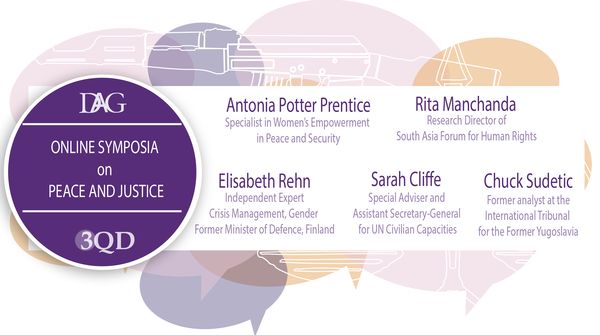
The distinguished participants in this symposium are:

  • Rita Manchanda: Research Director of South Asia Forum for Human Rights (SAFHR) and has written extensively on security and human rights issues in the region. In particular she has intellectually shaped the discourse on feminizing security. Among her many publications is the volume Women War and Peace in South Asia: beyond Victimhood to Agency which has been a pioneering study on feminist theorizing and praxis on conflict and peace building.
  • Antonia Potter Prentice: Prior to her current work on gender, peace and security as Senior Associate to the European Peacebuilding Liaison Office, Senior Advisor to the Dialogue Advisory Group and consultant for organizations including the Centre for Humanitarian Dialogue, the Global Network of Women Peacemakers and Terre des Hommes, she was Country Director for Oxfam GB in Indonesia, its largest programme in the SE Asia region. She initiated the Centre for Humanitarian Dialogue’s work on women, gender and peacemaking and has worked for a number of NGOs, mostly in Asia, having lived in Afghanistan, America (New York), Cambodia, India, Indonesia, Switzerland (Geneva), Timor Leste, and currently Belgium (Brussels). Antonia is a Board Member of the Democratic Progress Institute and is married with three small children. She is starting out on Twitter at Antonia_pp.
  • Elisabeth Rehn: Minister Rehn has a long political career in Finland, as Member of Parliament, Minister of Defense, Minister of Equality, Presidential candidate, and also as a Member of European Parliament. Since 1995 she has been with the United Nations, as Special Rapporteur on Human Rights in Former Yugoslavia, as Special Representative of the Secretary General in Bosnia & Herzegovina, and later as independent expert on Peace and Security. She is the co-author of the 1325 report for Unifem “Women War Peace” 2002, Programme of Assistance to the Palestinian People (PAPP) report for UNDP on the situation in Palestine 2004, and the UNHCHR report on DRC 2010. Rehn is also the Chair of the Board of Directors at the Trust Fund for Victims at the International Criminal Court, the Hague.
  • Chuck Sudetic: Writer and former journalist and analyst for the United Naitons war crimes tribunal in The Hague. His work has appeared in The New York Times, Rolling Stone, The Economist, The Atlantic Monthly, and other publications. He authored Blood and Vengeance, a critically acclaimed book that captured the experiences of two Bosnian families, one Muslim Slav, one Serb, during the tumultuous century that ended with the Srebrenica massacre of 1995. He co-authored La Caccia, the memoirs of the war crimes prosecutor, Carla Del Ponte.
  • Sarah Cliffe: Special Adviser and Assistant Secretary-General for Civilian Capacities at the United Nations. Before joining the United Nations, she worked at the World Bank, covering post-conflict reconstruction, community driven development and civil service reform. She was chief of mission for the Bank’s program in Timor-Leste from 1999 to 2002; led the Bank’s Fragile and Conflict-Affected Countries Group from 2002-2007 and was Director of Operations for East Asia and the Pacific from 2007 – 2009. She was Special Representative and Director for the World Development Report on Conflict, Security and Development. She holds degrees in History and Economic Development from Cambridge and Columbia Universities.

I would like to thank the participants as well as the indefatigable Amanda Beugeling of the Dialogue Advisory Group for working closely with me in organizing these symposia. The logo for the symposia has also been designed by Amanda Beugeling.

We look forward to your comments and feedback.

Yours,

S. Abbas Raza

NOTE: DAG and 3QD wish to acknowledge the generous contribution of the Nederlandse Organisatie voor Wetenschappelijk Onderzoek (NWO, the Dutch Organisation for Scientific Research) toward these symposia, as well as the support of our readers.

THE SYMPOSIUM

[Click the links below to read the essays.]

  1. Who’s that girl? Women, war, and the challenges of identity by Rita Manchanda and Antonia Potter Prentice
  2. The Necessity of Integrating Women into Peace Processes by Elisabeth Rehn
  3. Stop Bandying about Anecdotes and Loose Commentary by Chuck Sudetic
  4. Women as Actors Rather than Victims of War by Sarah Cliffe
  5. Let Us Start by Listening Seriously by Rita Manchanda and Antonia Potter Prentice

***********************

***********

******

*


Please leave comments about any of the essays in the symposium on this post. Thank you.


Who’s that girl? Women, war, and the challenges of identity

by Rita Manchanda and Antonia Potter Prentice

It’s been another knockabout month on the frontlines of that old unwon war of attrition about equality between the sexes. On the upside we had Australian Prime Minister Julia Gillard thrilling the hearts of those who abhor sexism, misogyny and hypocrisy with her magnificent, finger-pointing skewering of the Leader of the Opposition on the floor of Australia’s parliament. On the downside, first we had Pakistani schoolgirl and human rights activist Malala Yusufzai shot in the head by the Taliban; then second, back in peaceful Canada, the well-respected Human Security Report Project was telling us that they found out this year that sexual violence against women in war isn’t quite the big deal we’ve been making it out to be (although to be fair they also reminded us that domestic violence in war settings—and indeed beyond—is a serious and neglected problem; a conflict perhaps to be recognized as such all on its own).

But without getting into the whys and wherefores of the data the Human Security Report got and how they used and presented it, the three events make you realize that the mere fact of being labelled a man or woman (or a boy or a girl) remains a very incendiary business indeed, even in peacetime. The fact is, labels matter, arguably more in wartime than in peace. After all, labels are what a lot of conflicts are about. Are you Muslim or Christian? Alawite or Sunni? Hutu or Tutsi? ‘Have’ or ‘have not’? ‘With us’ or ‘against us'? But is it less risky to ask ‘and are you are a woman or a man?’ Does that descriptive make any difference to the labels that went before? Not only do women have many different labels, and where they can, a tendency to use them in many different ways, but as we shall see, they have a venerable history of using common labels, and those that denote shared values, to make constructive contributions to resolving their communities’ worst ills such as armed conflict, to the benefit of all.

The thing is, that women, like men, are not just women. The other labels they can lay claim to might be ethnic (I’m Tuareg), religious (I’m Jewish), political (I’m pro-government) or related to things they do like bearing children (I’m a mother), bearing arms (I’m a guerilla), or bearing witness (I’m a human rights worker) — frankly bearing a whole lot of things besides, though that is not the particular axe we want to grind in this piece. So what difference does it make which of those labels a woman uses, or others use of her? Does it matter which she chooses to prioritize and when? Is she even free to do that?

Violence starts putting red lines and black and white boxes around 'who we are' in ways we might not always choose, as do national projects and our choice of politics. Life hangs on the balance of such labels—ask Rohingya Muslims fleeing Myanmar, Buddhist tribals attacked in Bangladesh, or people with Kurdish or Armenian roots, or professing Alawite or Sunni faith from Syria fleeing into bordering lands. And if to that I am label is added, ‘woman’ —that female body can become the ground on which some fronts of that war is fought: the purveyor of community identity and its reproducer can be sexually tortured and stigmatised, displaced, impoverished or widowed. Or, while still a child, shot in the head on the way to school.

Read more »

The Necessity of Integrating Women into Peace Processes

by Elisabeth Rehn

Much good news is reaching us about “women making the case”, but it is also true that the opposite sometimes dominates. In which category should we put the Canadian Human Rights Report, telling us that sexual violence against women in war was not the big deal we are making it to be?

In their essay, Antonia Potter Prentice and Rita Manchandan raise the question, what then is a big deal? For me, after talking face to face with thousands of raped women and men in the Democratic Republic of Congo (DRC), Northern Uganda, Liberia, Sierra Leone, East Timor, Bosnia & Herzegovina—we have a tendency of counting this kind of problem by percentages, number of instances of sexual violence, child soldiers, refugees, IDP’s—every case is a big deal. Unfortunately, the violence continues after the war, from a tactic of war to a habit of post-conflict life. Dr. Denis Mukwege, the founder of the Panzi Hospital in Bukavu (DRC) has told me how the war changed sexual violence to a much more brutal and destructive form. He has during the history of Panzi treated close to 40,000 women, children and men who have been victims of sexual violence. Listening to him makes it clear that this is a big deal.

Sexual violence is indeed (despite its terrible influence on the society) not the only issue when making peace and building up society after a conflict. Women want inclusion, equality, and social reform, and very strongly, justice. When experienced conflict mediators are asked: What is more important, peace or justice? the answer predominantly given is peace as many lives are thereby saved. But the victims of sexual violence do find justice important. Sometimes it is the only way of building their future without fear, and for overcoming stigmatization. For them ending impunity and pursuing justice is of paramount importance.

Read more »

Stop Bandying about Anecdotes and Loose Commentary

by Chuck Sudetic

Preface:

1) I am a feminist. I see myself as fortunate to have come of age in this age when significant, growing, but still-inadequate numbers of women have taken their rightful place in business and government and the professions and all other walks of life in many parts of the developed world and in some corners of underdeveloped countries.

2) Women are the species. Men have controlled too much too long. They continue to maintain a stranglehold on too many women in too many parts of the world, from the high rises of Manhattan and The Bronx to the highlands of Lesotho and the hills of Swaziland.

Discussion:

I feel disappointed at the essay under discussion. Perhaps I’m missing something in these words. Perhaps I demand too much from words and essays. But I consider this piece a lost opportunity, a bandying about of undeveloped anecdotes and loose commentary undisciplined by a honed argument and without enough definition even to foster engaging discussion of something concrete and urgently important.

This is unfortunate, because when it comes to the question of women and war, I see war everywhere. I see as much violence, and perhaps more, in places where “peace” reigns.

The really important work in overcoming barriers confining women is on behalf of the hundreds of millions of women for whom the barriers in question are maintained and defended with violence, and in too many instances deadly force. This, to me, translates into urgency. So I seek discussions grounded in the practical, in the question “What is to be done?” rather than on the ethereal or the academic.

There is much to be said about labels and their effects, positive (protection) and negative (exclusion), which this essay suggests but, for me, fails to explore. The practical cannot, I fear, be grasped well at this level. Because the real problem, as I see it, is in the deeper structure that produces the labels, the mysterious workings deep beneath the anthropology, the sociology, the psychology, the linguistics…. And in these disciplines, it is revealed not through the theoretical discussions, but through the minutiae of the case studies.

Read more »

Women as Actors Rather than Victims of War

by Sarah Cliffe

This essay raises a series of fascinating questions about identity and women's participation in peace-making. The focus is—rightly, I believe—on women as actors rather than victims of war.

This is not to say that we should ignore the particular impact of conflict and violence on women: in the last two decades, for example, women and children have made up close to 80 percent of refugees and those internally displaced. Women generally bear the greatest burden of coping with the effects of conflict, whether in trying to feed and care for families that have lost all their income and assets, rebuilding homes that have been destroyed, or dealing with being chased from their neighborhoods and starting a new life elsewhere. And whatever the final statistical wisdom proves to be on the use of sexual violence as a weapon of war and intimidation, there is no doubt that rape and sexual humiliation of women have been used to to inflict suffering and create a climate of fear, from the conflicts in west and central africa, to authoritarian regimes in Chile and Argentina, to the Balkans, to the violence fuelled by drug monies in central America.

Activists—male and female—have done much to publicize these effects and to help women to organize to claim recognition and reparations for the harm suffered. The essay highlights however an element which is equally and perhaps even more important in considering the links between women's identity and violence—women's role as actors in peace-making and in rebuilding societies that have been torn apart by violence. It outlines clearly the “fact of life” that women do not have unique identities—they may be involved in efforts to resolve conflict as much through their political, ethnic or religious identity as through their sense of solidarity as women.

This raises an interesting question of the trade-offs between promoting participation of women in peace-making processes as a separate “women's representation”, versus promoting their participation as part of the other groupings (whether governmental, political and resistance organisations, social movements, or community representation) in which they take part, and from which part of their identity is drawn. In the end I believe—as do the authors of the essay—that this is a choice for the women in the societies concerned: they will have a stronger sense of whether they have shared interests as women which would benefit from being separately represented, or whether they feel energies should be devoted to making sure that their political, social and community groups are adequately representative of, and accountable to, the perspectives of the women that they should represent. Another way of thinking about this is through the lens of “inclusive enough” agreements, suggested by the 2011 World Development Report on Conflict, Security and Development. What does “inclusive enough” mean in terms of women's representation in the political settlements that aim to end violence. On the one hand having no women engaged is clearly a red flag, as it would be for other major identity groups in the societies concerned. But HOW women are represented is probably best left to be thrashed out by the societies concerned.

Read more »

Let Us Start by Listening Seriously

by Rita Manchanda and Antonia Potter Prentice

It’s hard to write a rebuttal when one gets the strong sense that even those, like Chuck Sudetic, who claims to be so disappointed by the ideas we shared (or the way we shared them?), actually subscribe very much to the main points we were making.

Elisabeth Rehn has dedicated her professional life to this work, and a key lesson her response to our piece, and her work in general, teaches conflict mediators, and peace process support actors is to listen, listen, and then listen some more to a broad representation of people on the ground, including of course women. Listening, and acting on what is heard, and reporting back on those actions are highly validating for the person being heard, especially when their experience is normally one of disempowerment and marginalization.

Unwittingly but helpfully answering Chuck’s vociferous call for ‘more practicality’ she describes the effective and pragmatic mechanism of the Senegal Women’s Situation Room. She trenchantly reminds statisticians, policy analysts and the writers of glib op eds that each individual experience of conflict related sexual violence is a shock to the world’s conscience, and a wound to its victim’s very soul that can never be forgotten. So whether there are in reality handfuls, hundreds or thousands of such cases, each individual one stands as a horror on its own. She reminds us that for victims of these kinds of crimes of conflict, peace and justice aren’t a ‘choice’ or a ‘tension’; they are quite simply the same thing. Impunity means for them that the conflict is not over. There’s no rebutting that from our side, and we’re pretty sure that Sarah Cliffe and Chuck Sudetic feel the same way.

What she does not perhaps spell out is an insight that comes out more in Sarah Cliffe’s piece and is an important finding of the 2011 World Bank Development Report on Conflict, Security and Development to which she referred: that investing in citizen security, justice, and jobs is essential to reducing violence in societies, especially post-conflict ones, a finding which relates quite as much to women as to men. The effects of sexual violence in conflict, especially when not dealt with, lead to extreme social distortions and specific, negative socio-economic consequences for the survivor and her or his family. It’s not hard to agree that sexual violence is bad for people, bad for communities, bad for societies; but recognizing that preventing it by empowering women across the board, alongside changing attitudes, seems to be a tougher sell. We would maintain that socio-economic empowerment as is as important for women as political empowerment: with resources, comes status and choices; with status and choices come voice and power.

Chuck Sudetic is right: violence is everywhere, the cultures that make this ok have got to change, and clumsy international attempts to support local efforts to do this have got to get more nuanced. Chuck wants us to fix this now; Sarah reminds us that cultural change, attitudinal change take years to take root. We agree with him: we wish it had been fixed yesterday; but Sarah’s right, mind-set changes are incremental, and if each society is to find its way from the ‘inside out’, as it were, it must set its own pace for change – taking into account women’s views alongside men’s about the pace that fits.

Read more »

Sunday, November 25, 2012

American Civil Religion in the Age of Obama: An Interview with Philip S. Gorski

9780814738726_Full

Over at the Immanent Frame:

JB: This leads to an interesting question: who’s going to take up the mantle of theology? In your essay in The Post-Secular in Question, you ask, “What’s the role of sociology?” Your answer is that it could be a moral science that recovers the idea of “the good.” What would that moral sociology look like? Is there a relationship that you see between the creation of a civil religion and the creation of a sociology that’s more concerned with the good?

PG: That would certainly be a hope of mine, and it’s something that I’ve been thinking about a great deal lately, whether there’s a limited kind of moral realism that we could defend, and that we might actually be able to contribute to through social science or at least through academic reflection of some kind or another? My suspicion is that there is; I just don’t know what the scope of it is. It would have to be premised on some understanding of human flourishing—that human beings are put together biologically, neurologically, in a certain way—that they have certain kinds of capacities or propensities—that their flourishing and well-being in general involves the development and cultivation of these propensities and capacities. Of course I’m simply channeling a lot of research that’s being done in neighboring fields. There’s recent work in positive psychology, for example, which is starting to get a great deal of attention by people like Jonathan Haidt and Marty Seligman. There’s a neo-Aristotelian virtue ethics tradition that people like Martha Nussbaum and Richard Kraut have revived and defended in recent years. Even some folks like Amartya Sen have tried to make a basis for a different way of thinking about economics and development policy. So the question is, “How do you develop a theory of the human good which doesn’t become a kind of hardened dogma, a sort of a one-size-fits-all understanding of what a life well-lived is going to mean?”

Rockets & Ethics

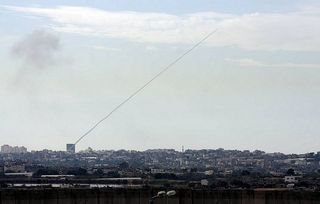
A_rocket_fired_from_a_civilian_area_in_Gaza_towards_civilian_areas_in_Southern_Israel

Mike LaBossiere in The Philosopher's Magazine (image from Wikimedia commons):

In a repeat of events in 2008 (and earlier) Hamas stepped up its rocket attacks from Gaza against Israel. Israel, not surprisingly, responded with attacks of its own. In addition to the political and humanitarian concerns, this matter raises numerous ethical issues.

One issue of concern is that Hamas generally locates its launch sites close to or in civilian areas. As such, Israel runs the risk of killing civilians when it attempts to destroy the launchers. This raises the general issue of launching attacks from within a civilian population.

On the face of it, this tactic seems to be immoral. To use the obvious analogy, if I am involved in a gun fight and I grab a child to use as a human shield, I am acting wrongly. After all, I am intentionally endangering an innocent to protect myself. If the child is hurt or killed, I clearly bear some of the moral blame. While my opponent should not endanger the child, I would rather limit her options if I kept attacking her while hiding behind the child. Naturally, if I was shooting at her innocent children while using a child as a shield, I would certainly be acting very wrongly indeed.

One possible counter is that the analogy is flawed. In the child example, the child is coerced into serving as a shield. If the civilians support Hamas and freely allow themselves to be used as human shields, then Hamas would not be acting wrongly. To use an analogy, if I am in a gun fight and people volunteer to take bullets for me by acting as human shields, I would seem to be acting in a way that would be morally acceptable. As such, as long as the civilians are not coerced or kept in ignorance (that is, employed as shields by force or fraud), then it would seem that Hamas could be acting in a morally acceptable way.

There is, of course, a rather obvious concern. To go back to the gunfight analogy, suppose my fellows volunteer to serve as human shields while I shoot randomly at my opponent’s friends and family. If my opponent returns fire and hits one of my shields while trying to stop me, it would seem that my opponent would not be acting wrongly.