
Daniel Pink in The Washington Post:
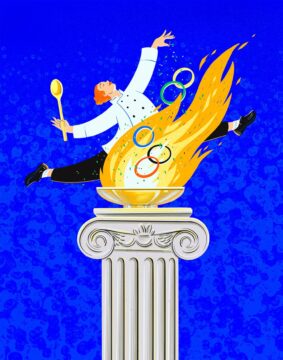 Hundreds of millions of people across the globe now earn their living less with their backs and more with their brains, relying on sharp reasoning and creative thinking. So how about seeing who’s best at that?
One idea: a competition such as the solar car challenges popular in many high school and college engineering programs. Squads of mixed-gender techies could receive a design brief months in advance and then arrive at the Games to pit their team’s creation against those of other nations on an official Olympic racetrack. It would be a competition that relies on teammates with smarts, skills and creativity — and some would need to be traditional athletes, too. Have you seen a pit crew at the Indy 500? I’d cheer on Team USA against Team China in a battle to create and race zero-emission automobiles. Besides, who wouldn’t want to see the Katie Ledecky of mechanical engineering smiling on a box of Wheaties? Or how about Olympic chess? Don’t laugh: The International Chess Federation has been pushing the idea for decades. In 1999, the IOC, whose byzantine rules and procedures determine which competitions are worthy of medals, relented and finally recognized chess as an official sport.
More here.
Enjoying the content on 3QD? Help keep us going by donating now.
 W
W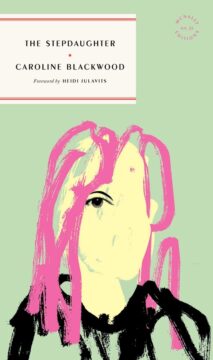 OPEN ANY BOOK BY CAROLINE BLACKWOOD and you will encounter the same woman. Articulate, adrift, callous, cosmically self-absorbed. She’s in the middle of her life, a retired actress or model, once striking and sought-after. Her misery has a predatory quality. Decisions made idly and capriciously she now clings to as essential facets of her “character.” She rebels continually against the restraints and privations she inflicts upon herself. She behaves as though she were onstage, thundering dramatic monologues of deceit and self-justification. What’s clearest is her anger: pure, whole, just beneath the surface, like a calcium deposit under the skin.
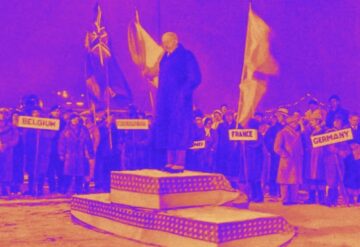 At the 1912 Olympic Games in Stockholm, Sweden, Jim Thorpe easily won the decathlon in the first modern version of the event. The grueling, ten-part feat was not the only addition to the burgeoning modern games. Other events that debuted at the 1912 Olympics included architecture, sculpture, painting, music… and literature.
 Drivers on a busy US freeway have been controlled by an AI since March, as part of a study that has put a machine-learning system in charge of setting variable speed limits on the road. The impact on efficiency and driver safety is unclear, as researchers are still analysing the results.
 Transnational organized crime is a paradox: ubiquitous yet invisible. While criminal tactics evolve rapidly, government-led responses are often static. When criminal networks are squeezed in one jurisdiction, they rapidly balloon in another. Although the problem concerns everyone, it is often considered too sensitive to discuss at the national, much less the global, level. As a result, the international community – including the United Nations and its member states –
  My family history of cancer is impressive, and not in a good way.
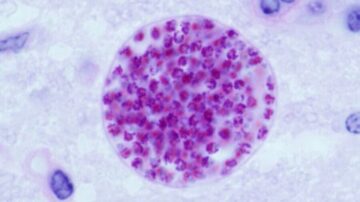 The brain is like a medieval castle perched on a cliff, protected on all sides by high walls, making it nearly impenetrable. Its shield is the blood-brain barrier, a layer of tightly connected cells that only allows an extremely selective group of molecules to pass. The barrier keeps delicate brain cells safely away from harmful substances, but it also blocks therapeutic proteins—like, for example, those that grab onto and neutralize toxic clumps in Alzheimer’s disease. One way to smuggle proteins across? A cat parasite. A
 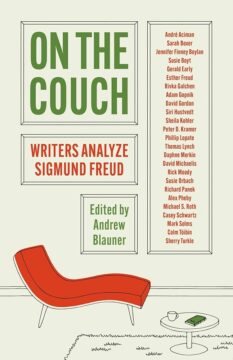 Freud’s influence waned during the 1980s and 1990s, in part because of the so-called “Freud Wars,” during which critics like
 This buoyant anvil of a book has brought me to the edge of a nervous breakdown. Night after night I’m waking with Seamus Heaney sizzling through—not me, exactly, but the me I was thirty-four years ago when I first read him, in a one-windowed, mold-walled studio in Seattle, when night after night I woke with another current (is it another current?) sizzling through my circuits: ambition. Not ambition to succeed on the world’s terms (though that asserted its own maddening static) but ambition to find forms for the seethe of rage, remembrance, and wild vitality that seemed, unaccountably, like sound inside me, demanding language but prelinguistic, somehow. I felt imprisoned by these vague but stabbing haunt-songs that were, I sensed, my only means of freedom.