Gish Jen goes from novels to nonfiction

Peter Cocchia in the Boston Globe:

ScreenHunter_147 Mar. 24 15.20Here in Cambridge’s Neighborhood Nine is your typical American house, a two-story affair in cadet grey; winters have tarnished its wrought-iron fence, the gate of which is fixed open; a flagstone path leads from there to the door. Inside, you’ll find a mixture of old and new: at one end of the kitchen, a squarish black Jotul stove, at the other, a stainless-steel fridge. Then there is Gish Jen.

Standing barefoot in the kitchen, she looks as though she could be only slightly taller than the doorbell out front. Since 1991, she has published four acclaimed novels and a prize-winning collection of short fiction, to say nothing of the fellowships she has held, the grants she has received. In a town filled with literary giants, among them Alice Hoffman, Ha Jin, and Jennifer Haigh, Jen stands tall.

“What’s most unique about Gish’s voice is that it’s humorous,” says Jennifer Ho, associate professor in the University of North Carolina-Chapel Hill’s Department of English and author of the forthcoming “Understanding Gish Jen.” “There’s a certain type of witty irony that she employs. She also has a generosity of spirit toward all of her characters, even the ones who aren’t particularly likable.”

In February, Jen made her nonfiction debut with “Tiger Writing,” an accessible work of scholarship that, without expressing a preference, contrasts the Eastern narrative with the Western, the interdependent self with the independent.

More here.

For Sri Lanka, More Empty Words

Samanth Subramanian in the New York Times:

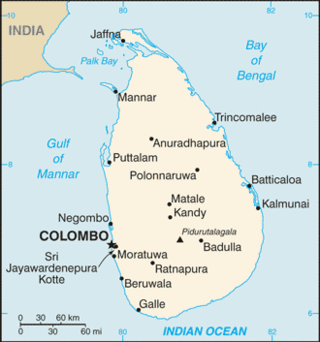
Ce-mapA year ago, when I was living in Colombo, Sri Lanka, I arranged to meet a friend for lunch, to talk about a Sri Lankan journalist who had gone missing and was presumed dead. By the time we met, my friend had a new mission: to keep another Sri Lankan safe.

The previous day, the United Nations Human Rights Council had passed aresolution “noting with concern” the Sri Lankan government’s refusal to address serious allegations of human rights abuses by the military — carried out during and after its 26-year war with the separatist Tamil Tigers, which ended with a defeat of the rebel group in 2009.

A number of Sri Lankan activists had flown to Geneva to lobby for the resolution, to their government’s dismay. Commentators on state TV lambasted them as villains and traitors, and word reached several of the activists that they might not want to rush back home. So my friend and I spent that sticky afternoon trying to help one get to safety, assembling the papers she needed to apply for a visa to the United States, where she hoped to lie low for a while.

Yesterday, the Human Rights Council voted once again to urge the Sri Lankan government to investigate “alleged violations of human rights” — or what The New York Times called “polite diplomatic shorthand” for the growing evidence that government soldiers killed tens of thousands of civilians in their bloody campaign to crush the rebels. But as with last year’s resolution, this year’s Council vote offers little more than hand-wringing.

While they carry symbolic weight, such resolutions may, in fact, be impeding progress rather than facilitating it.

More here.

Maybe Bangladesh has become the country Jinnah wanted to create

Abdul Majeed in the Express Tribune:

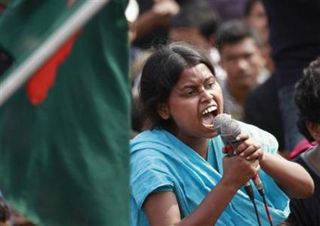
DownloadWhen East Pakistan decided to break away from West Pakistan in 1971, one of the leading factors was the lack of importance accorded by West Pakistan’s bureaucracy and intelligentsia towards the other part of the country. It is not a surprise that the attitude did not change even after the separation of Pakistan’s two wings.

Pakistan’s textbooks are still silent over the atrocities committed by our armed forces and their proxies in 1971. Although West Pakistan may have forgotten, but the people who were subjected to the inhumane behaviour just because they dreamt of a better future, remember it all too vividly.

The demand to prosecute the criminals from 1971 has reverberated in Bangladesh over the years. It was only in 2009 that an International Crimes Tribunal (ICT) was formed set up in Bangladesh to investigate and prosecute suspects for the atrocities committed in 1971.

It should also be noted that Bangladesh’s original constitution of 1972 had declared it a secular state but the 8th amendment, put in effect by General Hussain Mohammad Ershad in 1988, declared Islam as the state religion of Bangladesh. Interestingly, Pakistan also had a notorious 8th amendment to the 1973 constitution, giving the power to dissolve assemblies to the president, put in place by none other than General Ziaul Haq.

In 2010, the Bangladesh High Court declared the constitutional amendment that had changed the country’s secular status to that of an Islamic state was done without lawful authority.

More here.

The Brains of the Animal Kingdom

New research shows that we have grossly underestimated both the scope and the scale of animal intelligence. Primatologist Frans de Waal on memory-champ chimps, tool-using elephants and rats capable of empathy.

Frans de Waal in the Wall Street Journal:

OB-WU671_032213_G_20130322184659Who is smarter: a person or an ape? Well, it depends on the task. Consider Ayumu, a young male chimpanzee at Kyoto University who, in a 2007 study, put human memory to shame. Trained on a touch screen, Ayumu could recall a random series of nine numbers, from 1 to 9, and tap them in the right order, even though the numbers had been displayed for just a fraction of a second and then replaced with white squares.

I tried the task myself and could not keep track of more than five numbers—and I was given much more time than the brainy ape. In the study, Ayumu outperformed a group of university students by a wide margin. The next year, he took on the British memory champion Ben Pridmore and emerged the “chimpion.”

How do you give a chimp—or an elephant or an octopus or a horse—an IQ test? It may sound like the setup to a joke, but it is actually one of the thorniest questions facing science today. Over the past decade, researchers on animal cognition have come up with some ingenious solutions to the testing problem. Their findings have started to upend a view of humankind's unique place in the universe that dates back at least to ancient Greece.

More here.

The Song of Ourselves

From New Statesman:

An essay by Chinua Achebe first published in 1990 on creativity, Conrad and why he was not the “grandfather of African literature”.

AchebeI did not see myself as an African to begin with. I took sides with the white men against the savages. In other words, I went through my first level of schooling thinking I was of the party of the white man in his hair-raising adventures and narrow escapes. The white man was good and reasonable and intelligent and courageous. the savages arrayed against him were sinister and stupid or, at the most, cunning. I hated their guts. But a time came when I reached the appropriate age and realised that these writers had pulled a fast one on me! I was not on Marlowe's boat steaming up the Congo in Heart of Darkness. I was one of those strange beings jumping up and down on the river bank, making horrid faces. That was when I said no, and realised that stories are not innocent; that they can be used to put you in the wrong crowd, in the party of the man who has come to dispossess you.

And talking of dispossession, what about language itself? Does my writing in the language of my coloniser not amount to acquiescing in the ultimate dispossession? This is a big and complex matter I cannot go into fully here. Let me simply say that when at the age of 13 I went to that school modelled after British public schools, it was not only English literature that I encountered there. I came in contact also for the first time in my life with many boys of my own age who did not speak my Igbo language. And they were not foreigners, but fellow Nigerians. We lived in the same dormitories, attended the same morning assembly and classes, and gathered in the same playing fields. To be able to do all that we had to put away our different mother tongues and communicate in the language of our colonisers. This paradox was not peculiar to Nigeria. It happened in every colony where the British put diverse people together under one administration. Some of my colleagues, finding this too awkward, have tried to re-write their story into a straightforward case of oppression by presenting a happy monolingual African childhood brusquely disrupted by the imposition of a domineering foreign language. This historical fantasy demands that we throw out the English language in order to restore linguistic justice and self-respect to ourselves.

My position is that anyone who feels unable to write in English should follow their desires. But they must not take liberties with our history. It is simply not true that the English forced us to learn their language. On the contrary, British colonial policy in Africa and elsewhere emphasised again and again its preference for native languages. We see remnants of that preference today in the Bantustan policies of South Africa. We chose English not because the British desired it, but because having tacitly accepted the new nationalities into which colonialism had grouped us, we needed its language to transact our business, including the business of overthrowing colonialism itself in the fulness of time. Now, that does not mean that our indigenous languages should now be neglected. It does mean that these languages must coexist and interact with the newcomer now and in the foreseeable future. For me, it is not either English or Igbo, it is both.

More here.

Sunday Poem

Letter Composed During a Lull in the Fighting
.
I tell her I love her like not killing
or ten minutes of sleep
beneath the low rooftop wall
on which my rifle rests.
.
I tell her in a letter that will stink,
when she opens it,
of bolt oil and burned powder
and the things it says.
.
I tell her how Pvt. Bartle says, offhand,
that war is just us
making little pieces of metal
pass through each other.
.
.
by Kevin C. Powers
from Poetry Magazine, Feb. 2009

Mohsin Hamid

Kate Murphy in The New York Times:

HamidMohsin Hamid, a Pakistani writer, is the author, most recently, of “How to Get Filthy Rich in Rising Asia.” The film adaptation of his best-selling book, “The Reluctant Fundamentalist,” will be in theaters April 26.

WATCHING “Zero Dark Thirty.” It’s a very well-made film. But I didn’t particularly feel there was a humanization of Pakistan and that part of the world. Of course, there needn’t be. So I guess on its own terms, it was a successful film, but perhaps its success was in a direction that was different from my own sensibilities.

FOLLOWING 3QuarksDaily.com. I think it’s one of the most interesting aggregator blogs out there. It puts together stuff from art, science, philosophy, politics, literature. It’s a completely international, cosmopolitan place to get information. It’s become my entry point to reading on the Web.

CUSHIONING I tend to walk a lot — an hour and a half every morning. At some point I developed a pain in my foot. I was in New York and went to this really great shoe store called Eneslow on Park Avenue South, and the salesman recommended these Birko Balance cork inserts to put in my shoes. They are just fantastic — a real walking enabler.

COMPUTING I’m pretty Appled up: iPhone, iPad, Air. Kind of disturbed by that, actually. I fell in love with the underdog and now they’ve become this world-dominant thing. It was like I was rooting for the 13 colonies and somebody handed me the United States superpower.

More here.

Saturday, March 23, 2013

the birth of modern African literature

600

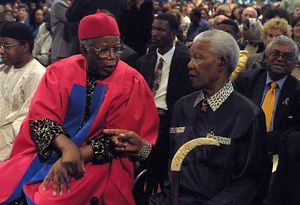
More to the point, as Philip Gourevitch observed online at the New Yorker on Friday, “Achebe — who has gone to his grave without ever receiving the Nobel Prize he deserved as much as any novelist of his era — has said that to be called simply a writer, rather than an African writer, is ‘a statement of defeat.’” In that sense, “Things Fall Apart” is not just the starting point of African literature, but of modern African literature: contemporary, hybrid, global in its implications, influenced by everything, and richer for it in its evocation of the world. For this reason, perhaps, the most affecting tributes to Achebe are the most personal, the testimony of younger writers whose lives he helped dream into being. In a 2009 TED talk, Adichie credited him with helping her to realize “that people like me, girls with skin the color of chocolate, whose kinky hair could not form ponytails, could also exist in literature,” a point she also made at Town Hall.

more from David L. Ulin at the LA Times here.

a sense sublime of something far more deeply interfused

8dc2d931-8dc7-4757-a91a-047f63c7a751

Much of our most famous literature of landscape was produced during the Romantic movement, and that may shed light on the genre’s current popularity. For then, as now, technological changes were convulsing society and creating perceived threats to the countryside; then, as now, science was in the ascendancy, promising answers to questions previously held to be beyond its reach; and then, as now, a belief in the inherent moral quality of nature developed in reaction to those changes, and, along with a renewed interest in myths and folk history, created a literature that celebrated a spiritual relationship to our environment and an emotional and historical connection to place. England was the first country to industrialise, and 90 per cent of the UK population now live in towns and cities, where wildlife must also find a way to rub along with us. The literature of nature has come to reflect that shift. Richard Mabey’s The Unofficial Countryside (1973, republished in 2010) led the way for those looking beyond the bucolic for an experience of nature; as did the poets Paul Farley and Michael Symmons Roberts in their dystopian and genre-defying Edgelands (2011).

more from Melissa Harrison at the FT here.

Obama’s Mission in Israel

David Remnick in The New Yorker:

Remnick-israel-obama-580But beyond winning over his Israeli audience, what was Obama prepared to do about a peace process? “Peace is necessary,” he told his audience at the International Convention Center, in Jerusalem. “But peace is also just.” In diplo-speak, he was short on the “deliverables.” His harshest talk was not harsh at all. He criticized the building of settlements, but he was no longer making strict or detailed demands about halting such construction. So what would Obama say about Palestine? I admired Ben Ehrenreich’s recent New York Times Magazine piece from the Palestinian village of Nabi Saleh, in the West Bank—just as I have admired Lawrence Wright’s work for this magazine in Gaza, Amira Hass’s articles from the West Bank in Haaretz, Taghreed el-Khodary’s work for the Times in Gaza—precisely because that brand of reporting and writing gets at the realities of Palestinian life not through high-handed and uninformed opinion or second-hand speculation but through a keen attention to the people themselves. And so it was also good to hear Obama, after going to such lengths to demonstrate his understanding of Israeli opinion and realities, pivot and call on his audience to empathize with the day-to-day realities of Palestinians, whose “right to self-determination and justice must also be recognized”:

Put yourself in their shoes—look at the world through their eyes. It is not fair that a Palestinian child cannot grow up in a state of her own, and lives with the presence of a foreign army that controls the movements of her parents every single day. It is not just when settler violence against Palestinians goes unpunished. It is not right to prevent Palestinians from farming their lands; to restrict a student’s ability to move around the West Bank; or to displace Palestinian families from their home.

In a sense, this was the moment that all of the events, along with all the previous language, were headed toward—an admonition, from a President determined to be a friend, that time is not on Israel’s side, that occupation was untenable. Obama added:

Neither occupation nor expulsion is the answer. Just as Israelis built a state in their homeland, Palestinians have a right to be a free people in their own land.

The room where Obama spoke was packed mainly with liberal, sympathetic, young listeners, and they applauded him, including after the passage about Palestinian self-determination. An Israeli friend of mine, a liberal centrist who was previously inclined to see Obama as a naïve, indifferent, and untutored statesman, e-mailed me to say that I was right—that Obama may be wary of, even loathe, Netanyahu and Israel’s radical right, which prizes the ethos of the settlers, but he is sympathetic to a truly liberal form of Zionism, one that recognizes that there is no future without negotiation, settlement, and a real and just peace. Obama may be ill at ease at AIPAC conventions, but as a young man he was a natural ally to the liberal Jews of Hyde Park, where he raised his family and began his political career. It is not by accident that on this most self-consciously crafted mission he took a pass on addressing the right-leaning Knesset but will lay a wreath, this morning, on the grave of Theodor Herzl. He managed to combine support, affection, and warning in one speech and series of gestures. Perhaps the most Obamian, and strangely overlooked, moment in the speech came when he cast doubt on the powers of politicians. This is a constant theme. Obama talks frequently about how early civil-rights leaders came to Franklin Roosevelt, asking him to take action, only to have F.D.R. reply, in essence, “make me.” Force my hand. Create a real movement. “That’s where peace begins,” Obama said in his speech:

Not just in the plans of leaders, but in the hearts of people; not just in some carefully designed process, but in the daily connections, that sense of empathy that takes place among those who live together in this land and in this sacred city of Jerusalem. And let me say this as a politician, I can promise you this: political leaders will never take risks if the people do not push them to take some risks. You must create the change that you want to see. Ordinary people can accomplish extraordinary things.

More here.

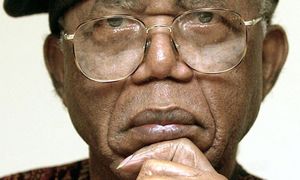
Chinua Achebe death: ‘a mind able to penetrate the mystery of being human’

Nadine Gordimer in The Guardian:

FILES-Nigerian-writer-Chi-008Taking the Irish poet WB Yeats's despairing statement of destruction – things fall apart – for its title, Chinua Achebe's first novel was a presentiment of what was to come in Nigeria during the end of the colonial occupations and their aftermath. It is the founding creation of modern African imaginative literature, the opening act of exploration into African consciousness using traditional modes of expression along with those appropriated from colonial culture, particularly the English language. That first work was also prescient – not only of Achebe's creative powers to develop as a writer in subsequent works, but of the political upheavals, the embattled end of colonialism, the fight for freedom by which the lives of the people of Africa have been shaped.

Achebe lived through these times – a tragic civil war in his country – as an activist in extreme personal danger, finally exile, fulfilling Albert Camus' statement of what it means to be a writer: “The day when I am no more than a writer I shall cease to be a writer.” He kept faith with this commitment. Yet during those years he wrote novels, stories, essays and poems that were a bold revelation to his countrymen and women and the world of what suppression and oppression really meant. And trust Achebe to give a new definition of colonialism. His collection of essays, recently reissued as a modern classic, is The Education of a British-protected Child. Achebe's works do not fear to challenge those post-colonial, independent regimes in Africa who abuse personal power in every possible way – from banning political opposition, to corruption. His novel A Man of the People, a biting satire on corruption in freed African regimes, uses the blade of humour to alert us to official greed and the cant which legitimises it.

More here.

Saturday Poem

Love in the Time of Chain-link Fences

I watched. There was a chain-link fence, a
tear falling from her face. The echo of a car
door slamming. It was Saturday. Believe me
when I tell you I fell in love. Not with her, but
with her tears. It was Saturday & the sun
was a fat globe in the sky. I'd been staring
at it, trying to fix my eyes, when she pulled
into the parking lot. The driver's side door
slammed my fantasies into a question mark.
Dave's sister. She visited twice a month. Her
hair the color of the back of my hand. I dreamed
about her for weeks & wrote her letters.
She cried when she walked to the car and hour
after walking in, ashamed at her brother in
chains. I wanted her to be ashamed of me.

by Reginald Dwayne Betts
from Shahid Read His Own Palm
Alice james Books, 2010

Friday, March 22, 2013

Disfluency

Alter630

A conversation with Adam Alter over at Edge:

Adam Alter is interested in examining the concrete ways in which we are affected by subtle cues, such as symbols, culture, and colors. Why are Westerners easily fooled by the Müller-Lyer illusion of two lines with different arrows at their ends, while Bushmen from southern Africa are not? Why do certain colors have a calming effect on the intoxicated? Why is it that people with easy-to-pronounce names get ahead in life?

In this conversation, we get an overview of Alter's current line of work on how we experience fluent and disfluent information. Fluency implies that information that comes at a very low cost, often because it is already familiar to us in some similar form. Disfluency occurs when information is costly–perhaps it takes a lot of effort to understand a concept, or a name is unfamiliar and therefore difficult to say. His work has interesting implications in the realms of market forces (stocks with pronounceable ticker codes tend to do better when they first enter the market than those that don't, for instance) and globalization, and is highly relevant in a world where cultures continue to meet and to merge.

Jennifer Jacquet

The basic idea here is that when you have a thought, any thought, it falls along a continuum from fluent to disfluent. A fluent thought is one that feels subjectively easy to have. When you speak English and you come across a common English name, like John, or Tom, or Ted, it's very, very easy to process that name. There's no difficulty in reading the name and in making sense of the name.

At the other end of the spectrum you might come across a foreign name or a novel name that you've never seen before or perhaps a name that you've seen before, but spelled very differently. In that case it's going to be much more difficult to process the name. Then it will be disfluent or subjectively difficult to process. It will feel more difficult to process. There's not only the content, what the name happens to be, and what it's like to store that information, but also what it's like to have the thoughts of processing the name, of making sense of the name.

This is a topic that I've been very interested in, and I've been interested in the concept of fluency and how that might affect a whole lot of different judgments that we make, and the way we process the world. The most basic effects in fluency research are pretty straightforward, and the idea is that when something is fluent, you feel differently about it from how you would feel if it were more difficult to process. I'll give you a few examples from my own research.

Washed Away

24STRAYED-articleInline

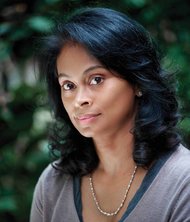
Cheryl Strayed reviews Wave by Sonali Deraniyagala (photo by Ann Billingsley), in the NYT Sunday Book Review:

Sonali Deraniyagala’s extraordinary memoir, “Wave,” opens on the morning of Dec. 26, 2004, as the author putters around a Sri Lankan beach-side hotel with her family. By chapter’s end she’s pantless, half-drowned, bleeding, bruised and numbly resistant to what she’ll soon be forced to know: The five people she loves most in the world are dead. Her two young sons. Her husband. Her parents. All of them killed by a force she can’t yet comprehend, though she was caught up in it and nearly killed by it too. She only knows that “something came for us.” It was, as she and the world will soon learn, a tsunami of epic scale that took an estimated 230,000 lives across a dozen countries.

So begins the most exceptional book about grief I’ve ever read. In prose that’s immaculately unsentimental and raggedly intimate, Deraniyagala takes us deep into her unfathomable loss. In the months after the tsunami, she lives in her aunt’s house in Colombo — the city she grew up in — huddling beneath the covers of her cousin’s bed, attempting to imprint the phrase they are dead on her consciousness. She fights off sleep because it only means she will have to relearn the truth in the morning.

She doesn’t allow herself to think of her home in London, her career as an economist or even to open the curtains in her borrowed bedroom. She wants to kill herself as soon as possible, but her relatives foil her plans by locking away the knives and uncovering her hidden accumulation of sleeping pills. Still she tries. She stabs herself with a butter knife and puts out cigarettes on her hands. “An army of family and friends” begin to watch over her day and night.

She resolves to never go outside again; how could she when outside is where she went with her sons, Vikram and Malli? She asks herself, “How can I walk without holding on to them, one on each side?” When she finally works up the courage to do so, she’s devastated by everything she sees — a child, a ball, a bird, a 100-rupee note in a man’s hand. “The last time I saw one of those,” she writes, “I had a world.”

participate!

JeremyDeller-BattleOfOrgreave-IndependentCuratorsIntl-Flickr-UnderCC-BY-NC-ND-2-0-LicenseNoncommercialUse1-300x199

Hal Foster has complained that “contemporary exhibitions often feel like remedial work in socialization: come and play, talk, learn with me.”[3] Moreover, Foster claims, the collective endeavour involved in such artworks no longer has any political meaning: “today simply getting together sometimes seems to be enough.” The architect and writer Markus Miessen has also questioned the associations frequently drawn between participation and empathy, consensus and democracy. For Miessen, “Any form of participation is already a form of conflict.”[4] A similar desire for conflict – for art that provokes and disrupts, is abrasive and perverse rather than soothing and consensual – is the driving force behind Claire Bishop’s Artificial Hells: Participatory Art and the Politics of Spectatorship (2012). Bishop’s book is exactly the kind of historically aware and politically sophisticated study that participatory art so badly requires. She assesses the current vogue for collaboration and participation in the context of the many attempts made during the twentieth century to rethink the role of the spectator, the artist and the artwork. Despite her initial caveats about the study’s scope, which is mainly limited to Europe, but which also includes work from Argentina, Cuba and North America, she includes a fascinating array of examples, each thoughtfully considered and skilfully summarised (no easy feat given that so many participatory projects involve a lengthy back-story). She is especially generous, but by no means uncritical, towards artistic intentions and the range of meanings provoked by individual works. This is part of a broader commitment to aesthetics. Bishop laments “the paucity of our ability to defend the intrinsic value of artistic experiences today,” which means that participatory art is often justified, rather lamely, for its apparent social benefits.

more from Richard Martin at Berlin Review of Books here.

Britten himself was torn

Britten1_332213h

The premiere of Gloriana has gone down in operatic history as a famous disaster, and the critical reception was not much better. Only in the twilight of the second Elizabeth’s own reign, sixty years on, will this difficult masterpiece be returning to its birthplace, with a new production at Covent Garden in 2013. Heather Wiebe’s subtle account of Gloriana in her fascinating study, Britten’s Unquiet Pasts: Sound and memory in postwar reconstruction, underlines the difficulty of the task which Britten undertook, and his anomalous position after the war, somehow straddling the old, pacifist Left of the 1930s, where he had started his career, and the revived upper-class society with which he now broke bread. One of Britten’s closest friends, Marion Stein, the daughter of his publisher Erwin Stein (an old associate of Schoenberg’s in pre-Anschluss Vienna), had married the Earl of Harewood, and it was in discussions with Harewood – a cousin of the Queen, but also a vigorous and innovative cultural impresario – that the notion of a “national opera” to match Italy’s Aida, Czechoslovakia’s Bartered Bride or France’s Manon was conceived. This was, Kildea suggests, “a slightly anachronistic idea for mid-twentieth-century Britain, a country without any of the nineteenth-century opera traditions and historical reformations that gave rise to the genre on the Continent”.

more from Ian Bostridge at the TLS here.

Surrealism anew

Schwartz_1-040413_jpg_470x739_q85

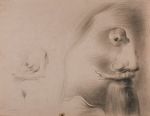
Surrealism’s chief artistic invention is probably the “exquisite corpse” drawing. It is created when a group of people pass around a piece of paper, and each participant, unaware of how the folded sheet has been handled by the previous person, adds his or her own contribution and sends it along. (The name “exquisite corpse” comes from a line in a poem that, made in the same group fashion, began with these words.) That most exquisite corpse drawings, including those in this exhibition, end up showing weird but not brilliantly weird standing figures has never dampened the game’s allure. The often could-be-better-next-time results may be why the Surrealists, we are told, found the game “addictive” and why we still like playing it. The corpse drawings on hand are certainly no match for the other kinds of works on display. They include collages, automatic drawings—doodles, essentially, in which the doodler goes as far as he or she can—and calligrams, or word drawings, comprised solely of words, letters, or made-up words in a made-up script. There are works of frottage, formed by putting a piece of paper over a textured surface of some sort and rubbing it with a pencil, say, to bring up that surface.

more from Sanford Schwartz at the NYRB here.