Why Don’t Politicians Care about the Working Class?

{E92C2686-94F7-481C-B4C7-E0D78BFA27C1}04132011_VICE_article

Mark Thoma in The Fiscal Times:

If we want to ensure that our children and grandchildren have the brightest possible future, the national debt is not the most important problem to address. Reversing the polarization of the labor market – the hollowing out of the middle class and the associated rise in inequality over the last thirty years or so – is much more important. But money driven politics and a political class that has all but forgotten about the working class – Democrats in particular have forgotten who they are supposed to represent – stand in the way of progress on this important problem.

As everyone surely knows by now, the last few decades have not been kind to workers in the middle and lower parts of the income distribution. Technological change, globalization, and the decline of unions that gave workers political clout and countervailing power in negotiations over wages, benefits, and working conditions have eroded the economic opportunity and security that the post World War II era brought to working class households.

During that time it was possible, with little formal education, to get a relatively secure job offering decent pay and benefits. But those days are mostly gone, and changes in labor market conditions during the recent recession highlight the longer-term trends. Consider, for example, four facts from a recent speech by Federal Reserve Governor Sarah Raskin.

First, around two-thirds of the jobs lost during the recession were in moderate-wage occupations, but more than one-half of subsequent job gains have been in low wage jobs. As she says, recent job gains have been largely concentrated in lower-wage occupations. Second, since 2010 the average wage for new hires has actually declined. Third, about one-quarter of all workers are “low wage” (just over $23,005 per year in 2011 dollars). Finally, involuntary part-time work is increasing, and more than a quarter of the net employment gains since the end of the reces-sion involve part-time work.

Solving these and other problems – low and stagnant wages, reduced health care and retirement benefits or no benefits at all, fewer hours, reduced job security, and, if Republicans get their way, substantially less social insurance – won’t be easy. To be successful, we must make jobs our top priority.

mounting nature

Naturalhistory

By the time Carl Akeley joined the taxidermy department of the American Museum of Natural History in 1909, he was producing exquisite mounts. The dull, listless unreality of his earlier work had given way to extraordinarily lifelike specimens, an effect he was able to achieve through pioneering methods of articulating the skeleton to characterize the animal’s mobility, behavior, and attitude. Where previously the skeleton had been discarded and the skin stuffed with straw, cotton, or wood shavings, it was now braced to an iron-and-wood armature to create an anatomical frame. This was cast in an underlayer of clay, which was worked up with a scalpel to express the internal biography of the animal, whose organic substance, including its lifeblood, had long since been lost. Muscles, veins, connective tissue, even wrinkles, were sculpted in meticulous detail (as an apprentice, Akeley had been taught simply to beat the detail into the stuffed mount with a plank of wood), at which point the animal was ready to receive its skin. Last to be added were the eyes (glass), tongue, and nose (resin or wax, varnished to suggest wetness). And there it stood—or leaped or prowled—more alive than dead, the perfect illusion of absolute reality.

more from Frances Stonor Saunders at Lapham’s Review here.

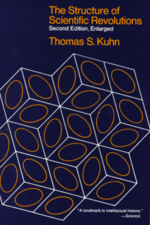
the structure of scientific revolutions at 50

Tumblr_md6h97NgYw1qandwoo1_400

Fifty years ago, Thomas Kuhn, then a professor at the University of California, Berkeley, released a thin volume entitled The Structure of Scientific Revolutions. Kuhn challenged the traditional view of science as an accumulation of objective facts toward an ever more truthful understanding of nature. Instead, he argued, what scientists discover depends to a large extent on the sorts of questions they ask, which in turn depend in part on scientists’ philosophical commitments. Sometimes, the dominant scientific way of looking at the world becomes obviously riddled with problems; this can provoke radical and irreversible scientific revolutions that Kuhn dubbed “paradigm shifts” — introducing a term that has been much used and abused. Paradigm shifts interrupt the linear progression of knowledge by changing how scientists view the world, the questions they ask of it, and the tools they use to understand it. Since scientists’ worldview after a paradigm shift is so radically different from the one that came before, the two cannot be compared according to a mutual conception of reality. Kuhn concluded that the path of science through these revolutions is not necessarily toward truth but merely away from previous error.

more from Matthew C. Rees at The New Atlantis here.

what is anthropology?

1363900485yanomami

Sahlins argues against the sociobiologists’ neo-Hobbesian view of human nature as a war of all against all—with a brutal, competitive nature clashing with culture. This view of human nature has deep roots in Western cultural traditions, he writes, but it also projects a more modern capitalist view of self-interested, even selfish, behavior on both humanity and the rest of the natural world. In many other societies, people do not see the same sharp division between nature and culture. And all human societies have systems of kinship, which Sahlins defines as “mutuality of being,” meaning that “kinfolk are members of one another, intrinsic to each other’s identity and existence.” “Symbolically and emotionally, kinfolk live each other’s lives and die each other’s deaths,” Sahlins says. “Why don’t scientists base their ideas of human nature on this truly universal condition—a condition in which self-interest at the expense of others is precluded by definition, insofar as people are parts of one another?” Sahlins cites a classic definition of kinship first developed by Aristotle: kinfolk are in various degrees other selves of ourselves.

more from David Moberg at Dissent here.

James Lovelock: A man for all seasons

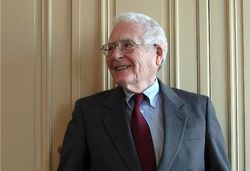
From New Statesman:

GaiaThere can be no doubt that the idea of Gaia came to Lovelock as a kind of epiphany. But the Gaia theory originated in the experimental difficulties of detecting signs of life on Mars, and he has developed the theory in rigorously scientific terms, producing a computer model of a virtual planet (Daisyworld) in which a self-regulating climate could emerge from simple organisms by a process of natural selection. The novelist William Golding was a neighbour of Lovelock’s in the Wiltshire village of Bowerchalke and became a close friend. He proposed the name of Gaia – the earth goddess in Greek mythology – for the self-regulating planet. Although Lovelock is grateful to Golding for his inspired suggestion, he views the notion of the earth as a self-regulating system as an integral part of science.

…Where he differs from many is that his life affirmation is not restricted to human beings. He tells me his next book will consider the possibility that evolution may produce another species, one more capable than human beings have been of coexisting with other life forms on the planet. His intellectual iconoclasm showing no signs of diminishing, Lovelock, in his tenth decade, continues to produce ideas that fundamentally challenge the prevailing world-view. A unique thinker, he has no obvious successor, yet in gaining wide acceptance of the idea that our planet is a self-regulating system, he has had a profound effect on many branches of scientific inquiry. Along with millions of others, I can’t wait to hear the latest thoughts of the scientist who, more than any other alive today, has changed the way we think of the earth and our place on it.

More here.

Social isolation shortens lifespan

From Nature:

SolitudeScientists have long known that both social isolation and feelings of loneliness can increase risk of illness and death in people. But it has been less clear whether isolation, which can lead to loneliness, undermines health, or whether either factor, acting alone, can harm well-being. Today, researchers report in the Proceedings of the National Academy of Sciences that limited contact with family, friends and community groups predicts illness and earlier death, regardless of whether it is accompanied by feelings of loneliness1. The scientists analysed data from 6,500 people aged 52 and older enrolled in the English Longitudinal Study of Ageing, which monitors the health, social well-being and longevity of people living in England. The researchers evaluated social isolation on the basis of the amount of contact participants reported having with family, friends and civic organizations, and they assessed loneliness using a questionnaire. They tracked sickness and mortality in study participants from 2004 to 2012.

The researchers found that social isolation was correlated with higher mortality — even after adjusting for pre-existing health conditions and socioeconomic factors — but loneliness was not. “When we think about loneliness and social isolation, we often think of them as two faces of the same coin,” says Andrew Steptoe, a psychologist and epidemiologist at University College London, who led the study. But the findings suggest that a lack of social interaction harms health whether or not a person feels lonely, he says. “When you’re socially isolated, you not only lack companionship in many cases, but you may also lack advice and support from people.”

More here.

Wednesday Poem

No Snow Fell on Eden

as i remember it – there was no snow,
so no thaw or tao as you say

no snowmelt drooled down the brae;
no human footfall swelled into that of a yeti
baring what it shoulda kept hidden;

no yellow ice choked bogbean;
there were no sheepskulls
in the midden –

it was no allotment, eden –
they had a hothouse,
an orangery, a mumbling monkey;

there was no cabbage-patch
of rich, roseate heads;
there was no innuendo

no sea, no snow
There was nothing funny
about a steaming bing of new manure.

There was nothing funny at all.
Black was not so sooty. No fishboat revolved redly
on an eyepopping sea.

Eve never sat up late drinking and crying.
Adam knew no-one who was dying.
That was yet to come, In The Beginning

.
Jen Hadfield
from Poetry International Web

Tuesday, March 26, 2013

The philosophy of the Higgs

Michael Krämer in The Guardian:

ScreenHunter_151 Mar. 26 15.51Many of the great physicists of the 20th century have appreciated the importance of philosophy for science. Einstein, for example, wrote in a letter in 1944:

I fully agree with you about the significance and educational value of methodology as well as history and philosophy of science. So many people today—and even professional scientists—seem to me like somebody who has seen thousands of trees but has never seen a forest.

At the same time, physics has always played a vital role in shaping ideas in modern philosophy. It appears, however, that we are now faced with the ruins of this beautiful marriage between physics and philosophy. Stephen Hawking has claimed recently that philosophy is “dead” because philosophers have not kept up with science, and Nobel laureate Steven Weinberg argues:

I know of no one who has participated actively in the advance of physics in the postwar period whose research has been significantly helped by the work of philosophers.

Not to mention the recent public argument between cosmologist Lawrence Krauss and philosopher of science David Albert about nothing, i.e. the vacuum, however driven it may be by book sales figures.

So is there a role for philosophy in modern physics? Should we physicists listen to philosophers?

More here.

Literature in the Fortress

Hasan Altaf in The Millions:

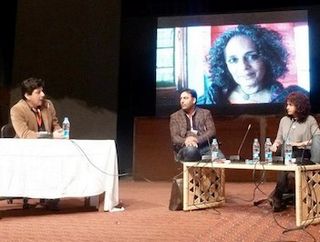
ScreenHunter_150 Mar. 26 15.40From the beginning, there was a hint of the surreal to the recent Lahore Literary Festival, but it was difficult to put my finger on the root of that unsettling emotion, especially given the overall aura of triumph. A response to similar events elsewhere in the region – the most famous in Jaipur; the most rivalry-inducing, for the last four years, in Karachi – the festival seemed its own victory party, a massive and successful gambit in Lahore’s bid to reclaim its title as the “cultural capital” of Pakistan. The excitement had Lahore full of visitors, Mall Road festooned with banners, the Alhamra Arts Council packed with people, and in the middle of all that buzz it seemed almost churlish to have the suspicion that something odd was at work.

The urge to make every(positive)thing in Pakistan somehow momentous and meaningful is dangerous – every movie cannot offer a revitalization or renaissance of cinema, every political party cannot, at this point, be logically seen as a rebirth of hope – but there was some predictable truth to the truism that the festival played, in Lahore, a very different role than it would have in a country or a city where such events are more common and less fraught. In part of course this had to do with the unimaginable odds that Pakistan has been facing, not just the most dramatic and terrible (including for example two recent, devastating attacks on the Hazara community, in Quetta; including for example the murder of a prominent doctor and his twelve-year-old son, in broad daylight as they drove to the boy’s school — located on the same Mall Road where we were gathered — simply because they were Shia), but also the more subtle and insidious, which have been at work far longer than any terrorist.

More here.

The Arms Race to Grow World’s Hottest Pepper Goes Nuclear

Spencer Jakab in the Wall Street Journal:

“Please don't try this at home—we are fully trained idiots.”

ScreenHunter_149 Mar. 26 15.30So went the disclaimer back in October 2010 as British pepper aficionado Leo Scott and his friend Lok Chi uploaded a video of themselves eating a new variety, the Naga Viper, developed by fellow grower Gerald Fowler. The warning was warranted as the two very experienced chiliheads sweated, writhed in pain and briefly lost the ability to speak after each chewing and swallowing one of the bright-red capsicums.

A month later, the Guinness Book of World Records certified what Mr. Scott found out the hard way: The Naga Viper was the hottest pepper ever grown, measuring 1.382 million Scoville Heat Units, the standard measure of heat. That is 225 times as hot as a jalapeño can sometimes be.

Unfortunately for Mr. Fowler, his record wouldn't stand for long. Four months later, the Naga was dethroned by the Trinidad Scorpion Butch T, the current record holder, at 1.464 million Scovilles.

“I was shocked,” says Mr. Scott, who lives near Bristol, England. “You've got this global community of chili growers who are competing ruthlessly with each other.”

The Naga itself had just surpassed the Infinity Chili, which held the official record for a mere eight months.

More here. [Thanks to Ruchira Paul.]

Plato, Our Comrade?

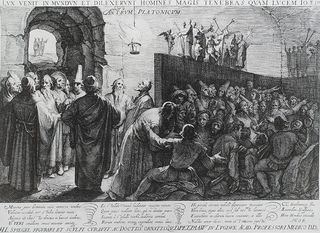
Platon_Cave_Sanraedam_1604

Daniel Tutt reviews Alain Badiou's Plato’s Republic: A Dialogue in 16 Chapters, in Berfrois:

In what Alain Badiou calls his “hyper-translation” of Plato’s Republic, we are taken into the world of Plato’s classic dialogue on politics and justice, sped up to the pace of a 21st century New York street corner. Socrates and his sophist interlocutors speak a gritty street talk that is both accessible and familiar, despite the fact they invoke intellectual figures from St. Paul to Jacques Lacan to the mathematician Paul Cohen.

Amanda, a female character who didn’t exist in Plato’s original is introduced. In some ways, Amantha plays the hysteric to Socrates, always pushing him to his next insight. Susan Spitzer’s translation of Badiou’s French into English is clearly designed for an American audience, one that resonates particularly well for a post #occupy angst that is hungry for political change. Badiou has refreshed Plato in more ways than bringing his own philosophical language into it; his wager is larger than this. He manages to traverse the twentieth century’s aversion to Plato as a totalitarian philosopher, and leaves us with new ways of understanding Plato’s conception of truth, the ideal form of government, and how we must participate in politics today.

Not surprisingly, there have already been critics of Badiou’s translation. Two interrelated problems have been raised. The first is that his translation breaks the formal rules of translation to such a degree that the original meaning of the text has lost its significance. But this critique is inadequate at face value because Badiou’s hyper-translation is forthright in its intention of taking Plato’s concepts and modifying them into his own lexicon. For example, the soul becomes the Subject, God becomes the big Other, and the true life becomes Truth – all terms that comport to Badiou’s own canon. Badiou’s hyper-translation is a type of translation that used to be common amongst philosophical texts, whereby the purpose of the translation was not to preserve the static meaning of the original, but to enable the text to speak to us in the present.

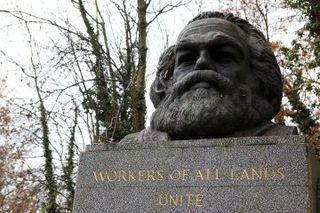
Marx’s Revenge: How Class Struggle Is Shaping the World

Karl_marx_0325

Michael Schuman in Time:

Karl Marx was supposed to be dead and buried. With the collapse of the Soviet Union and China’s Great Leap Forward into capitalism, communism faded into the quaint backdrop of James Bond movies or the deviant mantra of Kim Jong Un. The class conflict that Marx believed determined the course of history seemed to melt away in a prosperous era of free trade and free enterprise. The far-reaching power of globalization, linking the most remote corners of the planet in lucrative bonds of finance, outsourcing and “borderless” manufacturing, offered everybody from Silicon Valley tech gurus to Chinese farm girls ample opportunities to get rich. Asia in the latter decades of the 20th century witnessed perhaps the most remarkable record of poverty alleviation in human history — all thanks to the very capitalist tools of trade, entrepreneurship and foreign investment. Capitalism appeared to be fulfilling its promise — to uplift everyone to new heights of wealth and welfare.

Or so we thought. With the global economy in a protracted crisis, and workers around the world burdened by joblessness, debt and stagnant incomes, Marx’s biting critique of capitalism — that the system is inherently unjust and self-destructive — cannot be so easily dismissed. Marx theorized that the capitalist system would inevitably impoverish the masses as the world’s wealth became concentrated in the hands of a greedy few, causing economic crises and heightened conflict between the rich and working classes. “Accumulation of wealth at one pole is at the same time accumulation of misery, agony of toil, slavery, ignorance, brutality, mental degradation, at the opposite pole,” Marx wrote.

A growing dossier of evidence suggests that he may have been right.

the man without a country

1364079267

WHEN THE TIME CAME for Kurt Vonnegut to title his final book, not so long before he stumbled in his Park Avenue home, banged his head, and died, the writer turned, in a Rosebud touch, to a short story he read as an Indianapolis schoolboy during the Great Depression. That story was “The Man Without A Country” by Edward Everett Hale, first published anonymously in the December 1863 issue of a young Atlantic Monthly. Nowhere in Vonnegut’s long 2005 goodbye letter, A Man Without A Country, does he explain the title reference. This was less an oversight than a bonus message for the dwindling number of Americans who remember when Phillip Nolan, the sea-born hero-in-exile of Hale’s story, stood for allegorical and literal deracination of the saddest sort. The sly reference strikes twice. It evokes lost innocence and nostalgia for another age. Then drives a letter-opener through their heart. Vonnegut’s title also winks at the vicissitudes of literary fame. When Hale died at age 87 in 1909, he enjoyed an international reputation nearly as warm and deep as Vonnegut’s in 2005. After his once formidable output dried to a trickle, the New York Critic ranked Hale the 11th-greatest living American author.

more from Alexander Zaitchik at the LA Review of Books here.

wood for roth

Philip-Roth-010

Did anyone believe Philip Roth when, earlier this year, he announced that he was retiring from writing? Of all contemporary novelists, he is the one who has made writing seem a necessary and continuous act, inextricable from the continuities and struggles of being alive. For Roth, narration and self seem to have been born together; and, therefore, must die together, too. More than any other modern novelist, he has used fiction as confession and the displacement of confession: his ranters, complainers and alter egos, from Portnoy to Zuckerman to Mickey Sabbath all seem Rothian, even when they are only standing in for Roth. He has made his Newark childhood, his loving, annoying parents, his Jewishness, his sexuality, his very writing life familiar and vivid to millions of readers. He has seemed to need fiction as a kind of relentless performative report, which is why, in recent years, the great novels (Sabbath’s Theater, American Pastoral) have shared space with much weaker works, and why he has been so productive; the fiction at once urgent and a bit scrappy, as necessary as art and as helpless as life.

more from James Wood at The Guardian here.

The Science of Monsters

From The Telegraph:

Kaplan_main_2516071bIn its simplest forms, we like to put a face and a form to things we don’t understand. So when ships disappeared, unaccountably, from calm seas, their loss used to be ascribed not to technical failure but to monsters who came up from the bottom of the ocean to drag the unsuspecting mariners ever downwards. Those who lived in areas prone to earth tremors and eruptions put them down to angry monsters rising up from the ground to wreak havoc. Religion, inevitably since it represents our attempt to make some sort of sense of the world around us and the random blows of fate, came to endorse some of these formulations. The devil, the ultimate monster in Christianity, so very nearly a match for God, especially if we are craven enough to believe the empty promises he whispers in our ear, is the face and form put to the abstract reality that many call evil. He also used to be employed to explain natural disasters and illness.

So the rise of science should have pensioned off such beasts, and to some extent that is the case, as Kaplan demonstrates. However, it hasn’t quite dispensed with our propensity to want to believe such tales. Faced, for example, with the horror of Myra Hindley’s crimes, many retreated even in our secular, scientific times into labelling her as the devil incarnate. And even though we may now be able to send cameras down to the floor of the deepest oceans, we still can’t quite banish the notion that there may still be something lurking there. Can’t or won’t? Kaplan is especially good on how modern literature and especially cinema continues to feed our appetite for being frightened by monsters. The whole Jaws phenomenon – books and films that echo in the memory of anyone taking a dip off an unfamiliar beach – can be seen, he argues, as a modern manifestation of older fears of Charybdis, Leviathan and the Giant Squid, the creatures of “mysterious fathoms”. And the age-old association of man and monster which allows buried human insecurity to be projected onto mythical creatures has, he suggests, found a whole new dimension in the cinematic cult of alien invaders from outer space. Alienated humans express their disconnection with the rest of society by believing in aliens.

More here.

into the woods

Fig-03-b-Brandis-samples-from-the-Kew-GardensPS_reorganized

Around 1800, the condition of German forests was known to be pitiable. Centuries of exploitation had resulted in the depletion of most of the original species, and their replacement with faster-growing trees, such as birch, willow, or alder, was meant to address the constant timber famine. These local initiatives were gradually taken over by more systematic operations, aiming at establishing productive forests as quickly as possible.5 The extensive planting of these artificial forests was informed by the work of the forest scientists who, influenced by the liberal economic theories of Adam Smith, had devised the “soil rent theory.” This held that forests, understood as the combination of land value, timber capital, and silvicultural expense, should yield an annual interest.6 As a result, German forestry developed a highly rational approach in which all these elements were meticulously calculated to maximize profitability. This approach was eventually termed “scientific forestry” and put German forestry at the forefront of the profession.

more from Dan Handel at Cabinet here.

Tuesday Poem

Last Signature
—a Ghazal for Agha Shahid Ali

Our wounds are labeled forgettable, Shahid
Our life before death is imperceptible, Shahid

Billboards proclaim, Kashmir is Paradise
God has a reason to be chimerical, Shahid

Memory threads tied to wooden roses at Khankah
Even simple prayers are incomprehensible, Shahid

At Naseem Bagh, your presence was ephemeral
Now, your absence is a spectacle, Shahid

Our laments are lost, our yearnings are empty
Grief— the source of all that is poetical, Shahid.

Fear has abandoned us; Hope has embraced us
Yours are the best words in our arsenal, Shahid

Your last illegible scrawl, an emblem of your name
The Beloved Witness, grievable, indelible, Shahid

by Ather Zia
from Kashmir Walla

The Marvels in Your Mouth

Mary Roach in The New York Times:

FaceDr. Van der Bilt and his colleagues have laid claim to a strange, occasionally repugnant patch of scientific ground. They study the mouth — more specifically, its role as the human food processor. Their findings have opened up new insights into quite a few things that most of us do every day but would rather not think about. The way you chew, for example, is as unique and consistent as the way you walk or fold your shirts. There are fast chewers and slow chewers, long chewers and short chewers, right-chewing people and left-chewing people. Some of us chew straight up and down, and others chew side-to-side, like cows. Your oral processing habits are a physiological fingerprint.

Dr. Van der Bilt studies the neuromuscular elements of chewing. You often hear about the impressive power of the jaw muscles. In terms of pressure per single burst of activity, these are the strongest muscles we have. But it is not the jaw’s power to destroy that fascinates Dr. Van der Bilt; it is its nuanced ability to protect. Think of a peanut between two molars, about to be crushed. At the precise millisecond the nut succumbs, the jaw muscles sense the yielding and reflexively let up. Without that reflex, the molars would continue to hurtle recklessly toward one another, now with no intact nut between. To keep your he-man jaw muscles from smashing your precious teeth, the only set you have, the body evolved an automated braking system faster and more sophisticated than anything on a Lexus. The jaw knows its own strength. The faster and more recklessly you close your mouth, the less force the muscles are willing to apply. Without your giving it a conscious thought. Teeth and jaws are impressive not for their strength but for their sensitivity, Dr. Van der Bilt has found. Chew on this: Human teeth can detect a grain of sand or grit 10 microns in diameter. A micron is 1/25,000 of an inch.

More here.

Monday, March 25, 2013