Events in the Future Seem Closer Than Those in the Past

From APS:

Future_vs_pastWe say that time flies, it marches on, it flows like a river — our descriptions of time are closely linked to our experiences of moving through space. Now, new research suggests that the illusions that influence how we perceive movement through space also influence our perception of time. The findings provide evidence that our experiences of space and time have even more in common than previously thought. The research, conducted by psychological scientist Eugene Caruso of the University of Chicago Booth School of Business and colleagues, is published in Psychological Science, a journal of the Association for Psychological Science. “It seemed to us that psychological scientists have neglected the important fact that, in everyday experience, people don’t evaluate the past and the future in exactly the same way,” says Caruso. From research on spatial perception, we know that people feel closer to objects they are moving toward than those they are moving away from, even if the objects are exactly the same distance away. Because our perceptions of time are grounded in our experiences of space, Caruso and his colleagues hypothesized that the same illusion should influence how we experience time, resulting in what they call a temporal Doppler effect.

Surveying college students and commuters at a train station, the researchers found that people perceived times in the future (i.e., one month and one year from now) as closer to the present than equidistant times in the past (i.e., one month and one year ago). Similarly, participants who completed an online survey one week before Valentine’s Day felt that the holiday was closer to the present than those who were surveyed a week after Valentine’s Day. These findings hint at the relationship between movement in space and perceptions of time; to establish a direct link between the two, the researchers conducted a fourth study using a virtual reality environment.

More here.

Sunday Poem

History as a Crescent Moon

The horns
of a bull
who was placed
before a mirror at the beginning
.. of human time;
. .. in his fury
at the challenge of his double,
.. he has, from
.. that time to this,
been throwing himself against
…………………………..the mirror, until..
. . by now it is
shivered into millions of pieces—
………………………….here an eye, there
a hoof or a tuft
of hair; here a small wet shard made
entirely of tears.
And up there, below the spilt milk of
.. the stars, one
. silver splinter—
parenthesis at the close of a long sentence,
new crescent,
beside it, red
asterisk of
Mars

by Eleanor Wilner
From: Poetry, Vol. 189, No. 4, January, 2007

Pakistan does not have an image problem

Saroop Ijaz in the Express Tribune:

ScreenHunter_141 Mar. 17 10.09How would it feel to lose everything and then hear that the real tragedy is that the image of this country has been tarnished? Your suffering and loss do not matter; you are just a marketing prop. You should, perhaps, be ashamed for having your houses burnt and bringing embarrassment to the Fatherland. Pakistan does not have an “image” problem. The gap in the conveyed image and reality is there, but it is the other way around. Pakistan should be thankful that most of the world does not read or hear the Urdu press, the local Friday Khutba [sermon in a mosque], banners on Hall Road, Lahore, or pamphlets in the Civil Courts. Pakistan has an image that is softer than it deserves.

More here.

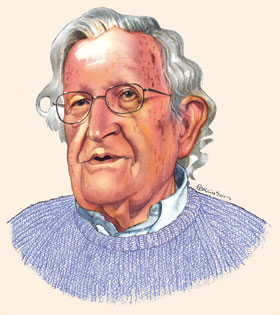
Lunch with Noam Chomsky

304a42fc-8d1b-11e2-aed2-00144feabdc0

John McDermott talks to Noam Chomsky in the FT:

I am about to ask the professor about Hugo Chávez, who died the night before our lunch, but a waitress arrives and asks for our order. Chomsky chooses the clam chowder, and a salad with pecans, blue cheese, apples and a lot of adjectives. I go for tomato soup and a salmon salad. The professor asks for a cup of coffee and since we are about to discuss the late Venezuelan leader, I ask for a cup, too.

In 2006, Chávez recommended Chomsky’s Hegemony or Survival: America’s Quest for Global Dominance to the UN General Assembly. “It’s a mixed story,” Chomsky says of Chávez’s legacy. He points to reduced poverty and increased literacy. “On the other hand there are plenty of problems,” such as violence and police corruption; he also mentions western hostility – in particular an attempted coup in 2002 supported by the US. America’s behaviour towards Caracas is obviously important in any assessment of Chávez but its appearance is an early signifier of a pattern in a Chomsky conversation: talk for long enough about politics with the professor and the probability of US foreign policy or National Socialism being mentioned approaches one.

I say that he hasn’t referred to Chávez’s human rights record. Some of Chomsky’s critics have accused him of going easy on the faults of autocrats so long as they are enemies of the US. Chomsky denies this vehemently: he spoke out against the consolidation of power by the state broadcaster; he protested the case of María Lourdes Afiuni, a judge who spent more than a year in prison awaiting trial for releasing a government critic. “And I do a million cases like that one.”

Still, Chomsky thinks about how hard to hit his targets. He admits as much as our soups arrive. “Suppose I criticise Iran. What impact does that have? The only impact it has is in fortifying those who want to carry out policies I don’t agree with, like bombing.” He argues that any criticisms about, say, Chávez, will invariably get into the mainstream media, whereas those he makes about the US will go unreported. This unfair treatment is the dissident’s lot, according to Chomsky. Intellectuals like to think of themselves as iconoclasts, he says. “But you take a look through history and it’s the exact opposite. The respected intellectuals are those who conform and serve power interests.”

Saturday, March 16, 2013

Barack, a few travel tips for your upcoming trip to Israel

Amer Zahr in The Civil Arab:

ScreenHunter_140 Mar. 16 16.48Mr. President, I hear you are traveling to Israel next week. As a concerned patriotic American citizen of Palestinian descent, I have some pointers for you.

Now, I assume you’ll be flying into Tel Aviv. Usually, when non-Jews arrive there, especially if they are a little darker-skinned, they are asked to wait in a… let’s call it a “VIP Room.” Incidentally, the room is quite nice. There’s a water cooler, comfortable chairs, and a soda machine. It’s probably the only place in the world where you can be racially profiled and get an ice-cold Coca-Cola all at once.

To avoid the room, I would mention that you are the President of the United States. It might help.

You may get strip-searched. Saying you are an American doesn’t help much here. I’ve tried. I even sang the national anthem last time an Israeli soldier was looking down my pants. Right after I said, “Oh say can you see,” he said, “Not much.”

To escape this embarrassment, I would mention that you are the President of the United States. It might help.

In case they don’t already know, you might not want to tell Israeli security you are half-Muslim. As a fellow half-Muslim, I can tell you they don’t really care about the percentage. Any bit of Muslim freaks them out. And I’m not sure if you heard, but the fans of one of Israel’s soccer teams, Beitar Jerusalem, actually protested when the club signed two Muslim players. When one of them scored in a game last week, hundreds of fans actually walked out of the stadium. One of the fans later stated about the Muslim players, “It’s not racism. They just shouldn’t be here.” Hopefully, they don’t know your middle name is “Hussein.” Maybe they didn’t watch the inauguration.

In any case, I would mention that you are the President of the United States. It might help.

More here. [Thanks to John Ballard.]

Remembering Rachel Corrie

Ten years ago today Rachel Corrie was killed by an Israeli bulldozer. It is still worth having a look at Edward Said's article on the subject, which is also almost ten years old. From CounterPunch:

ScreenHunter_139 Mar. 16 16.21In early May, I was in Seattle lecturing for a few days. While there, I had dinner one night with Rachel Corrie’s parents and sister, who were still reeling from the shock of their daughter’s murder on March 16 in Gaza by an Israeli bulldozer. Mr. Corrie told me that he had himself driven bulldozers, although the one that killed his daughter deliberately because she was trying valiantly to protect a Palestinian home in Rafah from demolition was a 60 ton behemoth especially designed by Caterpillar for house demolitions, a far bigger machine than anything he had ever seen or driven. Two things struck me about my brief visit with the Corries. One was the story they told about their return to the US with their daughter’s body. They had immediately sought out their US Senators, Patty Murray and Mary Cantwell, both Democrats, told them their story and received the expected expressions of shock, outrage, anger and promises of investigations. After both women returned to Washington, the Corries never heard from them again, and the promised investigation simply didn’t materialize. As expected, the Israeli lobby had explained the realities to them, and both women simply begged off. An American citizen willfully murdered by the soldiers of a client state of the US without so much as an official peep or even the de rigeur investigation that had been promised her family.

But the second and far more important aspect of the Rachel Corrie story for me was the young woman’s action itself, heroic and dignified at the same time. Born and brought up in Olympia, a small city 60 miles south of Seattle, she had joined the International Solidarity Movement and gone to Gaza to stand with suffering human beings with whom she had never had any contact before.

More here. [Thanks to Najla Said.]

the great unmentionable

041d48f7-0fc0-4fb7-8db1-47a83447295d

Philip Roth knows he is running out of time. He speaks now of the end – certainly of the end of his writing life. He ought to have won the Nobel Prize long ago, but perhaps his work is simply too American for the august Swedes of the Nobel committee, who have grumbled about the parochialism of the American novel, of how it looks inward rather than out to the rest of the world. That is nonsense, of course. The greatest living American writers – Cormac McCarthy, Don DeLillo and, preeminently, Roth – are universalists who in radiant prose ask, again and again: what does it mean to be human and how should we act in a world that is as mysterious as it is indifferent to our fate? At the end of The Tempest, as he prepares to take his leave, Prospero, a magician of words, hints that “the story of my life” is ending, and now “Every third thought shall be my grave”. Roth has told the story of his life many times and in many different ways, and now he is done.

more from Jason Cowley at the FT here.

auster and coetzee talk sports

17riker-img-articleLarge

For potential pen pals, these two famous writers might seem at first an unlikely pairing. Auster, the younger by seven years, is an enthusiast, or certainly I’ve always thought of him that way: his fascination with coincidences and odd circumstances; his bottomless bag of anecdotes; his championing of out-of-the-way books and films that always end up being very good. Meanwhile Coetzee, the Nobel Prize-winning South African, seems more of a skeptic, a fastidious thinker and uncompromising moralist, who strips away social and political conventions in search of an ethics of essential experience. Yet whatever their differences, real or perceived, what quickly becomes clear in the pages of “Here and Now” is that they have far more in common than not. They both love sports, for example, and the fact that they don’t love precisely the same sports, or love them for precisely the same reasons, is largely why they have so much to say to each other about them. Discussing the nature of sports’ appeal, Auster proposes they are “a kind of performance art.” Coetzee responds that his interest in sports is “ethical rather than aesthetic,” having to do with “the need for heroes that sports satisfy.”

more from Martin Riker at the NY Times here.

the red shoes

Papal-shoes_jpg_470x385_q85

Can it be coincidence that shoemakers like Maurizio Gucci of Florence and Salvatore Ferragamo of Campania and Florence came from places with strong Etruscan connections? A tomb painting from the Etruscan city of Tarquinia, executed perhaps around 530-520 BC, shows several mourners in elegant pointed boots. The people portrayed in this “Tomb of the Augurs” may well have had close connections with Rome, where the ruling dynasts were named Tarquinius, and the tyrant-slayer Brutus, credited with founding the Roman Republic a few years after this tomb was decorated (509 BC), was actually a Tarquinius on his mother’s side. When Roman patricians sported red shoes in subsequent centuries, they were simply carrying on ancestral tradition. With the red shoes went a red-striped robe, again in Phoenician purple—a wide stripe for members of the Senate, a narrower stripe for the second-rank aristocrats known as horsemen, equites. After the coming of Christianity, the tradition of wearing red passed from the Roman Senate to the “Sacred Senate,” the College of Cardinals. Cardinal red, in fact, is Roman senatorial red, derived from Phoenician purple (or a cheaper—but not cheap—substitute called cochineal, made by grinding the shells of beetles).

more from Massimo Gatto at the NYRB here.

Bad girls: A history of unladylike behaviour

From The Independent:

BadDomestic and demure. Neat and sweet. Sugar and spice and all things nice… but what happens when girls go bad? It's a subject that has long fascinated, and titillated, the press, public, and politicians, from whispers over 'fallen women' in the past to drunken 'sluts' slumped in the gutter in 2013. Now a new book, Girl Trouble, by the cultural historian Carol Dyhouse, explores the history of our moral panics over rebel girls, from the late-19th century onwards. Dyhouse found herself “more and more interested in rebel girls, bad girls, the ones who went off the rails. They're not exactly feminist, but they're representing a discontent with what's in front of them. It allows you an insight into the constraints young women have operated under.” And what constraints… from an inability to vote, own property, prevent pregnancy, get a degree, an abortion, or a job, to more ephemeral, societal expectations of decorous behaviour, obedience to men, feminine beauty, and sexual restraint. No wonder nearly every generation had its own modern lasses who stuck their fingers up at societal norms and got stuck into enjoying themselves instead.

…Jump forward to the 1990s for a more recent incidence of moral panic. Once again, it's when girls take on masculine traits that the Establishment gets worried, and in the late Nineties and early Noughties, young women were perceived to be doing just that, matching blokes when it came to drinking lager and behaving raucously. The ladette was born, and she wasn't pretty. During the Seventies and Eighties, much was obviously achieved in the way of equal rights for women and the breaking of gender stereotypes. The Nineties saw the rise of a more pop-y feminism, too, with the gobby, garish 'Girl Power', as espoused by the Spice Girls. Easy to mock today, it did at least promote easy-to-swallow enfranchised concepts, like sticking by your female friends and girls ruling the world. But when young ladies started to behave like lads in the 1990s, many commentators felt this was a flip-side of equality, feminism gone too far. “Girls drinking too much, taking drugs, taking their clothes off, exhibiting loud-mouthed and vulgar behaviour, and creating mayhem in the streets began to dominate newspaper headlines in the 1990s,” writes Dyhouse. Common tropes assigned to these tabloid-filling folk-devils were a slatternly approach to housework and hygiene, the ability to down pints, a resistance to settling down and starting a family, and even a willingness to scrap in the streets on a Saturday night. Celebrity ladettes, such as Sara Cox, Zoe Ball, Charlotte Church and Denise van Outen, were subject to fascinated press scrutiny.

…But she is optimistic that today's young women will soar beyond pornification; for if history has taught us one thing, it's that girls, their bodies and their femininity (or indeed masculinity), is a source of endless, and often over-hyped, concern. Wearing a padded bra, Dyhouse suggests jovially, is not “going to turn someone into a sexual object or rot their brains”.

More here.

The Unwilling Witness

ABDULRAZZAQ AL-SAIEDI in The New York Times:

BridgeWe arrived in Falluja to see people gathered around two burned-out S.U.V.’s. Insurgents had gunned down four Blackwater security contractors who were driving through the city; a mob had set the vehicles ablaze. My reporter’s instincts carried me, almost against my will, through the sea of rioters, to where the bodies of the contractors had been dragged — a bridge over the Euphrates about a half-mile away. Two bodies were on the ground, their jackets still smoking. A boy of about 10 was kicking one of them, yelling, “Pacha, pacha,” the name of an Iraqi dish made from the head of a sheep. It crossed my mind that this child could not be human. Then my attention turned to the bodies swinging mutilated from the bridge. I felt briefly disoriented. Hordes of people glared at me, a stranger in a small, insular city. I pretended to be part of the crowd. “These Americans deserve this destiny!” I yelled. I knew I would be the fifth body if I were exposed as a reporter for a U.S. paper. When I returned to the bureau in Baghdad, I resolved to quit my job with The New York Times. It was too dangerous and too upsetting to witness the seething violence so closely. A few years later, after losing two of my Iraqi colleagues at The Times, both of whom were murdered, I finally did leave, to pursue a graduate degree and get away from a lifetime of war.

I never imagined that on the quiet streets of Cambridge, Mass. — a world away from the chaos of Iraq — I would meet Donna Zovko, the mother of one of the murdered contractors. Zovko had come to attend an event at Harvard; a friend introduced us, knowing that I had been in Falluja just after her son was killed. We met for breakfast in an Au Bon Pain on a rainy Sunday in late winter. The woman sitting across from me was soft-spoken and warm, referring to me as “a young boy” (I was 39) and asking me about my life in Iraq. I learned from Zovko that, as I was standing in that mob in Falluja, she was listening to a radio report of the deaths of four Americans in Iraq. She had e-mailed her son Jerry, telling him to be careful. Two hours later, she learned that he was among the four killed. In the cafe, she became suddenly quiet, and her eyes fixed on mine. “Please tell me what happened to my son,” she pleaded. “Why he died like this.” I started to cry. I didn’t know how to tell her about the terrible scene I witnessed. I replied elusively: “He was killed quickly. He was shot.” My words hung in the air. “Then why was he burned and dragged?” she asked quietly. “Why did they do that?” As she spoke, my thoughts rushed to my own mother. I told Zovko that my brother was executed by Saddam Hussein’s security forces in Abu Ghraib. What if our situations were reversed and Zovko had seen my brother killed? What could she say to my mother to explain how or why it happened? We consoled each other. In that moment, there was no difference between Jerry’s mother and mine. Each had lost her beloved oldest son to a violent, unjust end: Jerry was 32; Sadoon was 36. Zovko told me that she was not angry with the Iraqis who murdered her son. Instead, she empathized with Iraqi mothers who lost children to the American forces.

The American invasion of Iraq took place 10 years ago this month. Even before the invasion, I lived most of my life in war zones, losing friends and relatives with numbing frequency. We thought the trauma of war would be over when Hussein was deposed in 2003, but it extends past the execution of a thug. Ten years ago, I called the Iraq war the right war, but now, I cannot say that I know that such a thing exists.

More here. (Note: Abdulrazzaq Al-Saiedi is a former New York Times reporter and a Nieman fellow at Harvard. He is currently a senior researcher with Physicians for Human Rights.)


No New York: A Jade Anniversary

NoNewYork35LKYGB

Logan K. Young in 3:AM Magazine:

(You mean you don’t own a copy? What are you, sick or something?)”

– Lester Bangs, “A Reasonable Guide to Horrible Noise

May 5-6, 1978. For once, it really did happen so fast. All of it. Rather literally, too. Blink, bat an eye or go take a piss, and you probably missed it. (Those things worth remembering, anyways.) What a bummer. Indeed. If you weren’t there, then you just don’t know. Alas, such is life; you have to seize it while ye may. But even if you were around (and you truly were doing it right) you still don’t remember. (Or at least you shouldn’t.) The ones that claim total recall, well, suffice it to say they’re lying. They have to be. For No Wave was the one, true Blank Generation. Yes. It took Aristotle’s tabula rasa, and with one flailing swipe per Attali, all the rest was noise. Noise being code for negation — a deliberate dithering of all things affirmative — No Wave is then best described not by what it was, but instead by what it wasn’t: no shirt, no shoes, no problem. No fucking future. None at all.

But what’s really in a name? No, seriously? It’s a simple enough inquisition. The line is straight, ‘tis the answer what’s crooked. Ensconced in the void plied by these otherwise nameless, at-risk kids, that inquiry becomes a near tautology. Is the thing now the name? Dunno. Is its name just a thing now? Ibid. So, like Beckett’s L’innommable, perhaps anything longform on No New York is primordially flawed. We shan’t go on; we shall go on. On y va! After all, there’s music, movies and mores left to kill. Still. Janie, get your gun.

To be fair, such existential quandaries didn’t matter to a group like Mars. Meanwhile, a band such as D.N.A. couldn’t be bothered. Likewise, not a single epistemological shit was given by Teenage Jesus & the Jerks. And The Contortions, umm, they were just too cool. Sorry. Basically, they were all looking only for a light. But what we’ve come to call ‘No Wave’ wasn’t anyone’s beacon. That’s for damn sure. A raging burnout in a left-for-dead New York City, nah, it was not built to last the night. Everything about it (the look, the feel, the lifestyle…the savagery) was ephemeral. On purpose, no less.

The Folly of Defunding Social Science

Scott Atran in the Huffington Post:

Scott-Atran-WebWith the so-called sequester geared to cut billions of dollars to domestic programs, military funding, social services, and government-sponsored scientific research — including about a 6 percent reduction for the National Institutes of Health and the National Science Foundation — policymakers and professionals are scrambling to stave off the worst by resetting priorities. One increasingly popular proposal among congressional budget hawks is to directly link federal funding of science to graduate employment data that seriously underestimates the importance and impact of social sciences to the nation at large, in order to effectively justify eliminating social science from the federal research budget. For example, federal legislation introduced by Senators Marco Rubio (R-Fla.), and Ron Wyden (D-Ore.), would require states to match information from unemployment insurance databases with individual student data and publish the results, which would show earnings by program at each institution of higher education. But educators and economists note that measuring return on investment via salary alone is too simplistic: liberal arts majors often start out at lower salaries but make more than their peers in later decades. Even more worrisome, in the guise of practicality, such maneuvers offer up a not-so-veiled attempt to justify eliminating government funding for the social sciences, perilously underestimating their importance and impact to the economy and national welfare.

More here. And Scott's article in Foreign Policy is here.

Resurrecting the Extinct Frog with a Stomach for a Womb

Gastric_brooding_frog

Ed Yong in Not Exactly Rocket Science:

Two years ago, Mike Archer from the University of New South Wales looked down a microscope and saw that a single fertilised frog egg had divided in two. Then, it did it again. And again. Eventually, the egg produced an embryo containing hundreds of cells.

“There were a lot of hi-fives going around the laboratory,” says Archer.

This might seem like an over-reaction. After all, millions of frog eggs divide into embryos every day, as they have done since before dinosaurs walked the earth. But this egg was special. Archer’s team of scientists had loaded it with the DNA of the southern gastric brooding frog—a bizarre creature that has been extinct for almost 30 years.

The fact that it started to grow into an embryo was a big deal. The fact that it never went further was disappointing, but not unexpected. This is cutting-edge science—cloning techniques put to the purpose of resurrection.

Archer’s goal is simple: To bring the extinct gastric brooding frog back from oblivion and, in doing so, provide hope for the hundreds of other frogs that are heading that way. Getting the embryo was a milestone and Archer is buoyantly optimistic that he’ll cross the finish line soon. Lazarus, he says, will rise again.

The Little that Hugo Chávez Got Right

Lansberg-rodriguez_38.2_chavez

Daniel Lansberg-Rodriguez in Boston Review:

There was a time when the world spoke of “Venezuelan Exceptionalism.” For nearly half a century—while Argentina, Bolivia, Brazil, Uruguay, and Paraguay were military dictatorships, the Andean nations were trapped in a carousel of coups d’état, and violent civil insurgency seemed ubiquitous—Venezuela was South America’s only stable and functional democracy. Today that exceptionalism cuts the other way. As Latin America rises, Venezuela is a backwater, starkly divided on social and political grounds and wantonly violent: a world leader in kidnappings, murders, and prison riots. It is a country with a broken heart.

And now, with President Hugo Chávez dead from an unspecified cancer at just 58 years of age, things look bleaker than ever. There were times when I—long an unapologetic opponent of Chávez and his revolution—dreamed that an early death for El Comandante might save Venezuela. No such luck. In his short time in charge, Nicolás Maduro, the successor, has already proven himself to be as erratic as Chávez, a bit meaner, and far more insecure.

Yet I find myself traipsing into the backwoods of my own conviction. What if, in rejecting Chávez, I unwittingly placed myself on the wrong side of history? In the few days since the announcement of his death, I have found myself returning to this question often. Am I simply feeling compassion for a fellow person suffering and dying from terrible illness? Is it empathy for the millions who have responded to Chávez’s death with earnest sadness? Or perhaps, having so often spoken ill of the now dead, I have guilt on my conscience.