Haifa’s Imaginary: A Mythopoetic Reclamation of Palestine, Part II

In Haifa you avoided testing the imagination in the room where it had trained you to step out of yourself. You were content with observing, like a bird watching a feather clinging to the bitter orange tree. — Mahmoud Darwish [1

By Sousan Hammad

The emphasis of this text is to discuss the role that the imaginary plays in poetry that is rooted in both a geographic place and virtual (poetic) space, arguing that the poem, in its poetic imaginary, is an attempt to become a place that exists in its displacement. By using images that create an imaginary representation of a space it enables spectators to see the possible variations of a place. In so doing, it will aim to serve as an archive of an imaginary Haifa, creating a platform to collectively rethink and reimagine our experiences with Palestine, a challenge that maps multiplicities: those experiences and feelings in a particular space that are totally unknown or ‘unreal' to some readers, or actual and ideal to others.
6579ba20051f109b5784ff8db033b93e

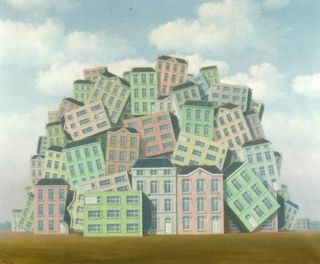
“The Breast” by Rene Magritte, 1961

Still, no physical reality of Palestine can ever take the place of the mythic place that was lost. The liturgy of longing for Palestine, for a lost time and space, has become a tired and clichéd phenomenon (as the traditions of memorializing have proved) for its diasporic, exiled, and refugee communities. Rather than end the reaction to longing, rethinking nostalgia and the force of roles, such as the imaginary, can be understood as modes for provoking liberation from the ‘what has been' and ‘what is'. It is a break from clichés and manifestos, a way to cope with the obsession of the Palestine question that every Palestinian struggles with. The attraction of imagining new forms is that it lets us dream in a new Palestine and live in a new Palestine – in other words it allows us to ‘materialize' an imaginary Palestine, one that can be thought of in various ways, for Palestine exists in its multiplicities.

This is not to say that Palestine should merely exist in our imagination, but this is what it has come to: a place that must go beyond reality, for there is no one physical place that is equal to a Palestinian's memories, longings and reveries – our imaginations. Our notions of the real and the imaginary are nothing but misunderstandings. This is why the role of longing is much more than a problem to be solved, it, like translation, lets itself be represented in fantastic variations.
Read more »

Sunday, April 14, 2013

On Cavafy’s Side

Cavafy1900-portrait

From 1977, Joseph Brodsky in the NYRB (image from Wikimedia Commons):

The uneventfulness of Cavafy’s life extends to his never having published a book of his poems. He lived in Alexandria, wrote poems (occasionally printing them infeuilles volantes, as pamphlets or broadsheets in a severely limited edition), talked in cafés to local or visiting literati, played cards, bet on horses, visited homosexual brothels, and sometimes attended church.

I believe that there are at least five editions of Cavafy’s poetry in English. The most successful renderings are those by Rae Dalven and Messrs. Edmund Keeley and Philip Sherrard. The hard-cover version of the latter is bilingual. Since there is little or no cooperation in the world of translation, translators sometimes duplicate others’ efforts without knowing it. But a reader may benefit from such duplication and, in a way, the poet may benefit too. In this case, at least, he does, although there is a great deal of similarity between the two books in the goal they set themselves of straightforward rendering. Judged by this goal, Keeley and Sherrard’s versions are certainly superior. It is lucky though that less than half of Cavafy’s work is rhymed, and mostly his early poems.

Every poet loses in translation, and Cavafy is not an exception. What is exceptional is that he also gains. He gains not only because he is a fairly didactic poet, but also because, starting as early as 1900-1910, he began to strip his poems of all poetic paraphernalia—rich imagery, similes, metric flamboyance, and, as already mentioned, rhymes. This is the economy of maturity, and Cavafy resorts to deliberately “poor” means, to using words in their primary meanings as a further move toward economy. Thus he calls emeralds “green” and describes bodies as being “young and beautiful.” This technique comes out of Cavafy’s realization that language is not a tool of cognition but one of assimilation, that the human being is a natural bourgeois and uses language for the same ends as he uses housing or clothing. Poetry seems to be the only weapon able to beat language, using language’s own means.

“No Pakistanis”: The racial satire the Beatles don’t want you to hear

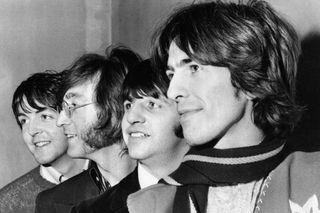
Beatles_68-620x412

Alex Sayf Cummings in Salon:

Imagine that a popular American rock band – say, the Black Keys – wrote a song about immigrants. There are too many of them, the lyrics suggest, and they take jobs away from native-born workers. The chorus recommends that they go back to their countries of origin, where they really belong. Though the song was meant to satirize xenophobia, “No Mexicans” could be easily interpreted as an anthem of racism.

This was the situation that the Beatles faced in 1969, when they first concocted the song that would become “Get Back.” Better known as a playful take on counterculture, starring the gender-bending Sweet Loretta Martin and the grass-smoking Jo-Jo, the song originally dealt with South Asian immigration to the United Kingdom. The strange story of “Get Back,” its politics, and its bootlegs tells us much about the limits of what musicians, even hugely popular and politically engaged ones, can say in popular music — and what’s at stake in the battle over file-sharing and free culture today.

An early version of the song, known to bootleggers as “No Pakistanis,” began with Paul McCartney muttering, “Don’t dig no Pakistanis taking all the people’s jobs.” Many Americans have heard similar complaints, having listened to the anti-immigrant invective of Joe Arpaio and Tom Tancredo for years. Brits are also familiar with such rhetoric, seeing the British Nationalist Party ride their slogan of “British jobs for British workers” to prominence in the last decade.

Many who hear the song today are startled to hear this sort of cranky posturing from the Beatles, the lovable moptops who told us that “All You Need Is Love.” Bootleg versions of “No Pakistanis” have even won the hearts of neo-Nazi groups like Stormfront, who believe that the Beatles were really on the side of the white man’s cause all along. (The white supremacist band Battlecry even recorded its own clueless version of the tune.) If released today, a similar song would likely ignite controversy, regardless of the songwriter’s intentions.

Sunday Poem

Pigeons
.
Like every kingdom,
the kingdom of birds
has its multitude of the poor,
the urban, public poor
whose droppings whiten
shingles and sidewalks,

who pick and pick
(but rarely choose)
whatever meets their beaks:
the daily litter
in priceless Italian cities,
and here, around City Hall—
always underfoot,
offending fastidious people
with places to go.

No one remembers how it happened,
their decline, the near-
abandonment of flight,
the querulous murmurs,
the garbage-filled crops.
Once they were elegant, carefree;
they called to each other in rich, deep voices,
and we called them doves
and welcomed them to our gardens.

.
by Lisel Mueller
from Alive Together
Louisiana State University Press

Life Science

Eran Gilat in lensculture:

Gilat_2I am a neuroscientist and an avid art photographer. In recent years I found myself directing most of my attention and energy to still life photography of biological specimens, highly inspired by my long-lasting confrontation with biological tissues in my clinical research. It takes a while for a young clinician or a researcher to accommodate to the laboratory or hospital scenes. Even after extensive training, some cannot adjust to the visuals. I feel my photographic activity carries me to these sometimes emotionally disturbing regions too.

My photographic activity deals with the aesthetics of the scene, improvising various contexts; the tools and paraphernalia shown are not just the typical ones used in the operating place. My “Life Science” project situates biological tissue into relatively pleasant, sometimes artificial scenarios, contemplating issues of materialism, erotica and mortality, corresponding with the complicated and intriguing category of “Animal Reminder” in the visual arts. I feel my work also challenges various ideas about violence. We tend to describe violent humankind behavior as an animal-like beastly revolting one, associated with violent animal behavior. However, I believe in many aspects we are inferior to the moral conduct of the animal world, while being superior in our “creative violent behavior”.

More here.

The Lives of Erich Fromm: Love’s Prophet

From Boston Review:

FrommThe book, however, that accounted most fully for the ’50s’ near-morbid desire for security at any price, had been written a decade earlier by the émigré psychoanalyst Erich Fromm. Escape from Freedom (1941), rooted in a European intellectual thought that had been heavily influenced by the work of both Karl Marx and Sigmund Freud, brought social psychology to the United States where, in the years ahead, it flourished wildly. The book launched its author on one of the most celebrated careers that any public intellectual, anywhere, has ever achieved.

Erich Fromm was born in 1900 in Frankfurt, Germany, into a lower-middle-class Jewish family that was nominally Orthodox. While Fromm never became religious, very early he fell in love with Judaism’s great book of wisdom, and for years wished only to become a student of the Talmud. At the same time, on the verge of teenaged life, he came under the influence of an employee of his father, who introduced him to the work of Karl Marx. Then came the First World War, which, in later years, Fromm labeled “the most crucial experience of my life.” His newest biographer, historian Lawrence J. Friedman, tells us in The Lives of Erich Fromm: Love’s Prophet that when the war was over the eighteen-year-old Fromm remained “obsessed by . . . the wish to understand the irrationality of human mass behavior.” By Fromm’s own accounting, these three strands of influence—Talmudic ethics, Marxist socialism, and the psychological power of unreason—shaped his intellectual life.

More here.

Uniting the Radical Left and the Radical Right: Pragmatic Centrism Is Crony Capitalism

Political_chart

Ashwin Parameswaran in Macroeconomic Resilience (image from Wikimedia Commons):

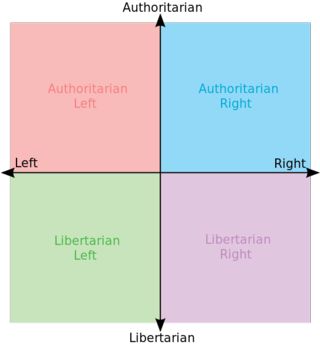
Most critics of neoliberalism on the left point to the dramatic reduction in the scale of government activities since the 80s – the privatisation of state-run enterprises, the increased dependence upon private contractors for delivering public services etc. Most right-wing critics lament the increasing regulatory burden faced by businesses and individuals and the preferential treatment and bailouts doled out to the politically well-connected. Neither the left nor the right is wrong. But both of them only see one side of what is the core strategy of neoliberal crony capitalism – increase the scope and reduce the scale of government intervention. Where the government was the sole operator, such as prisons and healthcare, “pragmatic” privatisation leaves us with a mix of heavily regulated oligopolies and risk-free private contracting relationships. On the other hand, where the private sector was allowed to operate without much oversight the “pragmatic” reform involves the subordination of free enterprise to a “sensible” regulatory regime and public-private partnerships to direct capital to social causes. In other words, expand the scope of government to permeate as many economic activities as possible and contract the scale of government within its core activities.

Some of the worst manifestations of crony capitalism can be traced to this perverse pragmatism. The increased scope and reduced scale are the main reasons for the cosy revolving door between incumbent crony capitalists and the government. The left predictably blames it all on the market, the right blames government corruption, while the revolving door of “pragmatic” politicians and crony capitalists rob us blind.

Saturday, April 13, 2013

le Carré looks back

VARIOUS-010

I wrote The Spy Who Came in from the Cold at the age of 30 under intense, unshared, personal stress, and in extreme privacy. As an intelligence officer in the guise of a junior diplomat at the British Embassy in Bonn, I was a secret to my colleagues, and much of the time to myself. I had written a couple of earlier novels, necessarily under a pseudonym, and my employing service had approved them before publication. After lengthy soul-searching, they had also approved The Spy Who Came in from the Cold. To this day, I don’t know what I would have done if they hadn’t. As it was, they seem to have concluded, rightly if reluctantly, that the book was sheer fiction from start to finish, uninformed by personal experience, and that accordingly it constituted no breach of security. This was not, however, the view taken by the world’s press, which with one voice decided that the book was not merely authentic but some kind of revelatory Message From The Other Side, leaving me with nothing to do but sit tight and watch, in a kind of frozen awe, as it climbed the bestseller list and stuck there, while pundit after pundit heralded it as the real thing.

more from John le Carré at The Guardian here.

Atheists Richard Dawkins, Christopher Hitchens and Sam Harris face Islamophobia backlash

From The Independent:

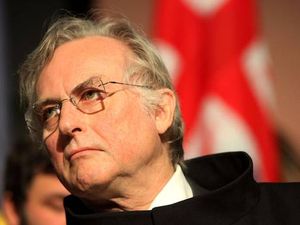
Dawdvkins-TwitterThey are often described as “The Unholy Trinity” – a trio of ferociously bright and pugilistic academics who use science to decimate what they believe to be the world’s greatest folly: religion. But now Richard Dawkins, Christopher Hitchens and Sam Harris are on the receiving end of stinging criticism from fellow liberal non-believers who say their particular brand of atheism has swung from being a scientifically rigorous attack on all religions to a populist and crude hatred of Islam. In the last fortnight a series of columns have been written denouncing the so-called New Atheist movement for, in one writer’s words, lending a “veneer of scientific respectability to today's politically-useful bigotry.” The opening broadside began earlier this month with a polemic from Nathan Lean on the Salon.com website. Lean, a Washington DC native and Middle East specialist who has recently written a book about the Islamophobia industry, was prompted to pen his attack following a series of tweets last month by Professor Dawkins attacking Islam in snappy 140 character sound bites. “Haven’t read Koran so couldn’t quote chapter & verse like I can for Bible. But often say Islam [is the] greatest force for evil today,” the Cambridge evolutionary biologist wrote on 1 March.

Writing on Al Jazeera’s website a few days later, Murtaza Hussain, a Toronto based Middle East analyst, penned an even more scathing critique. What the New Atheists were doing, he argued, was similar to the kind of scientific racism that was dominant within western cultures in the eighteenth and nineteenth centuries as they tried to use eugenics to classify – and consequently legitimise – the subjugation of certain races. Hussain reserved particular ire for Sam Harris, a neuroscientist by trade whose atheist tracts “The End of Faith” and “Letter to a Christian Nation” have made him one of the leading anti-religious polemicists of his age. Harris is an accomplished writer and public speaker with a solid background in academic rigour. But there are no shortages of statements from his over the years lumping all Muslims into one box. “The idea that Islam is a ‘peaceful religion hijacked by extremists’ is a fantasy, and is now a particularly dangerous fantasy for Muslims to indulge,” is just one he wrote in “Letter to a Christian Nation.” Wearing a palpable disdain for Islam on his sleeve he has also written in favour of torture, pre-emptive nuclear strikes and the profiling not just of Muslims but “anyone who looks like he or she could conceivably be a Muslim.” In response, Hussain wrote: “[Harris’] sweeping generalisations about a constructed civilisation encompassing over a billion people are coupled with fevered warnings – parallel with the most noxious race propaganda of the past – about the purported demographic threat posed by immigrant Muslim birthrates to Western civilisation.”

More here.

larry summers on blyth

Ae533d10-a2fc-11e2-9b70-00144feabdc0

Mark Blyth’s important polemic Austerity: The History of a Dangerous Idea seeks to put much of this in perspective. Blyth, a professor at Brown University, is no two-handed economist. He pulls no punches in making the case against austerity. His idiom is not that of modern macroeconomics – no theoretical equations, econometrics, stylised models, or even data tables. Rather, Blyth writes in the tradition of Keynes, slashing away at orthodoxy and the orthodox, emphasising the power of ideas as well as interests in shaping outcomes, ranging widely over the history of economic and political thought, expressing deep scepticism about financial actors, and rejecting the curtailment of spending as the solution to a period of excess. Much of what he says is valid and compelling. On many previous occasions – notably efforts to return to the gold standard during the interwar period – austerity has proven to be a disastrous policy. Contrary to widespread belief, the historical record suggests it is more plausible to blame the rise of Hitler on the depression under way as he rose to power than on the previous hyperinflation.

more from Lawrence Summers at the FT here.

Saturday Poem

The Sea Question
.
The sea asks “How is your life now?”
It does so obliquely, changing colour.
It is never the same on any two visits.

.
It is never the same in any particular
Only in generalities: tide and such matters
Wave height and suction, pebbles that rattle.
.
It doesn't presume to wear a white coat
But it questions you like a psychologist
As you walk beside it on its long couch.
.
by Elizabeth Smither
from The Sea Question

Be Fruitful and Simplify!

Michiko Kakutani in The New York Times:

Less is more. The bare essentials. Back to basics. User-friendly. No fine print. Clutter-free. Transparent. Clean. Easy. Back in the mid-19th century Henry David Thoreau exhorted us to “simplify, simplify,” and his appeal to distill things down to “the necessary and the real” has only gained more resonance, as our Internet-driven, A.D.D. culture has grown ever more complex and frenetic. The re-embrace of simplicity is not exactly new. In the 1990s some neo-hippies and fed-up yuppies took up the idea of Voluntary Simplicity, Downshifting or Simple Living. In 2000 the commercial possibilities of this trend were ratified with Time Inc.’s introduction of the magazine “Real Simple,” and in 2005 Staples started promoting itself with an “Easy Button.”

…“Simple,” by two business consultants, Alan Siegel and Irene Etzkorn, is a straightforward brief on simplicity, providing the reader with interesting examples of companies that have successfully embraced it as a business strategy while only occasionally slipping into overly simplistic advice. (“Simplification requires a thorough and pervasive commitment by an organization to empathize, distill and clarify.”) “Simpler,” by Cass R. Sunstein — who as the administrator of the White House Office of Information and Regulatory Affairs from 2009 to 2012 helped “oversee the issuance of nearly 2,000 rules from federal agencies” — is a more detailed, more nuanced look at how rules and regulations can be made simpler, and how the social environment in which we make decisions can be “nudged” in ways that help us to make more rational, sensible choices. Many of the more original and illuminating ideas in this book, however, were previously mapped out by Mr. Sunstein and Richard H. Thaler in their fascinating 2008 best seller “Nudge: Improving Decisions About Health, Wealth and Happiness,” or build upon the groundbreaking ideas laid out by Daniel Kahneman in his compelling 2011 book “Thinking, Fast and Slow.”

More here.

The Second Cooing: Raising Passenger Pigeons from the Dead

Image-483098-breitwandaufmacher-yhyf

Philip Bethge in Spiegel Online:

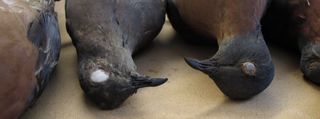
The eye sockets of the slender pigeon are filled with light-colored cotton. Its neck feathers shimmer in iridescent colors, and it has a russet chest and a slate-blue head. The yellowed paper tag attached to its left leg reads: “Coll. by Capt. Frank Goss, Neosho Falls, Kansas, July 4, 1875.”

Ben Novak lifts up the stuffed bird to study the tag more closely. Then he returns the pigeon to a group of 11 other specimens of the same species, which are resting on their backs in a wooden drawer. “It's easy to see just dead birds,” he says. “But imagine them alive, billions of birds. What would they look like in the sky?”

Novak has an audacious plan. He wants to resurrect the passenger pigeon. Vast numbers of the birds once filled the skies over North America. But in 1914 Martha, the last of her species, died in a zoo in Cincinnati, Ohio.

Novak, a researcher with the Long Now Foundation, a California think tank, wants to give the species a second chance. At the Museum of Vertebrate Zoology in Berkeley, Novak used a scalpel to slice small tissue samples from the red-painted toes of the passenger pigeons kept there. He hopes to isolate tiny bits of DNA from the samples and use them to assemble an entire genotype. His ultimate goal is the resurrection of the passenger pigeon.

“It should be possible to reconstruct the entire genome of the passenger pigeon,” says Novak. “The species is one of the most promising candidates for reintroducing an extinct species.”

The art of breathing new life into long-extinct species is in vogue among biologists. The Tasmanian devil, the wooly rhinoceros, the mammoth, the dodo and the gastric-breeding frog are all on the list of candidates for revival. To recover the genetic makeup of species, experts cut pieces of tissue from stuffed zoological rarities, pulverize pieces of bone or search in the freezers of their institutions for samples of extinct animals.

When Dickens met Dostoevsky

Naiman_Commentary_336746h

Eric Naiman in TLS:

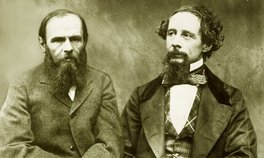
Late in 2011, Michiko Kakutani opened her New York Times review of Claire Tomalin’s biography of Charles Dickens with “a remarkable account” she had found in its pages. In London for a few days in 1862, Fyodor Dostoevsky had dropped in on Dickens’s editorial offices and found the writer in an expansive mood. In a letter written by Dostoevsky to an old friend sixteen years later, the writer of so many great confession scenes depicted Dickens baring his creative soul:

“All the good simple people in his novels, Little Nell, even the holy simpletons like Barnaby Rudge, are what he wanted to have been, and his villains were what he was (or rather, what he found in himself), his cruelty, his attacks of causeless enmity toward those who were helpless and looked to him for comfort, his shrinking from those whom he ought to love, being used up in what he wrote. There were two people in him, he told me: one who feels as he ought to feel and one who feels the opposite. From the one who feels the opposite I make my evil characters, from the one who feels as a man ought to feel I try to live my life. ‘Only two people?’ I asked.”

I have been teaching courses on Dostoevsky for over two decades, but I had never come across any mention of this encounter. Although Dostoevsky is known to have visited London for a week in 1862, neither his published letters nor any of the numerous biographies contain any hint of such a meeting. Dostoevsky would have been a virtual unknown to Dickens. It isn’t clear why Dickens would have opened up to his Russian colleague in this manner, and even if he had wanted to, in what language would the two men have conversed? (It could only have been French, which should lead one to wonder about the eloquence of a remembered remark filtered through two foreign tongues.) Moreover, Dostoevsky was a prickly, often rude interlocutor. He and Turgenev hated each other. He never even met Tolstoy. Would he have sought Dickens out? Would he then have been silent about the encounter for so many years, when it would have provided such wonderful fodder for his polemical journalism?