Is Culture the New Politics in Russia?

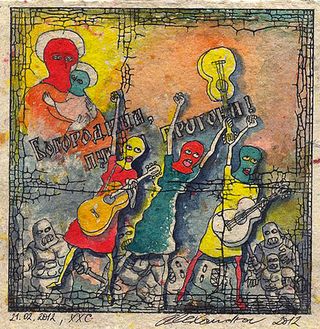
Pussyriot1

Artemy Troitsky, Peter Pomerantsev and Oliver Carroll in Berfrois:

Russia’s 1968?

Oliver Carroll: From Voina to Bykov, Pussy Riot to Moscow hipsterism, culture seems to be playing a very political game in Russia. How can we explain this? Is this something that Russia has seen before? Are we witnessing this Russia’s ‘1968’ moment? And if so, is accompanied by the same kind of generational and political splits that we saw in Europe’s rebellion? Or is it something completely different?

Artemy: If this really is a cultural revolution, then I’m afraid it happening on a very small scale. Compared to the first decade of the 21st century, which was absolutely lethargic and comatose, Russia’s cultural life and political community has started to show some life. But compared to the kind of cultural euphoria Russia experienced in other times — during the so-calledshestidesiatniki movement in the late 1950s and early 1960s, or in late 80s during Perestroika and Glasnost — it’s on a much smaller scale.

The saddest thing of all is that today’s cultural developments are much more elitist, touching a much finer layer of Russian people than either of the earlier cultural thaws (ottepel). The cultural movement back then was simply massive, supported and followed by millions of so-called ordinary Russians. What is happening right now is more a minority movement, largely ignored by the majority of the Russian population. And there is also a strong counter-reaction too. Sure, Glasnost had some some reactionary things like Nina Andreeva writing her letter in Sovetskaia Rossiia, or the Stalinist writers who urged people not to give up on their principals. But they were the tiny minority. Right now it’s us that feel as if we are pushed in the corner.

More on Reinhart and Rogoff

041613krugman3-blog480

First, Reinhart and Rogoff respond via email (over at Slate):

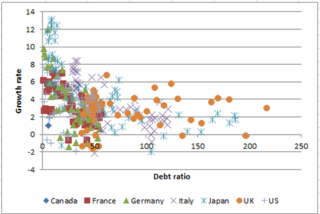
We literally just received this draft comment, and will review it in due course. On a cursory look, it seems that that Herndon Ash and Pollen also find lower growth when debt is over 90% (they find 0-30 debt/GDP, 4.2% growth; 30-60, 3.1 %; 60-90, 3.2%,; 90-120, 2.4% and over 120, 1.6%). These results are, in fact, of a similar order of magnitude to the detailed country by country results we present in table 1 of the AER paper, and to the median results in Figure 2. And they are similar to estimates in much of the large and growing literature, including our own attached August 2012 Journal of Economic Perspectives paper (joint with Vincent Reinhart) . However, these strong similarities are not what these authors choose to emphasize.

2012 JEP paper largely anticipates and addresses any concerns about aggregation (the main bone of conention here), The JEP paper not only provides individual country averages (as we already featured in Table 1 of the 2010 AER paper) but it goes further and provide episode by episode averages. Not surprisingly, the results are broadly similar to our original 2010 AER table 1 averages and to the median results that also figure prominently. It is hard to see how one can interpret these tables and individual country results as showing that public debt overhang over 90% is clearly benign.

The JEP paper with Vincent Reinhart looks at all public debt overhang episodes for advanced countries in our database, dating back to 1800. The overall average result shows that public debt overhang episodes (over 90% GDP for five years or more) are associated with 1.2% lower growth as compared to growth when debt is under 90%. (We also include in our tables the small number of shorter episodes.) Note that because the historical public debt overhang episodes last an average of over 20 years, the cumulative effects of small growth differences are potentially quite large. It is utterly misleading to speak of a 1% growth differential that lasts 10-25 years as small.

Second, Paul Krugman responds (also here):

I was going to post something sort of kind of defending Reinhart-Rogoff in the wake of the new revelations — not their results, which I never believed, nor their failure to carefully test their results for robustness, but rather their motives. But their response to the new critique is really, really bad.

What Herndon et al did was find that the R-R results on the relationship between debt and growth were partly the result of a coding error, partly the result of some very odd choices about which data to exclude and how to weight the data that remained. The effect of fixing these lapses was to raise the estimated mean growth of highly indebted countries by more than 2 percentage points.

So how do R-R respond?

First, they argue that another measure — median growth — isn’t that different from the Herndon et al results. But that is, first of all, an apples-and-oranges comparison — the fact is that when you compare the results head to head, R-R looks very off. Something went very wrong, and pointing to your other results isn’t a good defense.

Tyler Cowen's take:

2. …as Ray Lopez mentions, including in the data the postwar bouncebacks of some Anglo countries (NZ, Australia, and Canada), as recommended by the critics, is not obviously going to improve the quality of the answer. For instance the Kiwis have postwar growth rates of 7.7, 11.9, -9.9, and 10.8 percent, across the late 1940s. Are those numbers — which were combined with high postwar levels of debt — relevant to current fiscal policy issues? I say no, while admitting this may lead us to throw out other data points as well. I don’t know what is the non-cherry-pick answer here or if there even is one.

3. It is perhaps unfortunate in this age of the internet that rebuttals must be presented so quickly, but so be it. It will be interesting to hear from R&R.

4. Not too long ago I reread R&R to ascertain whether they actually present the 90% level as an emergency cliff of sorts. I concluded they did not, although there were some sentences that a reader could take out of context toward confirming such an interpretation.

the centroid

Topa0750_featured

To trace the path of the centroid is to skim a great narrative spanning 220 years. That narrative is the nation’s history of growth, with each point along the way emerging as a sort of chapter: the rise of industrialism in the Northeast, the expansion of the western frontier, the waves of European, Latin American, and Asian immigration, the post–World War II population boom. In its migration, only twice has the center of population come to rest in an actual population center: Baltimore, Maryland (population center, 1800), and Covington, Kentucky (population center, 1880, and hometown of a fourth-grade-dropout named Haven Gillespie, who penned numerous classic American songs including “Drifting and Dreaming” and “Santa Claus Is Coming to Town”). Over the years, the centroid has been found in places like Clarksburg, West Virginia, population center of 1840, where today the FBI operates its National Instant Criminal Background Check System to screen purchasers of firearms. Its path also passes through Portsmouth, Ohio, childhood home of Roy Rogers, which held the distinction in 1870. Portsmouth lost its NFL team to Detroit in 1933, its steel mills in the 1980s, and more than half its population of forty thousand between 1950 and 2000. And let us not forget Olney, Illinois, which held the honor in 1950.

more from Jeremy Miller at Orion Magazine here.

leeching with wordsworth

Leeches-198x300

“I saw a Man before me unawares: / The oldest man he seemed that ever wore grey hairs.” This was not the Lake District, but in this busy market I thought of William Wordsworth’s “Resolution and Independence.” Facing these tiny barrels of leeches and their keeper, all I could think of was the Romantic’s leech gatherer. Several hundred leeches writhed. They gathered like a black belt round the middle of each container, near the water’s surface. A few ambitious leeches left the waistband, inching their way toward the lid; a few fell from those curving heights to the bottom of the barrels. “Prof. Dr. Sülük,” it said at the top of every placard, and beneath those bold headings were lists of ailments of almost every sort: from migraines to fungus, eczema, rheumatism, and even cellulite. The leeches, then, were medicinal.

more from Casey N. Cep at Paris Review here.

zizek’s tribute to thatcher

166794644_1

The Master is needed especially in situations of deep crisis. The function of a Master is to enact an authentic division – a division between those who want to drag on within the old parameters and those who are aware of the necessary change. Such a division, not the opportunistic compromises, is the only path to true unity. Let us take an example which surely is not problematic: France in 1940. Even Jacques Duclos, the second man of the French Communist Party, admitted in a private conversation that if, at that point in time, free elections were to be held in France, Marshal Petain would have won with 90 per cent of the vote. When de Gaulle, in his historic act, refused to acknowledge the capitulation to Germans and continued to resist, he claimed that it was only he, not the Vichy regime, who speaks on behalf of the true France (on behalf of true France as such, not only on behalf of the “majority of the French”!). What he was saying was deeply true even if it was “democratically” not only without legitimacy, but clearly opposed to the opinion of the majority of the French people. Margaret Thatcher, the lady who was not for turning, was such a Master, sticking to her decision which was at first perceived as crazy, gradually elevating her singular madness into an accepted norm.

more from Slavoj Zizek at The New Statesman here.

The Martian Chroniclers

From The New Yorker:

MarsThere once were two planets, new to the and inexperienced in life. Like fraternal twins, they were born at the same time, about four and a half billion years ago, and took roughly the same shape. Both were blistered with volcanoes and etched with watercourses; both circled the same yellow dwarf star—close enough to be warmed by it, but not so close as to be blasted to a cinder. Had an alien astronomer swivelled his telescope toward them in those days, he might have found them equally promising—nurseries in the making. They were large enough to hold their gases close, swaddling themselves in atmosphere; small enough to stay solid, never swelling into gaseous giants. They were “Goldilocks planets,” our own astronomers would say: just right for life. The rest is prehistory. On Earth, the volcanoes filled the air with water vapor and carbon dioxide. The surface cooled, a crust formed, and oceans condensed upon it. In hot springs and undersea vents, simple carbon compounds bubbled up to form amino acids and peptides. The first bacteria moved through the ooze; then came blue-green algae, spreading across the planet like a watery carpet, drinking in sunlight and exhaling oxygen, giving breath to everything that came after. Geologists call this the Great Oxygenation Event—the most momentous change in the planet’s history. It seems inevitable now: life’s triumphant march toward complexity, toward us. But like most creation stories this one is also a cautionary tale. It has both a Heaven and a Hell.

In 1877, when the Italian astronomer Giovanni Schiaparelli drew the first detailed map of Mars, he imagined the planet as an earthly paradise. He labelled one region Eden, another Elysium, others, on later maps, Arcadia and Utopia. Peering through his telescope on the roof of the Palazzo di Brera, in Milan, Schiaparelli had seen what looked like oceans, continents, and water channels swim into view. “The planet is not a desert of arid rocks,” he wrote. “It lives.” And his successors often took him at his word: the sharper their telescopes, the blurrier their vision. They saw mountains of ice and rivers of snowmelt, William Sheehan writes in his 1996 book, “The Planet Mars: A History of Observation and Discovery.” They saw fertile oases and a moss-green equator. They saw an irrigation system so linear and “trigonometric,” as the astronomer Percival Lowell put it, that it could only be the work of a highly intelligent race. Some even saw a Hebrew word for Almighty—Shajdai—spelled out on the planet’s surface. “True, the magnitude of the work of cutting the canals into the shape of the name of God is at first thought appalling,” the San Francisco Chronicle noted in 1895. “But there are terrestrial works which to us today seem no less impossible.”

More here.

implantable, bioengineered rat kidney

From Kurzweil AI:

KidBioengineered rat kidneys developed by Massachusetts General Hospital (MGH) investigators successfully produced urine both in a laboratory apparatus and after being transplanted into living animals. The approach used in this study to engineer donor organs, based on a technology that Ott discovered as a research fellow at the University of Minnesota, involves stripping the living cells from a donor organ with a detergent solution and then repopulating the collagen scaffold that remains with the appropriate cell type — in this instance human endothelial cells to replace the lining of the vascular system and kidney cells from newborn rats.

The research team first decellularized rat kidneys to confirm that the organ’s complex structures would be preserved. They also showed the technique worked on a larger scale by stripping cells from pig and human kidneys. Making sure the appropriate cells were seeded into the correct portions of the collagen scaffold required delivering vascular cells through the renal artery and kidney cells through the ureter. Precisely adjusting the pressures of the solutions enabled the cells to be dispersed throughout the whole organs, which were then cultured in a bioreactor for up to 12 days. The researchers first tested the repopulated organs in a device that passed blood through its vascular system and drained off any urine, which revealed evidence of limited filtering of blood, molecular activity and urine production. Bioengineered kidneys transplanted into living rats from which one kidney had been removed began producing urine as soon as the blood supply was restored, with no evidence of bleeding or clot formation.

More here.

Wednesday Poem

The Pear
.
November. One pear
sways on the tree past leaves, past reason.
In the nursing home, my friend has fallen.
Chased, he said, from the freckled woods
by angry Thoreau, Coleridge, and Beaumarchais.
Delusion too, it seems, can be well read.
He is courteous, well-spoken even in dread.
The old fineness in him hangs on
for dear life. “My mind now?
A small ship under the wake of a large.
They force you to walk on your heels here,
the angles matter. Four or five degrees,
and you’re lost.” Life is dear to him yet,
though he believes it his own fault he grieves,
his own fault his old friends have turned against him
like crows against an injured of their kind.
There is no kindness here, no flint of mercy.
Descend, descend,
some voice must urge, inside the pear stem.
The argument goes on, he cannot outrun it.
Dawnlight to dawnlight, I look: it is still there.
.
.

by Jane Hirshfield
from Poetry, Vol. 192, No. 2, May
publisher Poetry, Chicago, 2008

Researchers Finally Replicated Reinhart-Rogoff, and There Are Serious Problems

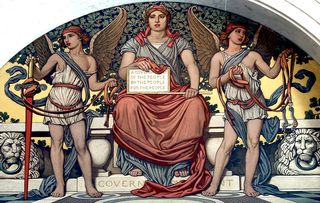
800px-Government-Vedder-Highsmith-detail-1

Mike Konczal over at Rortybomb (image from Wikimedia Commons):

In 2010, economists Carmen Reinhart and Kenneth Rogoff released a paper, “Growth in a Time of Debt.” Their “main result is that…median growth rates for countries with public debt over 90 percent of GDP are roughly one percent lower than otherwise; average (mean) growth rates are several percent lower.” Countries with debt-to-GDP ratios above 90 percent have a slightly negative average growth rate, in fact.

This has been one of the most cited stats in the public debate during the Great Recession. Paul Ryan's Path to Prosperity budget states their study “found conclusive empirical evidence that [debt] exceeding 90 percent of the economy has a significant negative effect on economic growth.” The Washington Posteditorial board takes it as an economic consensus view, stating that “debt-to-GDP could keep rising — and stick dangerously near the 90 percent mark that economists regard as a threat to sustainable economic growth.”

Is it conclusive? One response has been to argue that the causation is backwards, or that slower growth leads to higher debt-to-GDP ratios. Josh Bivens and John Irons made this case at the Economic Policy Institute. But this assumes that the data is correct. From the beginning there have been complaints that Reinhart and Rogoff weren't releasing the data for their results (e.g. Dean Baker). I knew of several people trying to replicate the results who were bumping into walls left and right – it couldn't be done.

In a new paper, “Does High Public Debt Consistently Stifle Economic Growth? A Critique of Reinhart and Rogoff,” Thomas Herndon, Michael Ash, and Robert Pollin of the University of Massachusetts, Amherst successfully replicate the results. After trying to replicate the Reinhart-Rogoff results and failing, they reached out to Reinhart and Rogoff and they were willing to share their data spreadhseet. This allowed Herndon et al. to see how how Reinhart and Rogoff's data was constructed.

They find that three main issues stand out. First, Reinhart and Rogoff selectively exclude years of high debt and average growth. Second, they use a debatable method to weight the countries. Third, there also appears to be a coding error that excludes high-debt and average-growth countries. All three bias in favor of their result, and without them you don't get their controversial result.

Tuesday, April 16, 2013

The Boston bombing produces familiar and revealing reactions

Glenn Greenwald in The Guardian:

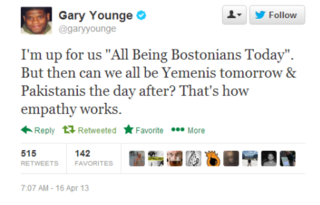
YoungeThere's not much to say about Monday's Boston Marathon attack because there is virtually no known evidence regarding who did it or why. There are, however, several points to be made about some of the widespread reactions to this incident. Much of that reaction is all-too-familiar and quite revealing in important ways:

(1) The widespread compassion for yesterday's victims and the intense anger over the attacks was obviously authentic and thus good to witness. But it was really hard not to find oneself wishing that just a fraction of that compassion and anger be devoted to attacks that the US perpetrates rather than suffers. These are exactly the kinds of horrific, civilian-slaughtering attacks that the US has been bringing to countries in the Muslim world over and over and over again for the last decade, with very little attention paid. My Guardian colleague Gary Younge put this best on Twitter this morning…

More here.

When a scientific result fails the test of “naturalness,” it can point to new physics

Don Lincoln in Symmetry:

Higgs_on_scale_REGSuppose a team of auditors is tasked with understanding a particular billionaire’s bank account. Each month, millions of dollars flow into and out of the account. If the auditors look at the account on random days, they see varying amounts of money. However, on the last day of every month, the balance is briefly set to exactly zero dollars.

It’s hard to imagine that this zero balance is an accident; it seems as if something is causing the account to follow this pattern. In physics, theorists consider improbable cancellations like this one to be signs of undiscovered principles governing the interactions of particles and forces. This concept is called “naturalness”—the idea that theories should make seeming coincidences feel reasonable.

In the case of the billionaire, the surprising thing is that, on a set schedule, the cash flow reaches perfect equilibrium. But one would expect it to be more erratic. The ups and downs of the stock market should cause monthly variations in the tycoon’s dividends. A successful corporate raid could lead to a windfall. And an occasional splurge on a Lamborghini could cause a bigger withdrawal than usual.

This unnatural fiscal balance simply screams for an explanation. One explanation that would make this ebb and flow of funds make sense would be if this account worked as a charity fund. Each month, on the first day of the month, a specific amount would be deposited. Over the course of the month, a series of checks would be cut for various charities, with the outflow carefully planned to match identically the initial deposit. Under this situation, it would be easy to explain the recurring monthly zero balance. In essence, the “charity account principle” makes what at first seemed to be unnatural now appear to be natural indeed.

More here.

On The Sufferings of Young Werther

1365976379

Sam Stark on Stanley Corngold’s translation “The Sufferings of Young Werther” in the LA Review of Books:

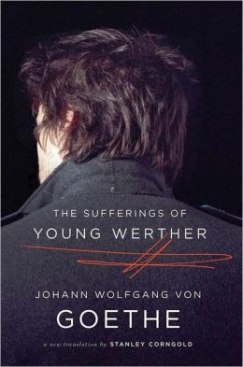
WHAT EXACTLY DID LOTTE DO to Werther on their first night together? In Stanley Corngold’s 2011 translation of the book that he calls The Sufferings of Young Werther, she “won” his heart. In some other translations, she just “touched” it. David Constantine’s restrained new Oxford Classics edition leaves the heart out altogether: “She touched me more closely,” Werther writes in this version, “than any other here.” In any case, Lotte came between Werther’s heart and his great love at home: his best friend Wilhelm, to whom he is writing to explain why he hasn't been writing lately. The pivotal letter in the book, dated June 16, 1771, begins as his answer to that question. Werther himself may not be able to say what happened: “I have — I don't know.”

The reader has to want to know. Hearts are to a love story what corpses are to murder mysteries; if we don’t know exactly what happens to them, the plot just makes no sense. Johann Wolfgang von Goethe’s Die Leiden des jungen Werthers has something in common with both genres. Goethe puts his anonymous fictional Editor in the role of detective, who has “diligently collected everything I could discover about the story of poor Werther,” as her unsigned prefatory note has it — “never neglecting the slightest slip of paper we found,” she reassures the reader near the end of the book, admitting “the difficulty of discovering the truly genuine, the authentic motives behind even a single action when it is found among persons who are not of the common stamp.” That difficulty often comes down to particular words, and a translator’s influence goes well beyond style to encompass character, plot, and every moral implication of the story.

Werther is a radical reinvention of the epistolary novel, mostly made up of fragments of prose ranging in length from a sentence to a few pages, dated but unsigned and without salutations. These are generally assumed to be letters written by young Werther, mostly to his close friend Wilhelm (who is, nevertheless, rarely addressed directly and whose responses, if they are supposed to have existed, are missing). It's hard to talk about the book at all without assuming at least this much about it: that these are letters, all by Werther, and almost all to Wilhelm, except in a few cases where the writer explicitly addresses someone else. The sophisticated reader of Goethe's time might have thought of it as an exercise in philology; today, it looks an awful lot like a blog.

White Indians

Image

Over at n+1:

In a recent article on the lack of ethnic diversity on American television, the critic Emily Nussbaum paused from pondering the absence of blacks on TV — the usual complaint against homogeneity — to note the sudden ubiquity of South Asians. “Black and white are not the only colors of diversity,” she wrote, and listed roles accorded to desi actors in The Office, Parks and Recreation, Community, Smash, The Big Bang Theory, Whitney, and The Good Wife. Never mind that at least two thirds of these shows suck. The mottling by occasional brown faces of the otherwise creamy expanse of TV whiteness, like the smattering of freckles on Pippi Longstocking, should be a sign of character — and progress. Nussbaum understands that diversity isn’t quite the right word for this. “At times I’ve wondered if this isn’t a psychic workaround: is brown safer than black?”

Every South Asian reader knew the answer. When even whiteness is freighted in liberal circles with maudlin guilt, no color is safer than South Asian brown. No minority presence in the US is more reassuring, or less likely to get angry or acknowledge your antiblack racism. The South Asian is sometimes the soft-spoken but intense professional— the alert-eyed and firm-jawed Dr. Sanjay Gupta on CNN. But just as often the television South Asian echoes the gestures of the standard fawning coolie of yore: palms clasped together, head shaking from side to side, mumbling “sahib” through an apologetic smile crowned with an anachronistic mustache. Or she is a cartoon auntie flinging her sari over her shoulder as she hovers over a pot of steaming aloo methi, yelling to her son in Rushdiean patois: “Eat-na, why you no eat! Food is spoiling-goiling,” et cetera. Nussbaum didn’t mention that the show that for a while came after The Office in the NBC Thursday night lineup was called Outsourced. The show followed the comic travails of whites stranded in an Indian call center, but was chiefly humiliating because its South Asian actors had lined up eagerly, in possession of free will, to portray racist stereotypes. South Asians have done this proudly for years, chiefly in film: from the many who played monkey brain eaters in Indiana Jones and the Temple of Doom to Kal Penn as the repressed nerd in the Van Wilder movies, Dev Patel tomming through The Best Exotic Marigold Hotel, and the guy who literally played a coolie in The Royal Tenenbaums. Such minstrel figures paved the way for and now coexist with the accentless, “American” desi nebbish who fills the minority quota on TV.

But if we blamed the ghoras for their tacit racism, we’d only be going too easy on ourselves. The presence of desis on television isn’t just a sign of executives obliged to present diversity and doing it by stereotyping a docile minority.

distance and seeing

ID_PI_GOLBE_ANIMA_CO_003

Flach calls his photographs portraits, and yet they often lack faces. In a portrait of a sphinx cat, the head is just outside the frame, leaving the viewer to contemplate the skin folds on an anonymous, hairless, pink body. On page 248 is a rusty keyhole dropped onto a pile of white and orange stones that is actually the eye of a gecko. Stretched across two pages at the beginning of the book is a grey swathe of skin and fur. Brown cracks run along folds in the skin. What animal does this skin belongs to? An elephant? A monkey? You aren’t even sure what part of the animal it is. An ear? An arm? Never mind not seeing the forest for the trees. In this animal portrait of flesh and fur, you cannot even see the trees for the bark. Flach writes that his aim with these photographs is to bring the viewer “into an unnatural proximity to the subject and [allow] them to engage with it, creating an unreality that in turn brings the viewer closer to reality.” Flach’s photography holds out the promise that the animals will reveal more to us the nearer we get to them. But the closeness of the photographs often brings us to a wall rather than a door. On page 176, an armadillo is rolled up into a ball of its own shell. The detail on the shell’s surface is a bit like flowered wallpaper. The animal is all surface. You cannot see the armadillo’s face, or its legs, or anything identifying it as animal. It may be a rock for all we know. We are told there’s an animal in this portrait yet it’s nearly impossible to find.

more from Stefany Anne Golberg at The Smart Set here.

love and meat walls

20130403_TNA38HurlbutFrancis270w

For Francis, the answer lay, not in escape from the desperations of natural life, but in a transformation in his spiritual understanding of the interwoven meaning of suffering and love. He came to see that the whole of creation, and each of its varied creatures in their distinct strengths and struggles, reflected and revealed the perfection of the Creator. If all things are from one Father, then all are kin and worthy of solicitude and appreciation. It was not nature in the abstract that he loved but every differentiated being in its particularity and individuality. Likewise, he loved not humanity in the abstract so much as individual human beings. He described this love as courtesy, a tender affection and concern for others as precious and unique, as creatures beloved of God; and his courtesy was born not of magnanimity or largesse (with their implicit sense of superiority) but of genuine humility of heart. He became the “little brother” (the Order of Friars Minor is the official name of his followers), placing himself in a position of neediness before others. Not so much a giver of gifts as a “giver of giving,” Francis provided the invitation to give by putting himself in circumstances that drew forth the generosity of others — and with it, their self-respect.

more from William B. Hurlbut at The New Atlantis here.

life in acrosanti

Arcosanti-9-660x439

Arcosanti felt like an anachronism, a permanent representation of a different time and a different ideology. Walking through the domes felt like walking through ruins, rather than the white-hot center of architectural thought it ought to have been, and to many, always seemed so close to becoming. (The idea of arcology has always been touted as of crucial importance — just not yet.) Unlike New Delhi, which has blossomed since I lived there, Arcosanti was too rigid of a structure — literally, its physical plant couldn’t adapt, and figuratively, its social structure was too fixed — to contain the full spectrum of people a city needs to survive; not just high priests and acolytes, but entrepreneurs and rogues too. From my perspective as an eighteen-year-old architecture student who, at the time, shared (or thought he shared) Soleri’s vision, Arcosanti was undone by the same thing that killed off so many other projects: the people living in it. Not so much because they didn’t believe what Soleri believed, but because the original people working there either got frustrated and left, or stayed there and got older and settled into their cozy, Soleri-designed apartments to live a pleasant, hippy-dream life, sustained by the acolytes, the eager arcology champions like myself, who paid a couple hundred dollars to come out to the Arizona desert and learn from the master.

more from James McGirk at Wired here.

Dennis Lehane: Proud, brokenhearted to be Bostonian

From Salon:

Dennis Lehane, who was born in Dorchester and whose many books set in and around Boston include “Mystic River,” posted this on his Facebook page.

Dennis_Lehane_BBF_2010_Shankbone_crop-479x412When I watch the footage of the first explosion, I look at the Boston Public Library Main Branch across the street, and I think no matter who they turn out to be–Islamic jihadists, home grown militia, neo-Nazis, something else–what really scares them, what they truly hate, is the access to knowledge that building exemplifies. Youngest victim is 8. Sigh. What can you do with that? If your “CAUSE” involves the death of kids, it’s not a cause, it’s a pestilence.

So proud to be a Bostonian tonight. So brokenhearted to be one, too.

More here.

Human Genome, Then and Now

From The New York Times:

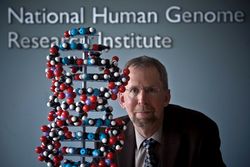
GenomeEight years of work, thousands of researchers around the world, $1 billion spent — and finally it was done. On April 14, 2003, a decade ago this week, scientists announced that they had completed the Human Genome Project, compiling a list of the three billion letters of genetic code that make up what they considered to be a sort of everyperson’s DNA. To commemorate the anniversary, Eric D. Green, the director of the National Human Genome Research Institute at the National Institutes of Health, spoke about what has been accomplished, what it means and what is coming next. Our conversation has been condensed and edited.

How hard is it today to sequence a person’s genome? We can sequence a human genome in a couple of days for well under $10,000, probably around $4,000 or $5,000. And we sequence the genome you got from your father and the one you got from your mother. That’s a total of six billion bases. It is already around the cost of an M.R.I., and it will get cheaper yet. The original Human Genome Project sequenced just one representation, three billion bases.

How did it get so cheap? In April 2003, right after the completion of the human genome, our institute put into print a call for technology to deliver a $1,000 human genome sequence. That became the battle cry. I remember thinking someday we would get to a $1,000 genome. I don’t worry about the $1,000 genome anymore. We have had six orders of magnitude improvement in a decade.

What about the naysayers who asked, “Where are the cures for diseases that we were promised?” I became director of this institute three and a half years ago, and I remember when I first started going around and giving talks. Routinely I would hear: “You are seven years into this. Where are the wins? Where are the successes?” I don’t hear that as much anymore. I think what’s happening, and it has happened in the last three years in particular, is just the sheer aggregate number of the success stories. The drumbeat of these successes is finally winning people over. We are understanding cancer and rare genetic diseases. There are incredible stories now where we are able to draw blood from a pregnant woman and analyze the DNA of her unborn child. Increasingly, we have more informed ways of prescribing medicine because we first do a genetic test. We can use microbial DNA to trace disease outbreaks in a matter of hours. These are just game changers. It’s a wide field of accomplishment, and there is a logical story to be told.

More here.

Done with Tolstoy

2013_0304_webimages_20_translation

Kevin Mahnken in Humanities:

“In Crime and Punishment, there is a sentence that goes like this: ‘It was a very simple matter and there was nothing complicated about it.’” Richard Pevear lets the words hang in the air, along with a note of faint bafflement. From his Paris apartment, one half of the world’s only celebrity translation team is recollecting some of the knotty, cross-lingual jumbles that he has spent his working life trying to untangle.

“I came running to Larissa”—Larissa Volokhonsky, Pevear’s wife of thirty years and collaborator on twenty-one works of Russian-to-English translation—“and said, ‘Can that be? Is that what he said?’ And she checked and said yes. ‘It was a very simple matter and there was nothing complicated about it.’” Reassured, if still skeptical, he jotted it down and moved on to Dostoyevsky’s next syntax-warping creation.

The inconspicuous passage would resurface before long, though. The translation was published and, Richard recalls, “one very eminent reviewer . . said, ‘They occasionally lapse into banalities, for instance.’ And he quotes this same sentence.” First lodged years ago, the complaint is a rare blemish on a generally worshipful public reception, perhaps tempting the duo to tidy up such repetitive, infelicitous wording. Instead, two decades and many printings later, Richard shrugs off the critic’s jibe and sticks to his guns. “But it’s unmistakable in Russian!”

“It’s very simple,” adds Larissa in her heavy Slavic accent, “so simple, I later found the same sentence in Chekhov.”

But there is nothing simple about the ongoing Pevear-Volokhonsky partnership (known widely in literary circles as PV). Their output, spilling over tens of thousands of pages and encompassing the hundred-fifty-year golden age of Russian literature, rivals even their most prolific forerunners in both quality and quantity. It is easier to list the canonical prose authors they have neglected (only Turgenev and Nabokov, though Larissa has lobbied her husband to turn their attentions to the former) than all of those they have translated. From the Patriotic War against Napoléon to the era of nineteenth-century radicalism and reform, and then on to the October Revolution, the Communist terror, and the postwar period, the Pevear-Volokhonsky project now surveys a cultural expanse as broad as the Siberian frontier.

Even their unconventional division of labor sets them apart from their contemporaries. Occupying separate rooms, husband and wife execute a two-step process that begins with Larissa’s word-for-word English rendition from the original. Richard, who speaks only basic Russian, then shapes Larissa’s special proof into literary English while rejecting anachronistic vocabulary and constructions. After hundreds of chapters, revisions, and personal consultations, the method has resulted in two prestigious PEN Translation Prizes and—as a mark of their uncommon public acceptance—a much-coveted selection to Oprah Winfrey’s juggernaut book club.

Now they have passed another important milestone. In putting their stamp on Lev Tolstoy’s final novel, Hadji Murat, they have at last reached the end of the great writer’s immense corpus.

Monday, April 15, 2013

Horwich vs. Lynch on Wittgenstein’s therapeutic conception of philosophy

by Dave Maier

Paul Horwich is a philosopher best known for his “minimalist” (or “deflationist”) theory of truth: that there is nothing more to the idea than that saying that something is true (“'Grass is green' is true”) is the same thing as saying it oneself (“Grass is green”). This view has met with little success, and now Horwich is dressing it in Wittgensteinian garb for resale. As marketing strategy goes, this isn't terrible – Wittgenstein's views are notoriously obscure, and his “quietism” has the same generally meta-skeptical tone as “minimalism” – but I'm not buying it, in neither the old guise nor the new.

Michael Lynch isn't buying it either. He too has a theory of truth (let's not get into it right now), and doesn't appreciate it being dismissed, not for its content, or his arguments for it, but merely for its being a “constructive” theory of truth in the first place. But it's hard to know whom to root for here, as Lynch's anti-Wittgensteinian remarks simply reprise the same trite, uncomprehending dismissals that philosopher has endured for nearly a century now. I won't have enough space here to say what Wittgenstein really meant, nor why he was right to say it; but it's important not to let these things go unchallenged.

Horwich bookHorwich begins by painting himself as the underdog fighting the good fight: “Apart from a small and ignored clique of hard-core supporters the usual view these days is that his writing is self-indulgently obscure and that behind the catchy slogans there is little of intellectual value.”

This is too stark a picture, not to mention a bit self-serving. It's not that there isn't such a clique, or such harsh rejection; but I'd identify at least two further gradations between idolatry and contemptuous dismissal. First, many mainstream philosophers recognize Wittgenstein's contributions, even without accepting (or understanding) his conclusions. More to the point, you don't have to be a “hard-core supporter” to share Wittgenstein's general attitude toward the tendencies in philosophy he objects to. I for one would be perfectly happy to leave Wittgenstein out of it entirely if I could get what I wanted some other way. But there are some things we need that only he gives us.

After some throat-clearing, Horwich boils his Wittgenstein down into four main claims (for elaboration see his recent book on the subject).

1. Philosophy is “scientistic” in aiming at “simple, general principles”.

Such principles, I take it, are fine for science, where no one is complaining about the abstract generality of, say, Newton's laws. But philosophy is not science. I'd agree with this part, except to point out that philosophy was aiming at such principles long before science came along. In fact science as we know it developed from what we used to call “natural philosophy”. More important than labels, though, is the fact that there's nothing wrong with either simplicity or generalization if they're properly understood.

Read more »