Guest Workers As Bellwether

1364821886guestworkeralliance

Josh Eidelson in Dissent:

By the time Martha Uvalle’s boss threatened to have her children assaulted, she’d already lowered her expectations. Uvalle, a forty-year-old from Tamalipas, Mexico, has come to Louisiana as a guest worker every year since 2006. “I came to fulfill the American Dream,” Uvalle told me with a laugh in November. Her choice to become a guest worker was “difficult, because you know you’re leaving your children.” But given “the chance to make a little money…you decide the sacrifice is worth it.” Each year, Uvalle worked for two to five months for CJ’s Seafood in Louisiana, supplying shrimp to companies including the retail giant Wal-Mart. “You have the costs here, the costs there, the costs to come here, so you really can’t save any money.” She also took out high-interest loans to pay for the costs of the travel. Still, “it’s more than you can make in Mexico. But it’s not what I was expecting.” (Interviews with Uvalle and other guest workers were conducted in Spanish.)

For years, the hours at CJ’s were long, and the work was hard. Then, in 2011, Mike LeBlanc replaced his father as the head of the company. “That,” said CJ’s worker Ana Rosa Diaz, “was when it started to get out of control.” Workers say they were required to come to work earlier and stay later, sometimes working as many as sixteen to twenty-four hours straight. Management installed security cameras in the plant and also around the company-owned trailers where the workers lived. Workers say management imposed a curfew, threatened to confiscate the keys to their cars, and told them they couldn’t have visitors. Worse, one of the managers repeatedly said, “If you don’t understand that your break is over, I’ll make you understand with this shovel.” Uvalle understood: “He was saying he would beat us.”

The worst day at CJ’s, Uvalle remembered, was “the day of the threat.” It came after LeBlanc heard that a worker had attempted to report him to the police. Workers say they were called into a mandatory meeting where LeBlanc told them that if any of them got him in trouble, he wouldn’t just get them deported forever. He would send armed men to assault their families back in Mexico.

A Secret Deal on Drones, Sealed in Blood

Mark Mazzetti in the New York Times:

ScreenHunter_168 Apr. 07 14.50Nek Muhammad knew he was being followed.

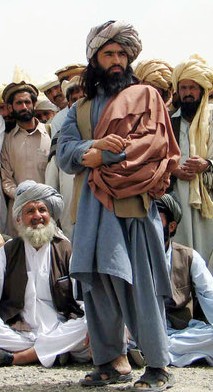
On a hot day in June 2004, the Pashtun tribesman was lounging inside a mud compound in South Waziristan, speaking by satellite phone to one of the many reporters who regularly interviewed him on how he had fought and humbledPakistan’s army in the country’s western mountains. He asked one of his followers about the strange, metallic bird hovering above him.

Less than 24 hours later, a missile tore through the compound, severing Mr. Muhammad’s left leg and killing him and several others, including two boys, ages 10 and 16. A Pakistani military spokesman was quick to claim responsibility for the attack, saying that Pakistani forces had fired at the compound.

That was a lie.

Mr. Muhammad and his followers had been killed by theC.I.A., the first time it had deployed a Predator drone in Pakistan to carry out a “targeted killing.” The target was not a top operative of Al Qaeda, but a Pakistani ally of theTaliban who led a tribal rebellion and was marked by Pakistan as an enemy of the state. In a secret deal, the C.I.A. had agreed to kill him in exchange for access to airspace it had long sought so it could use drones to hunt down its own enemies.

That back-room bargain, described in detail for the first time in interviews with more than a dozen officials in Pakistan and the United States, is critical to understanding the origins of a covert drone war that began under the Bush administration, was embraced and expanded by President Obama, and is now the subject of fierce debate. The deal, a month after a blistering internal report about abuses in the C.I.A.’s network of secret prisons, paved the way for the C.I.A. to change its focus from capturing terrorists to killing them, and helped transform an agency that began as a cold war espionage service into a paramilitary organization.

More here.

it’s better to accept the facts of death

From The Telegraph:

IanBanks_2528826bIain Banks has written startlingly dark, intelligent novels – most notably The Wasp Factory – but tells the world that the new one will be the last. He announces his coming death with characteristic humour but without darkness, only frank resignation: “I am officially Very Poorly.” He has gall bladder cancer and counts his remaining life in months. He asked his partner, Adele Hartley, “to do me the honour of becoming my widow”, apologising for the “ghoulish humour”. All public appearances are cancelled in favour of seeing friends and relatives. He has gone on honeymoon and reports via a friend that he is in Italy “enjoying life to the max”. There is an admirable breezy gallantry and good example about the way in which public people have begun to take back ownership of their own mortality, kicking away the cobwebs of terror and denial and dispelling the sickly, deceptive miasma of false hope. It is not the same as ''giving up” or refusing to “fight” (terminal cancer patients get really sick of that language, with its implication that if they were a bit more positive they’d get better). There is a time to fight and hope for life, but when modern medicine, despite its bias in favour of prolonging life at all costs, admits that it can do no more, acceptance is healthy. Use the time, smell the roses, speak your love.

Dennis Potter said, when he was dying, that looking at spring outside the window had become marvellous. “The whitest, frothiest, blossomest blossom that there ever could be, and I can see it… the nowness of everything is absolutely wondrous, the glory of it, the comfort of it, the reassurance… The fact is, if you see the present tense, boy do you see it! And boy can you celebrate it.” More recently, Terry Pratchett confronted his illness with a riveting, troubling exploration of the Dignitas assisted suicide clinic, in which he publicly considered whether he would want to take that route rather than decline into helplessness. He came to no conclusion, but examined medical research into the illness with the words: “I’m going to make Alzheimer’s sorry it got ME!” He does not pretend that any day now he will be cured, however. He is grown-up enough to know better, and to know, as Iain Banks does, that death has made an appointment. Accepting this, in the long or the short term, is the ultimate test of adulthood: when Damien Hirst titled his pickled shark, The physical impossibility of death in the mind of someone living, he revealed nothing but his own callow youth.

More here.

NIH explains Brain Research through Advancing Innovative Neurotechnologies (BRAIN) initiative

From Kurzweil:

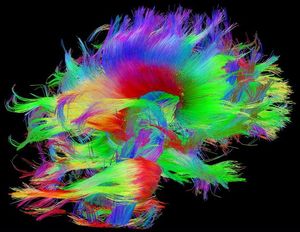
Human_connectome1With nearly 100 billion neurons and 100 trillion connections, the human brain remains one of the greatest mysteries in science and one of the greatest challenges in medicine. Neurological and psychiatric disorders, such as Alzheimer’s disease, Parkinson’s disease, autism, epilepsy, schizophrenia, depression, and traumatic brain injury, exact a tremendous toll on individuals, families, and society. Despite the many advances in neuroscience in recent years, the underlying causes of most of neurological and psychiatric conditions remain largely unknown, due to the vast complexity of the human brain. If we are ever to develop effective ways of helping people suffering from these devastating conditions, researchers will first need a more complete arsenal of tools and information for understanding how the brain functions both in health and disease.

Why is now the right time for the NIH BRAIN Initiative?

In the last decade alone, scientists have made a number of landmark discoveries that now create the opportunity to unlock the mysteries of the brain. We have witnessed the sequencing of the human genome, the development of new tools for mapping neuronal connections, the increasing resolution of imaging technologies, and the explosion of nanoscience. These discoveries have yielded unprecedented opportunities for integration across scientific fields. For instance, by combining advanced genetic and optical techniques, scientists can now use pulses of light in animal models to determine how specific cell activities within the brain affect behavior. What’s more, through the integration of neuroscience and physics, researchers can now use high-resolution imaging technologies to observe how the brain is structurally and functionally connected in living humans.

More here.

Sunday Poem

Sonnet 18

Shall I compare thee to a summer's day?
Thou art more lovely and more temperate:
Rough winds do shake the darling buds of May,
And summer's lease hath all too short a date:
Sometime too hot the eye of heaven shines,
And often is his gold complexion dimmed,
And every fair from fair sometime declines,
By chance, or nature's changing course untrimmed:
But thy eternal summer shall not fade,
Nor lose possession of that fair thou ow'st,
Nor shall death brag thou wander'st in his shade,
When in eternal lines to time thou grow'st,
So long as men can breathe, or eyes can see,
So long lives this, and this gives life to thee.
.

William Shakespeare

“In 2001 or 2002, guitarist and singer David Gilmour of Pink Floyd recorded a musical interpretation of William Shakespeare’s “Sonnet 18″ at his home studio aboard the historic, 90-foot houseboat the Astoria. This video of Gilmour singing the sonnet was released as an extra on the 2002 DVD David Gilmour in Concert, but the song itself is connected with When Love Speaks, a 2002 benefit album for London’s Royal Academy for the Dramatic Arts.”

from openculture.com

Interpreting The World, Changing The World

Marx6

Onora O’Neill in Philosophy Now:

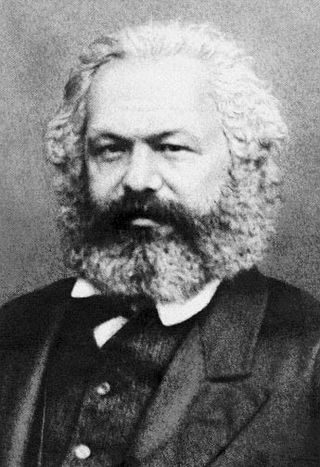
In his 11th thesis on Feuerbach, Marx wrote, “The philosophers have only interpreted the world in various ways; the point, however, is to change it.” (Theses on Feuerbach, 1845.) Although it may not be a fair accusation, his acid comment sits in the recesses of memory, and plenty of people still share this view, including a lot of philosophers. Sometimes they are queasy about aiming to change the world, and feel that there is something unsavoury, irresponsible or self-important about philosophers who try to. Yet, like others, philosophers are under pressure to show that what they do matters, that they contribute to changing the world – to show, indeed, to use modish jargon, that work in philosophy has ‘impact’. ‘Impact’ is a multiply ambiguous term, and a lot of impact has negative value, so presumably what is meant is that philosophers should show that their work has impact of a desirable sort. On a simplistic view, good impact is economic impact. When claims about impact first came to prominence in academia a few years ago, many people assumed that this meant that the research in some subjects clearly had economic impact, but research in other areas – including philosophy – clearly did not. Some welcomed the thought that funders might be persuaded to channel all the research money towards the former areas. At its crudest, this approach assumed that desirable impact only occurred if research findings yielded novel products, increased productivity, new jobs, or more exports.

Spotting Winners?

This picture of research with ‘impact’ is not particularly helpful, even for the natural sciences. It is the nature of the case that outcomes are unknown when research is being done. So to discover the impact of research, one needs to look at matters retrospectively, tracing back from successful innovations to the research from which they grew. This exercise reveals that successful innovations often depend on manypieces of research in a multiplicity of disciplines, and that the interval from research to innovation can bemany decades. For example, the GPS capabilities that are built into humble mobile phones incorporate corrections that depend on Einstein’s theory of General Relativity, research that was published in 1916. There is no way of telling upstream how great an impact any specific bit of research will have. That is why research councils, foundations or universities typically fund or undertake a portfolio of research projects, and why companies that do research – Big Pharma, for example – fund a lot of projects, and expect a high rate of failure. Nobody can spot the winners upstream.

Saturday, April 6, 2013

Why I Study Duck Genitalia

Patricia Brennan in Slate:

130402_SCI_DuckPenis.jpg.CROP.article250-mediumIn the past few days, the Internet has been filled with commentary on whether the National Science Foundation should have paid for my study on duck genitalia, and 88.7 percent of respondents to a Fox news online poll agreed that studying duck genitalia is wasteful government spending. The commentary supporting and decrying the study continues to grow. As the lead investigator in this research, I would like to weigh in on the controversy and offer some insights into the process of research funding by the NSF.

My research on bird genitalia was originally funded in 2005, during the Bush administration. Thus federal support for this research cannot be connected exclusively to sequestration or the Obama presidency, as many of the conservative websites have claimed.

Since Sen. William Proxmire's Golden Fleece awards in the 1970s and 1980s, basic science projects are periodically singled out by people with political agendas to highlight how government “wastes” taxpayer money on seemingly foolish research. These arguments misrepresent the distinction between and the roles of basic and applied science. Basic science is not aimed at solving an immediate practical problem. Basic science is an integral part of scientific progress, but individual projects may sound meaningless when taken out of context. Basic science often ends up solving problems anyway, but it is just not designed for this purpose. Applied science builds upon basic science, so they are inextricably linked. As an example, Geckskin™ is a new adhesive product with myriad applications developed by my colleagues at the University of Massachusetts. Their work is based on several decades of basic research on gecko locomotion.

More here.

3-D Printer Makes Synthetic Tissues from Watery Drops

Ed Yong over at Not Exactly Rocket Science:

In the University of Oxford, Gabriel Villar has created a 3-D printer with a difference. While most such printers create three-dimensional objects by laying down metals or plastics in thin layers, this one prints in watery droplets. And rather than making dolls or artworks or replica dinosaur skulls, it fashions the droplets into something a bit like living tissue.

Each of your cells, whether it’s a neuron or muscle cell, is basically a ball of liquid encased by a membrane. The membrane is made from fat-like molecules called lipids, which line up next to one another to create two layers. And that’s exactly what Villar’s 3-D printer makes—balls of liquid encased by a double-layer of lipids.

Other scientists have already created 3-D printers that spit out human cellsin the shape of living tissues, and some have even created facsimiles of entire organs. But Hagan Bayley, who led Villar’s study, thinks that there’s value in creating tissues that look and behave like living ones, but that don’t actually contain any cells. They would probably be cheaper and without any genetic material, you don’t have to worry about controlling growth or division.

The team’s printer has two nozzles that exude incredibly small droplets, each one just 65 picolitres—65 billionths of a millilitre—in volume. The nozzles “print” the drops into oil at the rate of one per second, laying them down with extreme precision. As each drop settles, it picks up a layer of lipids from the surrounding oil, and the layers of neighbouring drops unite to create a double-layered membrane, just like in our cells.

Rediscovering Gandhi

53372562

Tridip Suhrud in Caravan the Magazine:

IN CONVERSATIONS, social theorist Ashis Nandy fondly recalls an exchange between philosopher Ramachandra Gandhi and poet Umashankar Joshi. The philosopher argued that MK Gandhi was inconceivable without his spiritual strivings, while the poet—and one suspects Ashis Nandy too—insisted that Gandhi’s significance lay in his willingness to engage and transform the “slum of politics”.

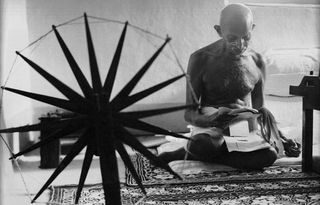
This divide between the religious, spiritual Gandhi and the political one or, more aptly, the divide between Gandhi the ashramite and Gandhi the satyagrahi has come to shape not only our academic engagement with the life and thought of Gandhi, but also our memory of the man whom we revere, revile or remain indifferent to. The dichotomy is a superficial one. Gandhi saw himself as a satyagrahi and an ashramite. His politics was imbued with spiritual strivings and his relationship with religion was a deeply political one.

A long, rich and diverse biographical tradition, which has deepened our understanding of Gandhi’s life and his strivings, has not escaped this divide either. This tradition has been partial to the satyagrahi Gandhi; whereas the ashram, the ashram community, his striving to see “god face to face”, his fasts and his experiments with brahamcharya remain shadowy. Gandhi’s practices of silence, fasting, walking and spinning, his brahmacharya, and his need for prayer were integral to his self-search and to swaraj and yet we are still casting about for adequate modes of capturing and recounting these practices.

We have few serious studies on Gandhi’s ashrams. There is one by Mark Thompson titled Gandhi and His Ashrams (1993); another major exception is the recent four-volume biography of Gandhi, My Life is My Message (2009), by Narayan Desai. Desai, an ashramite himself, understands that Gandhi’s politics was not possible without the ashram as a site of experimentation, and in the absence of the ashramites who were his co-experimenters.

Our limited understanding of the ashram is also due to our neglect of the diaries of Mahadev Desai, Gandhi’s closest associate and secretary. Desai wrote a diary for each day that he spent with Gandhi from 1917 until the former’s death in the Aga Khan Palace prison in 1942. The diaries are not just records of letters sent and received and accounts of all those who visited Gandhi; running to 23 volumes in Gujarati, they are the most detailed accounts of Gandhi’s “experiments with truth”.

Was Chilean Poet Pablo Neruda Poisoned?

Pablo_neruda.jpg.size.xxlarge.promo

Oakland Ross in The Star [h/t: Pablo Policzer]:

What — or who — killed Pablo Neruda?

Nobody knows for certain, but the world may soon find out.

This Sunday or Monday, the celebrated but long-dead poet is supposed to rise from the tomb — and maybe, just maybe, he will speak.

In a decision that may well owe more than a little to the expert opinion of three Canadian toxicologists, an investigating judge named Mario Carroza has ordered the removal of Neruda’s body from its grave near the Nobel laureate’s home at Isla Negra on Chile’s Pacific coast, following nearly 40 years of interment in two different locations.

The purpose: to try to determine whether the poet was poisoned, as many now suspect.

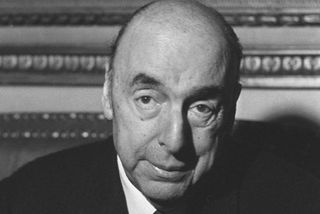
A committed socialist and long-time Communist party member, Neruda died just 12 days after the military coup in September 1973 that overthrew the democratically elected government of Marxist president Salvador Allende.

Amid mounting suspicion of foul play, the Chilean Communist party has spearheaded a campaign for a judicial investigation.

It has also demanded the exhumation of the poet’s remains, so that they may be tested for evidence of poisoning.

Last month, Carroza ordered that the disinterment go ahead, but there continues to be some uncertainty about who will be responsible for analyzing Neruda’s corpse and whether foreign experts, including three Canadians, will be involved.

sylvia

C2c4d296-9d9c-11e2-a8db-00144feabdc0

The Ariel poems were so remarkable because women poets had never written like this before: they are personal, raw, incantatory. But they are also informed by Plath’s talent, and years of hard graft: her virtuosity is on display throughout. Poems such as the unforgettable “Daddy” used the rhythms and imagery of a nursery rhyme to reject, defiantly, the father figure who would infantilise her. Imagining marriage as being shackled to yet another “Fascist”, the speaker symbolically kills off the men who have held her back: “If I’ve killed one man, I’ve killed two/ … Daddy, you can lie back now./ There’s a stake in your fat black heart/ And the villagers never liked you./ They are dancing and stamping on you./ They always knew it was you./ Daddy, daddy, you bastard, I’m through.” In 1965, this was electrifying stuff, a call to feminist arms, and Plath became a heroine, giving voice to women’s frustration – but also to their tenderness, and maternity. If the Ariel poems vibrate with outrage, they also seek an escape hatch, trying to rise above the meanness of rage.

more from Sarah Churchwell at the FT here.

katznelson on fdr

07BOYLE-articleInline

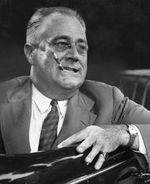
It’s a powerful argument, swept along by Katznelson’s robust prose and the imposing scholarship that lies behind it. Only at the very end of the book, though, does he acknowledge another side of the story. For all its compromises, the New Deal gave millions of Americans a sense of belonging — a sense of rights — they’d never had before. That sense swept through the industrial working class, where union buttons suddenly became badges of honor. It swept through all those ethnic communities that until the 1930s had been treated as not quite American. And despite the racial dynamics Katznelson so ably describes, it swept through African-­American communities too. No doubt that’s why Bubbeh Frima saw Roosevelt as such a towering figure, because where she lived up in Washington Heights, America seemed a better place than it had been before he took office. That’s also why, just a few years after Roosevelt’s death, Jim Crow began to come tumbling down, shattered by a social movement that had been invigorated by the promise, if not necessarily the practice, of the New Deal era. Roosevelt can’t be given credit for that extraordinary triumph, of course; that belongs to the men, women and children who risked their lives on the streets of the South. But he played a role, however indirect.

more from Kevin Boyle at the NY Times here.

We make war, it's what we do
We have a tradition of glorious cruelty
and moneyed interests

……………………. —Roshi Bob

Prisoners

Usually at the helipad
I see them stumble-dance
across the hot asphalt
with crockersack over their heads,
moving toward the interrogation huts,
thin-faced as box kites
of sticks and black silk
anticipating a hard wind
that'll tug and snatch them
out into space. I think
some must be laughing
under their dust-colored hoods,
knowing rockets are aimed
at Chu Lai—that the water's
evaporating & soon the nail
will make contact with metal.
How can anyone anywhere love
these half-broken figures
bent under the sky's brightness?
The weight they carry
is the soil we tread night & day.
Who can cry for them?
I've heard the old ones
are the hardest to break.
An arm twist, a combat boot
against the skull, a .45
jabbed into the mouth, nothing
works. When they start talking
with ancestors faint as camphor
smoke in pagodas, you know
you'll have to kill them
to get an answer.
Sunlight throws
scythes against the afternoon.
Everything's a heat mirage; a river
tugs at their slow feet.
I stand alone & amazed,
with a pill-happy door gunner
signaling for me to board the Cobra.
I remember how one day
I almost bowed to such figures
walking toward me, under
a corporal's ironclad stare.
I can't say why.
From a half-mile away
trees huddle together,
& the prisoners look like
marionettes hooked to strings of light.
.

by Yusef Komunyakaa
from Unaccustomed Mercy
Soldier-Poets of the Vietnam War
Texas Tech University Press, 1989

Photographing Love

From The New Yorker:

Lovers-01Nicholas Pye and Sheila Pye, “Sitting on a Unicorn” (2004). “Playing self-invented, absurdist, and at times juvenile games, Sheila and I developed a situation or stage for power struggles between female and male to play out. This photograph deals with the meaning of language through abjection,” Nicholas told me. “The camera had always been a tool to explore the deeper side of loving relationships for Nick and me,” Sheila continued. “I think that when we decided to go our separate ways, it was a bit like cutting off a limb… so art was a way of avoiding that pain. We still make a lot of photographic and video art together, and shifting our love into a brotherly-sisterly realm actually made our work stronger.”

More here.

The Messenger and the Message

From The New York Times:

FirstBigots looking to confirm their prejudices will, by and large, find “The First Muslim” a disappointment: Hazleton approaches her subject with scrupulous respect. She blogs as “the Accidental Theologist,” where she describes herself as “a psychologist by training, a Middle East reporter by experience, an agnostic fascinated by the vast and often terrifying arena in which politics and religion intersect.” In 2010, she gave a TED talk debunking some of the more egregious myths about the Koran, notably the salaciously Orientalist “72 virgins.” This is a writer who is working to dispel contradictions, not sharpen them.The story of Muhammad is undoubtedly extraordinary.

…Orphaned in childhood in Mecca, an Arabian trading hub, he rose to be the trusted business agent and later husband of Khadija, a wealthy merchant woman. This respectable citizen took to climbing into the mountains overlooking the town, where he would spend nights in solitary meditation. Eventually he received a revelation, in the form of the voice of the angel Gabriel, who began to dictate the verses of the Koran. As the messenger of this radical new form of monotheism, he disrupted the power structure and eventually led his followers out of Mecca to nearby Medina, where he took full political control and began military operations against the rulers of his birthplace. By the time of his death, Islam had been embraced throughout the Arabian Peninsula and was spreading farther afield. “The First Muslim” tells this story with a sort of jaunty immediacy. Bardic competitions are “the sixth-century equivalent of poetry slams.” The section of the Koran known as the Sura of the Morning has “an almost environmentalist approach to the natural world.” Theological ideas and literary tropes are “memes” that can go “viral.” Readers irritated by such straining for a contemporary tone will find it offset by much useful and fascinating context on everything from the economics of the Meccan caravan trade to the pre-Islamic lineage of prophets called hanifs, who promoted monotheism and rejected idolatry.

More here.

Friday, April 5, 2013

tony judt and the crappy generation

Judt_335431h

If Judt had merely been an anti-Communist “cold warrior”, in the stale vocabulary of another age, he might have gloated over the disintegration of the structure Lenin and Stalin had built. To the contrary, he saw that the downfall had “undermined not just communism, but a whole progressive narrative of advance and collectivization”. Judt now became a ferocious critic of “Bush’s useful idiots”, the so-called liberal interventionists who had provided supposedly enlightened cover for brutish policies. He was dismayed by the self-evisceration of the democratic Left, exemplified by New Labour, and he saw that the historical background to this disturbing loss of moral confidence was “in large measure the collapse of the old Left, with all its faults, and the attendant ascendancy of the soft cultural Left”. At the very end of his life, Judt said that he was “more or less the same age as George W. Bush, Bill Clinton, Hillary Clinton, Gerhard Schröder, Tony Blair and Gordon Brown – a pretty crappy generation, when you come to think of it . . . a generation that grew up in the 1960s in western Europe or in America, in a world of no hard choices, neither economic nor political”.

more from Geoffrey Wheatcroft at the TLS here.