
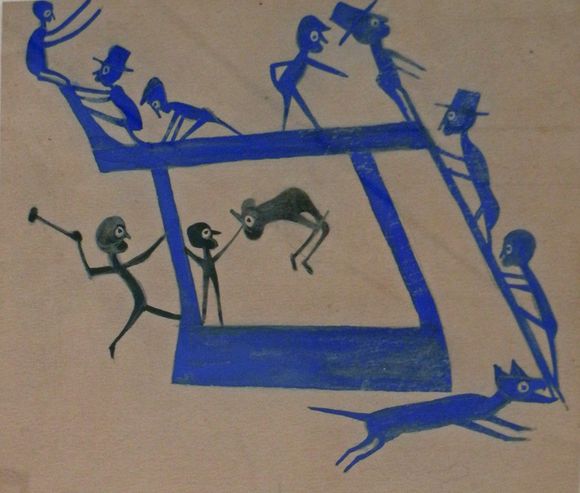
Bill Traylor. Untitled. 1939-42.
Category: Recommended Reading
Sunday, April 21, 2013
“I Think I’ve Just Thought Up Something Important” – Francois Jacob (1920-2013)
Carl Zimmer in National Geographic:
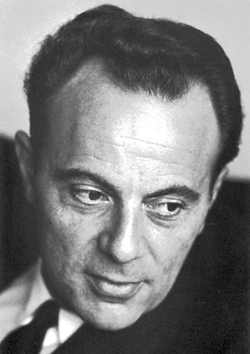
Jacob was also a wonderful writer, and so I had enormous pleasure mining his memoirs for my book Microcosm: E. coli and the New Science of Life. I hope this passage gives a sense of what he was like–
One day in July 1958, François Jacob squirmed in a Paris movie theater. His wife, Lise, could tell that an idea was struggling to come out. The two of them walked out of the theater and headed for home.
“I think I’ve just thought up something important,” François said to Lise.
“Tell!” she said.
Her husband believed, as he later wrote, that he had reached “the very essence of things.” He had gotten a glimpse of how genes work together to make life possible.
Jacob had been hoping for a moment like this for a long time. Originally trained as a surgeon, he had fled Paris when the Nazis swept across France. For the next four years he served in a medical company in the Allied campaigns, mostly in North Africa. Wounds from a bomb blast ended his plans of becoming a surgeon, and after the war he wandered Paris unsure of what to do with his life. Working in an antibiotics lab, Jacob became enchanted with scientific research. But he did not simply want to find a new drug. Jacob decided he would try to understand “the core of life.” In 1950, he joined a team of biologists at the Pasteur Institute who were toiling away on E. coli and other bacteria in the institute’s attic.
Jacob did not have a particular plan for his research when he ascended into the attic, but he ended up studying two examples of one major bio- logical puzzle: why genes sometimes make proteins and sometimes don’t.
More here.
Podcast: Ottoman Slave Narratives
From Diwaniyya:
Shemsigul was a teenage slave girl in 19th century Cairo. She was supposed to have been sold into one of the most elite harems in the Ottoman Empire. There, she'd have had a chance at social mobility. Instead, she became pregnant by the wrong man, was severely beaten by his wife, and eventually, she testified against them.
In this second installment of The Body Series, we explore the stories of slaves who lived in the Ottoman Empire in the 19th century: the story of Shemsigul; the story of an African eunuch who escaped to freedom; a woman who was kidnapped into slavery, and the stranger who saved her; and an ex-slave who became a prostitute and was murdered in a crime of passion.All these slave narratives were found in Ottoman police and court records by our guests, Ehud Toledano and Liat Kozma.
Ottoman Slave Narratives
(Click the link to download. Macs: right click to save.)
Biblical Blame Shift
Richard Wolin on Jan Assmann's in The Price of Monotheism, in The Chronicle of Higher Education:
In his more recent work, Assmann has taken the corrosive spirit of early modern Bible criticism a step further. In The Price of Monotheism (Stanford University Press, 2010) and related studies, Assmann ignited an international controversy by claiming that the Old Testament, by discriminating between true and false religion, was responsible for ushering in unprecedented levels of historical violence. Provocatively, he has designated this fateful cultural caesura—whose origins lie in the sacred texts of ancient Judaism and which Assmann describes as a world-historical transition from “cult to book”—as the “Mosaic distinction.” It is a perspective we must transcend, he contends, if the world is to surmount the theologically authorized violence and hatred that have been responsible for so much bloodshed and misfortune. “We cannot change history, but we can change the myths into which history is continuously transformed through collective memory,” writes Assmann in Of God and Gods (University of Wisconsin Press, 2008). “This is the road that should be taken. Monotheism itself pushes us to go beyond the logic of exclusivity and the language of violence.”
Assmann argues that biblical monotheism, as codified by the Pentateuch, disrupted the political and cultural stability of the ancient world by introducing the concept of “religious exclusivity”: that is, by claiming, as no belief system had previously, thatits God was the one true God, and that, correspondingly, all other gods were false. By introducing the idea of the “one true God,” Assmann suggests that monotheism upended one of the basic precepts of ancient polytheism: the principle of “divine translatability.” This notion meant that, in ancient Mesopotamia, the various competing deities and idols possessed a fundamental equivalence. This equivalence provided the basis for a constructive modus vivendi among the major empires and polities that predominated in the ancient world.
Assmann readily admits that the ancient Middle East was hardly an unending expanse of peaceable kingdoms. However, he suggests that before monotheism's emergence, the rivalries and conflicts at issue were predominantly political rather than religious in nature.
Beckett the Nietzschean Hedonist
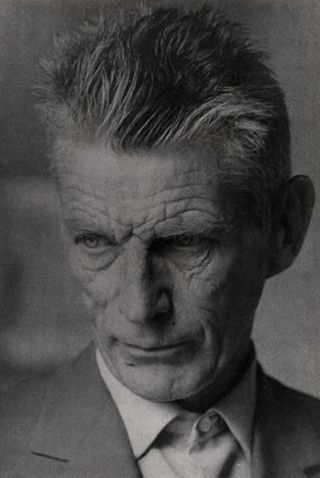
Richard Marshall in 3AM Magazine:
‘Clov: There are so many terrible things now.
Hamm: No, no, there are not so many now.’ (‘Endgame’).A body of despair has been assembled. It has manifest arrangements. Atomic loneliness engulfs us as if parodying our vast populations. Hopes for even timid liaisons diminish in paradox. We recognize that the best times for such hopes are when alone. Never has solipsistic terror been so crowded. Conrad wrote, ‘Who knows what true loneliness is – not the conventional word but the naked terror? To the lonely themselves it wears a mask. The most miserable outcast hugs some memory or some illusion.’ Charlotte Bronte is autobiographical: ‘The trouble is not that I am single and likely to stay single, but that I am lonely and likely to stay lonely.’ Loneliness will always have an obscure history. If it led to easily discerned conclusions then it would be less so. But we refuse obedience to the logic of ending it, aping willpower though powerless. We continue with the hubris of the lonely. This is when the ego strives to stay at least at stalemate and refuses suicide. That is the absurd ground. What are we to make of this attachment to our calamity? Schopenhauer’s question hovers around this: why not self-annihilation given so much agony? The writer finds her ground variously.In Beckett an isolated atomic subjectivity finds a strange equipoise in choreographic endurance. Think of ‘Quad 1’ and ‘Quad 2’ where a dance of exactly such anonymous atomic subjectivity persists unabated over millennia. Jean-Michel Rabaté is pithily deft. He describes the effect of these works as ‘the Inferno as ballet’. This captures their condensed enormity. There is a species of the harmonious in it, a harmony of despair that is ironical, bleak and registering dimensions summarised in Mercutio’s bitterly wry: ‘tis not so deep as a well, nor wide as a church-door; but ‘tis enough, ‘twill serve.’
Beckett’s characters are wrecked particles in this body of despair. Are they outside of anything but a naturalistic philosophy?
richard burton reads john care
maria tallchief
willie dixon
Sunday Poem
My Sister, Life's Overflowing Today
.
My sister – Life’s overflowing today,
spring rain shattering itself like glass,
but people with monocles still complain,
and sting, politely, like snakes in the grass.
The elders have their logic of course,
certainly yours is foolish, no doubt:
that eyes and lawns glow lilac in storms,
and sweet perfume blows from the south.
That in May, when traveling you see
the timetable on the Kamyshin line,
the Bible’s penned no less magnificently,
while in reading it you’re mesmerised.
That sunset has only to show a village,
girls crowding the track as we flee,
and I find that it’s not my stop today,
the sun offering its sympathy.
With three splashes the bell swims by,
‘Sorry, not here’: its apology’s far.
Burning night seeps under the blind,
the steppe plunges, from step to star.
Winking, blinking, sweetly somewhere,
my love, a fata-morgana, sleeps yet,
while, like my heart, splashed on platforms there,
the carriage throws window-light over the steppe.
.
.
by Boris Pasternak
Black, White, and Many Shades of Gray
From Harvard Magazine:
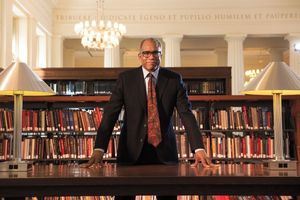
…The interaction of race and legal institutions is Kennedy’s niche; this is how he describes the approach he’s used in his classes and five books: “Here’s this deep, complex, troubling, anxiety-producing subject. Let’s really go at it. Let’s not be afraid of it. Let’s turn it over and take a look at what your opponents have to say. There were people who believed slavery was a positive good, and that segregation was a positive good. Who were they? Let’s really be precise, let’s not just condemn them and laugh at them, but understand them, get in a position where you can state very clearly what their point of view was. You might end up condemning it, but let’s understand it first….I take strong positions, but I also try to be attentive to the complexity of things.”
More here.
Will you be wearing ‘smart clothes’?
From Kurzweil AI:

“We won’t see such garments in stores for another 20 or 30 years, but the practical and creative possibilities are exciting,” says Berzowska. Berzowska will present her findings at the Smart Fabrics 2013 conference April 17–19 in San Francisco and in an exhibit to be held at the PHI Centre in Montreal next year.
More here.
Saturday, April 20, 2013
Dead White Reds
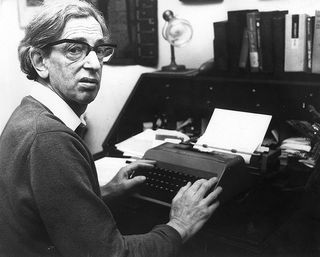
Matt Karp in Jacobin:
“The tradition of all the dead generations,” Marx wrote a 150 years ago, “weighs like a nightmare on the brain of the living.” Today, with our politics trapped in capitalism’s endless fugue state, the nightmare that troubled Marx may seem to contemporary left-wingers like a pleasant dream of days gone by.
At least the dead generations took Marx seriously. At least they had a powerful labor movement and center-left parties that believed in the welfare state. And at least Ralph Miliband, the dead leftist whose son is the living leader of Britain’s Labour Party, would never have answered a question about capitalism with a grudging obeisance to the creative power of BlackBerry.
It’s easy to get nostalgic.
A longer glance back into the past should cure us of this sentimentalism. The British historian Eric Hobsbawm and the American critic Irving Howe, both eminent socialist members of Ralph Miliband’s dead generation, can help. Hobsbawm, born in the red year of 1917, remained a defiant communist all his life. Howe, arriving three years later, devoted his own career to defending the socialist idea against Stalin’s Soviet Union. But taken together, their memoirs — Howe’s A Margin of Hope, published in 1982, and Hobsbawm’sInteresting Times, in 2002 — form as poignant a record as exists of the courageous hopes and constant sorrows of the twentieth century Anglo-American left.
These memoirs remain valuable today — both as vivid portraits of a previous century’s problems, and as bracing reminders to the contemporary left that those problems are not our own. “The central experience of the twentieth century,” as Howe once quoted Theodore Draper, “was communism,” and this was as true for the left-wingers who resisted it as it was for those who succumbed to its chilly embrace.
The central experience of the twenty-first century, of course, cannot yet be reckoned. But whatever it is, we can be grateful that all our dreams and arguments about a just, egalitarian future will not be defined — or distracted, or divided, or destroyed — by the fate of a particular Russian dictatorship.
Noel Malcolm on Thomas Hobbes’ Leviathan in Context
Over at Philosophy Bites:
Thomas Hobbes' Leviathan, published in 1651, is one of the great works of political philosophy. Noel Malcolm has recently published a 3 volume scholarly edition of the book (reviewed here in The Economist) based on decades of research. In this episode of thePhilosophy Bites podcast he discusses Leviathan's historical context with Nigel Warburton.
Listen to Noel Malcolm on Hobbes' Leviathan in Context
Philosophy Bites is made in association with the Institute of Philosophy.
The Tragedies of Other Places and America’s
Rafia Zakaria in Guernica [h/t: Vijay Prashad]:
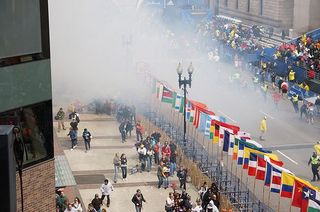
Attacks in America are far more indelible in the world’s memory than attacks in any other country. There may be fewer victims and less blood, but American tragedies somehow seem to occur in a more poignant version of reality, in a way that evokes a more sympathetic response. Within minutes American victims are lifted from the nameless to the remembered; their individual tragedies and the ugly unfairness of their ends are presented in a way that cannot but cause the watching world to cry, to consider them intimates, and to stand in their bloody shoes. Death is always unexpected in America and death by a terrorist attack more so than in any other place.
It is this greater poignancy of attacks in America that begs the question of whether the world’s allocations of sympathy are determined not by the magnitude of a tragedy—the numbers dead and injured—but by the contrast between a society’s normal and the cruel aftermath of a terrorist event. It is in America that the difference between the two is the greatest; the American normal is one of a near-perfect security that is unimaginable in many places, especially in countries at war. The very popularity of the Boston Marathon could be considered an expression of just this. America is so secure and free from suffering that people have the luxury of indulging in deliberate suffering in the form of excruciating physical exertion; this suffering in turn produces well-earned exhilaration, a singular sense of physical achievement and mental fortitude. The act of running a marathon is supposed to be simple, individual—a victory of the will over the body, celebrated by all and untouched by the complicated questions of who in the world can choose to suffer and who only bears suffering.
When terror hits the site of such faith in human fortitude, the impact is large.
a sebald extract

When Rousseau fled to the Île Saint-Pierre in the autumn of 1765, he was already on the verge of utter physical and mental exhaustion. Between 1751 and 1761, in his fifth decade and in ever more precarious health, he had, first in Paris and then in the Ermitage at Montmorency, committed to paper thousands upon thousands of pages. The Discourse on the Sciences and the Arts, which earned him the prize of the Académie de Dijon, the treatise On the Origin and Basis of Inequality Among Men, the opera Le Devin du village, the letters on French music and on Providence, to Voltaire and to D’Alembert, the fairytale La Reine fantasque, the novel La Nouvelle Héloïse; Émile, and The Social Contract – all this and more was written during this period alongside the extremely copious correspondence which Rousseau always maintained. When one considers the extent and diversity of this creative output, one can only assume that Rousseau must have spent the entire time hunched over his desk in an attempt to capture, in endless sequences of lines and letters, the thoughts and feelings incessantly welling up within him. Scarcely had he reached the apogee of literary fame for his passionate epistolatory novel proclaiming the natural rights of lovers, than the state of nervous exhaustion resulting from this manic productivity was further exacerbated when Émile and The Social Contract were banned and confiscated by the parlement in Paris, thus making of the celebrated author an outcast, ostracised and banished from France on pain of arrest. Nor does Rousseau fare any better in his native city of Geneva. Here too he is condemned as a godless and seditious person, and his writings consigned to the flames.
more from WG Sebald at The Guardian here.
A Common Struggle
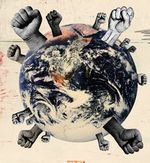
In “The Undivided Past,” David Cannadine challenges those who believe that all history is the history of conflict, whether over class, as Marx and Engels proclaimed, or over religion, nationality, race, gender or civilization. The fact is, mankind’s divisions may not be the most important part of the story. As Cannadine succinctly puts it, “humanity is still here.” This is so hopeful a book, and so authoritative in its coverage of history, that a reader wants to believe its thesis. I do, but only in part. Of all the texts that map the world into hopelessly hostile camps, “The Communist Manifesto” no doubt sold the most copies. Its authors argued that two features of class conflict would make it especially significant: class would trump all other forms of division, and the differences between classes would prove so profound that their strife could be resolved only through revolution.
more from Alan Wolfe at the NY Times here.
occupy?

A sympathetic reader of these books will end up with the slightly exasperated feeling that Occupy wasted its chance as a political movement. It had friends with great influence on policy making – economists Joseph Stiglitz and Andrew Haldane, to mention just two. Occupy could have put its “people power” behind a few clear, concrete, policy proposals such as student or mortgage debt restructuring, higher bank capital ratios or specific tax reforms – more progressive direct tax rates, for example, or the elimination of such outrageous loopholes as the tax discount on carried interest. The success of Tobin tax campaigners in Europe shows that politicians are responsive to anti-finance sentiment. Granted, campaigns such as Strike Debt have grown out of OWS but they no longer have the numbers in the street to make themselves heard. A greater willingness to engage could have secured the movement a more permanent voice – a voice that would carry weight when decisions are made, rather than a voice merely talking to itself. Those of us who think that the system is ours to reform will see this as a missed opportunity to fix the problems that brought people to Zuccotti Park in the first place.
more from Martin Sandbu at the FT here.
Inbred royals show traces of natural selection
From Nature:

Royal families such as the Habsburgs are an ideal place to look, says Francisco Ceballos, a geneticist at the University of Santiago de Compostela in Spain, who led the research. He and colleague Gonzalo Álvarez used written records to track the marriages, births and deaths of 4,000 individuals across more than 20 generations. “The royal dynasties of Europe are a lab of inbreeding for human populations,” says Ceballos. The team's study is published this month in Heredity1. The Habsburg pedigree resembles the organizational flowchart of a dysfunctional government agency. Inbred marriages, such as those between first cousins or between uncles and nieces, were the rule rather than exception. Such pairings, which include the marriage between Philip II of Spain — Charles II's great-grandfather — and his niece Anna of Austria, were used to keep titles in the family and to forge political alliances.
More here.
Crossing Dangerous Borders: Mira Nair on ‘The Reluctant Fundamentalist’
Fred Kaplan in The New York Times:

From another angle, though, Ms. Nair is a natural fit. Her father was raised in Lahore before the partitioning that carved out Pakistan as a separate nation. Later, as a lawyer in New Delhi, he helped found the India-Pakistan Friendship Society. Ms. Nair first visited Lahore only in 2004, when she was 47, as a result of a speaking invitation. (Her films are popular in Pakistan as well as in her native India.) “The trip had a big impact on me,” she recalled in an interview in her apartment on Manhattan’s Upper West Side. “There was this incredible feeling of familiarity — the hospitality, the music, the artistic expression: modern paintings are everywhere. We never see this aspect of contemporary Pakistan on our screens.” She resolved to change that. Two years later she read Mr. Hamid’s novel in galleys, saw it as an ideal vehicle and arranged to meet the author in London, where he was living. A fan of her films, he sold her the rights and helped with some early drafts of the screenplay.
More here. (Note: Saw the film, loved it, recommend it strongly)
Saturday Poem
Two Souls
.
My cat cries when I enter the garden, as
if I have aroused her from winter’s dream
or as if she wants to sing to me, her name.
What do cats dream of, Lord Krishna?
A coconut shell of milk or a glittering fish?
Now her slender limbs complete their asanas.
Now her neck arches, her jaw, an elastic.
The sharp eye constricts, discerns wind
in the quivering grass from a grasshopper’s
camouflage. But there’s no mistaking Maya.
My cat rehearses the accurate lunge of her paw.
She cries as one compelled, hungry, yet not.
Perhaps my being here deserves an answer.
For weeks I too have watched her, how
she hunts. I’ve heard the moan of her catch
at dusk, which is your hour, Lord Krishna.
Then, no bird sings and only a cat with two souls
dreams of death, her stigma left on a lizard
or on a butterfly, whatever moves towards
the shadow of meaning. As I am born of fire
I burn, my Lord, but I sleep in your arms.
I am one Upanishad moon on fragrant nights.
By day I am the consort of oceans, rice fields,
pale and invisible to you as the sky’s temple.
.
by Michelle Cahill
from Seva Bharati Journal of English Studies, Vol 5, 2009
from Seva Bharati Journal of English Studies, Vol 5, 2009