The Internet’s Shameful False ID

White_hat_crowd

Alex Pareene in Salon:

Yesterday, a Reddit user posted a new, startlingly clear image of the aftermath of the explosion, that shows, on the far left, what looks very much like one of the FBI’s suspects fleeing the scene. After Philip Bump, an Atlantic Wire writer and Photoshop expert,explained why he believed the image was genuine the New York Times confirmed the photo’s authenticity.

So: The Internet actually found a new, much clearer photo of one of the FBI’s suspects. Amazing! It could’ve taken ages, before the Internet, for this evidence to surface and be sent to law enforcement. Immediately after the Internet did this admirable thing, of course, it took it to a dark and irresponsible place.

Remember how thousands of Reddit users and 4chan people spent the days after the bombing combing through every available photo and frame of video of the site of the bombings, searching for the perpetrators, and they found a bunch of guys with backpacks— so many guys they made a spreadsheet! — and (inadvertently) allowed the New York Post to identify, on the front page, two innocent people as the bombers? And remember how when the FBI released images of the actual suspects, neither of them had been spotted by Reddit or 4Chan or any other online sleuth? Well, armed with this new, clearer photo, and giddy from having uncovered it, the message board investigative geniuses then determined that “suspect two” was a missing college student.

Sunil Tripathi is a Brown University student from Pennsylvania who has been missing since March 16. On that day, surveillance cameras picked him up leaving his Providence, R.I., apartment. He left behind his computer, wallet and phone. He hasn’t been seen since.

The Death of the Book

1332803613

Ben Ehrenreich in the LA Review of Books:

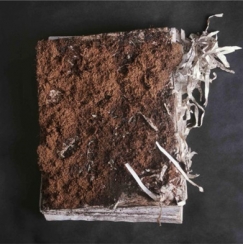
PITY THE BOOK. IT'S DEAD AGAIN. Last I checked, Googling “death of the book” produced 11.8 million matches. The day before it was 11.6 milion. It's getting unseemly. Books were once such handsome things. Suddenly they seem clunky, heavy, almost fleshy in their gross materiality. Their pages grow brittle. Their ink fades. Their spines collapse. They are so pitiful, they might as well be human.

The emphasis shifts with each telling, but every writer, editor, publisher, bookseller, and half-attentive reader knows the fundamental story. After centuries of steady climbing, book sales leveled off towards the end of the 1900s. Basic literacy began to plummet. As if television and Reaganomics were not danger enough, some egghead lunatics went and built a web — a web! — out of nothing but electrons. It proved a sneaky and seductive monster. Straight to our offices and living rooms, the web delivered chicken recipes, weather forecasts, pornography, the cutest kitten videos the world had ever seen. But while we were distracted by these glittering gifts, the internet conspired to snare our friend the book, to smother it.

The alarm at first built gradually. In 1999, Robert Darnton, writing in The New York Review of Books, consoled his readers that, all the grim prophecies notwithstanding, “the electronic age did not drive the printed word into extinction.” The book seemed safe enough for a few years, in more danger from the avarice of the carbon-based conglomerates that ate up all the publishers, than from anything in silicon. Safe until the fall of 2007, when lady Amazon released her hounds. Within a month of the Kindle's debut, the New Yorker was writing of the “Twilight of the Books.” (Cue soundtrack: all minor keys, moody cello.) The London Times worried that “the slow death of the book may be with us.”

Last summer Amazon announced that it was selling more e-books than the paper kind. The time to fret had passed. It was Kindle vs. kindling. MIT Media Lab co-founder Nicholas Negroponte — whose name is frequently preceded by the word “futurist” — declared that the demise of the paper book should be written in the present tense. “It's happening,” Negroponte said, and gave the pulpy artifacts just five years to utterly expire.

Heart of Lightness

800px-Chinua_Achebe_-_Buffalo_25Sep2008_crop

Morgan Meis in The Smart Set (image from Wikimedia Commons):

By the time the Nigerian novelist Chinua Achebe died late last month he'd taken on an official title: “Father of Modern African Literature.” Achebe received this title mostly because of his novel, Things Fall Apart, published in 1958. Things Fall Apart is often called the archetype of the African novel. It's a story of the Igbo peoples of southeastern Nigeria and British colonials who arrived to the area in the late 19th century. The Igbo people were trying to preserve their way of life. The British were trying to replace the Igbo way of life with their own. And that's how things fall apart.

Being dubbed the Father of Modern African Literature has its consequences. One consequence is that people start listening to what you have to say. So, when Chinua Achebe gave a lecture in which he said that Joseph Conrad was a “bloody racist,” the world took note. Well, the literary world did, anyway. Achebe's lecture was entitled “An Image of Africa: Racism in Conrad's Heart of Darkness.” He delivered the lecture at the University of Massachusetts Amherst in 1975.

Achebe's charge against Conrad is a serious one. He considered Conrad's short novel to be an instance of the Western desire to set up Africa as “a place of negations at once remote and vaguely familiar, in comparison with which Europe's own state of spiritual grace will be manifest.” Achebe thought that Conrad had two basic metaphors for Africa, which Conrad returns to over and over again. The first is silence. The second is frenzy. Achebe takes two quotes from Heart of Darkness to illustrate the point. The “stillness of an implacable force brooding over an inscrutable intention.” And, “The steamer toiled along slowly on the edge of a black and incomprehensible frenzy.”

After Achebe delivered his lecture, the literary world delivered its hysteria. Articles were published. Books were written. Conferences were organized. Conrad was defended. Conrad was further denounced. Conrad was declared essential. Conrad was declared unreadable. In the end, both sides largely agreed upon two conclusions. Conrad was discovered to have been more or less a racist in his personal views. Heart of Darknesswas discovered to be a tremendous piece of writing. Those two facts may sit uncomfortably together. But no one has yet figured out how to resolve them.

In all the hoopla over Conrad's racism, a strange irony went unnoticed. Conrad wrote a racist book that denounces the values of the civilization that produced racism. Achebe, on the other hand, attacked a racist writer using the values of the civilization that had created racism and which Conrad had denounced.

beacons

Beacons

“It is inevitable,” Stephanie Bernhard wrote in The New Inquiry in January, “that our fictional landscapes will evolve in tandem with our physical landscapes.” A changing climate, she argued, will change the way we write: the ravages of a warming world “will soon be ubiquitous enough that novelists will make them a central concern.” Climate change literature will become the war literature of our generation—its central concern so “painfully known to readers that it will hardly need to be named.” Inevitable perhaps … but how “soon” really? Last fall, I posed the question “Where is all the climate change fiction?” in an article in the Guardian. And yet, since then only Barbara Kingsolver’s Flight Behavior has offered itself up as a mainstream, non-genre response. Perhaps, this lack of climate change fiction reflects what’s going on in the world: we know how serious a problem we face, but do we engage with it directly? Perhaps tomorrow, we say to ourselves. Aren’t other people looking into it? We are not too concerned about our relationship with climate change, and neither, it seems, are the characters in most published novels.

more from Daniel Kramb at The Point Magazine here.

the letter from jail

Index

Fifty years ago this month, Martin Luther King Jr. drafted a letter from a cramped cell in Birmingham, Alabama. King’s “Letter from Birmingham Jail,” Jonathan Rieder says in his new book Gospel of Freedom, reveals a more complex King, tough and tender, in equal measure. Rieder’s narrative reflects a major shift in the way many historians now understand the African American freedom struggle. The new scholarship challenges the division of black activism into integrationism and separatism, blurring the previously sharp lines between non-violence and violence, civil rights and black power. Rieder aims to replace the “sunny view of King” as a quixotic champion of the American dream and interracial brotherhood with a fiercer and more uncompromising King, a man who consistently preached a doctrine of black self-sufficiency. Martin, in other words, wasn’t that far from Malcolm. While Rieder succeeds in showing us a more multifaceted King, he neglects the long history of African American rhetorical dissent that shaped King’s message.

more from Jeffrey Aaron Snyder at TNR here.

against the flow

Flow2

We often speak poetically of the ‘flow’ of ‘the river of time’. This is clearly wrong, because rivers, unlike the water in them, do not flow – otherwise maps would be continually out of date, with all rivers disappearing into the ocean. But couldn’t time move like the water in the river? Let’s leave aside the question – not as daft as may seem – of whether ‘water’ here means all the water in the river or the water at a specific place, and focus on the more obvious problems. If time flows, what does it flow in? Stuff such as water flows in space, relative to other stuff in space (such as banks) that flow not at all, or more slowly. This is clearly not something that time could manage: time could not flow in or relative to time in the way that spatially-extended, located matter such as water flows between other bits of spatially-extended matter. Besides, how quickly would it flow? The obvious answer, one second per second, demonstrates the vacuity of the very notion of ‘time on the move’. Velocity or rate cannot have the same dimension on both the numerator and the denominator. Nevertheless, the idea of temporal flow is irresistible. It gets a bit of a boost from the way the calendar makes us think of time in lumps. On Friday at noon, my doctor’s appointment next Wednesday noon is five days away. On Saturday at noon, Wednesday noon will be four only days away. Wednesday, it seems, is coming nearer, bearing the dreaded appointment in its belly.

more from Raymond Tallis at Philosophy Now here.

Friday Poem

Driving to Katoomba
.
Today, you span the far mountains
with an arm and say,
‘This I offer you—
all this blue sweat
of eucalypt.’

Then you teach me
how to startle kookaburras
in my throat

and point out Orion
among the glowworms.

I, too, can love you
in my dialect, you know,
punctuated with cicadas
and their eternal afternoons:

‘Mahal kita. mahal kita.’

I can even save you monsoons,
pomelo-scented bucketfuls
to wash your hair with.

And, for want of pearls,
I can string you the whitest seeds
of green papayas

then hope that, wrist to wrist,
we might believe again
the single rhythm passing
between pulses,

even when pearls
become the glazed-white eyes
of a Bosnian child
caught in the cross-fire

or when monsoons cannot wash
the trigger-finger clean
in East Timor

and when Tibetans
wrap their dialect
around them like a robe

lest Orion grazes them
from a muzzle.

Yes, even when among the Sinhalese
the birds mistake the throat
for a tomb

as gunsmoke lifts
from the Tamil mountains,

my tongue will still unpetrify
to say,

‘Mahal kita. Mahal kita.’

.

by Merlinda Bobis
from Summer was a fast train without terminals
Publisher: Spinifex, North Melbourne, 1998

Poets's Note: Mahal kita means ‘I love you’ in Pilipino

Bending the arc of history towards justice and freedom

From New Statesman:

ArcBeatrice and Sidney Webb founded the New Statesman in a spirit of optimism. They were outraged by the plight of the poor and the way the unfettered market had created monstrous inequality at a time of great technological advance. (Does this sound familiar?) They wanted their new weekly review of politics and the arts to be a reforming journal as well as a vehicle for their ideas. They believed in the rational, scientific method and in the “world movement towards collectivism”. Theirs was a socialism of experts: technocratic, centralising, bureaucratic. Through their research – they co-founded the London School of Economics and William Beveridge worked for them as a young researcher – they helped to lay the foundations of the welfare state. Yet their socialism of experts was flawed and often wrongheaded and its worst excesses have been deeply sedimented in the Labour tradition of “the man in Whitehall knows best”: command and control, tax and transfer. The Webbs were fellow-travellers of the Soviet Union and they were imperialists. Statists rather than liberals, they were insufficiently interested in personal freedom. Very quickly, the journal they created broke free of their influence. In 1922, Sidney Webb resigned as NS chairman, unhappy that the “paper” was too free in its criticisms of the Labour Party. “A melancholy ending to our one journalistic adventure,” Beatrice Webb wrote in her diary.

Fifteen months after the first issue of the NS appeared, Europe was plunged into the imperial slaughter of the First World War. The twin evils of Stalinism and fascism and then the long cold war would follow. However, for the British, at least, the 20th century was broadly one of progress. In common with many countries, Britain incrementally became both a more liberal and a more equal society. Universal suffrage was introduced. The National Health Service was created and a universal welfare state was established. The UK surrendered its colonial possessions and Europe was transformed from a continent of war into one of peace. Capital punishment was abolished and homosexuality was decriminalised. Laws were passed against discrimination on the basis of race, sex or disability. Through decades of struggle, the left bent the arc of history towards justice.

More here.

Tracking whole colonies shows ants make career moves

From Nature:

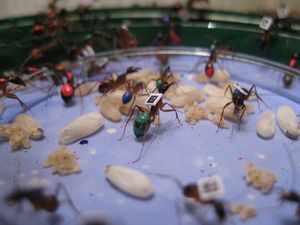
AntBecause all the workers in an ant colony look the same, tracking their movements and interactions by eye is fiendishly difficult. Instead, Danielle Mersch and her colleagues tagged every single worker in entire colonies and used a computer to track them, accumulating what they say is the largest-ever data set on ant interactions. The biologists, based at the University of Lausanne in Switzerland, have found that the workers fall into three social groups that perform different roles: nursing the queen and young; cleaning the colony; and foraging for food. The different groups move around different parts of the nest, and the insects tend to graduate from one group to another as they age, the researchers write in a paper published today in Science1.

The team reared six colonies of carpenter ants (Camponotus fellah) in the lab and tagged each worker with paper containing a unique barcode-like symbol. The colonies — each comprising more than 100 ants — lived in flat enclosures filmed by overhead cameras. A computer automatically recognized the tags and recorded each individual’s position twice per second (see video below). Over 41 days, the researchers collected more than 2.4 billion readings and documented 9.4 million interactions between the workers. The researchers found that around 40% of the workers were nurses, which almost always stayed with the queen and her brood. Another 30% were foragers, which gathered most of the colony’s food and were found near the entrance to the nest. The rest were cleaners, and these were more likely to visit the colony’s rubbish heaps. The workers move between jobs as they get older — nurses are generally younger than cleaners, which are younger than foragers. Honeybees go through similar transitions from young nurses to older foragers, but this study provides the clearest evidence yet that ants do the same.

More here.

Thursday, April 18, 2013

John le Carré Has Not Mellowed With Age

Mag-21lecarre-t_CA0-articleLarge

Dwight Garner in the NYT:

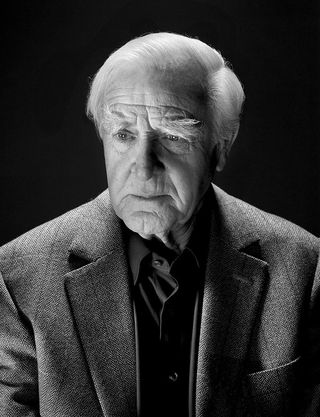
On a recent Saturday morning in February, two dozen or so scent hounds streamed through the streets of St. Buryan, a small village in Cornwall, England. Behind them drifted a loose formation of men and women perched atop well-groomed horses and wearing boots, breeches and hunting coats. As the fox hunt clopped through town, John le Carré, the pre-eminent spy writer of the 20th century, sipped from a paper cup of warm whiskey punch, doled out by a local pub to riders and spectators.

At 81, he remains an enviable specimen of humanity: tall, patrician, cleanlimbed, ruddy-complected. His white hair is floppy and well cut, so much so that the actor Ralph Fiennes, who starred in the 2005 film version of le Carré’s novel “The Constant Gardener,” badgered him for the name of his barber.

Le Carré is not a hunter himself, but he nodded at the people he knew and mounted a casual and running defense of fox hunting, as if he were doing color commentary from the 18th hole at the Masters. It’s an ancient part of the rural culture, he said. It’s egalitarian in this area (some 300 miles west-southwest of London), not an upper-class diversion. It’s also largely futile: an actual fox is rarely cornered. When one is, a trained eagle owl is brought in to kill it.

As the final horse strode past, le Carré swallowed the dregs of his punch and crumpled his cup. His eyebrows, so thatchy and animated that they seem ready to leap off his forehead and start nibbling the shrubbery, rose as he turned toward me, his blue eyes alight, and happily declared, “At least they aren’t hunting that poor goddamn thing with drones.”

Also see Emma Hogan in More Intelligent Life:

KEY DECISION

To use the jargon of spycraft. Smiley’s people are lamplighters, scalphunters and talent-spotters. Secretaries are “mothers”; spies on your side are “part of the family”. To be blackmailed is to be “burned”, a style of spying is “handwriting” and a failed mission is “being sent home in your socks”. Like boarding school, the secret service runs on nicknames and catchphrases. Le Carré’s skill stops this being irritating, and lets us join the club.

The Facts, the Myths and the Framing of Immigration: The Case of Britain

Malik_imm_468w

Kenan Malik in Eurozine:

At the heart of the current debate about immigration are two issues: the first is about the facts, the second about the public perception of immigration.

The facts are relatively straightforward. Immigration is a good thing and the idea that immigrants come to Britain to live off benefits laughable. Immigrants put more money into the economy than they take out and have a negligible impact on jobs and wages. An independent report on the impact of immigration commissioned by the Home Office in 2003, looked at numerous international surveys and conducted its own study in Britain. “The perception that immigrants take away jobs from the existing population, or that immigrants depress the wages of existing workers”, it concluded, “do not find confirmation in the analysis of the data laid out in this report”. More recent studies have suggested that immigration helps raise wages except at the bottom of the jobs ladder where it has a slight negative impact. That impact on low paid workers matters hugely, of course, but is arguably more an issue of labour organization than of immigration…

Whatever the truth about immigration, it is clear that there exists widespread popular hostility to immigrants. For some, often on the right, the hostility makes sense because, irrespective of its economic benefits, the social impact of immigration is destructive. For others, often on the left, such hostility exists because people are irrational and take little notice of facts and figures. Both arguments have little merit.

An Interview with Aleksandar Hemon

C201301VBChicago001_28-200x200

Rachel Dewoskin in Rumpus:

Rumpus: What about in terms of physical dislocation and geography? When you write about moving to the U.S. and assembling a street map in your mind, you say that borders are nonexistent in Sarajevo but in Chicago, they are designed to keep people safely apart. Is that a culture-shocked observation from when you were first here or an objective one about the nature of American cities in general?

Hemon: Chicago has very few public spaces where people are encouraged to get together. It’s partly to prevent riots, and also to segregate a city with a history of racial segregation. Giving people cars? It’s all under the pretense of giving everyone a lot of space. So circulation in the city is discouraged, at least functionally; the subway is designed to take people downtown to work and then back home. Bus lines, too. And whenever they cut services, they cut out the poor neighborhoods, which reinforces segregation even if it’s not cynical. Sarajevo and European cities are not designed the way Chicago is, like a grid. They tend to go out of the city center concentrically. So there was the sense of physical displacement, yes, and I needed to contend with that. So I assembled my domain.

Rumpus: Within that domain, what about personal interiority and exteriority? Do you have to blur those borders to write stories?

Hemon: When I was young, I was all about personal sovereignty and that junk, because there was no privacy and the available ideologies were collective, both socialism/communism and nationalism. And every agency—political and therefore, by extensions, all other agencies—were collective. And also I was young and this is what young people do when they want to assert themselves on the world. So I was all about individualism. Conan the Barbarian was one of my favorite movies. But only when I got here did I realize that I had overrated that kind of individualism and Conan the Barbarian was a proto-fascist in more than one way. In Sarajevo I thought I was inventing myself from scratch, but only once I was devoid of the network of the people and practices that are part of living in a city like that did I realize how much of my interiority and selfhood was really dependent—operated and actualized itself—upon that network of exchanges with other people. It’s about physical space but also just spending a lot of time with friends and family in your daily life.

Voices in the Wilderness: Chinese Online Literature

20130323_bkp510

In the Economist blog Prospero:

Internet writing has been nothing short of a revolution for Chinese literature. It has allowed myriad voices to be heard. The digital landscape and technology have changed since the first wave of authors began to write; readers in China now access novels through smartphones and tablets rather than desktops. Yet the internet remains the “single root” in China today to kick-start a career as a wordsmith, says Jo Lusby, managing director of Penguin China, a publishing house. “There are no authors under the age of 35 who were not discovered on the internet,” she adds.

Online literature sites have blossomed in the last decade. They provide a rich, and grassroots, alternative to the staid state-run publishing houses. While all books published in the mainland are subject to scrutiny by cautious editors and zealous censors, online literature sites are watched less carefully. They still operate behind the “great firewall”, China’s internet-filtering system which blocks sensitive words or topics, but the sheer volume of works produced, combined with the lack of editorial oversight, creates an important loophole.

On sites such as Rongshuxia visitors pay per instalment to read works. Authors, often posting and writing simultaneously, can gauge reader feedback and shift plots as they go. Innovative editors from China's burgeoning private publishing industry trawl through them to find the next big thing.

Merrrrdrrrre!

Pindar_1__338276h

It all began with the “classroom martyrdom” of one Félix-Frédéric Hébert (1832–1917), a physics teacher at the lycée in Rennes. Possessed of a large stomach, short legs and an air of bluff pomposity, Hébert was ragged mercilessly by his pupils. “What made him unique and inspired a plethora of ingenious inventions aimed at stirring him up”, recalled one, “was that we could look forward to beautiful tears, noble sobs and ceremonious supplications.” Two brothers, Charles and Henri Morin, began writing and illustrating a series of satirical sketches recounting the exploits of the ridiculous Père Hébert, and these stories were added to by other boys. The “Hébert cycle” consists of long poems, plays, mock newspapers and fantasy adventures, many exhibiting a protosurreal wit: “Appearance of P. H. – He was born complete with bowler hat, woollen cloak and check trousers. On top of his head is a single, extendible ear, usually covered by his hat; both his arms are on the same side (likewise his eyes) and, unlike humans, whose feet are situated next to each other, he has one behind the other, so that when he falls over he is unable to pick himself up without assistance and remains prostrated, shouting until someone helps him up.” When the fifteen-year-old Alfred Jarry arrived at the lycée in 1888 he was swiftly initiated into the cult of Père Hébert.

more from Ian Pindar at the TLS here.

an intense intellectual egotism swallows up everything

Wallace_stevens200-4ba615266326d0dab647dc7c712a288cdcc7e8da-s6-c10

Even among Stevens’ various practices, the structure of “The Motive for Metaphor” is peculiar. The first stanza coincides with two simple, parallel sentences. A third sentence is stretched out over the remainder of the poem, not because the syntax becomes complex—it doesn’t—but because one phrase is instructed to produce another by association, and that one to bring forward yet another by a similar device. The practice is common in Stevens, where a particular clause tends not to reach conclusion but to keep the discourse going by stirring a further association, an echo or a repetition—“Disguised pronunciamento, summary, / Autumn’s compendium . . .” His sentences tend not to be decisive, he is reluctant to concede that a poem has to end. We sometimes wonder is he a man without will—does he take pleasure in withholding himself, as if keeping a secret? If we go from reading Frost, say, who is always willful, to Stevens, who seems to write poems by letting phrases write themselves, we recall that in “The Creations of Sound” he said that “there are words / Better without an author, without a poet, /Or having a separate author, a different poet, / An accretion from ourselves, intelligent / Beyond intelligence, an artificial man / At a distance, a secondary expositor . . . .”[18] In “The Motive for Metaphor” the repetition of “the obscure moon” is labored, the momentum has to be started up again, until the appositive colon after “changes” is reached and the long sentence continues, specifying the nature of the desire. Even when Stevens designates something, the thing he designates is rarely allowed to speak for itself or to bring the sentence to an end; he must apply his commodious adjectives to every noun. It would be fair to say of Stevens’ poems what Hazlitt said of Wordsworth’s The Excursion, that “an intense intellectual egotism swallows up everything”…

more from Denis Donoghue at the Hudson Review here.

new amsterdam

130422_r23420_p465

The Stedelijk is still the most chaste of the world’s white-walled modern museums, even with its obligatory representations of frolicsome Pop, rugged postminimalist, and miscellaneous contemporary art. Intentionally or not, the new bathtub entrance hall’s suggestion of hygiene resonates. Finely proportioned, evenly lit rooms anticipate hushed contemplation of things that are hard put to merit it. Austere abstraction fares well. Big canvases by Barnett Newman, inflected only with the vertical divisions (not quite lines and not quite shapes) that he termed “zips,” look more brilliantly cogent at the Stedelijk than in any other setting, including New York’s Museum of Modern Art. Much of the rest of the work—most tellingly, the work since Andy Warhol—feels impatient with the sacred aura of the place. Physical imperfections glare. The collaged and slathered surfaces and vernacular objects (an umbrella, a mirror) in Robert Rauschenberg’s huge early “combine” painting “Charlene” (1954) come across now as less daring than decrepit. To the extent that the Stedelijk institutionalized the faith of modernism, it has come to incite heretical doubt. That being so—and not neglecting such glories as a room of seminal paintings by Willem de Kooning—it functions as a jittery barometer of present discontents.

more from Peter Schjeldahl at The New Yorker here.

Thursday Poem

I'm Working on the World
.

I'm working on the world,
revised, improved edition,
featuring fun for fools,
blues for brooders,
combs for bald pates,
tricks for old dogs.
.
Here's one chapter: The Speech
of Animals and Plants.
Each species comes, of course,
with its own dictionary.
Even a simple “Hi there,”
when traded with a fish,make
both the fish and you
feel quite extraordinary.
.
The long-suspected meanings
of rustlings, chirps, and growls!
Soliloquies of forests!
The epic hoot of owls!
Those crafty hedgehogs drafting
aphorisms after dark,
while we blindly believe
they are sleeping in the park!
.
Time (Chapter Two) retains
its sacred right to meddle
in each earthly affair.
Still, time's unbounded power
that makes a mountain crumble,
moves seas, rotates a star,
won't be enough to tear
lovers apart: they are
too naked, too embraced,
too much like timid sparrows.
.
Old age is, in my book,
the price that felons pay,
so don't whine that it's steep:
you'll stay young if you're good.
Suffering (Chapter Three)
doesn't insult the body.
Death? It comes in your sleep,
exactly as it should.
.
When it comes, you'll be dreaming
that you don't need to breathe;
that breathless silence is
the music of the dark
and it's part of the rhythm
to vanish like a spark.
Only a death like that. A rose
could prick you harder, I suppose;
you'd feel more terror at the sound
of petals falling to the ground.
.
Only a world like that. To die
just that much. And to live just so.
And all the rest is Bach's fugue, played
for the time being
on a saw.
.
by Wislawa Szymborska
from
Poems New and Collected
trans. by S. Baranczak and C. Cavanagh

Ayad Akhtar, winner of the 2013 Pulitzer Prize for Drama

From The Telegraph:

What a day to discover that you’ve won the Pulitzer Prize for Drama. Ayad Akhtar got the call from New York to tell him the surprise good news that he had been awarded one of the most prestigious accolades a playwright can get around the same time that reports started coming in about the bombings at the Boston marathon. Currently staying in London to be on hand for the UK premiere of the winning work, Disgraced, at the Bush next month, he felt, he reveals, “really odd receiving email after email congratulating me when the BBC was showing the sad events in Boston. In an eerie way, though,” he continues, “it’s very much the world the play comes from and points to.” First produced in Chicago last year, before a successful run at the Lincoln Center, Disgraced centres on a successful corporate lawyer — Amir Kapoor — who, together with his artist wife, hosts a dinner party at their swish Upper East Side apartment that escalates from amicable chit-chat into something far more perturbing and confrontational. The New York Times review praised it as “a continuously engaging, vitally engaged play about thorny questions of identity and religion in the contemporary world, with an accent on the incendiary topic of how radical Islam and the terrorism it inspires have affected the public discourse. In dialogue that bristles with wit and intelligence, Mr Akhtar, a novelist and screenwriter, puts contemporary attitudes toward religion under a microscope, revealing how tenuous self-image can be for people born into one way of being who have embraced another.”

…Articulate and easygoing, he’s still digesting the good news — “At first I thought it was a crank call” — and doesn’t yet know what it might mean for his career. “I suspect it means people will take my work more seriously. I’ve spent a long time peddling my wares and trying to get people to take note; hopefully this will make it that much easier,” he says. However much, or little, tangible benefit will accrue, he adds with amusement that he came across an article in Variety “saying the only thing guaranteed for sure if you win the Pulitzer Prize for Drama is a New York Times obituary. I thought that was funny.”

More here.

Why some stress is good for you

From Kurzweil:

StressUC Berkeley researchers have uncovered exactly how acute stress — short-lived, not chronic — primes the brain for improved performance. In studies on rats, Daniela Kaufer, associate professor of integrative biology at the University of California, Berkeley and post-doctoral fellow Elizabeth Kirby they found that significant but brief stressful events caused stem cells in rat brains to proliferate into new nerve cells that, when mature two weeks later, improved the rats’ mental performance. “I think intermittent stressful events are probably what keeps the brain more alert, and you perform better when you are alert,” said Kaufer. Kaufer is especially interested in how both acute and chronic stress affect memory, and since the brain’s hippocampus is critical to memory, she and her colleagues focused on the effects of stress on neural stem cells in the hippocampus of the adult rat brain. Neural stem cells are a sort of generic or progenitor brain cell that, depending on chemical triggers, can mature into neurons, astrocytes or other cells in the brain.

…What exactly is “good” stress?

Kaufer noted that exposure to acute, intense stress can sometimes be harmful, leading, for example, to post-traumatic stress disorder. Further research could help to identify the factors that determine whether a response to stress is good or bad. “I think the ultimate message is an optimistic one,” she concluded. “Stress can be something that makes you better, but it is a question of how much, how long and how you interpret or perceive it.”

More here.

Wednesday, April 17, 2013

Crossing the Line

Daf_yomi_041513__620px

Adam Kirsch in Tablet:

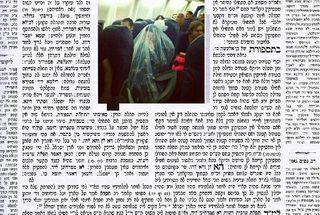
It’s not often that the subject of the weekly Daf Yomireading makes headlines in the blogosphere. But last week, the web—especially its Jewish corners—was buzzing over a bizarre photograph of an Orthodox Jewish man on an airplane, completely wrapped in a plastic bag. Many commenters on the photo assumed this had something to do with sexual purity or avoiding women, but in fact, as knowledgeable readers pointed out, it actually involved another taboo entirely.

The man must have been a Kohen, a member of the priestly class, and Kohanim are prohibited from coming into contact with corpses. Passing over a cemetery—even, in this case, at 30,000 feet—qualifies as such a contact. By wrapping himself in plastic, the man in question must have been guarding himself against that kind of impurity or tumah. Since most Orthodox Jews, even Kohanim, do not regularly fly in plastic, it’s clear that the man in the photo was adopting a minority position about what’s required to avoid contamination. (I’d be glad to hear from knowledgeable commenters about the law on this issue.)

As it turned out, just this question—how a Kohen can travel through a cemetery—was addressed in the Talmud last week, in Eruvin 30b. The issue arose in connection with the tractate’s ongoing discussion of eruvei techumin, the extension of Shabbat boundaries. As I wrote in my last column, the techum or boundary for walking on Shabbat is 2,000 amot, around 2/3 of a mile. But the place from which this circumference is measured can be shifted, by establishing a Shabbat residence at a different location from the one you actually occupy. To do this, you must deposit food at the spot of your Shabbat residence; and the third chapter of Eruvin has been dedicated to the technicalities of this process.