On Szymborska

Simic_1-122211_jpg_470x926_q85

What does the poetry of Szymborska, marked as it is by such a lightness of touch, skeptically smiling, playful, have to do with the history of the twentieth, or any other, century? In its beginnings, it had much to do with it, but its mature phase moves away from images of linear time rushing toward utopia or an apocalyptic catastrophe, as the just-ending century liked to believe. Her dimension is personal, of one person who reflects on the human condition. It is true that her reflection goes together with a remarkable reticence, as if the poet found herself on a stage with the decor for a preceding play, a play which changed the individual into nothing, an anonymous cipher, and in such circumstances to talk about oneself is not indicated. Szymborska’s poems explore private situations, yet they are sufficiently generalized, so that she is able to avoid confessions. In her well-known poem about a cat in an empty apartment, instead of complaint about the loss of the husband of a friend, we hear: “To die/one does not do that to a cat.”

more from Czeslaw Milosz’s 1996 essay at the NYRB here.

Beware Dinner Talk on Identity and Islam

Charles Isherwood in the New York Times:

ScreenHunter_171 Apr. 26 14.10Watching the fierce clash over the salad course during a dinner party in “Disgraced,” the rollicking new play by Ayad Akhtar, feels at times like observing a hotly contested game of Twister. As two couples exchange observations about faith and politics in the modern world, the intellectual thickets they find themselves in become increasingly tangled. The language grows more testy, tempers begin to flare, and you have the unsettling sense that someone is going to lose his or her balance and take a hard fall. You’re just not sure who it’s going to be.

The players are a quartet of accomplished New Yorkers of differing races, creeds and, yes, colors, although they have all arrived at the same high plateau of worldly achievement and can agree on the important things, like the tastiness of the fennel and anchovy salad and the banana pudding from Magnolia Bakery. What they cannot agree on — and what will ultimately tear apart at least one of the relationships in the play — is who they really are and what they stand for, once the veneer of civilized achievement has been scraped away to reveal more atavistic urges.

“Disgraced,” which opened on Monday night at Lincoln Center’s Claire Tow Theater in a sleek production directed by Kimberly Senior, is a continuously engaging, vitally engaged play about thorny questions of identity and religion in the contemporary world, with an accent on the incendiary topic of how radical Islam and the terrorism it inspires have affected the public discourse. In dialogue that bristles with wit and intelligence, Mr. Akhtar, a novelist and screenwriter, puts contemporary attitudes toward religion under a microscope, revealing how tenuous self-image can be for people born into one way of being who have embraced another.

More here.

Why Does the Higgs Particle Matter?

Frank Wilczek in Big Questions Online:

Templeton-higgs_0The first inkling of its existence came in the 1960s. By that time physicists had devised especially beautiful equations for describing elementary particles with zero mass. Nature likes those equations, too. The photons responsible for electromagnetism, the gravitons responsible for gravity, and the color gluons responsible for the strong force are all zero mass particles. Electromagnetism, gravity, and the strong force are three of the four fundamental interactions known to physics. The other is the weak force.

A problem arose, however, for the W and Z bosons, which are responsible for the weak force. Though they have many properties in common with photons and color gluons, W and Z bosons have non-zero mass. So it appeared that one could not use the beautiful equations for zero mass particles to describe them. The situation grew desperate: The equations for particles with the properties of W and Z, when forced to accommodate non-zero mass, led to mathematical inconsistencies.

The right kind of cosmic medium could rescue the situation, however. Such a medium could slow down the motion of W and Z particles, and make them appear to have non-zero mass, even though their fundamental mass––that is, the mass they would exhibit in ideally empty space––is zero. Using that idea, theorists built a wonderfully successful account of all the phenomena of the weak interaction, fully worthy to stand beside our successful theories of the electromagnetic, strong, and gravitational interactions. Our laws of fundamental physics reached a qualitatively new level of completeness and economy.

More here.

Randa Jarrar: A Sailor

A very short story by Randa Jarrar in Guernica:

ScreenHunter_170 Apr. 26 14.00She fucks a Sailor, a Turkish sailor, the summer she spends in Istanbul. When she comes home to Wisconsin, it takes her three days to come clean about it to her husband.

He says this doesn’t bother him, and she tells him that it bothers her that it doesn’t bother him. He asks if she prefers him to be the kind of man who is bothered by fleeting moments, and she tells him that yes, she prefers that he be that kind of man. He tells her he thinks she married him because he is precisely the kind of man who doesn’t dwell on fleeting moments, because he is the kind of man who does not hold a grudge. She tells him that holding a grudge and working up some anger about one’s wife fucking a sailor is not the same thing. He agrees that holding a grudge isn’t the same as working up some anger about one’s wife fucking a sailor, but, he adds, one’s wife, specifically his own, would never leave him for a sailor, and not a Turkish sailor. In fact, he says, she did not leave him for the Turkish sailor. She is here. So why should he be angry?

Now, she becomes angry, and asks him why he assumes she did not consider leaving him for the sailor. Besides, she says, she and the sailor shared a Muslim cultural identity, something she does not share with her husband. She asks him if he thought of that.

He says he had not thought of it, and that even if she had considered leaving him for the Turkish sailor, she must have decided not to.

More here.

Friday Poem

The Conductor

There's no mention, of course, in the program
that the conductor has Parkinson's.
He enters the stage, stands for a moment
facing the audience,
his hands by his sides, tapping air.
Then he holds them together, an act of gratitude
—we are gathered, we can do this—
and of firmness, each hand forcing
the other to be still.
His expression, darkly bemused,
the good news/bad news:
I've lived long enough to lose so much.
Or maybe he's staving off our sympathy,
don't clap because of this.
Then he turns his back to us, begins his work.
Mendelssohn's Scottish Symphony.
No baton, and from behind
his body is jerky as a boy's,
jumpy with excitement.
His hands shake when they scoop
the sections of the orchestra,
as though pulling a weighted net
from the sea. Still, I wonder if this work
is easier than taking on the ordinary
objects of a day—
buttons, keys, and pens.
I am an old man
he must think when he looks
in the mirror,
briefly naked before trading
the bathrobe for the tie and tails.
And when he turns to us again
after the last movement, he looks both
old and young, his face washed
of the expression in the program photograph,
clearly taken years before,
one eyebrow slightly raised,
his smile more satisfied than happy.
Now he shows us his innocence,
if innocence is what the face
unconstructed can be called.
What else can he do,
while his fingers tap their useless code,
while the audience, in rows, rises from their seats,
still clapping, what can he do
but show us who he is,
a man standing too close to the edge,
edge no one can call him back from.
.

by by Jacqueline Berger
from The Gift That Arrives Broken
Autumn House Press, 2010.

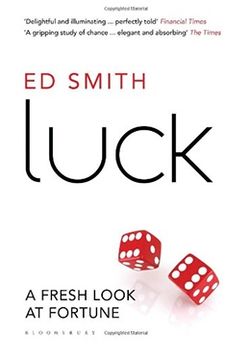
success takes more than hard work – it can simply come down to chance

From Guardian:

BookIn Tom Campbell's pleasing novel Fold there's a character who is fond of the aspirational sporting slogan most often attributed to Gary Player: “The more I practice, the luckier I get.” It is one of the more dispiriting slogans of our times (and indeed, the character who lives by it is a most unpleasant person); we also have Malcolm Gladwell's Outliers, whose core message is that the more work you put into something, the more successful you'll be. This may sound like a statement of the obvious. But there is more to success than hard work and application, and we should be grateful to Ed Smith for pointing it out in this brief but elegant and resonant book.

Smith's first career was as a cricketer; he applied himself, we learn here, to becoming the best. It was as if he had inhaled Gladwell's book before it had even been written. From the age of four, by his account, he would spend hours in front of the television, watching his hero, Geoffrey Boycott. For those who know little or nothing of cricket, Boycott was an unlikely hero for a child: a batsman who would devote himself single-mindedly to amassing his own score through the application of dry and rigorous technique. Smith could spend hours studying his technique because Boycott stayed in for hours, often to the exasperation even of his team-mates. No bars at cricket grounds ever emptied when the news went round that Boycott had arrived at the crease. He was the archetypal sporting figure who refused to believe in luck. It was all down to technique. Smith's technique was good enough for him to get picked for England. But after a promising start, he never flourished, and was dropped after only a few games, his final innings closing thanks to a poor umpiring decision. Five years later, he broke his ankle in a freak accident (his physios didn't realise it was broken for some time, and the punishing regime of exercise they imposed makes for uncomfortable reading) and had time to think about the luck he had hitherto disdained.

More here.

Humans are not the only copycats

From Nature:

CatBirds of a feather may flock together, but do birds that flock together develop distinct cultures? Two studies published today in Science1, 2 find strong evidence that, at the very least, monkeys that troop together and whales that pod together do just that. And they manage it in the same way that humans do: by copying and learning from each other. A team led by Erica van de Waal, a primate psychologist at the University of St Andrews, UK, created two distinct cultures — 'blue' and 'pink' — among groups of wild vervet monkeys (Chlorocebus aethiops) in South Africa1. The researchers trained two sets of monkeys to eat maize (corn) dyed one of those two colours but eschew maize dyed the other colour. The scientists then waited to see how the groups behaved when newcomers — babies and migrating males — arrived.

Both sets of newcomers seemed to follow social cues when selecting their snacks. Baby monkeys ate the same colour maize as their mothers. Seven of the ten males that migrated from one colour culture to another adopted the local colour preference the first time that they ate any maize. The trend was even stronger when they first fed with no higher-ranking monkey around, with nine of the ten males choosing the locally preferred variety. The only immigrant to buck this trend was a monkey who assumed the top rank in his new group as soon as he got there — and he may not have given a fig what anyone else ate. “The take-home message is that social learning — learning from others rather than through individual trial and error — is a more potent force in shaping wild animals’ behaviour than has been recognized so far,” says Andrew Whiten, an evolutionary and developmental psychologist at St Andrews and co-author of the paper.

More here.

Against the Seriousness of Theology

468px-SummaTheologiae

Via Andrew Sullivan, Razib Khan over at Gene Expression (image from Wikimedia Commons):

Though I have always been skeptical of God, and an explicit and self-conscious atheist from childhood on, I found religious beliefs peculiar and difficult to comprehend in any intuitive sense. This led me early on to reading the source texts and scriptures, as well as theological commentaries (e.g., Summa Theologica, and I’ve read the whole of the Hebrew Bible and New Testament multiple times, and Genesis dozens). In this way I felt I understood on some deep level why people were religious.But I was wrong. When I read Scott Atran’s In Gods We Trust it opened up a whole landscape of cognitive anthropology which explained with much greater accuracy the paradoxes of religious belief and behavior with which I was confronted. The key insight of cognitive scientists is that for the vast majority of human beings religion is about psychological intuition and social identification, and not theology. A deductive theory of religion derived from axioms of creed fails in large part because there is no evidence that the vast majority of religious believers have internalized the sophisticated aspects of their theologies and scriptures in any deep and substantive sense. To give a concrete example, Sri Lankan Buddhists, Hindus, and Muslims can give explicit explanations to at least a rudimentary level as to the differences of their respective religious beliefs. But when prompted to explain their understanding of the supernatural in a manner which was unscripted, and which was not amenable to a fall back upon indoctrinated verbal formulas, their conceptions of god(s) were fundamentally the same! (see: Theological Incorrectness). The superficiality of theological system building is also evident in the fact that when confronted with radicalism derived from the logic of shared axioms during the Reformation prominent Protestant thinkers fell back upon tradition and revelation to defend the common creeds inherited from the early Roman church.

And that is why one should always been cautious of taking theology, textual analysis, and intellectualism too seriously when it comes to religion. Mathematicians can derive proofs from logical analysis. Those proofs are invariant across individuals and subcultures. They are true in a fundamental sense. Though natural science attempts to validate and refine theories and formal models which are robust, it fails when there is no empirical check upon the model building.Outside of pure math our powers of ratiocination are overwhelmed by subjective decisions along the chain of propositions. Separate theologians and have them derive from first principles, and there will be no similarity in their final inferences about the nature of God and the universe. Elite theological conformity is a function of social conformity, not the power of intellectual rigor. When isolation is imposed upon a community of religious believers for any given period of time they are almost always defined by a rapid shift toward heterodoxy, as they lose contact with the broader elite consensus (see: Dao of Muhammad as an example of how strongly an alien milieu can totally transform a familiar religious group unless that subculture remains in contact with the broader community).

Theology is not a cause of any great robustness on the macro scale. Nor does it explain much of micro scale behavior. Where does that leave us to be “serious” about religion? As Noah Millman stated it requires a deep program of empirical analysis and research of massive multi-disciplinary scope. Almost no one is interested in such a program from what I have seen.

Thursday, April 25, 2013

Governments Now Answer to Business. Mainstream Parties Grow ever Harder to Distinguish. Is Democracy Dead?

Child-elections-italy

Henry Farrell in Aeon Magazine:

Last September, Il Partito Democratico, the Italian Democratic Party, asked me to talk about politics and the internet at its summer school in Cortona. Political summer schools are usually pleasant — Cortona is a medieval Tuscan hill town with excellent restaurants — and unexciting. Academics and public intellectuals give talks organised loosely around a theme; in this case, the challenges of ‘communication and democracy’. Young party activists politely listen to our speeches while they wait to do the real business of politics, between sessions and at the evening meals.

This year was different. The Italian Democratic Party, which dominates the country’s left-of-centre politics, knew that it was in trouble. A flamboyant blogger and former comedian named Beppe Grillo had turned his celebrity into an online political force, Il Movimento 5 Stelle (the Five Star Movement), which promised to do well in the national elections. The new party didn’t have any coherent plan beyond sweeping out Old Corruption, but that was enough to bring out the crowds. The Five Star Movement was particularly good at attracting young idealists, the kind of voters who might have been Democrats a decade before.

Worries about this threat spilt over into the summer school. The relationship between communication and democracy suddenly had urgent political implications. The Democratic Party had spent two decades suffering under the former prime minister Silvio Berlusconi’s stranglehold on traditional media. Now it found itself challenged on the left too, by internet-fuelled populists who seemed to be sucking attention and energy away from it.

On Being Brown in America

25-kal-penn-IndiaInk-articleInline

Amitava Kumar in the NYT's India Ink:

The recent bombings in Boston threw up many questions. One of the most pressing, in my somewhat narrow view, is the meaning of being brown in America.

On April 17, two days after the bombs went off during the Boston Marathon, killing three people and injuring almost 200 others, CNN’s John King went on air to say that the suspect was a “dark-skinned male.” In the CNN video, which shows that the time of the broadcast was 1.15 p.m. on Wednesday, we see King pointing to a photograph from the front-page of The New York Times. A positive identification had been made based on a surveillance video from a Lord & Taylor store just outside the frame of the picture in the Times, King said. A little later that afternoon, King would go on to assure viewers that a subsequent arrest had been made.

No one had been arrested that day, of course, and, alas, there was no dark-skinned male. What is remarkable is that even while first reporting his piece of “exclusive” news, CNN’s King felt it necessary to qualify what he was saying. The qualifications he offered were not about the haste with which he was sharing a piece of misinformation, or the bewildering lack of specificity in his description, or even the absence of adequate verification. Instead, his remarks appeared to suggest to his viewers that he couldn’t be more open with them because of politically correct sentiments that complicated open disclosures of “game changers” that the police had uncovered:

“I was told they have a breakthrough in the identification of the suspect, and I’m told — and I want to be very careful about this because people get very sensitive when you say these things — I was told by one of these sources who’s a law enforcement official that this was a dark-skinned male… The official used some other words. I’m not going to repeat them until we get more information because of the sensitivities. There are some people who will take offense even in saying that.”

Some people! Who are they?

spark on shelley

Muriel-Spark_339666h

I n 1950 the thirty-two-year-old tyro poet Muriel Spark drew up a proposal for a “Critical Biography” of Mary Shelley. The project was never going to be easy to sell to publishers. Spark was virtually unknown outside the London poetry scene and, in any case, there was little interest in female novelists of the nineteenth century. Mary Shelley was remembered mostly for having run away with Percy Bysshe Shelley while he was still married to his first wife. Although Frankenstein, Mary Shelley’s first novel, had subsequently become familiar through its many theatre and film adaptations, as a piece of literature it was considered a freakish fairy tale written by an eighteen-year-old who scarcely knew what she was doing. As for the novels Mary Shelley went on to write following Percy’s death in 1822, it was probably best to draw a veil. Nonetheless, Muriel Spark’s determination to rescue Mary Shelley from cultural amnesia and condescension was sufficiently persuasive to win her a commission from a small publisher. The original publication of Child of Light: A reassessment of Mary Shelley was timed to coincide with the centenary of Shelly’s death in 1951, but Spark tinkered with her text over the following decades to take account of emerging scholarship, eventually republishing the biography in 1987 with a new preface.

more from Kathryn Hughes at the TLS here.

evolutionary psychology still bunk

051254606.a4ze7nq0zxckskwokk80gkk0s.arl05jts5oo48sc08go8okk48.th

But the suspicion that something is amiss will not dissipate. It comes into focus when Pinker, at the end of his New York Times Magazine article, makes the inevitable pitch for “how all this can be useful to us going forward.” In a section called “Doing Better by Knowing Ourselves,” he breaks with the rigorous Hume and tries to rescue “moral reasoning” from the insignificance to which moral sense theory consigned it.12 He speaks of how salutary it would be if we all recognized that opponents in political debates share a moral foundation. But then, as he presses his point home, stressing that the moral sense is as subject to illusions as the other senses, cracks appear in the veneer of sprightly optimism. We get a glimpse of the modules he favors when he describes these illusions as “apt to confuse morality per se with purity, status and conformity.”13 What happened to Harm and Fairness? Could it be that he actually believes that “morality per se” is to be found in the vicinity of those modules? And what to make of the penultimate gesture: “our habit of moralizing problems, merging them with intuitions of purity and contamination, and resting content when we feel the right feelings, can get in the way of doing the right thing.”14 “Doing the right thing”? “Morality per se”? Moore would take much pleasure in these maneuvers. No matter how advanced the natural science—the naturalistic fallacy—the assumption that something is morally good because it is natural—is philosophically secure. This fallacy is exposed when any definition of good offered by an ethical naturalist is subjected to a particular linguistic test. For example, when hedonism tries to define good by claiming that “pleasure is good,” the sentence itself is obviously saying something other than “pleasure is pleasure.” The two sentences are not synonymous, therefore good and pleasure are not identical.

more from Thomas de Zengotita at The Hedgehog Review here.

mila 18

220px-Mila18

More recently, literary critic Adam Kirsch identified Uris’s writerly flaw as his disproportionate focus on Jewish toughness, which “becomes something monomaniacal and amoral—an obsession with proving that Jews can and will use violence.” Yet for better or worse, it is precisely this quality in Uris’s work that has fundamentally influenced American Jewish identity. “Suddenly for us there was this new Jewish way of thinking,” filmmaker Harvey Weinstein once reflected on reading Uris as a boy. “Instead of growing up to be a professor, a lawyer or a doctor, you could grow up to be a soldier, you know, for your people. You can be tough. You can be John Wayne, too.” When Uris published Exodus—his 1959 blockbuster about the founding of the State of Israel, which sold over seven million copies in the US—the state’s first prime minister David Ben-Gurion remarked archly: “As a literary work it isn’t much. But as a piece of propaganda, it’s the best thing ever written about Israel.” In 2008, Barack Obama told Atlantic writer Jeffrey Goldberg that Uris was one of the Jewish writers “who helped shape my sensibility”—namedropping Uris being “a kind of code Jews readily understand,” thought Goldberg.

more from Emma Garman at Bookforum here.

the Common Core Reading Standards

Karen Swallow Prior in The Atlantic:

This English professor thinks the program's approach to reading could fix the problems she sees among her college students.

AtAbout ten years ago, I started requiring the students in my general education English classes at the university where I teach (primarily freshmen and sophomores not majoring in English) to sign a “contract” during the first week of the class. They must agree, among other things, to obtain the required textbook and bring it to each class. It might seem odd that in a college class I would have to make such expectations so explicit. But in the past decade or so, I have found that students are seldom if ever held accountable for or even actually expected to read the assigned texts. Years of their so-called “reading” is spent “making connections” between themselves and text or the world and the text, but the foundational step of actually reading the words on the page is neglected often to the point that actually reading the assignment isn't necessary: Students become skilled at responding to leading questions that solicit merely their opinions or experiences. And they apparently get decent, or even excellent, grades for doing so.

Getting my college students to own and use a literary text hasn't been the only challenge. I have found that, increasingly, I have to teach students to read, actually read, the words on the page in order to be able to answer simple questions about the text. I have to train them to look down at the words rather than looking at me or up at the ceiling or into their hearts in order to comprehend the meaning of the language. I have to remind them to cite passages as evidence when they answer questions, something more and more of them are unaccustomed to doing. I have to exhort them to use dictionaries to look up words they don't know because the approach to “reading” they are so familiar with does not depend on knowing the meanings of words. Instead, they have been expected merely to offer “reader-response” answers to questions that prompt readers to react superficially to the text rather than to comprehend it. This subjective approach emphasizes loose, personal reactions to texts and interpretations that can not always be supported the text itself. So, for example, when I teach William Blake's poem, “The Tyger,” many of my students are erroneously convinced, based on reader-response style impressions, that the tiger in the poem is a “symbol of evil” when nothing in the text offers such evidence. A colleague of mine recently had a class of students insist with no textual support that Samuel Becket's 1953 existential drama, Waiting for Godot, is about gay marriage. Even English majors, I'm finding, rely more and more on Spark Notes summaries because years of lively classroom debates about vague literary themes have overtaken attention to how authors create worlds through language.

More here.

Antibody that Transforms Bone Marrow Stem Cells Directly into Brain Cells

From Scripps Research Institute:

In a serendipitous discovery, scientists at The Scripps Research Institute (TSRI) have found a way to turn bone marrow stem cells directly into brain cells. Current techniques for turning patients’ marrow cells into cells of some other desired type are relatively cumbersome, risky and effectively confined to the lab dish. The new finding points to the possibility of simpler and safer techniques. Cell therapies derived from patients’ own cells are widely expected to be useful in treating spinal cord injuries, strokes and other conditions throughout the body, with little or no risk of immune rejection. “These results highlight the potential of antibodies as versatile manipulators of cellular functions,” said Richard A. Lerner, the Lita Annenberg Hazen Professor of Immunochemistry and institute professor in the Department of Cell and Molecular Biology at TSRI, and principal investigator for the new study. “This is a far cry from the way antibodies used to be thought of—as molecules that were selected simply for binding and not function.”

The researchers discovered the method, reported in the online Early Edition of the Proceedings of the National Academy of Sciences the week of April 22, 2013, while looking for lab-grown antibodies that can activate a growth-stimulating receptor on marrow cells. One antibody turned out to activate the receptor in a way that induces marrow stem cells—which normally develop into white blood cells—to become neural progenitor cells, a type of almost-mature brain cell.

More here.

Thursday Poem

The Traveler

I

Among the quiet people of the frost,
I remember an Eskimo
walking one evening
on the road to Fairbanks.

II

A lamp full of shadows burned
on the table before us;
the light came as though from far off
through the yellow skin of a tent.

III

Thousands of years passed.
People were camped on the bank
of a river, drying fish
in the sun. Women bent over
stretched hides, scraping
in a kind of furry patience.

There were long hunts through
the wet autumn grass,
meat piled high in caches –
a red memory against whiteness.

IV

We were away for a long time.
The footsteps of a man walking alone
on the frozen road from Asia
crunched in the darkness
and were gone.

by John Haines
from The Owl in the Mask of the Dreamer
Graywolf Press, 1993