Israel’s Fraying Image

Netanyahu_and_obama_shake_pdJacob Heilbrunn in The National Interest:

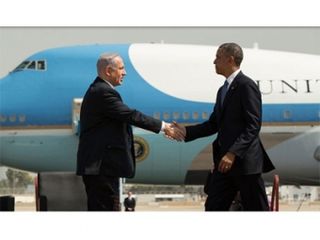
When the American Israel Public Affairs Committee (AIPAC) holds its annual spring meeting in Washington, DC, the organization takes elaborate measures to present a portrait of overwhelming political clout. Huge video screens featuring footage on Israel’s geopolitical perils, thousands of attendees, rousing speeches, a steady stream of Democratic and Republican politicians proclaiming their undying fealty to Israel—all are meant to suggest an irrepressible organization on a roll. This year, as in previous ones, Iran was the dominant topic. “Words alone will not stop Iran,” Israeli prime minister Benjamin Netanyahu told the conference by satellite. “Sanctions alone will not stop Iran.” He then admonished his American audience: “Sanctions must be coupled with a clear and credible military threat if diplomacy and sanctions fail.” At the same time, Senator John McCain excoriated the Obama administration for not being sufficiently friendly toward the Jewish state, while Vice President Joe Biden sought to assuage lingering unease about the administration’s stance by declaring that Obama is “not bluffing” when he threatens Iran with military action to forestall its nuclear-weapons development.

But, as AIPAC once again tried ostentatiously to display its influence, distant drumbeats raised new questions about America’s relationship with the Jewish state—and whether AIPAC’s influence is perhaps not always exercised strictly in Israel’s or America’s interest.

More here.

IBM Solar Collector Harnesses the Power of 2,000 Suns

Morgana Matus in Inhabitat:

Ibm-hcpvt-edit-537x379A team of IBM researchers is working on a solar concentrating dish that will be able to collect 80% of incoming sunlight and convert it to useful energy. The High Concentration Photovoltaic Thermal system will be able to concentrate the power of 2,000 suns while delivering fresh water and cool air wherever it is built. As an added bonus, IBM states that the system would be just one third the cost third of current comparable technologies.

Based on information by Greenpeace International and the European Electricity Association, IBM claims that it would require only two percent of the Sahara’s total area to supply the world’s energy needs. The HCPVT system is designed around a huge parabolic dish covered in mirror facets. The dish is supported and controlled by a tracking system that moves along with the sun. Sun rays reflect off of the mirror into receivers containing triple junction photovoltaic chips, each able to convert 200-250 watts over eight hours. Combined hundred of the chips provide 25 kilowatts of electricity.

The entire dish is cooled with liquids that are 10 times more effective than passive air methods, keeping the HCPVT safe to operate at a concentration of 2,000 times on average, and up to 5,000 times the power of the sun. The direct cooling technique is inspired by the branched blood supply system of the human body and has already been used to cool high performance computers like the Aquasar. The system will also be able to create fresh water by passing 90 degree Celsius liquid through a distillation system that vaporizes and desalinates up to 40 liters each day while still generating electricity. It will also be able to amazingly offer air conditioning by a thermal drive absorption chiller that converts heat through silica gel.

More here.

Our Feelings About Inequality: It’s Complicated

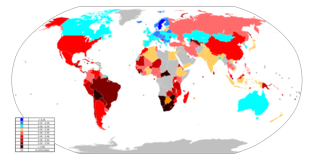
Gini_Coefficient_World_CIA_Report_2009

Ilyana Kuziemko and Stefanie Stantcheva in the NYT (image from Wikimedia Commons):

How much do Americans care about rising income inequality? Surveys send mixed signals.

In a poll released last year by the Pew Research Center, two-thirds of Americans agreed that there were “strong conflicts between the rich and poor” — up substantially from when the question was asked in 2009 — but in a Gallup poll taken at the height of Occupy Wall Street, in the fall of 2011, reducing the income and wealth gap was low on respondents’ list of priorities for government action.

It seems like a paradox: Americans are increasingly worried about the gap between rich and poor, but are hesitant to have the government do anything about it.

An experiment we conducted, described in more detail below, may help explain the contradiction. Americans who were given more information about rising inequality expressed significant concern about the problem, but that concern did not always translate into greater support for redistributive policies. Our work identified a possible explanation for this seeming disconnect, and it is a sad one: the more people focused on inequality, the less they trusted the government.

How much Americans care about income inequality and the extent to which they want the government to address it are two distinct questions that are often conflated. Democrats and Republicans agree that America faces a long-run fiscal imbalance that in the coming decades will most likely require cutting social services, raising taxes or both — policies that directly influence income distribution. Who will bear the brunt of this rebalancing will depend on whether the government uses tax and other policies to counteract rising income inequality with greater redistribution.

Since the 1970s, income inequality in the United States has increased at a historic rate. In 1970, the richest 1 percent of Americans enjoyed 9 percent of total national pre-tax income. In 2011, by contrast, that share had risen to 19.8 percent. And this large increase in inequality has not been softened by more progressive tax policy. Tax rates on the top 1 percent of taxpayers have fallen over the same period.

US Out of VT

Vermount_1_low-400x0

Vermont is also home to a vibrant movement of people who, like Doughty, want to secede from the United States of America. Though they hold a wide range of political views, Vermont’s secessionists seem to agree that the country—“the empire,” as some call it—is overactive in world affairs and incompetent in curing its own ailments, with a democratic process largely meaningless to citizens. Their solution? Expel the rest of the States from their own borders. They even have T-shirts that say so: “US Out of VT.” Vermont has a long history of freewheeling politics. It entered the War of 1812 only reluctantly, and many residents illegally continued to sell goods and livestock to British Canada. Vermont was the first state to outlaw slavery, and it refused to enforce the Fugitive Slave Act. Later, it became a haven for hippies in the 1960s and 1970s, especially those following the “back to the land” movement.

more from Kelly Ebbels at maisonneuve here.

the new noah

130429_r23448_p465

Noah Baumbach, the writer and director, has been more willing than most to think of his films of the past decade—about disappointment, broken families, dying pets—as comedies. When “Greenberg” opened, in 2010, the spectacle of Ben Stiller as a sour, haunted man—an asshole in a down vest—was so off-putting, to some people, that one cinema posted a sign reading, “We must limit refunds to an hour past the start time.” A few years earlier, during a panel that followed a screening of “Margot at the Wedding,” an audience member compared Nicole Kidman’s character, a self-involved fiction writer, to Hitler’s mother. Baumbach recently told me that in 2005, when he began previewing “The Squid and the Whale,” which is based on memories of his parents’ divorce, he was “expecting more laughs.” He also recalled that, while showing the film to his mother, he began sobbing and had to leave the screening room. Not long ago, at dusk, Baumbach was in an elegant old café in Berlin, having a jet-lagged late lunch with Greta Gerwig, the actress, before a festival screening of “Frances Ha,” his new film.

more from Ian Parker at The New Yorker here.

the real marx

Gray_1-050913_jpg_230x1438_q85

The renewed popularity of Marx is an accident of history. If World War I had not occurred and caused the collapse of tsarism, if the Whites had prevailed in the Russian Civil War as Lenin at times feared they would and the Bolshevik leader had not been able to seize and retain his hold on power, or if any one of innumerable events had not happened as they did, Marx would now be a name most educated people struggled to remember. As it is we are left with Marx’s errors and confusions. Marx understood the anarchic vitality of capitalism earlier and better than probably anyone else. But the vision of the future he imbibed from positivism, and shared with the other Victorian prophet he faces in Highgate Cemetery, in which industrial societies stand on the brink of a scientific civilization in which the religions and conflicts of the past will fade way, is rationally groundless—a myth that, like the idea that Marx wanted to dedicate his major work to Darwin, has been exploded many times but seems to be ineradicable. No doubt the belief that humankind is evolving toward a more harmonious condition affords comfort to many; but we would be better prepared to deal with our conflicts if we could put Marx’s view of history behind us, along with his nineteenth-century faith in the possibility of a society different from any that has ever existed.

more from John Gray at the NYRB here.

Wednesday Poem

9

When one has lived a long time alone,
and the hermit thrush calls and there is an answer,
and the bullfrog head half out of water utters
the cantillations he sang in his first spring,
and the snake lowers himself over the threshold
and creeps away among the stones, one sees
they all live to mate with their kind, and one knows,
after a long time of solitude, after the many steps taken
away from one's kind, toward these other kingdoms,
the hard prayer inside one's own singing
is to come back, if one can, to one's own,
a world almost lost, in the exile that deepens,
when one has lived a long time alone.

by Galway Kinnell
from New Selected Poems: Galway Kinnell
publisher, Houghton Mifflin

What Evolution Really Tells Us About Sex, Diet, and How We Live

From Guardian:

Book“If there has been no spiritual change of kind / Within our species since Cro‑Magnon Man …” Louis MacNeice, who wrote this nearly 80 years ago, could be excused a little poetic licence, but it is only 12 years since the distinguished evolutionary biologist Stephen Jay Gould expressed more or less the same idea: “There's been no biological change in humans in 40,000 or 50,000 years. Everything we call culture and civilisation we've built with the same body and brain.” Not only has this become received scientific wisdom but it has passed into popular consciousness and spawned fad diets. Marlene Zuk is an evolutionary biologist at the University of Minnesota and Paleofantasy targets the movement that insists we are biologically adapted to a Palaeolithic diet and lifestyle. On the face of it, the idea seems plausible: in the standard model of human evolution, anatomically modern Homo sapiens have been around for around 200,000 years, only 10,000 of them as farmers, let alone modern industrial people. Evolution is slow, so it stands to reason that we haven't had time to adapt to the huge changes in our lifestyle. Many evolutionary biologists, however, including the author of this book, believe that this is wrong. The changes wrought in the human genome by settled farming and the consequent enormous growth in population can indeed be seen: they are profound and have been rapid.

Drinka Pinta Milka Day” could be the slogan for the new thinking. It would have made no sense to the Cro‑Magnons (from around 43,000 BP) because, even if they could have collected milk from the wild animals they slaughtered for meat they would not have been able to digest it. All mammalian babies can digest milk, but the gene that allows this switches off at the age of weaning. Except in many modern humans. In the most northern human populations, ie Scandinavian, almost 100% can digest milk. The percentage declines as you track south‑east. A single base pair mutation allows adults to drink milk. It emerged around 7,500 years ago with the first dairying in southern Turkey, and as these herders moved north and west the milk drinkers out-bred the rest. This is rapid evolution and it's not the only case.

More here.

Microbes: The trillions of creatures governing your health

From Smithsonian:

BodyThe modern microbiome era started in the late 1990s, when David Relman, an infectious disease physician at Stanford University, decided to get a sample of the microbes in his own mouth. It’s a simple process: A dentist scrapes a sort of elongated Q-tip across the outer surface of a tooth, or the gums, or the inside of a cheek. These samples typically look like nothing at all. (“You have to have a lot of faith in the invisible,” one dentistry professor advises.)

…It’s not just that there are more than 1,000 possible microbial species in your mouth. The census, as it currently stands, also counts 150 behind your ear, 440 on the insides of your forearm and any of several thousand in your intestines. In fact, microbes inhabit almost every corner of the body, from belly button to birth canal, all told more than 10,000 species. Looked at in terms of the microbes they host, your mouth and your gut are more different than a hot spring and an ice cap, according to Rob Knight, a microbial ecologist at the University of Colorado. Even your left and right hands may have only 17 percent of their bacterial species in common, according to a 2010 study. But the real news is that the microbial community makes a significant difference in how we live and even how we think and feel. Recent studies have linked changes in the microbiome to some of the most pressing medical problems of our time, including obesity, allergies, diabetes, bowel disorders and even psychiatric problems like autism, schizophrenia and depression. Just within the past year, for instance, researchers have found that:

•Infants exposed to antibiotics in the first six months of life are 22 percent more likely to be overweight as toddlers than unexposed infants, perhaps because antibiotics knock down essential microbes.
•A lack of normal gut microbes early in life disturbs the central nervous system in rodents, and may permanently alter serotonin levels in the adult brain. Scientists suspect that the same could hold for humans.
•Just giving enough food to starving children may not permanently fix their malnutrition unless they also have the “right” digestive micro-organisms, according to a study of kids in Malawi.

More here.

Tuesday, April 23, 2013

The Pythagorean Temptation

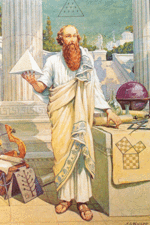
Pythagoras-Knapp

In his Degrees of Knowledge, Jacques Maritain argues that one central fault of the modern mind has been its propensity to think of mathematics rather than metaphysics as first philosophy. If we take number for the foundation of all things, then we deprive ourselves of the capacity to think of being; we truncate reality, and fail to see the elegant assent the human mind can make from the immediacy of sense experience, by way of abstraction, to the conception of being and, at last, – by the grace of God — to the immediate experience of Being. Too assiduous a delight in the quantitative may conceal our intellectual natures from us, and disfigure our lives. And yet, from Galileo through the contemporary Physicist, number has seemed to be something like the language of God (a phrase sometimes used to describe DNA, but that utterly misunderstands what DNA actually tells us about reality, as if God only spoke living things into being). As someone concerned with the way in which art, and poetry in particular, reveals being to us, the way in which it clarifies the vision and initiates us into a richer way of dwelling in the Real, I have always appreciated the admonitions of Maritain and others who would draw us, with St. Thomas Aquinas, to think being first, last, and always.

more from James Matthew Wilson at Front Porch Republic here.

A radical hard sell: Mira Nair’s ‘The Reluctant Fundamentalist’

From Financial Times:

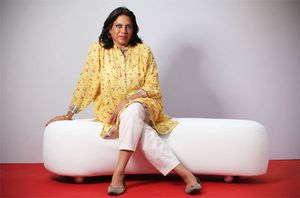
MiranAs ambitious as a Bond film in its five-country narrative, the adaptation of Pakistani author Mohsin Hamid’s Booker prize-shortlisted book equates the economic fundamentalism of hard-headed western business and the violent religious ideology sweeping the Islamic world. Parallels are drawn between their dehumanised adherents, and swift, brutal judgments.

…“I wanted to make a film about contemporary Pakistan and not one riddled by partition and the weight of all that because [as Indians] that is all we see. We don’t see anything that is now.” More broadly, she wanted to tell a tale of a global conflict from the other side, and took The Battle of Algiers, Gillo Pontecorvo’s 1966 film about the Algerian revolution, as inspiration. “From Vietnam’s Deer Hunter to Iraq, films are never about the person who has had his house destroyed. I want to tell the other side … It’s really about this duel, this dance. “At its heart it is a thriller. The colour is all very well but it’s what is going to happen. Is he or isn’t he [a fundamentalist]? That’s an amazing razor to walk on,” she says. “The elegance of the story is that you don’t know what side our hero is on.”

Unlike Hamid’s book, Nair’s softer, homespun optimism wins out. The protagonist’s lover in New York does not fade away with anorexia, depression and suicide. The climax of the book is left darkly to the reader’s imagination; less so in the film, where the hero steps back from violence. Monsoon Terrorist is what Hamid, who worked on the adaptation, dubs the film. Lighter fare is almost certainly next. Nair is working on taking Monsoon Wedding to Broadway as a musical. Six out of 12 songs have been written and composed. The pull of high-rolling, Hindi-language Bollywood is also strong. Nair tells how her accountant entreats her to turn to more commercial cinema. “‘I trade on your name,’ he says, ‘but when I look at your bank account, I say: why, why don’t you make just one Bollywood film, please?’” He should not expect Nair to break a habit of a lifetime. “My films, no one else will do,” she says.

More here.

Radioactive bacteria attack cancer

From Nature:

CancerTwo dangerous things together might make a medicine for one of the hardest cancers to treat. In a mouse model of pancreatic cancer, researchers have shown that bacteria can deliver deadly radiation to tumours — exploiting the immune suppression that normally makes the disease so intractable. Fewer than one in 25 people diagnosed with pancreatic cancer are alive five years later. Chemotherapy, surgery and radiotherapy are generally ineffective, mainly because the disease has often spread to other organs even before it is detected.

The work, which is described in the Proceedings of the National Academy of Sciences1, began when Ekaterina Dadachova of the Albert Einstein College of Medicine in New York thought of combining two ways to fight cancer. She studies how radioactive isotopes can be used as anti-cancer weapons, and her colleague Claudia Gravekamp has been looking at whether weakened bacteria can be used to carry compounds that provoke a patient’s white blood cells into attacking the cancer. “I thought maybe we could combine the power of radiation with the power of live bacteria,” Dadachova says. Sometimes found in food, the bacterium Listeria monocytogenes can cause severe infection, but is usually wiped out by the immune system. Exploiting the fact that cancer cells tend to suppress the immune reaction to avoid being destroyed, the two researchers and their collaborators decided to coat Listeria with radioactive antibodies and injected the bacterium into mice with pancreatic cancer that had spread to multiple sites. After several doses, the mice that had received the radioactive bacteria had 90% fewer metastases compared with mice that had received saline or radiation alone. “That was the first time we'd seen such a big effect,” says Gravekamp. The immune system rapidly clears Listeria from healthy tissue, says Gravekamp, but tumour cells suppress the immune system and allow Listeria to remain. That means that tumour cells will receive continuous exposure but normal cells will be spared, she says.

More here.

Poem: “By Chance the Cycladic People”

Anne Carson in the London Review of Books:

9.4. They put stones in their eye sockets. Upper-class people put precious stones.

16.2. Prior to the movement and following the movement, stillness.

8.0. Not sleeping made the Cycladic people gradually more and more brittle. Their legs broke off.

1.0. The Cycladic was a neolithic culture based on emmer wheat, wild barley, sheep, pigs and tuna speared from small boats.

11.4. Left hand on Tuesdays, right hand on Wednesdays.

10.1. She plied the ferryboat back and forth, island to island, navigating by means of her inner eye.

9.0. When their faces wore smooth they painted them back on with azurite and iron ore.

12.1. All this expertise just disappears when a people die out.

2.0. They wore their faces smooth with trying to sleep, they ground their lips and nipples off in the distress of pillows.

4.4. How you spear it, how you sheer it, how you flense it, how you grind it, how you get it to look so strangely relaxed.

4.0. Mirrors led the Cycladic people to think about the soul and to wish to quiet it.

More here. [Thanks to Justin E. H. Smith.]

How the hyperkinetic media is breeding a new generation of terrorists

Scott Atran in Foreign Policy:

166997599“Americans refuse to be terrorized,” declared President Barack Obama in the aftermath of the Boston Marathon bombings. “Ultimately, that's what we'll remember from this week.” Believe that, and I've got a bridge to sell you in Brooklyn.

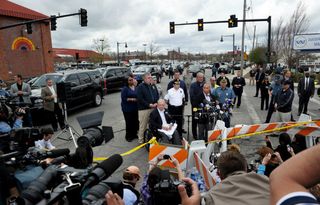
The Boston bombings have provoked the most intense display of law enforcement and media coverage since the 9/11 attacks. Greater Boston was in full lockdown: “a ghost town,” “a city in terror,” “a war zone,” screamed the headlines. Public transit was stopped, a no-fly zone proclaimed, people told to stay indoors, schools and universities closed, and hundreds of FBI agents pulled from other pressing investigations to focus exclusively on the case — along with thousands upon thousands of other federal, state, and city agents equipped with heavy weapons and armored vehicles. It all came close to martial law, with all the tools of the security state mobilized to track down a pair of young immigrants with low-tech explosives and small arms who failed to reconcile their problems of identity and became suspected amateur terrorists.

Not that the events weren't shocking and brutal. But this law enforcement and media response, of course, is part of the overall U.S. reaction to terrorism since 9/11, when perhaps never in history have so few, armed with so few means, caused so much fear in so many. Indeed, as with the anarchists a century ago, last week's response is precisely the outsized reaction that sponsors of terrorism have always counted on in order to terrorize.

More here.

Oldest European Medieval Cookbook Found

Jennifer Viegas in Discovery News:

Dnews-files-2013-04-MEDIEVAL-RECIPE-5A1-660x433-jpgA 12th-century manuscript contains the oldest known European Medieval food recipes, according to new research.

The recipes, which include both food and medical ointment concoctions, were compiled and written in Latin. Someone jotted them down at Durham Cathedral’s monastery in the year 1140.

It was essentially a health book, so the meals were meant to improve a person’s health or to cure certain afflictions. The other earliest known such recipes dated to 1290.

Many of the dishes sound like they would work on a modern restaurant menu. Faith Wallis, an expert in medical history and science based at McGill University, translated a few for Discovery News:

“For “hen in winter’: heat garlic, pepper and sage with water.”

“For ‘tiny little fish’: juice of coriander and garlic, mixed with pepper and garlic.”

For preserved ginger, it should kept in “pure water” and then “sliced lengthwise into very thin slices, and mixed thoroughly with prepared honey that has been cooked down to a sticky thickness and skimmed. It should be rubbed well in the honey with the hands, and left a whole day and night.”

More here.

Russia After Boston: A Free Pass on Human Rights?

Corbis.Nalvny_jpg_470x417_q85

Amy Knight in the NYRB blog:

The close cooperation between Moscow and Washington on the Boston bombing investigation raises new questions about the issue of human rights in Russia. Revelations that the alleged bombers were two brothers of Chechen origin, and that Russian authorities had warned their American counterparts in 2011 about one of them, the older brother Tamerlan Tsarnaev, has put pressure on the FBI for not adequately following up on the Russian requests. Will the US government now turn a blind eye to Russia’s increasingly brutal crackdown on its own democratic opposition because of overriding concerns about national security, just as it did after 9/11? Will the Kremlin wager that it can get away with its hard-line approach now that, as a result of the Boston attacks, the Obama Administration needs its help in counter-terrorism efforts?

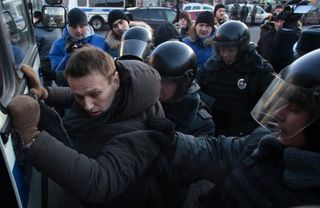
A test case could be the trial of Russian anti-corruption blogger and opposition leader Aleksei Navalny. The trial, which began in a district court in the city of Kirov last week has aroused world-wide attention for its blatant political motivations. Long a target of the Kremlin, Navalny has already received two fifteen-day prison sentences in the last eighteen months for involvement in street protests. Now he faces up to ten years in prison on charges of embezzling 16 million rubles (over $500,000) from a state-owned timber company. As with other such prosecutions, it seems a foregone conclusion that Navalny will be found guilty, despite the bogus nature of the charges. It also seems clear that the verdict will be dictated by the Kremlin.

And yet, the Navalny trial—which has adjourned until April 24 so that the defense can study the thirty volumes of case materials submitted by the prosecution—marks a special challenge for Russian President Vladimir Putin. In recent months, the Kremlin has confronted growing economic problems, some of them directly connected to its crackdown on the opposition.

A conversation with Olivier Roy on the nature of the alleged Marathon terrorists

Images

John Judis in TNR (via Andrew Sullivan):

I wanted to ask you about the two brothers, Tamerlan and Dzhokhar Tsarnaev, who allegedly set off the two bombs at the Boston Marathon. In your book,Globalized Islam, you recounted how many terrorists who act in the name of Islam were brought up in Western Europe rather than in the Middle East and who are often provoked by events outside the Middle East. Are these two brothers, who were largely raised in the United States, more evidence for your thesis?

Yes, my idea from the beginning was that Al Qaeda and the people who used the mark of Al Qaeda were not really concerned with the core—with the Middle East, the Middle East of Palestine. They were more concerned by the periphery of the Middle East than the core of the Middle East. They were usually more concerned with Bosnia and Afghanistan, Chechnya at the end of the ‘90s; it is now Mali, Mauritania and Yemen, which is the only place where they are strong. Most of these guys have a global trajectory, they were born in one place, they go to fight somewhere else. These guys were born in Kyrgyzstan, they went to Dagestan, they speak Russian, they came to the United States very young, they were educated in the United States, they speak English without an accent and so on.

And they seemed to have discovered Islam in the United States rather than in Dagestan or Kyrgyzstan?

Same thing with Mohammed Merah, the killer in Toulouse last year. They are self-radicalizing in a Western environment.

In your book, and also in your previous book on political Islam, you describe a transition from the nationalist and Marxist-Leninist movements in the Middle East after World War II to a stateless movement like Al Qaeda. Now we have something beyond that, where the terrorists may not even belong to, or be under orders from a specific group, but may only have been influenced by a radical preacher they heard. I am thinking of the Army Major Nidal Malik Hasan who killed thirteen people at Fort Hood in 2009.

Yes, globalization and individualization are the two terms. Instead of organization, they connect through the Internet. They connect to a virtual Ummah not to a real society. For instance, most of them didn’t socialize in a Western community. They may have gone to mosques, but they were never an integral part of a congregation, they have no real life, social life. Their social life is through the Internet, all of them.