Doris Lessing: a model for every writer coming from the back of beyond

Margaret Atwood in The Guardian:

British-novelist-Doris-Le-008Wonderful Doris Lessing has died. You never expect such rock-solid features of the literary landscape to simply vanish. It's a shock. I first encountered Lessing on a park bench in Paris in 1963. I was a student, living on baguettes, oranges and cheese, as one did, and suffering from a stomach ailment, as one did. My pal Alison Cunningham and I had been barred from our hostel during the day, so Alison was soothing my prostrate self by reading from The Golden Notebook, which was all the rage among such as us. Who knew we were reading a book that was soon to become iconic?

Just as we were getting to a crucial moment in the life of Anna Wulf, along came a policeman to tell us that lying down on park benches was against the law, so we decamped for a bistro and another interesting washroom experience. (Footnote: this was before second-wave feminism. It was before widespread birth control. It was before mini-skirts. So Anna Wulf was a considerable eye-opener: she was doing things and thinking things that had not been much discussed at the Toronto dinner tables of our adolescence, and therefore seemed pretty daring.) The other woman we were sneakily reading in 1963 was Simone de Beauvoir, but the childhoods of little-girl colonials such as ourselves lacked starched petticoats and were not very French. We had more in common with a remote-places-of-the-Empire parvenue such as Doris Lessing: born in Iran in 1919, growing up on a bush farm in Rhodesia (now Zimbabwe); then, after two failed marriages, running away to England with scant prospects, which was where we colonials with scant prospects ran away to then.

Picture: 'If there were a Mount Rushmore of 20th-century authors, Lessing would be carved on it.'

More here.

Tuesday Poem

Trochees and Dactyls

He met her at the reception.
She was exceptionally beautiful
and spoke with a thick accent

as she talked about her native
tongue. Popping an appetizer
(some sort of crustacean)

into her mouth, she airily
waved the tiny spear
of a tasseled toothpick in the air

as he waited for her to chew
and to swallow. “In my native
tongue,” she told him, giving

her upper lip a last fluid lick,
and gesturing with the toothpick
which came down on each word

like a conductor's baton
or a tool for poetic scansion,
“the first syllable always carries

the stress. No exceptions. Like love
at first sight, phonetically speaking.
The words are all trochees and dactyls.”

He nodded his understanding
and she went on, “Nevertheless,
our Slavic liquids,” and here she

aimed the lucky tip of the toothpick
at her mouth, nearly touching it,
“are difficult for you foreigners

to pronounce.” And she rolled
a consonant cluster with an r inside
right off he tongue, to demonstrate–

a dark grape wrapped in its native
mist, which he expertly caught
in his own mouth, and without bursting it,

gave back to her, whole.

by Paul Hostovsky

A Cold War Fought by Women

John Tierney in The New York Times:

WomenThe existence of female competition may seem obvious to anyone who has been in a high-school cafeteria or a singles bar, but analyzing it has been difficult because it tends be more subtle and indirect (and a lot less violent) than the male variety. Now that researchers have been looking more closely, they say that this “intrasexual competition” is the most important factor explaining the pressures that young women feel to meet standards of sexual conduct and physical appearance. The old doubts about female competitiveness derived partly from an evolutionary analysis of the reproductive odds in ancient polygynous societies in which some men were left single because dominant males had multiple wives. So men had to compete to have a chance of reproducing, whereas virtually all women were assured of it. But even in those societies, women were not passive trophies for victorious males. They had their own incentives to compete with one another for more desirable partners and more resources for their children. And now that most people live in monogamous societies, most women face the same odds as men. In fact, they face tougher odds in some places, like the many college campuses with more women than men.

To see how female students react to a rival, researchers brought pairs of them into a laboratory at McMaster University for what was ostensibly a discussion about female friendships. But the real experiment began when another young woman entered the room asking where to find one of the researchers. This woman had been chosen by the researchers, Tracy Vaillancourt and Aanchal Sharma, because she “embodied qualities considered attractive from an evolutionary perspective,” meaning a “low waist-to-hip ratio, clear skin, large breasts.” Sometimes, she wore a T-shirt and jeans, other times a tightfitting, low-cut blouse and short skirt. In jeans, she attracted little notice and no negative comments from the students, whose reactions were being secretly recorded during the encounter and after the woman left the room. But when she wore the other outfit, virtually all the students reacted with hostility. They stared at her, looked her up and down, rolled their eyes and sometimes showed outright anger. One asked her in disgust, “What the [expletive] is that?”

More here.

Monday, November 18, 2013

Free Exclusive Invitation For 3 Quarks Readers to Attend a Lecture and Lunch with Daniel C. Dennett entitled “What can cognitive science tell us about free will?”

THE ELEVENTH HARVEY PREISLER MEMORIAL SYMPOSIUM

Saturday, November 23, 2013

International House

500 Riverside Drive
New York, NY 10027

www.ihouse-nyc.org

RSVP in the comments area of this post to be put on the guest list.

Let us know if you will be bringing guests and, if so, how many.

10:00 am: Welcome and Tribute to Harvey Preisler by Sheherzad Raza Preisler

10:15 am: Introduction of Dr. Dennett by Azra Raza

10:30 am: Dr. Daniel C. Dennett: “What can cognitive science tell us about free will?”

11:30 am: Q/A session moderated by Dr. Raza

12:00 pm: Light lunch

Screenhunter_1_9

Harvey David Preisler, M.D., Director of Rush Cancer Institute and the Samuel G. Taylor III Professor of Medicine at Rush University, Chicago, died on May 19th 2002. The cause of death was lymphoma. Dr. Preisler grew up in Brooklyn, New York, and trained in Medicine at New York Hospitals, Cornell Medical Center, and in Medical Oncology at the National Cancer Institute and Columbia Presbyterian Hospital in NYC. At the time of his death, he was the Principal Investigator of a ten million dollar grant from the National Cancer Institute in addition to several other large grants which funded his independent research laboratory with approximately 25 scientists. He was married to Azra Raza, M.D.

http://3quarksdaily.blogs.com/3quarksdaily/2006/05/rx_harvey_david.html

http://images.ted.com/images/ted/1469_254x191.jpgDaniel Clement “Dan” Dennett III is an American philosopher, writer and cognitive scientist whose research centers on the philosophy of mind, philosophy of science and philosophy of biology, particularly as those fields relate to evolutionary biology and cognitive science. He is best known for his concept of intentional systems, and his multiple drafts model of human consciousness, which sketches a computational architecture for realizing the stream of consciousness in the massively parallel cerebral cortex. Professor Dennett is an atheist and a secularist, a member of the Secular Coalition for America advisory board. His first book, Content and Consciousness, appeared in 1969, followed by Brainstorms, Elbow Room, The Intentional Stance, Consciousness Explained, Darwin's Dangerous Idea, Kinds of Minds, Brainchildren: A Collection of Essays 1984-1996 and Sweet Dreams: Philosophical Obstacles to a Science of Consciousness. He co-edited The Mind's I with Douglas Hofstadter in 1981. He is the author of over four hundred scholarly articles on various aspects of the mind, published in journals ranging from Artificial Intelligence and Behavioral and Brain Sciences to Poetics Today and the Journal of Aesthetics and Art Criticism. His most recent publication is Intuition Pumps and Other Tools for Thinking ( 2013). Professor Dennett is the recipient of multiple national and international awards and is the Co-director of the Center for Cognitive Studies, the Austin B. Fletcher Professor of Philosophy, and University Professor at Tufts University in Boston.

Sunday, November 17, 2013

Letter from Israel: Leftists on Zionism’s Past, Present, and Future

Susie Linfield in the Boston Review:

ScreenHunter_402 Nov. 17 18.38It is no secret that the Israeli left is marginalized; the suicide bombings of the Second Intifada (2000–2005) killed not only individual Israeli civilians but the credibility of the left itself. The shredded bodies, especially those of children and old people—in supermarkets, at cafés, on buses—made it difficult if not impossible to speak of a peaceful, or perhaps any, solution to the Israeli-Palestinian conflict.

Nothing that has happened since, either internally or externally, has caused the left to recover. But in a series of interviews I did with various leftist Israelis—journalists, academics, historians—this June in Jerusalem and Tel Aviv, I was struck not only by their despondency but also by their vibrancy, which seems to stem from the rich cultural, intellectual, and civic life that coexists with—and at the same time is separate from—a desolate political situation. I was impressed, too, by the complexity of the challenges leftist Israelis face, which are often simplified in the Western press. In addition to the occupation of the Palestinian territories, these include Israel’s rightward trend toward exclusionary ethnic nationalism; the violent turmoil in surrounding Arab countries, especially neighboring Egypt and Syria; the continuing rule of Hamas in Gaza; and the political apathy, or perhaps fatigue, of their fellow citizens. As Bar-Ilan University professor Ilan Greilsammer told me, “The big problem [among students] is depoliticization. They’re not for Zionism or against Zionism—they tend to be indifferent to any ‘ism.’” Then there are the deeply emotional, perhaps even unconscious, aspects of the Israeli-Palestinian conflict that in part explain its peculiar virulence. As journalist Gershom Gorenberg put it, “We have two pretty neurotic peoples facing off.”

More here.

Why Does Dark Energy Make the Universe Accelerate?

Sean Carroll in Preposterous Universe:

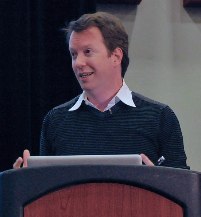
Blogpic1Peter Coles has issued a challenge: explain why dark energy makes the universe accelerate in terms that are understandable to non-scientists. This is a pet peeve of mine — any number of fellow cosmologists will recall me haranguing them about it over coffee at conferences — but I’m not sure I’ve ever blogged about it directly, so here goes. In three parts: the wrong way, the right way, and the math.

The Wrong Way

Ordinary matter acts to slow down the expansion of the universe. That makes intuitive sense, because the matter is exerting a gravitational force, acting to pull things together. So why does dark energy seem to push things apart?

The usual (wrong) way to explain this is to point out that dark energy has “negative pressure.” The kind of pressure we are most familiar with, in a balloon or an inflated tire, pushing out on the membrane enclosing it. But negative pressure — tension — is more like a stretched string or rubber band, pulling in rather than pushing out. And dark energy has negative pressure, so that makes the universe accelerate.

If the kindly cosmologist is both lazy and fortunate, that little bit of word salad will suffice. But it makes no sense at all, as Peter points out. Why do we go through all the conceptual effort of explaining that negative pressure corresponds to a pull, and then quickly mumble that this accounts for why galaxies are pushed apart?

More here.

A Wilde Fashion

Nathaniel Popkin in The Smart Set:
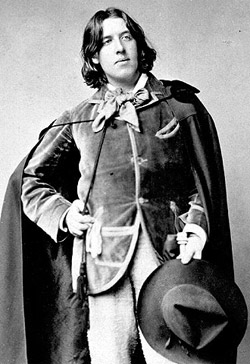
WildeAnd thus, we’ve come to see Wilde’s “true literary life,” when he wrote Dorian Gray, The Importance of Being Earnest, Salomé, and A Woman of No Importance, and made his mark as a piercingly funny avant garde social critic and dramatic visionary, as a kind of spontaneous explosion of genius and self-invention. Failing at brilliance, it’s been long imagined, from a somewhat determinist perspective, Wilde was so unflappably clever and intellectually original he could flip personas, almost as if playing a game. “Wilde’s game centered on masks, a game he relished…both in all seriousness and with delight in its manifest absurdities,” writes Richard Allen Cave, editor of the Penguin Classics edition of The Importance of Being Earnest and Other Plays (2000). Even so, this sort of psychological explanation accounts for Wilde’s personality, but not necessarily the mechanics of a career about to blossom (writers rarely become famous by accident). The hard stop, journalism is over, now I’ll write a shocking novel and scores of beloved plays, wasn’t quite adequate for John Cooper, a non-academic Wilde scholar, who runs a project called Oscar Wilde in America. Cooper understood implicitly that one thing draws from the other. “People know about Wilde’s early poetry. People know about the drama,” he says. “But this middle career: people tend to think he had merely settled down. They overlook the period as simply a domestic time.” In desiring to better understand the middle period, Cooper had often thought about something Wilde had said while at Oxford:

I'll be a poet, a writer, a dramatist. Somehow or other I'll be famous, and if not famous, I'll be notorious.

He began to imagine that “to locate Wilde the writer we must use the mantra of his quotation as a roadmap.” Youthful bravado or nonsense, the sequence of poet, writer, dramatist became for Cooper a research framework. He wanted to find new Wilde material that would help tell a richer story of this evolution, both personally and professionally, and that would provide links — seams, we might venture — between poet and writer, writer and dramatist. Then, this spring, he found it: a body of work, including Wilde’s first major piece of published prose writing, The Philosophy of Dress, an essay published in 1885 and mentioned again only once more, in 1920, on clothing, dress, and fashion. In the essay, Wilde lays out an argument for clothing that hangs, properly in his view according to the human form, from the shoulders, and allows women particularly freedom of movement (even to ride a bicycle). “I hold that the very first canon of art is that Beauty is always organic,” he writes, “and comes from within, and not from without,”

comes from the perfection of its own being and not from any added prettiness. And that consequently the beauty of a dress depends entirely and absolutely on the loveliness it shields, and on the freedom and motion that it does not impede.

More here.

The Origin of New Species

Rithika Merchant in The Morning News:

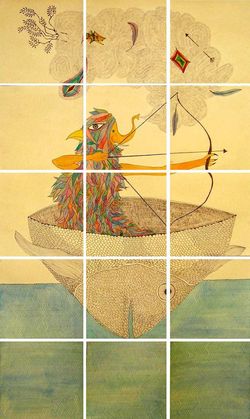
Briny_Briny_Sea The Morning News: Some anthropologists theorize that early images of hybrid creatures, such as in cave paintings and Assyrian reliefs, depict shamans interacting with or transforming into spirit animals. Historically, hybrids do often represent deities and other religious figures—the elephant-headed Ganesha in Hinduism, Christianity’s winged angel Gabriel, for instance. To what extent does your art incorporate religious messaging?

Rithika Merchant: “Origin of Species” was in part inspired by the Shamanic concept of the spirit/power animal. I focused on the emotional complexes and relationships between people and animals using universally recognizable motifs. However, my work has less to do with religion and more to do with folklore and indigenous culture.

TMN: So what drew you to folklore?

RM: I first became interested in it after being introduced to Gond tribal art as a teenager. I was drawn to how each artist had their own signature decorative pattern that they used to fill their paintings. My interest in the visual representation of folklore began from looking at these drawings. Soon after that I began to seek out indigenous art and folktales from other cultures.

More here.

Crops, Towns, Government

9780141024486

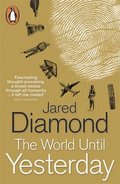
James C. Scott reviews Jared Diamond's The World until Yesterday: What Can We Learn from Traditional Societies?, in the LRB (via Crooked Timber):

What were our ancestors like before the domestication of plants and animals, before sedentary village life, before the earliest towns and states? That is the question Diamond sets himself to answer. In doing so, he faces nearly insurmountable obstacles. Until quite recently, archaeology recorded our history as a species in relation to the concentration of debris (middens, building rubble, traces of irrigation canals, walls, fossilised faeces etc) we left behind. Hunter-gatherers were typically mobile and spread their largely biodegradable debris widely; we don’t often find their temporary habitats, which were often in caves or beside rivers or the sea, and the vast majority of such sites have been lost to history. When we do find them, they can tell us something about their inhabitants’ diet, cooking methods, bodily adornment, trade goods, weapons, diseases, local climate and occasionally even causes of death, but not much else. How to infer from this scant evidence our ancestors’ family structure and social organisation, their patterns of co-operation and conflict, let alone their ethics and cosmology?

It is here that Diamond makes his fundamental mistake. He imagines he can triangulate his way to the deep past by assuming that contemporary hunter-gatherer societies are ‘our living ancestors’, that they show what we were like before we discovered crops, towns and government. This assumption rests on the indefensible premise that contemporary hunter-gatherer societies are survivals, museum exhibits of the way life was lived for the entirety of human history ‘until yesterday’ – preserved in amber for our examination.

In the unique case of Highland New Guinea, which was apparently isolated from coastal trade and the outside world until World War Two, Diamond might be forgiven for making this inference, though the people of New Guinea have had exactly the same amount of time to adapt and evolve as homo americanus and they managed somehow to get hold of the sweet potato, which originated in South America. The inference of pristine isolation, however, is completely unwarranted for virtually all of the other 35 societies he canvasses. Those societies have, for the last five thousand years, been deeply involved in a world of trade, states and empires and are often now found in undesirable marginal areas to which they have been pushed by more powerful societies. The anthropologist Pierre Clastres argued that the Yanomamo and Siriono, two of Diamond’s prime examples, were originally sedentary cultivators who turned to foraging in order to escape the forced labour and disease associated with Spanish settlements. Like almost all the groups Diamond considers, they have been trading with outside kingdoms and states (and raiding them) for much of the past three thousand years; their beliefs and practices have been shaped by contact, trade goods, travel and intermarriage. So thoroughly have they come to live in a world of powerful kingdoms and states that one might call these societies themselves a ‘state effect’.

More here.

Sunday Poem

Fox

The light that limped in lantern circles down the road
Lit the grass heaved ditches and the cobbled stars of stone,
And came upon it, bleeding in the stream's cold sleep;
Fox, red into fawn, sharp as a coin and ruined now.
While blind signals pilfered its garbling wit-
Spasm to spasm I watched, then touched its wetsmooth fur,
As it snapjawed at the air, splashed for a furious time,
Alive again in a newer fear, then blinked back to the old.
I, thinking that misery ended it, tilted my gun
And ended its misery. The lantern flicked through the leaves;
Green, back through the woods the light fumbled a path,
The stars hardened, and a fresh breeze screamed in the trees.

by John Bruce

Nadezhda Tolokonnikova of Pussy Riot’s prison letters to Slavoj Žižek

Nadezhda-Tolokonnikova-of-009

Tolokonnikova and Žižek in The Guardian:

2 January 2013

Dear Nadezhda,

I hope you have been able to organise your life in prison around small rituals that make it tolerable, and that you have time to read. Here are my thoughts on your predicament.

John Jay Chapman, an American political essayist, wrote this about radicals in 1900: “They are really always saying the same thing. They don't change; everybody else changes. They are accused of the most incompatible crimes, of egoism and a mania for power, indifference to the fate of their cause, fanaticism, triviality, lack of humour, buffoonery and irreverence. But they sound a certain note. Hence the great practical power of persistent radicals. To all appearance, nobody follows them, yet everyone believes them. They hold a tuning-fork and sound A, and everybody knows it really is A, though the time-honoured pitch is G flat.” Isn't this a good description of the effect of Pussy Riot performances? In spite of all accusations, you sound a certain note. It may appear that people do not follow you, but secretly, they believe you, they know you are telling the truth, or, even more, you are standing for truth.

But what is this truth? Why are the reactions to Pussy Riot performances so violent, not only in Russia? All hearts were beating for you as long as you were perceived as just another version of the liberal-democraticprotest against the authoritarian state. The moment it became clear that you rejected global capitalism, reporting on Pussy Riot became much more ambiguous. What is so disturbing about Pussy Riot to the liberal gaze is that you make visible the hidden continuity between Stalinism and contemporary global capitalism.

More here.

Saturday, November 16, 2013

How IBM is Using Big Data to Invent Creative Recipes

Aatish Bathia in Wired [h/t: Jennifer Ouellette]:

Computers are constantly getting smarter. But can they ever be creative? A team of IBM researchers believes so. They’ve built a program that uses math, chemistry, and vast quantities of data to churn out new and unusual recipes.

To build their algorithm, the researchers modeled the steps that we might go through to develop creative ideas. First, you need to understand the problem that you’re trying to solve. Then, build expertise by learning everything you can about the problem. With this knowledge under your belt, generate a bunch of new ideas, and maybe even combine different types of ideas. Then pick the most creative ideas from the lot. Finally, implement your idea. While computers have executed many of these steps before, the key insight of the IBM group was to find a way to quantitatively gauge the creativity of a recipe, and to put all the different pieces together.

“I have dishes from the system all the time”, says Lav Varshney, who led IBM’s team to develop this novel recipe generation engine. “Some of the recipes that we created ourselves like the Kenyan Brussels sprout gratin, the Caymanian plantain dessert, and the Swiss-Thai asparagus quiche are very good. Others that we did jointly with our partners, the Institute of Culinary Education, like the Spanish almond crescent and the Ecuadorian strawberry dessert are world-class.”

More here.

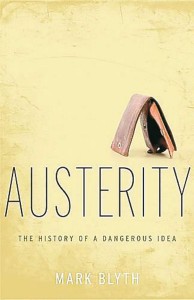
Symposium on Mark Blyth’s Austerity: The History of a Dangerous Idea

Austerity-Cover-194x300

Comparative European Politics has a symposium on Mark Blyth's Austerity: The History of a Dangerous Idea, with comments from Nicolas Jabko, Jamie Peck, Wolfgang Streeck, Helen Thompson and Mark Blyth. Wolfgang Streeck:

Why write a comment on a book that must command as much respect and indeed admiration as Blyth’s? Fortunately one can always ask questions, extend one or the other line of argument to see where it may lead and probe for underlying assumptions that might usefully be uncovered. Having convincingly demonstrated that ‘austerity doesn’t work’, Blyth in my view remains conspicuously silent on what would work and for whom. This is, of course, entirely legitimate in principle; he or she who undertakes to explain a problem cannot be obliged to deliver a solution as well. However, although Blyth refrains from explicitly telling us what might replace austerity, it seems to me that implicitly he suggests that the alternative is just around the corner, too obvious to be in need of discussion, in the form of monetary and fiscal expansion. It is here that I have my doubts.

Before I get to them, let me reassure the reader that I have not overlooked the last chapter of the book where Blyth does turn policy advocate, if only with respect to public debt, for the reduction of which he recommends a combination of fiscal repression and higher taxes. In recent months that combination seems to have become popular even among governments and their economists, and Blyth is to be commended for having seen this coming. Whether there are good reasons to be as enthusiastic about it as he is, however, a different matter. Fiscal repression is predicated on high growth, real or nominal or a combination of the two, plus low interest rates secured by, presumably, monetary expansion. As to real growth, the problem, nowhere mentioned by Blyth, is that is has been and continues to be on a long-term decline. Up to now nobody can convincingly say how that trend may be reversed; while opinions differ, however, few if any have suggested that the thing to do would be raising taxes. To the contrary, the mantra has been and still is that growth is stimulated, not by raising but by cutting taxes, promoting investment at the high end of the income distribution or consumption at the lower end. (There is also the minor problem of tax flight, although governments are about to take care of this, or so they say.) Hence, the growth trick must almost entirely be done by monetary expansion, and indeed against the odds of the growth-impeding effects of a tax increase.

Fortunately, if the real growth trick refused to work, monetary expansion could also do with the nominal growth trick. Inflation, however, seems hard to engineer in the absence of strong trade unions, that is, by easy money alone. This at least could be the lesson of recent years, when central banks were expanding as though there was no tomorrow but inflation remained miraculously absent. Maybe this would at some point change. However, what would be supposed to cure public indebtedness could have serious side-effects. If easy money eventually did cause inflation, this would disproportionately punish people on fixed incomes. Of these, because of a changed demography, there are many more today than in the 1970s.

More here.

Switzerland’s Proposal to Pay People for Being Alive

Annie Lowrey in the New York Times:

Mag-17Economy-t_CA0-popupThis fall, a truck dumped eight million coins outside the Parliament building in Bern, one for every Swiss citizen. It was a publicity stunt for advocates of an audacious social policy that just might become reality in the tiny, rich country. Along with the coins, activists delivered 125,000 signatures — enough to trigger a Swiss public referendum, this time on providing a monthly income to every citizen, no strings attached. Every month, every Swiss person would receive a check from the government, no matter how rich or poor, how hardworking or lazy, how old or young. Poverty would disappear. Economists, needless to say, are sharply divided on what would reappear in its place — and whether such a basic-income scheme might have some appeal for other, less socialist countries too.

More here.

Wall Street Isn’t Worth It

Wall-street-bull-620x412

John Quiggin in Jacobin:

David Graeber’s denunciation of “bullshit jobs” resonated with many, producing a string of responses. Alex Tabarrok and Brad DeLong have suggested that the apparent inverse relationship between earnings and the social value of work done is simply an illustration of “diamond-water” paradox, that prices and wages are determined by marginal, rather than absolute values and that marginal values reflect scarcity as well as utility. Peter Frase refutes this claim in both empirical terms (noting for example the fact that the price of diamonds is set by the De Beers cartel rather than pure market forces) and as a resurrection of the discredited marginal productivity ethics of the 19th century.

I’d like to look at a specific question raised by the discussion of private returns and social value, namely: can Wall Street, in its present form, be justified? That is, does the share of income flowing to corporations and professional workers in the financial sector reflect their marginal contribution to the total value of social output, so that, if their work ceased to be done and their skills were allocated elsewhere, we would all be worse off?

I argue that society as a whole would be better off if the financial sector were smaller, and received much smaller returns. A political strategy based on cutting the financial sector down to size has more promise for the Left than any alternative approach now on offer, and is a necessary precondition for a broader attempt to make the distribution of wealth and power more equal.

More here.