15 tips to guarantee awful sex

Anna Pulley in Salon:

ScreenHunter_394 Nov. 12 20.325. Cosmo: “Use your bra to bind his hands behind his back, then cover your nipples in yummy toppings and command him to lick them off.”

Ignoring for a moment why you would want to needlessly stretch out an expensive bra, and how many other better restraints exist in the world, does Cosmo think we all have mini-fridges full of Cocoa Puffs and slivered almonds by our bedsides? Because, there’s barely enough room for my Nutella bucket from Costco as it is.

6. Cosmo: “Sprinkle a little pepper under his nose right before he climaxes. Sneezing can feel similar to an orgasm and amplify the feel-good effects.”

A mini-fridge and a spice rack, got it. There’s nothing that aids an impending orgasm like a dry rub marinade. Besides, what’s sexier than sneezing? Crying, which is exactly what will happen if you’re one inch off.

7. Men’s Health: “According to new research, the smell of toast is a serious mood booster.”

A mini-fridge, a spice rack, and a toaster oven. Got it. We’re starting to think we know what the Beyond stands for in Bed, Bath &.

More here.

Why are testicles kept in a vulnerable dangling sac? It’s not why you think

Liam Drew in Slate:

ScreenHunter_393 Nov. 12 20.24Some of you may be thinking that there is a simple answer: temperature. This arrangement evolved to keep them cool. I thought so, too, and assumed that a quick glimpse at the scientific literature would reveal the biological reasons and I’d move on. But what I found was that the small band of scientists who have dedicated their professional time to pondering the scrotum’s existence are starkly divided over this so-called cooling hypothesis.

Reams of data show that scrotal sperm factories, including our own, work best a few degrees below core body temperature. The problem is, this doesn’t prove cooling was the reason that testicles originally descended. It’s a straight-up chicken-and-egg situation—did testicles leave the kitchen because they couldn't stand the heat, or do they work best in the cold because they had to leave the body?

Vital organs that work optimally at 98.5 degrees Fahrenheit get bony protection: My brain and liver are shielded by skull and ribs, and my girlfriend’s ovaries are defended by her pelvis. Forgoing skeletal protection is dangerous. Each year, thousands of men go to the hospital with ruptured testes or torsions caused by having this essential organ suspended chandelierlike on a flexible twine of tubes and cords. But having exposed testicles as an adult is not even the most dangerous aspect of our reproductive organs’ arrangement.

More here.

The Undergraduate…On to Plan B

Jessica Salley in Harvard Magazine:

UnderI cannot remember the exact moment when I decided it was my dream to be a Rhodes Scholar. I think I was in fifth grade. It was around the time the Mary-Kate and Ashley Olsen movie Winning London came out on home video.

…During the past three years, this fantasy crystallized into something more concrete: I could apply for the Rhodes. I had a decently high GPA, leadership positions, and a unique project in mind. I thought the fact that I am from Louisiana, a chronically underrepresented state, would give me traction, and I spent countless summer hours writing draft after draft of my recommendation requests and personal statement. Our House tutors informed us all, of course, that the Harvard nomination process is nearly as cutthroat as the Rhodes competition itself. Of about 100 prospective applicants, they would endorse fewer than half to submit their materials to the Rhodes committee.

But I had faith. I could envision myself in front of the Rhodes interview committee, wearing those penguin-esque robes to Oxford matriculation, walking on the shores of the River Thames, engaging in spirited debates with accented men in pubs. And, impossibly slim as I knew the odds were, logically, I thought that wanting it as badly as I did would be enough to see me through. At 11:28 a.m. on Friday, September 13, after 15 hours of pacing my room, attempting fitful sleep, and checking my e-mail so much my phone battery was half-drained by the end of my 10 a.m. class, I received a short message from my House fellowships tutor informing me that Harvard would not be endorsing my application for the Rhodes. My tired brain registered what this line meant. Not only had I not won the Rhodes, I wasn’t even allowed to apply. I stopped reading after the second line. Instead, I behaved exactly as I would have in fifth grade: I called my mom and burst into tears. My mother’s response, too, was the same as always. She reassured me that life is not always fair, but this didn’t mean no graduate school anywhere would accept me. When my heaving sobs dwindled finally to a quieter form of crying, she reminded me, “You can’t win every time.”

More here.

A Cure for the Allergy Epidemic?

Moises Velasquez-Manoff in The New York Times:

AllergyThese days, one in five American children have a respiratory allergy like hay fever, and nearly one in 10 have asthma. Nine people die daily from asthma attacks. While the increase in respiratory allergies shows some signs of leveling off, the prevalence of food and skin allergies continues to rise. Five percent of children are allergic to peanuts, milk and other foods, half again as many as 15 years ago. And each new generation seems to have more severe, potentially life-threatening allergic reactions than the last.

Some time ago, I visited a place where seemingly protective microbes occurred spontaneously. It wasn’t a spotless laboratory in some university somewhere. It was a manure-spattered cowshed in Indiana’s Amish country. My guide was Mark Holbreich, an allergist in Indianapolis. He’d recently discovered that the Amish people who lived in the northern part of the state were remarkably free of allergies and asthma. About half of Americans have evidence of allergic sensitization, which increases the risk of allergic disease. But judging from skin-prick tests, just 7.2 percent of the 138 Amish children who Dr. Holbreich tested were sensitized to tree pollens and other allergens. That yawning difference positions the Indiana Amish among the least allergic populations ever described in the developed world. This invulnerability isn’t likely to be genetic. The Amish originally came to the United States from the German-speaking part of Switzerland, and these days Swiss children, a genetically similar population, are about as allergic as Americans. Ninety-two percent of the Amish children Dr. Holbreich tested either lived on farms or visited one frequently. Farming, Dr. Holbreich thinks, is the Amish secret. This idea has some history. Since the late 1990s, European scientists have investigated what they call the “farm effect.” The working hypothesis is that innocuous cowshed microbes, plant material and raw milk protect farming children by favorably stimulating their immune systems throughout life, particularly early on. That spring morning, Dr. Holbreich gave me a tour of the bonanza of immune stimuli under consideration.

More here. (Note: Thanks to Bhaisab)

Tuesday Poem

Stillborn

You were born dead
and your blue limbs were folded
on the living bier of your mother
the umbilical cord unbroken between you
like an out-of-service phone line.
The priest said it was too late
for the blessed baptismal water
that arose from Lough Bofinne
and cleansed the elect of Bantry.
So you were cut from her
and wrapped, unwashed,
in a copy of The Southern Star,
a headline about the War across your mouth.
An orange box would serve as coffin
and, as requiem, your mother listened
to hammering out in the hallway,
and the nurse saying to her
that you’d make Limbo without any trouble.
Out of the Mercy Hospital
the gardener carried you under his arm
with barking of dogs for a funeral oration
to a nettle-covered field
that they still call the little churchyard.
You were buried there
without cross or prayer
your grave a shallow hole;
one of a thousand without names
with only the hungry dogs for visitors.
Today, forty years on
I read in The Southern Star
theologians have stopped believing
in Limbo.
But I’m telling you, little brother
whose eyes never opened
that I’ve stopped believing in them.
For Limbo is as real as Lough Bofinne:
Limbo is the place your mother never left,
where her thoughts lash her like nettles
and The Southern Star in her lap is an unread breviary;
where she strains to hear the names of nameless children
in the barking of dogs, each and every afternoon.

by Derry O'Sullivan
from Cá bhfuil do Iúdas?
publisher: Coiscéim, Dublin, 1987
translation: 2013, Kaarina Hollo

Monday, November 11, 2013

3 Quarks Daily Welcomes Our New Columnists

Hello Readers and Writers,

We received a triple-digit number of submissions of sample essays in our search for new columnists. Most of them were very good as usual (with the normal number of incomprehensible and some even insane pieces thrown in just to test our sanity, I suppose) and it was hard deciding whom to accept and whom not to. So hard, in fact, that we ended up deciding that we will once again dramatically expand the number of 3QD columns on Mondays, which have withered by attrition in the last couple of years. Hence today we welcome to 3QD the top 32 people (in the combined ratings of the editors). Without further ado, here they are, in alphabetical order by last name:

  1. Fountain-pens-530Hari Balasubramanian
  2. Bill Benzon
  3. Grace Boey
  4. Eric Byrd
  5. Alexander B. Fry
  6. Dwight Furrow
  7. Kathleen Goodwin
  8. Paul Gowder
  9. Charlie Huenemann
  10. Ahmed Humayun
  11. Tasneem Zehra Husain
  12. Yohan John
  13. Tara Kaushal
  14. Madhu Kaza
  15. Mathangi Krishnamurthy
  16. Jon Kujawa
  17. Lisa Lieberman
  18. Michael Anthony Lopresto
  19. Katherine Blake McFarland
  20. Matt McKenna
  21. Debra Morris
  22. George Myerson
  23. Mara Naselli
  24. Fausto Ribeiro
  25. Alexander Richey
  26. Tamuira Reid
  27. Ben Schreckinger
  28. Ryan Seals
  29. Thomas Wells
  30. Emrys Westacott
  31. Monica Westin
  32. Joshua Yarden

I will be in touch with all of you to schedule a start date. The “About Us” page will be updated with short bios and photographs of the new writers no later than the day they start.

The following people also sent in columns which we really liked a lot and I would like to give them an honorable mention here and also let them know that we will keep them in mind for the future:

  1. Michel Chaouli
  2. Shoaib Daniyal
  3. Jason Friedman
  4. Filipe Gracio
  5. Brian Hanson
  6. Robert Hunter
  7. Lancelot Kirby
  8. Andrew Lloyd
  9. Beatrice Marovich
  10. Ben Oren
  11. Ashok Pannikar
  12. Carl Pierer
  13. Basharat Hussain Qizalbash
  14. Adnan Ahmad Qureishi
  15. John Sainsbury
  16. Klaus M. Stiefel
  17. Thomas Vozar
  18. John Washington

    Thanks to all of the people who sent samples of writing to us. It was sometimes tiring, but still a pleasure to read them all. Congratulations to the new columnists!

    Best wishes,

    Abbas

    Perceptions

    Suspended-structure5-550x698
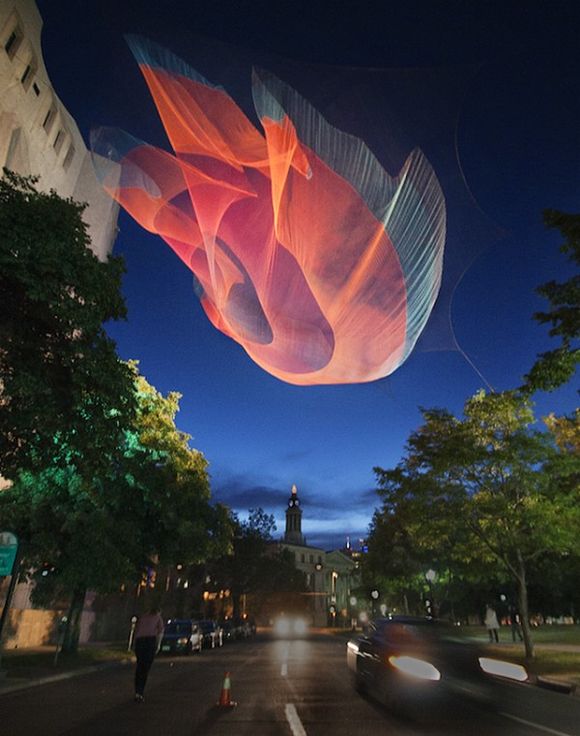
    Janet Echelman. 1.26 Sculpture Project at the Biennial of the Americas. Denver, Colorado.
    July 6 – August 6, 2010

    “The City of Denver asked the artist to create a monumental yet temporary work exploring the theme of the interconnectedness of the 35 nations that make up the Western Hemisphere. She drew inspiration from the NASA Jet Propulsion Laboratory’s announcement that the February 2010 Chile earthquake shortened the length of the earth’s day by 1.26 microseconds by slightly redistributing the earth’s mass. A 3-dimensional form of the tsunami’s amplitude rippling across the Pacific became the basis for the sculptural form. Exploring further, Echelman drew on a National Oceanic and Atmospheric Administration (NOAA) simulation of the earthquake’s ensuing tsunami, using the 3-dimensional form of the tsunami’s amplitude rippling across the Pacific as the basis for her sculptural form.

    1.26 pioneers a tensile support matrix of Spectra® fiber, a material 15 times stronger than steel by weight. This low-impact, super-lightweight design makes it possible to temporarily attach the sculpture directly to the façade of buildings – a structural system that opens up a new trajectory for the artist’s work in urban airspace.”

    More here, here, and here.

    Thanks to Jeanne Ackman Rosen.

    Sunday, November 10, 2013

    Socialize Social Media! A manifesto from n + 1

    Benjamin Kunkel in n + 1:

    ImageOn Wednesday, November 6, Twitter, the so-called microblogging service, went public, in the private sense. Shares initially offered at $26 were by the end of the day trading near $45, giving a company with fewer than 900 employees a market value of more than $31 billion, and meaning that each of the service’s 230 million users—who are also, in a real sense, its producers—could be considered to be contributing $135 to the company’s value. That value is almost certain to fall, since Twitter shares appear ludicrously overpriced. As John Cassidy of the New Yorker calculated, “Investors were paying forty-nine dollars per dollar of revenues, and five hundred and forty-one dollars per dollar of cash flow . . . Apple, the most valuable technology company in the world, trades at less than three times its revenue and eight times its cash flow.” But large for-profit social-media services are contradictory entities at any price, because they attempt to profit from activity that, precisely because it is social, is basically non-economic and non-productive. Social media can either be profitable or it can be social. In the end, it can’t be both.

    More here.

    Norman Geras: 1943-2013

    Geras

    I've been meaning to post about Geras's death. I didn't always agree with him, but then I don't always agree with Abbas or Morgan. But I did respect his mind. Ben Cohen in Tablet:

    There is one memory of Norman Geras–the distinguished academic, prolific author and blogger, and doughty fighter against anti-Semitism and racism, who passed away in England earlier today–that has stayed with me for the last twenty-five years. It was a dreary afternoon in the northern English city of Manchester, late in 1988. About twenty students, nearly all of us professed Marxists, had gathered for Geras’s weekly university seminar on Marxism. As we discussed how class interests manifest in politics, one participant, who clearly wasn’t a Marxist, opined that not every owner of the means of production was hellbent on class warfare. Could we not accept, in his inimitable phrase, that there were “cuddly capitalists?”

    Immediately, there were dismissive grunts and sycophantic glances in Geras’s direction. Surely the great Professor, on whose every word we hung, would rip this insolent pawn of the hated bourgeoisie a new one? But Norman Geras was not that kind of man. He answered with clarity and sympathy, artfully guiding the student through whatever text it was we were examining. In those few moments, the aspiring revolutionaries in his classroom were taught a salutary lesson on the enduring bourgeois values of respect, tolerance and kindness.

    More here.

    When Socrates Met Phaedrus: Eros in Philosophy

    Plato3

    Simon Critchley in The NYT's The Stone:

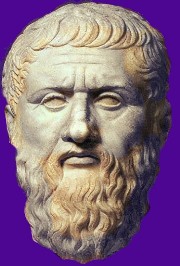
    [H]ow are we to understand the nature of eros as it appears in Plato’s “Phaedrus”? And here we approach the central enigma of the dialogue. For it appears to deal with two distinct topics: eros and rhetoric. My thought is very simple: I will try and show that these twin themes of eros and rhetoric are really one and they help explain that peculiar form of discourse that Socrates calls philosophy.

    For the ancient Greeks, there was obviously a close connection between the passions or emotions, like eros, and rhetoric. We need only recall that Aristotle’s discussion of the emotions is in the “Rhetoric.” Emotion was linked to rhetoric, for Aristotle, because it could influence judgment, in the legal, moral or political senses of the word.

    Of course, in the Athens of Socrates’ time, the two groups of people capable of stirring up powerful emotions were the tragic poets and the Sophists. Let’s just say that Socrates had issues with both groups. Tragedy, again in Aristotle’s sense, stirs up the emotions of pity and fear in a way that leads to their katharsis, understood as purgation or, better, purification. The Sophists exploited the link between emotion and rhetoric in order to teach the art of persuasive speech that was central to the practice of law and litigation. Classical Athens was a very litigious place, but mercifully did not have lawyers. Therefore, men (and it was just men) had to defend themselves and Sophists taught those who could pay a fee how to do it.

    More here.

    Games of Truth

    Face-map-383x574

    Rob Horning in The New Inquiry:

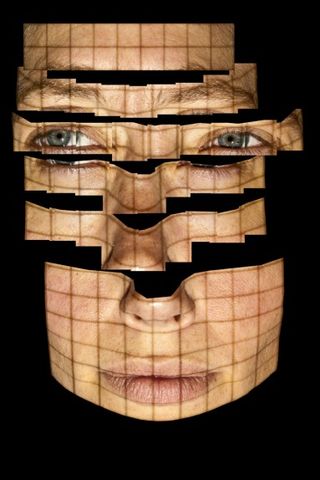
    Foucault’s last two lecture series at the Collège de France, in 1982-83 and 1983-84 — published in English as The Government of Self and Others and The Courage of the Truth — offer a series of interpretations of ancient Greek texts Foucault’s Berkeley lectures from 1983 also deal with parrhesia.to examine the relation of the “self” to public truth-telling. What did it mean to “know thyself,” as the Delphic oracle advised? What procedures guaranteed the truth of such knowledge? And why would telling the truth about the self be a precondition for having a self in the first place? Here’s how Foucault describes what he hoped to do in these lectures (poignantly, slipping into the subjective; he knew he wouldn’t get the project finished):

    What I would like to recover is how truth-telling, in this ethical modality which appeared with Socrates right at the start of Western philosophy, interacted with the principle of existence as an oeuvre to be fashioned in all its possible perfection, how the care of self, which, in the Greek tradition long before Socrates, was governed by the principle of a brilliant and memorable existence, […] was not replaced but taken up, inflected, modified, and re-elaborated by the principle of truth-telling that has to be confronted courageously, how the objective of a beautiful existence and the task of giving an account of oneself in the game of truth were combined …

    The emergence of the true life in the principle and form of truth-telling (telling the truth to others and to oneself, about oneself and about others), of the true life and the game of truth-telling, is the theme, the problem that I would have liked to study [Feb. 29, 1984, lecture].

    I’ve bolded the parts that jumped out at me in that passage, the ones that reminded me of social-media practice. The archive social media compiles of us could be seen as an “oeuvre to be fashioned in all its possible perfection”; it allows us to live with that ideal much more concretely in mind. Social media give us an opportunity to “confront courageously” the principles of truth-telling — how much to share, with whom, and with how much concern for our and others’ privacy — that are activated by the various platforms.

    For Foucault, that aim of living a “beautiful existence” has not been understood as something that can be achieved through a passive documentation of what we’ve done — escaping reflexivity does not make life more beautiful or pure as those who make a fetish of spontaneity insist. Instead, he argues that the “beautiful existence” came to hinge on playing “games of truth” that reveal the self to itself, as courageous.

    The “true life” is no longer given automatically to ordinary people as a reward for their ordinariness. We too must prove our lives are true, are real, are legitimate, to the audiences we marshal on social media.

    More here.

    Palestinian artist Larissa Sansour’s Science Faction

    Kevin Jones in ArtAsiaPacific:

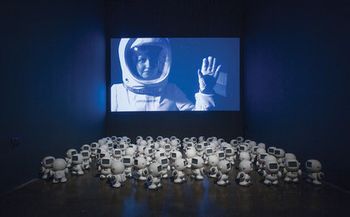
    Reviews_dubai_420As the name indicates, “Science Faction,” at Dubai’s Lawrie Shabibi Gallery, showcased Sansour’s appropriation of sci-fi in her ongoing dissection of the Palestinian impasse. The slick “Nation Estate” project (2012)—comprising the aforementioned nine-minute film, alongside “outtake” photos—was accompanied by the placid A Space Exodus video from 2009. Beyond the artist’s sci-fi influences, the show captured a maturation in Sansour’s use of humor and formalist balance. Exhibiting only two films separated by a mere three years, “Science Faction” neatly revealed her deepening message and increasingly sophisticated vision; it managed to freeze-frame an artist on the cusp of a ripened critical sensibility.

    In Sansour’s work, the concept of sci-fi perfectly mirrors the Palestinian condition—they both project to the future, but are mired in worn-out symbolism. Inspired by Stanley Kubrick’s 2001: A Space Odyssey (1968), with a tinge of Neil Armstrong’s moon walk the following year, A Space Exodus is ultimately an examination of power. A Palestinian astronaut (played by Sansour) plants a flag with her national colors on the lunar surface—the disenfranchised are suddenly mighty colonizers instead of stateless masses. The irony and wit here is razor sharp, despite the film’s unsettling ending (the protagonist eventually loses contact with home base in Jerusalem and drifts off into the unfathomable cosmos). An army of “Palestinauts”—toy replicas of the Palestinian spacewoman—teemed below the screen, further underscoring the accessibility and wry humor of A Space Exodus. Nation Estate employs sci-fi tropes as part of a more sophisticated examination of identity. “The struggle is what defines us as Palestinians,” says Sansour. “If you take that away, what is left?” Symbols, of course: olive trees, keffiyeh, flags, keys. Nation Estate features an explosion of symbols—a knowing, formalist gesture within a high-gloss, antidocumentary strategy.

    More here.

    Elizabeth Jane Howard: the novelist at 90

    Sabine Durrant in The Telegraph:

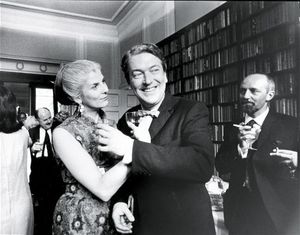
    With_Kingsley_Amis_2727030cElizabeth Jane Howard – Jane to her friends – is the great underrated novelist of the post-war period. For years, she was really more famous for being the muse of her more renowned associates (affairs with Arthur Koestler, Kenneth Tynan, Laurie Lee, Cecil Day-Lewis; marriage to Kingsley Amis). Her first book, The Beautiful Visit, won the John Llewellyn Rhys Prize in 1951, and her subsequent novels, such intricate masterpieces of style and tone as The Long View and The Sea Change, were widely praised, but she was never shortlisted for the Booker. “One was rather sad about that. I have missed the bus now.” It is for The Cazalet Chronicles that she is most known and loved – the unravelling semi-autobiographical saga of an upper-middle-class family in the period around the Second World War, the bulk of which she wrote in a flurry in the 1990s.

    …“Kingsley felt women were for f— and cooking. He stopped wanting to f— because if you get really very drunk all the time you stop being able to do it. That was no good. And he hated food. He would say, ‘This isn’t very nice,’ or, worse, ‘This is a bit authentic.’” She laughs, then coughs, giving her chest a bash. “Put that in. It’s funny. He could be terribly funny. That was one of the lovely things about him, really.” Amis wouldn’t see her after she left him – in his Memoirs he refers to her mostly as “my second wife”. Did that upset her? “He never forgave me, I’m afraid. I didn’t realise the depths of his phobias until I read Mart’s [Martin Amis’s] autobiography Experience, his terror of being alone. He concealed it really, and that was a great mistake. If I had known, I think I would have been better at dealing with it.” She is still in touch with Mart, her stepson. “He always says I got him educated and it is absolutely true. I gave him a copy of Pride and Prejudice and made him read it. But I tried just as hard with Sally and Philip, his siblings, and got nowhere, so it might have happened anyway.

    Picture: Elizabeth Jane Howard with Kingsley Amis at their wedding reception in 1965.

    More here.

    Sunday Poem

    After Apple Picking

    My long two-pointed ladder's sticking through a tree
    Toward heaven still.
    And there's a barrel that I didn't fill
    Beside it, and there may be two or three
    Apples I didn't pick upon some bough.
    But I am done with apple-picking now.
    Essence of winter sleep is on the night,
    The scent of apples; I am drowsing off.
    I cannot shake the shimmer from my sight
    I got from looking through a pane of glass
    I skimmed this morning from the water-trough,
    And held against the world of hoary grass.
    It melted, and I let it fall and break.
    But I was well
    Upon my way to sleep before it fell,
    And I could tell
    What form my dreaming was about to take.
    Magnified apples appear and reappear,
    Stem end and blossom end,
    And every fleck of russet showing clear.
    My instep arch not only keeps the ache,
    It keeps the pressure of a ladder-round.
    And I keep hearing from the cellar-bin
    That rumbling sound
    Of load on load of apples coming in.
    For I have had too much
    Of apple-picking; I am overtired
    Of the great harvest I myself desired.
    There were ten thousand thousand fruit to touch,
    Cherish in hand, lift down, and not let fall,
    For all
    That struck the earth,
    No matter if not bruised, or spiked with stubble,
    Went surely to the cider-apple heap
    As of no worth.
    One can see what will trouble
    This sleep of mine, whatever sleep it is.
    Were he not gone,
    The woodchuck could say whether it's like his
    Long sleep, as I describe its coming on,
    Or just some human sleep.

    by Robert Frost
    from Robert Frost: Collected Poems, Prose and Plays