WHAT PROOFS ABOUT GOD REALLY PROVE

LesendeMoncheNathan Schneider at Killing The Buddha:

William Lane Craig has faced Richard Dawkins in a debate about the existence of God only once. It was on November 13, 2010—part of La Ciudad de las Ideas, a three-day, all-star conference in Puebla, Mexico. The setting there suited the drama of the occasion; a podium stood at the center of a full-size boxing ring, which the debaters mounted in turn. The event’s organizer, the Mexican television personality Andrés Roemer, later described them to me as “gladiatores mentales” in “a war of intelligence and arguments.” There were three men on each side. Three thousand people watched live in the audience, and as many as ten million saw it on TV, especially when it was rebroadcast after the boxing match the following night between Manny Pacquiao and Antonio Margarito.

Richard Dawkins, whose name many people are likelier to know than Craig’s, was once professor of “the Public Understanding of Science” at Oxford. He wrote a parade of well-regarded popular books on evolutionary biology. In retirement, he has turned his attention to—or, against—religion.

more here.

David Simon: ‘There are now two Americas. My country is a horror show’

David Simon in The Guardian:

ScreenHunter_455 Dec. 10 20.42America is a country that is now utterly divided when it comes to its society, its economy, its politics. There are definitely two Americas. I live in one, on one block in Baltimore that is part of the viable America, the America that is connected to its own economy, where there is a plausible future for the people born into it. About 20 blocks away is another America entirely. It's astonishing how little we have to do with each other, and yet we are living in such proximity.

There's no barbed wire around West Baltimore or around East Baltimore, around Pimlico, the areas in my city that have been utterly divorced from the American experience that I know. But there might as well be. We've somehow managed to march on to two separate futures and I think you're seeing this more and more in the west. I don't think it's unique to America.

I think we've perfected a lot of the tragedy and we're getting there faster than a lot of other places that may be a little more reasoned, but my dangerous idea kind of involves this fellow who got left by the wayside in the 20th century and seemed to be almost the butt end of the joke of the 20th century; a fellow named Karl Marx.

I'm not a Marxist in the sense that I don't think Marxism has a very specific clinical answer to what ails us economically. I think Marx was a much better diagnostician than he was a clinician. He was good at figuring out what was wrong or what could be wrong with capitalism if it wasn't attended to and much less credible when it comes to how you might solve that.

More here.

What became of Jesus’s foreskin?

From Medievalists.net:

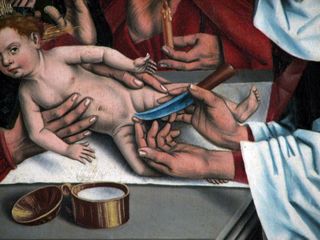
CirconcisionRothenburg-650x487Very few articles have been written on the topic of the Holy Foreskin, partly because in the year 1900 the Roman Catholic Church threatened to excommunicate anyone who did so. However, Robert Palazzo bravely did his research and his article “The Veneration of the Sacred Foreskin(s) of Baby Jesus: A Documentary Analysis,” offers some interesting details about this relic. He notes that apocryphal gospels, such as the The First Gospel of Baby Jesus, which was written sometime before the 6th century, described how the foreskin was kept and passed down from generation to generation.

By the eleventh century, several churches in Europe explained they had the Holy Foreskin – the story often went something like this – Jesus’ mother Mary kept the foreskin, along with the umbilical cord, and later gave it to Mary Magdalene. We then jump forward several centuries to the time of Charlemagne, when an angel gave the relic to the Emperor. From there it went to this place or that place, including to Rome. In 1421, it was even sent to Cathernine of Valois in England, so that it would bring good fortune (and a pregnancy) to her marriage with Henry V.

Palazzo has been able to find at least 31 churches in Europe that claimed to have the Holy Foreskin sometime during the Middle Ages, including ones in Paris, Antwerp, Bologna, Compostela and Toulouse.

More here.

Rites of Spring: A chronicle of Egypt’s uprising comes to grips with political reality

Hussein Ibish in Bookforum:

Cover00Henri Lefebvre’s notion of “Revolution as Festival,” which the great French political thinker developed in his account of popular uprisings of the twentieth century, continues to inspire today’s global Left and its ideas of “people power.” Cultural theorist Gavin Grindon cannily sees this vernacular spirit of celebration in “the global cycle of social struggles since the 1990s, from Reclaim the Streets to the Seattle World Trade Organization Csarnival Against Capitalism, Euromayday and Climate Camp to Occupy’s Debt Jubilee.” And this same narrative—which at times approached a shared, lived reality—informed many domestic and international perceptions of the early “Arab Spring” uprisings of 2011, particularly those in Tunisia and Egypt.

Most of Ahdaf Soueif’s new book, Cairo, participates wholeheartedly in this celebratory, utopian account of the eighteen-day overthrow of Egyptian dictator Hosni Mubarak and its aftermath. But as Soueif traces the still-unresolved and unstable arc of Egypt’s unfolding saga, she comes away—as Lefebvre would have anticipated—with a much more subdued evaluation of just how this festival may end. Looking back on his own youthful idealism, Lefebvre—with an obviously heavy heart—recalled how “a few years after the Russian Revolution,” the French Left “naïvely imagined the revolution as an incessant popular festival.” And in Soueif’s account of Mubarak’s downfall, there are hints of a similar leap of imagination. “Everyone is suddenly, miraculously, completely themselves,” she writes of the uprising. “Everyone understands.”

More here.

Richard Dawkins: Adversarial Journalism and The Selfish Gene

Richard Dawkins at the RDFRS website:

ScreenHunter_454 Dec. 10 14.12I have been asked to respond to an article by David Dobbs called ‘Die, selfish gene, die’. It’s a fluent piece of writing featuring some interesting biological observations, but it’s fatally marred: infected by an all-too-common journalistic tendency, the adversarial urge to (presumably) boost circulation and harvest clicks by pretending to be controversial. You have a topic X, which you laudably want to pass on to your readers. But it’s not enough that X is interesting in its own right; you have to adversarialise it: yell that X is revolutionary, new, paradigm-shifting, dramatically overthrowing some Y.

The Y in Dobbs’ article is my book, The Selfish Gene, and his main X is the important but far from new point that genes are not always expressed in the same way. He calls it phenotypic plasticity. Locusts are transformed grasshoppers: same genes, differently expressed. A caterpillar and the butterfly it morphs into have exactly the same genome, expressed in different ways. An animal is the way it is, not just because of the genes it possesses but because the context in which a gene sits affects how – and indeed whether – it is expressed. Dobbs makes some sensible points about all this, but there’s not a single one of them that I wouldn’t be happy to make myself – and in most cases did make, either in The Selfish Gene itself or in my other books. But his headline conclusion, namely that recent findings negate the thesis of The Selfish Gene, is not just untrue but deeply and perversely untrue.

More here.

Vitamins’ Old, Old Edge

Carl Zimmer in The New York Times:

VitIn 1602, a Spanish fleet was sailing up the Pacific coast of Mexico when the crew became deathly ill. “The first symptom is pain in the whole body that makes it sensitive to touch,” wrote Antonio de la Ascensión, a priest on the expedition. “Purple spots begin to cover the body, especially from the waist down; then the gums become so swollen that the teeth cannot be brought together, and they can only drink, and finally they die all of a sudden, while talking.” The crew was suffering from scurvy, a disease that was then both bitterly familiar and deeply mysterious. No one knew why it struck sailors or how to cure it. But on that 1602 voyage, Ascensión witnessed what he considered a miracle. While the crew was ashore burying the dead, one sick sailor picked up a cactus fruit to eat. He started to feel better, and his crewmates followed his example. “They all began to eat them and bring them back on board so that, after another two weeks, they were all healed,” the priest wrote. Over the next two centuries, it gradually became clear that scurvy was caused by a lack of fruits and vegetables on long-distance voyages. In the late 1700s, the British Navy started supplying its ships with millions of gallons of lemon juice, eradicating scurvy. But it wasn’t until 1928 that the Hungarian biochemist Albert Szent-Gyorgyi discovered the ingredient that cured scurvy: vitamin C.

Szent-Gyorgyi’s experiments were part of a wave of early-20th-century research that pulled back the curtain on vitamins. Scientists discovered that the human body required minuscule amounts of 13 organic molecules. A deficiency of any of the vitamins led to different diseases — a lack of vitamin A to blindness, vitamin B12 to severe anemia, vitamin D to rickets. Today, a huge amount of research goes into understanding vitamins, but most of it is focused on how much of them people need to stay healthy. This work does not address a basic question, though: How did we end up so dependent on these peculiar little molecules?

More here.

Tuesday Poem

The Tragedy of Hats

is that you can never see the one you're wearing,
that no one believes the lies they tell,
that they grow to be more famous than you,
that you could die in one but you won't be buried in it.

That we use them to create dogs
in our own image. That the dogs
in their mortarboards and baseball caps and veils
crush our hubris with their unconcern.

That Norma Desmond's flirty cocktail hat flung aside
left a cowlick that doomed her. That two old ladies
catfighting in Hutzler's Better Dresses both wore flowered
straw. Of my grandmother the amateur hatmaker,

this legend: that the holdup man at the Mercantile
turned to say Madam I love your hat before
he shot the teller dead who'd giggled at her
homemade velvet roses. O happy tragedy of hats!

That they make us mimic classic gestures,
inspiring pleasure first, then pity and then fear.
See how we tip them, hold them prettily against the wind
or pull them off and mop our sweaty brows

like our beloved foolish dead in photographs.
Like farmers plowing under the ancient sun.
.

by Clarinda Harriss
from Poetry, 1999

Monday, December 9, 2013

perceptions

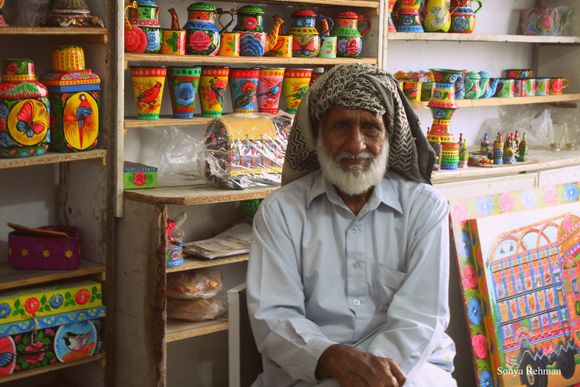
Haji sahib

Haji Habib-ur-Rehman, or Haji Sahib, who has been painting trucks, vehicles, and crafts since 1955, in Rawalpindi, Pakistan.

“They are everywhere. Those heavy-set Gods of the highway, those mammoth trucks in their entire jazzy splendor. The swirls, the motifs, the colours, the patterns, the tigers, the peacocks, the parrots, the lions, and the roses, the thick lashes on singular eyes, the lips, and (at times) the face of a politician, a star, thrown in for good measure …” from Allah Rung Laave by Sonia Rehman.

More here, here, and here.

Thanks to Nighat Mir.

Personal narrative on a journey to find the confluence of the Chicago River and the North Shore Channel

by Liam Heneghan

Chicago River Argyle IIOn the Saturday after Thanksgiving I walked, without having given it very much forethought, nor having fortified myself with breakfast, nor even with sufficient tea, a distance of about 7 miles from my home to discover the confluence of the North Shore Channel and the Chicago River. The digging of the former waterway was completed in 1909 in order to bear the sewage from Chicago’s prosperous North Shore communities away from Lake Michigan and into the Chicago River. By that time the Chicago River was itself a marvel of engineering, its flow having been reversed so that all soluble, floatable and mobile waste ran west into the Mississippi watershed rather than into the lake.

Breakfastlessly I walked alongside this water, keeping the channel to my left for the first few miles then crossing over into the parks to the east of the channel. In many places buckthorn, a dominant invasive species in the Midwest, and by some accounts the most common woody plant in Chicago, is so dense that I only rarely saw water. At its densest the soil under these plants is litter-less and rivulets have rent passageways through the channel bank.

Although it was past 10 AM when I walked under the bridge on Lincoln avenue, a homeless man swiveled in his sleeping bag, his head almost fully submerged, trying, on that cold morning, to stay aslumber. His radio played a Christmas carol on low; a paperback best seller peeped out from one of his bags. A little further along a woman behind me asked if I had enough food to keep me going. I turned but she was talking to another homeless fellow so on I walked.

I had not checked on a map where the confluence occurred, nor did I have a phone that I could consult. I knew that it could not be too far since I had kayaked the Chicago River north of Addison, though that spot was still a few miles to my south. As I walked through a park near Foster Avenue, the Canada geese glanced up from their listless grazing, and I finally spotted the fork where the two waters co-mingle. I could not, however, get close as I was separated from the water by a chain link fence and by phalanxes of those invasive shrubs. I leaned there for a moment against a spindly hackberry.

Read more »

Sunday, December 8, 2013

Adrian Moore on Bernard Williams on Ethics

Over at Philosophy Bites:

Bernard Williams was one of the most brilliant philosophers of his generation. In this episode of the Philosophy Bites, Adrian Moore, who knew him well, discusses his views about ethics.

Philosophy Bites is currently unfunded. If you enjoy our podcast, please support us by using the Paypal buttons on this site to subscribe or donate to the podcast.

Listen to Adrian Moore on Bernard Williams on Ethics

Why Biology Belongs in the Study of Politics

Genopolitics

John Hibbing makes the case in the Washington's Post's Monkey Cage:

Larry Bartels recently asked what studies of genes and politics — “genopolitics”– add to our “understanding of politics” and suggested the answer is “not much.” Bartels’s question is perfectly legitimate but his answer deserves more considered reflection.

I suppose those of us involved with genopolitics should be heartened by the tone of Bartels’ essay. After all, if the three stages of scientific discovery are “that can’t be true,” “that’s not important,” and “we’ve known that all the time,” it would appear that the genopolitics movement has entered the second stage.

From my perspective, it is unfortunate that Bartels focuses entirely on genopolitics given that much of the new work on biology and politics does not explicitly involve genes. Early (even pre-natal) development, salient environmental experiences, and genetics all interact to mold people’s biological predispositions, which then shape individuals’ responses to given environmental stimuli. Biology, not genetics alone, is the key and it is now possible to measure politically relevant biological predispositions with physiological, endocrinological, cognitive, and neurosciencetechniques.

But why would we want to? Here we come to an important potential contribution of work on biology and politics. Whether the preferred phrase is implicit attitudes,internalized information, motivated social reasoning, antecedent considerations, orpredispositions, much research shows that, though change is possible, people’s politics are quite consistent over the course of a lifetime.

More here.

Nobel prizewinner Alice Munro: ‘It’s a wonderful thing for the short story’

Lisa Allardice in The Guardian:

Alice-Munro-1980s-001“In many ways I've been writing personal stories all my life,” she said in Bailey's. If you are a Munro fan, you will know about the struggling mink and fox farm of her Depression-era childhood; the family's house at the end of the road; the burden of her mother's Parkinson's disease in her early 40s; her scholarship to university; her early marriage to a bookish student, young motherhood and divorce. And you will recognise the watermarks of shame and guilt running through each collection: “I was brought up in a community where there was shame,” she says of her Scots-Irish Presbyterian rural upbringing. “We say of some things that they can't be forgiven, or that we will never forgive ourselves,” she writes in the last line of Dear Life about her failure to visit her mother during her last illness or even to go to her funeral. “But we do,” she continues with characteristic insistence on absolute truthfulness – “we do it all the time.”

She says her feelings about her mother are “probably the deepest material of my life. I think when you are growing up you have to pull apart from what your mother wants or needs, you've got to go your own way, and that's what I did. And of course she was in a very vulnerable position, which in a way was also a position of power. So that was always a central thing in my life – that I did pull away from her when she was deeply in need. And yet I still feel I did it for salvation.” Her mother's illness meant that Munro took over the housework and care of her younger brother and sister from when she was around nine. “I wanted the house always to be clean. I would bake on Saturdays and I would iron everybody's clothes. It was a way of keeping up respectability. Superficially I was very kind to my mother, but I never allowed myself to enter into her predicament or I would have stayed and become the person who ran the family until she died and then it would have been too late for me to go.”

More here.

Politics and the Persian Language

Lee Lawrence in The Wall Street Journal:

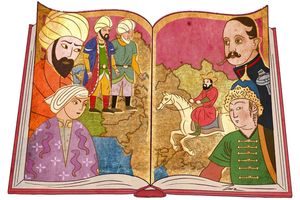
ShahWhether recounted in sweet-smelling tea shops or presented in illustrated manuscripts, the “Shahnameh” has entertained and inspired Iranians for more than 1,000 years. Of all their artistic treasures, Abu'l Qasim Firdausi's “Book of Kings” is the one Iranians most prize. They may not have its 50,000 verses memorized, but they are all familiar with this blend of myth and history filled with tales of heroes slaying demons, portents so fierce that kings fear “their liver will split in terror,” and maidens—oh, what maidens—”as elegant as cypress” and as pure as smokeless candles. From the start, however, the epic has also repeatedly served as a political tool. When Firdausi was penning his verses in 1007-10, Muslim Arab dynasties had ruled Persia for more than 31/2 centuries. Yet he avoided using Arabic words almost entirely and incorporated no elements of Islamic thought. His motive? To stir national pride and resistance to foreign rule by celebrating Persian culture. In the short run, Firdausi's gambit failed. For some 200 years the epic lay dormant, gaining traction only after the Mongols invaded in 1219. Scholars posit that courtiers advised the new rulers to win their subjects' hearts by commissioning sumptuous, illustrated copies of the “Book of Kings” or, as it is sometimes translated, the “King of Books.”

Over the coming centuries, rulers gave manuscripts to dazzle, curry favor or, as happened in 1829, avoid war. Two months after the Russian ambassador was murdered in Tehran, the shah sent a lavish gift package to the czar. Its most precious offerings, says Firuza Abdullaeva, head of the Shahnama Centre at Pembroke College, included Arab horses, gold, an 88.8-carat diamond and a 1651 “Shahnameh” with 192 miniatures. The shah hoped his largesse would so appease the czar that Russia would not only refrain from retaliation but forgive some of the indemnity Iran owed as part of a recent treaty. It worked.

More here.