Why do we listen to our favourite music over and over again?

Elizabeth Hellmuth Margulis in Aeon:

00017089What is music? There’s no end to the parade of philosophers who have wondered about this, but most of us feel confident saying: ‘I know it when I hear it.’ Still, judgments of musicality are notoriously malleable. That new club tune, obnoxious at first, might become toe-tappingly likeable after a few hearings. Put the most music-apathetic individual in a household where someone is rehearsing for a contemporary music recital and they will leave whistling Ligeti. The simple act of repetition can serve as a quasi-magical agent of musicalisation. Instead of asking: ‘What is music?’ we might have an easier time asking: ‘What do we hear as music?’ And a remarkably large part of the answer appears to be: ‘I know it when I hear it again.’

Psychologists have understood that people prefer things they’ve experienced before at least since Robert Zajonc first demonstrated the ‘mere exposure effect’ in the 1960s. It doesn’t matter whether those things are triangles or pictures or melodies; people report liking them more the second or third time around, even when they aren’t aware of any previous exposure. People seem to misattribute their increased perceptual fluency – their improved ability to process the triangle or the picture or the melody – not to the prior experience, but to some quality of the object itself. Instead of thinking: ‘I’ve seen that triangle before, that’s why I know it,’ they seem to think: ‘Gee, I like that triangle. It makes me feel clever.’ This effect extends to musical listening. But evidence has been accumulating that something more than the mere exposure effect governs the special role of repetition in music.

More here.

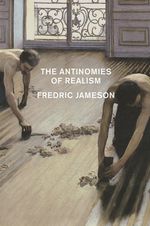
nonsite discusses Fredric Jameson’s new book, The Antinomies of Realism (Verso, 2013)

Antinomies_of_Realism_CMYK_300Goran Blix at nonsite:

It’s clear from Jameson’s latest book that a great deal remains to be said about the emergence and dissolution of the classical realist novel. Concepts like Auerbach’s mimesis and Bakhtin’s dialogism have hardly exhausted the problem, nor have more strictly historical accounts seeking to situate this hybrid form along a spectrum of modes and genres running from romance and epic to melodrama and modernism. Moreover, as Jameson recalls, discussions of realism sadly tend to get bogged down in narrow-minded aesthetic partisanship—realism, for or against?—as if the form could somehow intrinsically reinforce the dominant ideology through its apparent reification of existing reality, or, on the contrary, necessarily point toward the future by capturing the clashing forces working to undermine the status quo. Refreshingly, Jameson here tries to steer clear of any normative assessment and seeks to understand realism instead as a unique and fragile aesthetic constellation that flared up briefly within a larger dialectical movement, which then also ended up dissolving the form.

more here.

Jonathan Swift: His Life and His Work

683px-Jonathan_Swift_by_Charles_Jervas_detail-600x674George O'Brien at The American Scholar:

The final years of the 17th century and the early years of the 18th were turbulent times in England. The fate of the crown itself seemed to be in the balance, as did those of other institutions, Parliament and the Church of England. Yet, oddly, this period is also known as the Augustan Age of English literature—oddly, because the label connotes classical balance and proportion. And indeed such qualities are to be found in the period’s architecture as well as in the heroic couplets of its most accomplished poet, Alexander Pope. But expressions of neoclassical order were hard won, and for an idea of the challenges and complications of this decisive period in the evolution of the British polity, the life and works of Jonathan Swift are a very good place to start. Swift is not just the author of Gulliver’s Travels, though that most original and very alarming treatise on human nature would have been enough to make his name. He was also the author of a good deal of commentary, much of it bitingly satirical, on the manners and methods of the public scene in which he himself was immersed, partly in hopes of preferment. The fact that when these hopes were dashed he turned out to be an Irish patriot is only one of the many paradoxes of a career and a personality in which balance, order, establishment, and affiliation were problematic categories.

more here.

the whitney biennial

170327_r29618-690x583-1489702355Peter Schjeldahl at The New Yorker:

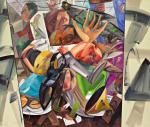
The work in the Biennial that you are most apt to remember, “The Meat Grinder’s Iron Clothes” (2017), by the Los Angeles artist Samara Golden, marries technique and storytelling on a grandiose scale. Golden has constructed eight miniaturized sets of elaborately furnished domestic, ceremonial, and institutional interiors. They sit on top of and are mounted, upside down, beneath tiers that frame one of the Whitney’s tall and wide window views of the Hudson River. Surrounding mirrors multiply the sets upward, downward, and sideways, to infinity. To reach a platform with a midpoint view of the work, you ascend darkened ramps, on which ominous hums, bongs, and whooshes can be heard. Concealed fans add breezes. Politics percolate in evocations of social class and function, with verisimilitude tipping toward the surreal in, for example, a set that suggests at once a beauty parlor, a medical facility, and a prison. But the work’s main appeal is its stunning labor-intensiveness: sofas and chairs finely upholstered, tiny medical instruments gleaming on wheeled carts. Golden is the most ambitious of several artists in the show who appear bent on rivalling Hollywood production design, with a nearly uniform level of skill. I’m reminded of a friend’s remark, apropos of the recent New York art fairs: “I thought I missed good art, but that’s always rare. What I miss is bad art.”

more here.

Traveling Through Palestine While Black: A Firsthand Look at a Slow-Moving Annexation

Bill Fletcher, Jr. in AlterNet:

Boy_and_soldier_in_front_of_israeli_wallIt has become almost a cliché to speak of Gaza, the Palestinian territories on the Mediterranean controlled by Hamas and blockaded by Israel, as the largest open-air prison on the planet. Yet I am not sure I will any longer agree with the limits of that characterization. The Palestinians are all in prison. While Gaza may be a maximum security facility, the West Bank is nevertheless a prison. So little is actually controlled by Palestinians despite the formal notion of autonomy. Israeli military incursions can and do happen at any time convenient for the Israeli government and its military occupation. Palestinians are prohibited from using certain roads. The ominous and illegal separation wall, better known as the apartheid wall, spreads like a disease across the land, dividing the Palestinians not as much from the Israelis as from their own land.

For all of that, it is the sense of permanent insecurity and maximum humiliation that reinforces the feeling one gets of being in a prison. There are checkpoints at seemingly every turn; one is subjected to being stopped at any time. There is an attitude of arrogance and contempt on the part of most of the Israeli military personnel. With their submachine guns and their insistence on using Hebrew in communicating with the Arabic-speaking Palestinians, they invade the space of the indigenous population, always reminding them that there is no such thing as privacy in the Occupied Territories.

More here.

Kitty Genovese

Jordan Michael Smith in The Christian Science Monitor:

KittyOkay, that last name might not be as familiar as the others. But the details of the crime are almost certainly known to you. In New York City in 1964, the 29-year-old Genovese was stabbed to death in three separate attacks as 38 neighbors watched and declined to get involved. At least, that is commonly reported version of the story. But Kevin Cook explains in his new book Kitty Genovese why this simplified version of the story is not the true one. Cook, a freelance journalist, has accessed for his book the detective’s reports of their preliminary interviews with Genovese’s neighbors. He found that, rather than including 38 eyewitnesses, the police log contained 38 entries. Writes Cook: “It was a roundup of interviews with many of Kitty’s neighbors, not a definitive accounting of anything.” Far fewer eyewitnesses actually existed, and those that did were generally fearful of getting involved, rather than indifferent to the woman. The popular figure of 38 resulted from a clerical error provided to the police chief, who passed it along to the New York Times reporter who made the case famous. It was a consequential mistake. The murder shocked Americans, who were horrified and baffled that so many onlookers refrained from intervening to assist the woman. The idea of 38 people so self-obsessed and alienated from their neighbors reflected the anxieties of many citizens, who saw rising crime, feared the Civil Rights Movement, and felt alone in an urbanized America.

CBS’s Mike Wallace narrated a segment on “The Apathetic Americans.” The murder spurred officials to create the 911 emergency-phone system. States created Good Samaritan laws. Victim-compensation laws, witness-assistance programs, neighborhood watch groups – the list of public policy changes that resulted from reaction to the case is extraordinary. Equally more remarkable has been the lasting influence the murder – particularly the false figure reported – has had in academia. One professor tells Cook that the murder is “the most-cited incident in social psychology literature until the September 11 attacks.” Cook manages to maintain an impressive level of tension in a book about a half-century old case about which everyone thinks they know the outcome. He assumes, surely correctly, that while many readers may have heard of the case, they don’t recall the specifics aside from the number of eyewitnesses. So he treats Genovese’s murder like something of a mystery – we may know that she was killed, but not why.

And who was Kitty Genovese, anyway? She was, in fact, a lesbian, a fact that likely would have drastically affected the public’s response to the crime, had it been reported at the time.

More here.

Tuesday Poem

What Makes a Poem

.
The barley
and the manner of its malting
its standing up to the wind
its sprouting and drying
its gradual ripening

The water
and the manner of its flowing
traces of peat and mineral
its floral and honey notes

The mash tun
and the manner of the yeasting
where malt and water mix
starch turning to sugar
the draining of the wort

The still
and the manner of its tending
its shape—column or pot—
the ancient skill of the coppersmith

The cask
and the manner of its keeping
the flavors of the wood
the subtle art of the cooper
its tempering of sublimities

Time
and the manner of its passing
of its passing

The maltmaster
and the manner of his knowing
the manner of his loving
the grain, the water, the copper, the wood,
and the slow ferment of years.

.
David Solway

The Monitored Man

Albert Sun in The New York Times:

MonitorFor years, health advocates have been telling us to move more. But just how much more? A multitude of activity tracking devices now promise to answer that question. Generally, these digital monitors, which can be worn around the wrist, on collars and belts, even as jewelry, record how and how much you move throughout the day. Some aim to do a great deal more. Makers of the devices have begun intensive campaigns aimed at convincing the large population of “worried well” consumers to get wired and start recording their every move. How well do these work? Curious about the benefits and limits, I’ve been testing as many different models as possible — wearing them day and night for six months, 11 models in all, sometimes four at once. I’ve learned a great deal about these gadgets. And about myself.

I’d thought I was a fairly active person: I bike to work most days and hit the gym or get other physical activity two or three times a week. The trackers, on the other hand, showed that aside from those spates of exercise, for the vast majority of each day I was completely sedentary. But that may not be the whole story. Activity trackers typically combine a wearable device with a website or smartphone app to view data collected about your movements. The goal is to measure not only your steps from the parking lot to your desk, but also your sedentary down time at work or in front of a television, bursts of intense exercise and even your sleep habits — all to create a complete picture of your most and least healthful behaviors. Some models also offer tips and set goals based on your data.

More here.

Monday, March 10, 2014

The nominees for the 3QD Politics and Social Science Prize 2014 are:

Alphabetical list of blog names followed by the blog post title:

(Please report any problems with links in the comments section below.)

For prize details, click here.

And after looking around, click here to vote.

  1. 3 Quarks Daily: Can America Survive What Our 1% And Their Useful Idiots, The GOP And The Dems, Have Done To Us?
  2. 3 Quarks Daily: Enduring Sharedom
  3. Abandoned Footnotes: Francisco Franco, Robust Action, and the Power of Non-Commitment
  4. Another Amateur Economist: Walmart, Oligopoly and Community Economy
  5. Committee on the Anthropology of Science, Technology, and Computing: What’s the Matter with Artificial Intelligence?
  6. Corey Robin: Jews Without Israel
  7. Family Inequality: State of Utah falsely claims same-sex marriage ban makes married, man-woman parenting more likely
  8. Forbes: How Putin Invented The New Authoritarianism
  9. Huffington Post: Love in the Syrian Revolution
  10. In Search of Enlightenment: Ottawa Talk on “Bridging the Gap”
  11. Los Angeles Review of Books: I Am Malala : The Girl Who Stood Up For Education and Was Shot by the Taliban
  12. Monkeypicked Aspie: Einstein-Rosen-Podolsky and Me
  13. New Economic Perspectives: Bow down to the Bubble: Larry Summerian Endorses Bubbleonian Madness and Paul Krugman Embraces the Hansenian Stagnation Thesis
  14. Open Democracy: A Cuban Diary
  15. Oxford Human Rights Hub: Malaysia’s Dangerous Path Towards “Allah”
  16. Pandaemonium: In Defense of Diversity
  17. Religious Left Law: Hugo Chávez and Chavismo: The Venezuelan Transcendence of Neo-Liberalism
  18. Save the Post Office: Betrayal without remedy: The unwinding of the Postal Service
  19. Social Pulses: Democratic Austerity: Semi sovereign states, semi sovereign peoples
  20. The Belgravia Dispatch: An Epidemic of Putin Derangement Syndrome
  21. The New Yorker: The Trial of Pervez Musharraf
  22. The Philosopher’s Beard: Britain’s sudden and bizarre resentment of migration
  23. The Philosopher’s Stone: How to Do History
  24. Unreported: The Poster Boy For Unending War
  25. U.S. Intellectual History Blog: Gramsci, Our Contemporary, Part II
  26. U.S. Intellectual History Blog: History, Memory, and THE ACT OF KILLING
  27. U.S. Intellectual History Blog: How American Studies Matter
  28. U.S. Intellectual History Blog: Not Everyone Wants to Hear Lee Atwater Sing the Blues
  29. U.S. Intellectual History Blog: Signs of the Times
  30. U.S. Intellectual History Blog: Thinking Like a Gramscian Historian: An Introduction, a Provocation, and Guide to the Basics
  31. Whispers of Satan: Keeping Ukraine Together
  32. XPostFactoid: What if the (Republican) dog catches the Obamacar(e)?

Vote now for one of the nominees for the 3QD Politics and Social Science Prize 2014

Alphabetical list of nominated blog names followed by the blog post title:

(Please report any problems with links in the comments section below.)

For prize details, click here.

  1. 3 Quarks Daily: Can America Survive What Our 1% And Their Useful Idiots, The GOP And The Dems, Have Done To Us?
  2. 3 Quarks Daily: Enduring Sharedom
  3. Abandoned Footnotes: Francisco Franco, Robust Action, and the Power of Non-Commitment
  4. Another Amateur Economist: Walmart, Oligopoly and Community Economy
  5. Committee on the Anthropology of Science, Technology, and Computing: What’s the Matter with Artificial Intelligence?
  6. Corey Robin: Jews Without Israel
  7. Family Inequality: State of Utah falsely claims same-sex marriage ban makes married, man-woman parenting more likely
  8. Forbes: How Putin Invented The New Authoritarianism
  9. Huffington Post: Love in the Syrian Revolution
  10. In Search of Enlightenment: Ottawa Talk on “Bridging the Gap”
  11. Los Angeles Review of Books: I Am Malala : The Girl Who Stood Up For Education and Was Shot by the Taliban
  12. Monkeypicked Aspie: Einstein-Rosen-Podolsky and Me
  13. New Economic Perspectives: Bow down to the Bubble: Larry Summerian Endorses Bubbleonian Madness and Paul Krugman Embraces the Hansenian Stagnation Thesis
  14. Open Democracy: A Cuban Diary
  15. Oxford Human Rights Hub: Malaysia’s Dangerous Path Towards “Allah”
  16. Pandaemonium: In Defense of Diversity
  17. Religious Left Law: Hugo Chávez and Chavismo: The Venezuelan Transcendence of Neo-Liberalism
  18. Save the Post Office: Betrayal without remedy: The unwinding of the Postal Service
  19. Social Pulses: Democratic Austerity: Semi sovereign states, semi sovereign peoples
  20. The Belgravia Dispatch: An Epidemic of Putin Derangement Syndrome
  21. The New Yorker: The Trial of Pervez Musharraf
  22. The Philosopher's Beard: Britain's sudden and bizarre resentment of migration
  23. The Philosopher's Stone: How to Do History
  24. Unreported: The Poster Boy For Unending War
  25. U.S. Intellectual History Blog: Gramsci, Our Contemporary, Part II
  26. U.S. Intellectual History Blog: History, Memory, and THE ACT OF KILLING
  27. U.S. Intellectual History Blog: How American Studies Matter
  28. U.S. Intellectual History Blog: Not Everyone Wants to Hear Lee Atwater Sing the Blues
  29. U.S. Intellectual History Blog: Signs of the Times
  30. U.S. Intellectual History Blog: Thinking Like a Gramscian Historian: An Introduction, a Provocation, and Guide to the Basics
  31. Whispers of Satan: Keeping Ukraine Together
  32. XPostFactoid: What if the (Republican) dog catches the Obamacar(e)?

If you are new to 3 Quarks Daily, we welcome you and invite you to look around the site after you vote. Learn more about who we are and what we do here, and do check out the full site here. Bookmark us and come back regularly, or sign up for the RSS feed. If you have a blog or website, and like what you see here, we would very much appreciate being added to your blogroll. Please don't forget!

Voting ends on March 13 at 11:59 pm NYC time.

Results of the voting round (the top twenty most-voted-for posts) will be posted on the main page on March 15. The finalists will be announced on March 17 and Winners of the contest will be announced on March 24, 2014.

PLEASE BE AWARE: We have multiple ways of detecting fraud such as multiple votes being cast by the same person. We will disqualify anyone attempting to cheat.

Now click HERE to vote.

Thank you.

Sunday, March 9, 2014

A nice empirical study of vaccine risk communication–and an unfortunate, empirically uninformed reaction to it

Dan Kahan at the Cultural Cognition Project at Yale Law School:

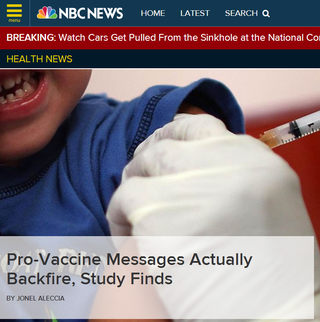
BackfirePediatrics published (in “advance on-line” form)an important study yesterday on the effect of childhood-vaccine risk communication.

The study was conducted by a team of researchers including Brendan Nyhan and Jason Reifler, both of whom have done excellent studies on public-health risk communication in the past.

NR et al. conducted an experiment in which they showed a large sample of U.S. parents with children age 17 or under communications on the risks and benefits of childhood vaccinations.

Exposure to the communications, they report, produced one or another perverse effect, including greater concern over vaccine risks and, among a segment of respondents with negative attitudes toward vaccines, a lower self-reported intent to vaccinate any “future child” for MMR (mumps, measles, rubella).

The media/internet reacted with considerable alarm: “Parents Less Likely to Vaccinate Kids After Hearing Government’s Safety Assurance”; “Trying To Convince Parents To Vaccinate Their Kids Just Makes The Problem Worse”; “Pro-vaccination efforts, debunking autism myths may be scaring wary parents from shots”. Etc.

Actually, I think this a serious misinterpretation of NR et al.

More here. [Thanks to Hugo Mercier.]

30 great one-liners

From The Telegraph:

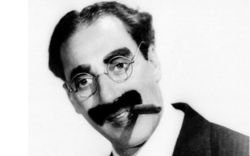
Groucho_2363267kGroucho Marx (1890-1977):

'I never forget a face, but in your case I’d be glad to make an exception.'

Les Dawson (1931-1993):

'My wife sent her photograph to the Lonely Hearts Club. They sent it back saying they weren't that lonely.'

Bob Newhart ( September 5, 1929-):

'I don't like country music, but I don't mean to denigrate those who do. And for the people who like country music, denigrate means 'put down'.

Oscar Wilde (1854-1900):

'The English country gentleman galloping after a fox is the unspeakable in full pursuit of the uneatable.'

Dorothy Parker (1893-1967):

'If you want to know what God thinks of money, just look at the people he gave it to.'

W.C Fields (1880-1946):

'Start every day off with a smile and get it over with.'

More here.

The Distracted Public: Saul Bellow on How Writers and Artists Save Us from the “Moronic Inferno” of Our Time

Maria Popova in Brain Pickings:

“The writer cannot make the seas of distraction stand still, but he [or she] can at times come between the madly distracted and the distractions.”

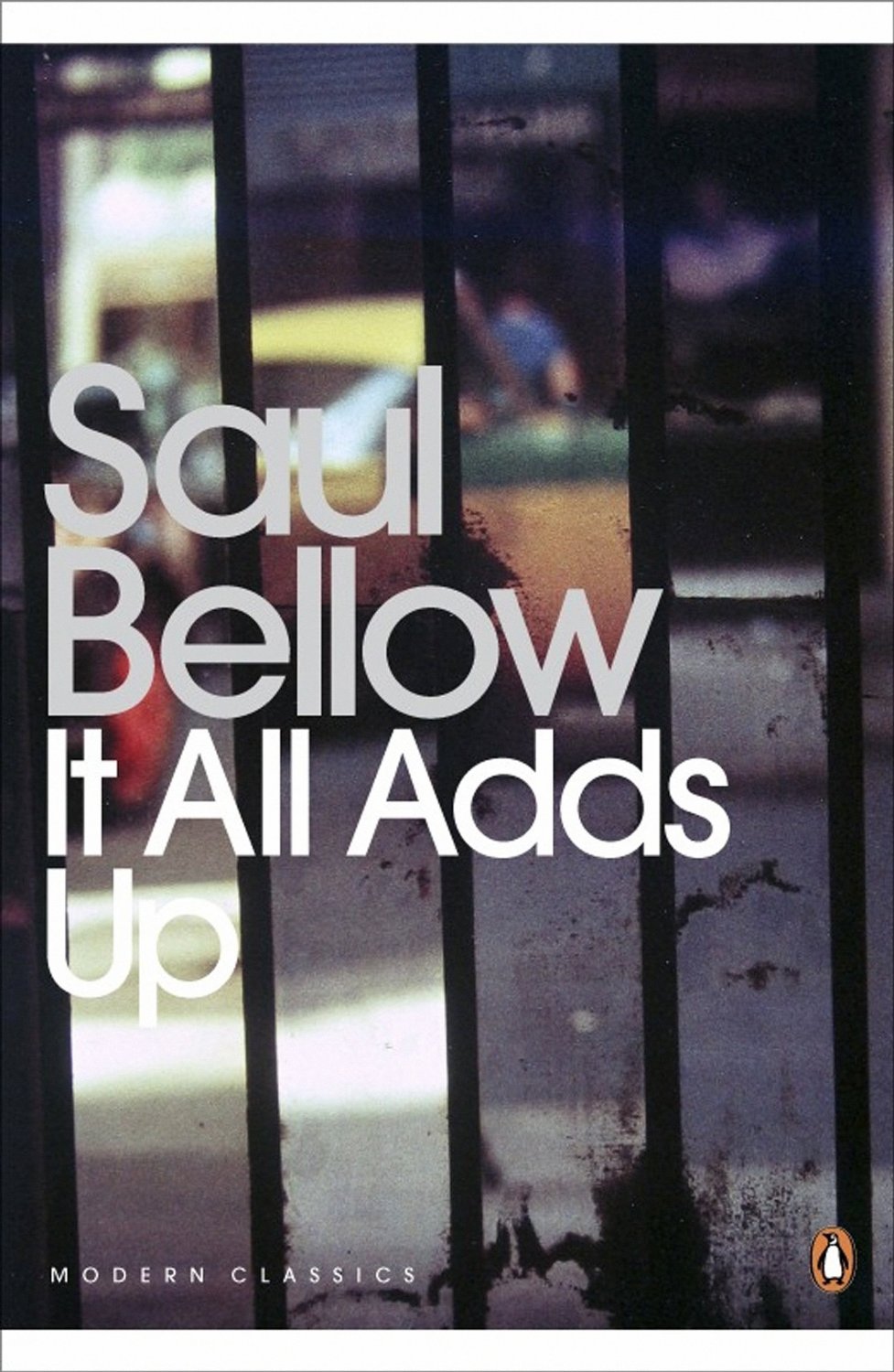
In 1990, fourteen years after he received the Nobel Prize in Literature and the Pulitzer Prize, and two years after being awarded the National Medal of Arts, Saul Bellow delivered a lecture at Oxford University titled “The Distracted Public.” Eventually included in It All Adds Up: From the Dim Past to the Uncertain Future(public library), Bellow’s talk laments the “moronic inferno” — a phrase he borrowed from Wyndham Lewis — produced by the “contemporary crisis” of distraction, “the apocalypse of our times,” calling on artists and writers to raise their voices in countering that “massive and worldwide” “hostile condition” of humanity.

Bellow begins by considering the role of the artist — the writer — in society, and in societies of various regimes:

The writer cannot make the seas of distraction stand still, but he [or she] can at times come between the madly distracted and the distractions. He [or she] does this by opening another world. “Another world,” I am fully aware, carries suggestions of never-never land, and people will be asking themselves how seriously any man can be taken who still believes that the moronic inferno can be put behind us, bypassed or quarantined by art. It isn’t as though the champions of art had won any great victories. Madame Bovary dies of arsenic, and Flaubert the artist-chronicler is dangerously wounded too. Tales of love and death can be mortal to the teller. Yet for many people … the abandonment of art cannot happen. Dictatorships did not succeed in frightening artists to death, nor has democracy done them in altogether, although some observers consider democracy to be by far the greater threat. In the West, Stalinism is sometimes seen as a political disaster but, to artists, a blessing in disguise. It kept them serious. They died, leaving us great works. With us, the arts sink into the great, soft, permissive bosom of basically indifferent and deadly free societies…

More here.

How to Save the US

E4a3b9d2-a40c-11e3-88b0-00144feab7de

Simon Kuper in the FT:

In two recent columns I explained how to save France and the UK. Now that’s done, it’s time to save America. The solution is obvious. The US needs to model itself on its most sanctified institution: the military. I speak from experience. In 2007 and 2008 I spent time on a US military base in a southern state, giving seminars to officers. Being a typical pinko anti-war European, I’d expected to hate the place. Instead I found it idyllic, intellectual and safe. Pottering about the base, I saw several things that the US could learn from its military:

1. Build socialism. Life in the US military is much like life in Sweden (unless you’re off in Afghanistan spreading democracy). The officers in my seminars spent a quarter of their careers in education, because the US military believes in life-long learning. The military also provides socialised healthcare, subsidised childcare, early pensions etc. I’ve never seen a socialist paradise like it, and I grew up in the Netherlands in the 1970s. Most of the military’s entitlements will survive the budget cuts now being proposed by Chuck Hagel, the defence secretary.

2. Ban guns. I was surrounded by fearsome warriors yet I felt perfectly safe, partly because hardly anyone is allowed to carry guns on US military bases. The “right to bear arms” just doesn’t apply there.

3. Believe in science. Any institution that spends its time firing drones from Nevada at pedestrians in Yemen is going to be pro-science. The Pentagon frets about climate change, and the army aims to be “net zero energy” by 2030. The superhero-like Navy Seals are already fuelled partly by solar power.

More here.