
Edith Hall at Aeon Magazine:
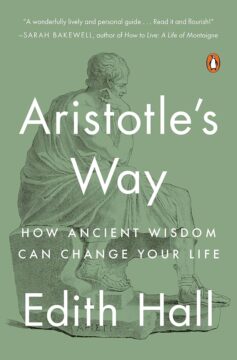 I’m an Aristotle scholar but also an enthusiast for his ideas. I’ve studied his work in the original Greek, and even made a pilgrimage to his birthplace and the various places he lived. He was the most brilliant philosopher ever to have lived. I believe that his Nicomachean Ethics offers us a guide for how to live good lives and flourish. Oddly, though, for a writer whose thinking was so clear and, in many ways, modern, people with radically different stances have tried to claim him for their own.
He often features as a darling of Right-wing ideologues: his Politics is the first text in Benjamin Wiker’s 10 Books Every Conservative Must Read (2010); his authority is invoked on the Breitbart News website. Yet he is celebrated by Marxists for identifying the importance of economic factors in political history, having been heroised in Hugo Gellert’s Karl Marx’ ‘Capital’ in Lithographs (1934). Over the past decade, Aristotle’s face has appeared in Greek wall-art protesting against austerity along with his statement that poverty engenders revolution and crime. On the other hand, his (misinterpreted) views on elites, women and slavery in his Politics are often censured, especially since the advent of ‘cancel’ culture. Yet he has a significant record and potential as a radical and reforming force. This has been overlooked because his views on constitutional issues, the equality of women and even slavery have often been misrepresented, distorted and downright falsified.
more here.
Enjoying the content on 3QD? Help keep us going by donating now.
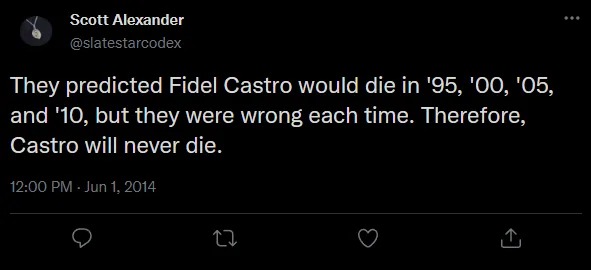 Suppose something important will happen at a certain unknown point. As someone approaches that point, you might be tempted to warn that the thing will happen. If you’re being appropriately cautious, you’ll warn about it before it happens. Then your warning will be wrong. As things continue to progress, you may continue your warnings, and you’ll be wrong each time. Then people will laugh at you and dismiss your predictions, since you were always wrong before. Then the thing will happen and they’ll be unprepared.
 Are hurricanes getting more intense due to climate change? This is one of those questions that seems straightforward—almost banal—but gets weirder the closer you look into it. The discussion atmospheric scientists are having about the drivers of the trend towards stronger hurricanes has shockingly little in common with the simplified story you get in the press.
 3:00 a.m., parked in a public lot across the street from the town beach in Westerly, Rhode Island. Just woke up, sleep evasive. It’s my first week out here. I pour an iced coffee from my cooler. I’m walking around the front of the Toyota I’m now living in when a car pulls into the lot, comes toward me. I see only headlights illuminating my fatigue and the red plastic party cup in my hand. Must be a cop. Someone gets out and approaches. It is a cop, young. I’m not afraid, exactly, but I’m also not yet used to being homeless.
 T
T As a medical doctor, my mother isn’t afraid of needles. But when she recently began injecting insulin daily for her newly diagnosed diabetes, the shots became a frustrating nuisance. A jab is a standard way to deliver insulin, antibodies, RNA vaccines,
  On March 20, 1995, members of a religious cult released toxic gas in three Tokyo subways, killing thirteen people. Some months later, the Japanese novelist Haruki Murakami happened to be reading the letters page of a banal Ladies’ Home Journal–type magazine in which a reader described her husband’s psychological inability to return to his job at the transit authority after surviving the terrorist attack. Murakami decided to interview survivors to examine the many traumatic effects of such a horrific event. The resulting book, Underground: The Tokyo Gas Attack and the Japanese Psyche, is an oral history in the vein of Studs Terkel. In one of the few moments that come from Murakami and not the victims, he inadvertently summarizes one of the core themes of his fiction. Without the ego, he explains, we lose the “narrative” of our identities, which, for him, is vital for our ability to connect with others.
 In the days after Daphna Cardinale delivered her second child, she experienced a rare sense of calm and wonder. The feeling was a relief after so much worrying: She and her husband, Alexander, had tried for three years to conceive before turning to in vitro fertilization, and Daphna, once pregnant, had frequent and painful early contractions. But now, miraculously, here was their baby, their perfect baby, May, with black hair plastered on her head. (May is a nickname that her parents requested to protect her privacy.)
 I think and talk a lot about the risks of powerful AI. The company I’m the CEO of, Anthropic, does a lot of research on how to reduce these risks. Because of this, people sometimes draw the conclusion that I’m a pessimist or “doomer” who thinks AI will be mostly bad or dangerous. I don’t think that at all. In fact, one of my main reasons for focusing on risks is that they’re the only thing standing between us and what I see as a fundamentally positive future. I think that most people are underestimating just how radical the upside of AI could be, just as I think most people are underestimating how bad the risks could be.
 Imagine sitting down with an AI model for a spoken two-hour interview. A friendly voice guides you through a conversation that ranges from your childhood, your formative memories, and your career to your thoughts on immigration policy. Not long after, a virtual replica of you is able to embody your values and preferences with stunning accuracy.
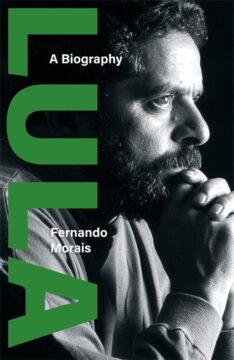 Fernando Morais’s Lula, a new biography of Brazil’s current third-term president, describes the tension on the morning of April 7, 2018. The night before, Luiz Inácio Lula da Silva—known simply as “Lula”—had been charged with corruption and given a day to turn himself in. He’d headed to São Paulo’s Metalworkers Union headquarters to discuss his next moves with a few close associates. “As the sun came up, fourteen of the twenty-four hours given by Judge Moro had come and gone,” Morais writes. “They can come and get me here,” Lula announces.
 In his 1974
 W
W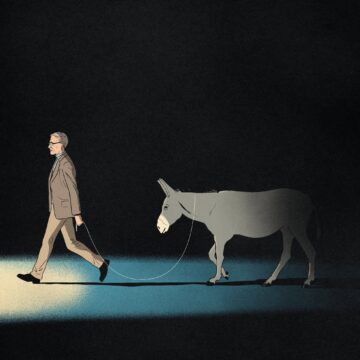 The election victory by Donald Trump and his Republican Party was a rebuke of a Democratic Party that has positioned itself as protector of a despised status quo, rendering it unable to connect with an electorate desperate for change. Defeating Mr. Trump in the future will require liberals, progressives and others on the left to articulate a positive vision that can capture the imagination of a broad majority of Americans.