Making Christianity Our National Religion Would Be Terrible for Christianity

Mike-huckabee

Elizabeth Stoker Bruenig in TNR:

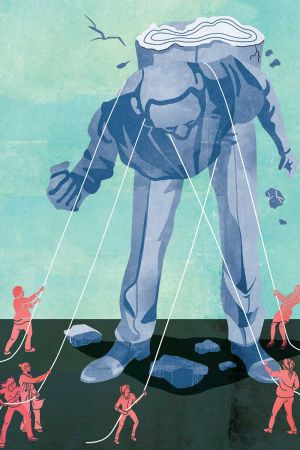
There are, of course, a slew of issues with establishing any state faith, chief among them the First Amendment. Naming state religion would also contravene all Republicans supposedly hold dear when it comes to maintaining a small unobtrusive government. But aside from the illegality and irrationality of it, naming Christianity the United States’ national faith would do damage to the faith and faithful even if it did somehow shore up national morality. This is because national faiths, for better or worse, tend to morph into nationalism with a faith element, rather than a faith that happens to be practiced by a particular nation.

This is already true of right wing rhetoric wherein Christianity is made to stand in for American conflicts or situations. Earlier this month, for example, President Barack Obama faced censorious outcry after noting that Christians of the past carried out the Crusades; with Republicans like Governor Bobby Jindal accusing the president of going hard on Christianity in lieu of ISIS, it’s clear the Crusades were, in this instance, turned into an analogy of a purely modern conflict, with Obama implied to be on the wrong side. By criticizing Christianity instead of Islam he was understood to take the side of foreigners rather than Americans.

With Christianity serving so often as a cheap byword for Americanism, it’s no surprise that 54 percent of Republicans believe the president is an undercover Muslim, and that a handful of their vocal politicians believe he does not love America. These are twin suspicions, both impossible to prove, both based on speculation about the president’s internal states, which trade evidence among them, such as the fact that Obama will not say that America is at war with Islam.

Were Christianity named our national religion, it would only be dubbed such to serve a particular national purpose, that is, to straighten out our morals or boost morale for our confrontation of terrorism abroad. But to do this would be to force Christianity into the servitude of particular national interests, which would only further the degree to which the Christian faith is already wrongly conflated with specific American political aims.

More here.
Monsters Together

Lukacs_1-042315_jpg_250x1180_q85

John Lukacs reviews Roger Moorhouse's The Devils’ Alliance: Hitler’s Pact with Stalin, 1939–1941, in the NYRB (Fine Art Images/Heritage Images/Getty Images):

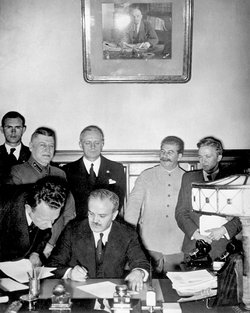
What was more important than the Non-Aggression Pact was its addendum, a Secret Protocol, that called for nothing less than a division of Eastern Europe, particularly Poland, part of which was to be taken over by the Soviets. In addition, Germany recognized Russia’s “sphere of interest” in Estonia, Latvia, Finland, some of Lithuania, and the Romanian province of Bessarabia. Moscow denied the very existence of this Secret Protocol for a long time, well beyond World War II. But it existed in the German archives; and in 1939 it became a somber and dreadful reality. As late as 1986 the aged Molotov (then over ninety) denied its very existence to a Russian journalist. In fact, many of its conditions survived both the world war and the succeeding conflicts until 1989.

Poland, its army and its people, fought the Germans bravely for a month in 1939 (almost as long as France, with its considerable army, in 1940). But seventeen days after the German invasion Stalin’s armies invaded Poland from the east. A few days later in Brest, a meeting place then just on the Russian side of the new partition of Poland, there was a small joint military parade of Nazi and Soviet soldiers and military vehicles. Just over two months later, less than three months after the outbreak of World War II, the only fighting on land in Europe was between Russians and Finns, who would not accept Russian control of their country. The British were aghast. They (and the French) even considered, briefly, intervening, but this did not come about. Soon Hitler’s armies conquered Denmark, Norway, Holland, Belgium—and then France. Churchill and Britain stood alone, for more than a year to come.

At the end of September 1939 Ribbentrop flew to Moscow once more to arrange some border deals that would carry out the Secret Protocol. Throughout the war, of all Germany’s high officials, he was the most inclined to seek and keep agreements with the Russians. (His counterpart among the Russians, Molotov, had often reciprocal inclinations.) In this respect we may also notice the reciprocal tendencies of Hitler and Stalin. Hitler thought it necessary to carry out the terms of the alliance with Stalin; Stalin, for his part, was more enthusiastic about it than Hitler. One example is his perhaps unnecessary toast to Hitler after the signing of their pact on August 24, 1939: “I know how much the German nation loves its Führer, I should therefore like to drink to his health.”

More here.

The Case Against Gay Marriage: Top Law Firms Won’t Touch It

Adam Liptak in the NYTimes:

12lawyers-JP-03-master180Representing unpopular clients has a long and proud tradition in American justice, one that experts in legal ethics say is central to the adversarial system. John Adams, the future president, agreed to represent British soldiers accused of murder in the 1770 Boston Massacre. Clarence Darrow defended two union activists who dynamited the Los Angeles Times building in 1910, killing 21 workers. Leading law firms today have lined up to defend detainees at Guantánamo Bay, Cuba, some accused of ties to Al Qaeda.

The Supreme Court has said criminal defendants are entitled to a lawyer. There is no right to counsel in civil cases, but most lawyers do not lightly turn away paying clients. Some lawyers, though, have been forced out of their firms for agreeing to take on clients opposed to same-sex marriage.

Whatever the reason, there is a yawning gap between the uniformity of views among legal elites and the more mixed opinions of the American public and the members of the Supreme Court. Polls indicate that while a slim majority of Americans support same-sex marriage, many remain skeptical, and the court’s decision, expected in June, is likely to be closely divided.

In earlier eras, the opposing sides were more evenly matched in landmark civil rights cases. One of the lawyers who argued in favor of segregated public schools in 1953 in Brown v. Board of Education was John W. Davis, a leader of the glittering New York law firm now known as Davis Polk & Wardwell. He was the Democratic nominee for president in 1924, the ambassador to Britain and the solicitor general, and he once held the record for most Supreme Court arguments in the 20th century.

Read the rest here.

Gasoline and Fertility

James H. Brown, PH.D. and the New Mexico Human Macroecology Group in Nautilus:

ScreenHunter_1136 Apr. 14 13.30The most basic function of a living organism is to take in energy and spend it on survival and reproduction. If humans are unique, then so must our energy use be. What we know today is that our energy use has both deep similarities to, and differences from, that of other animals.

Part of our energy budget is dedicated to biological metabolism, which is the set of processes through which our bodies produce and spend energy derived from the food we eat. This we share in common with all other animals. Unlike all other mammals, however, humans also use extra-biological energy, and a lot of it. The rate of biological energy use (or the metabolic rate) of a human is about 100 watts, equivalent to 2,000 kilocalories per day. But in the most developed countries, our average per capita energy use is on the order of 10,000 watts, or 100 times greater than what we need biologically. The total energy usage of an average person in the U.S., Canada, the Eurozone or Japan is equivalent to the biological metabolic rate of a hypothetical 30-ton primate. About 80 percent of this extra-biological energy consumption comes from burning fossil fuels.

In addition, unlike all other mammals, different communities of humans have vastly different energy consumption patterns. The New Mexico Human Macroecology Group has documented how energy use scales with GDP, a standard measure of economic activity. Across countries today, as per capita GDP increases by about 700 times, per capita energy use increases by about 200 times. This means that in the poorest developing nations of sub-Saharan Africa, the average per capita energy use is barely more than the 100 watts required for basic biological metabolism. Socially derived variations in energy consumption among other species do exist: for example, the alpha male in a wolf pack or a band of gorillas will often have a better diet and spend more energy. But these variations are rarely greater than a factor of two.

More here.

Günter Grass, Writer Who Pried Open Germany’s Past but Hid His Own, Dies at 87

Stephan Kinzer in the New York Times:

GRASS-OBIT-master675Günter Grass, the German novelist, social critic and Nobel Prize winner whom many called his country’s moral conscience but who stunned Europe when he revealed in 2006 that he had been a member of the Waffen-SS during World War II, died on Monday in the northern German city of Lübeck, which had been his home for decades. He was 87.

His longtime publisher, Gerhard Steidl, said that he had learned late Sunday that Mr. Grass had been hospitalized after falling seriously ill very quickly. The cause of death was not announced.

Mr. Steidl said he drank his final schnapps with Mr. Grass eight days ago while they were working together on his most recent book, which he described as a “literary experiment” fusing poetry with prose. It is scheduled to be published in the summer.

“He was fully concentrated on his work until the last moment,” Mr. Steidl said.

Mr. Grass was hardly the only member of his generation who obscured the facts of his wartime life. But because he was a pre-eminent public intellectual who had pushed Germans to confront the ugly aspects of their history, his confession that he had falsified his own biography shocked readers and led some to view his life’s work in a different light.

Mr. Grass came under further scrutiny in 2012 after publishing a poem criticizing Israel for its hostile language toward Iran over its nuclear program. He expressed revulsion at the idea that Israel might be justified in attacking Iran over a perceived nuclear threat and said that such a prospect “endangers the already fragile world peace.”

The poem created an international controversy and prompted a personal attack from Prime Minister Benjamin Netanyahu. Mr. Grass later said that he had not meant to criticize the country, but only its government.

He was propelled to the forefront of postwar literature in 1959, with the publication of his wildly inventive masterpiece “The Tin Drum.” Critics hailed the audacious sweep of his literary imagination.

More here.

Tuesday Poem

As Her Husband Sleeps, Sonya Tells a Story
.

…right in front of the approaching train

a woman and a man fuck in the snow.
Consider, my soul, this texture of stubbornness and quiet:
as she falls and rises
above him in the air,
he wants her and he does not want her—
Consider this approaching train
in which the conductor whistles, rings the bell and shouts
as if refusing to believe in their deafness.
Consider, my soul, the deafness
which seems to have chosen the man
as its earthly vehicle.
The train stops, the conductor whispers
May you win the lottery and spend it all on doctors!
The woman straightens her coat, and laughs—
“One of us had to stop first, sir. I couldn’t.”
.

by Ilya Kaminsky
from Connotation Press
Issue IV, Volume VI: March 2015

Saudis Face Defeat in Yemen and Instability at Home

Mike Whitney in Counterpunch:

House-of-SaudI served for twenty-one years with the CIA’s Directorate of Operations in the Middle East, and during all my years there I accepted on faith my government’s easy assumption that the money the House of Saud was dumping into weaponry and national security meant that the family’s armed forces and bodyguards could keep its members—and their oil—safe … I no longer believe this … sometime soon, one way or another, the House of Saud is coming down.” (The Fall of the House of Saud, Robert Baer, The Atlantic)

Neither the United States nor Saudi Arabia have any right to interfere in Yemen’s internal affairs or to install their own political puppets to head the government. That is the right of the Yemeni people. And while the current process of regime change might be messy and violent, the Houthi rebels better represent the interests of the indigenous population than anyone in Riyadh or Washington. The Saudi-US war is merely aimed at controlling the outcome so Yemen remains within the imperial grip. As Nasrallah says, “The real goal of the war is to retain control and domination of Yemen (but) the Yemeni people will not put up with this aggression and humiliation. They will fight to defend their dignity, their existence, their families, and their territory. And they will be victorious.”

More here.

‘Biophilia’ Celebrates Colorful Creatures, Icky and Otherwise

Dana Jennings in The New York Times:

BioChristopher Marley’s “Biophilia” is much more than a sumptuous coffee-table pleasure. It is also an elegant manifesto meant to nudge us off our couches and easy chairs and out the door. “It is clear to me that we are designed to experience as much of the natural world as possible with all five of our senses,” Mr. Marley writes. And later: “Without meaningful interactions with nature, we begin to deteriorate emotionally and spiritually.” “Biophilia” offers hundreds of spectacular color images of insects, sea creatures, reptiles, birds and fossils and minerals (the last perhaps to remind us that we, too, eventually return to dust). Mr. Marley, an artist, designer and photographer who divides his time between Oregon and Malaysia, says that his “objective is to inspire people to see natural artifacts with fresh eyes.” Preserved specimens are his medium. “Biophilia” is a praise song to all of those lovely and often exotic fellow travelers whom at best we ignore and at worst thoughtlessly kill. It also rightly and subtly scolds us, insists that we are somehow less human when we’re too distracted and dazed by our digital semi-lives.

Though Mr. Marley professes passion for all of nature, it is clear that insects are his purest animal love; his first book, “Pheromone” (2008), focused only on them. “They range in color, size, shape, texture and behavior like no other creatures,” Mr. Marley writes of insects, adding, “If the work I do provides no other benefit than to kindle a new appreciation of insects (and any other creatures that evoke trepidation in the human heart), that is enough for me.”

More here.

We Have Always Been Talking About Headscarves

Unknown

Melissa Schwartzberg reviews Jacob T. Levy's Rationalism, Pluralism and Freedom, in The New Rambler:

Have we been debating headscarves forever? Technically, of course, we haven’t. The French headscarf ban under laïcité is only ten years old. The Supreme Court this term considered the obligations of a potential employer to offer religious accommodations under Title VII of the Civil Rights Act, itself only 50 years old. And certainly debates over headscarves take many forms: the value of secularism and the importance of religious accommodations are different (if related) issues. Yet one might feel – not unreasonably – that the wider debate over whether religious associations constitute a threat to their members’ freedom or provide an important bulwark against state overreach has been both interminable and unanswerable.

In his new book, Jacob Levy tells us that we are right to feel that way. Since “time immemorial” – at least since the Norman Conquest – intermediate bodies have seemed to constitute both sources of liberty and barriers to freedom. And since the inception of liberalism, some political theorists have argued that these associations protect their members’ freedom against state incursions, whereas others have insisted that they constitute a locus of oppression. Levy points to two traditions: one “rationalist,” which urges congruence among associations and the liberal state, one “pluralist,” which emphasizes the freedom of members to associate and to live according to the traditional norms of their groups unencumbered by the state. The book, Levy emphasizes, “studies rather than answers questions” (p. 27) of the circumstances and mechanisms by which intermediate bodies impair or enable their members’ freedom. There can be no partisan victory, and no synthesis: rather, the “liberal understanding of freedom is constitutively torn” between the rationalist distrust of local parochialism and the pluralistic defense of associative freedom.

More here.

Monday, April 13, 2015

Sunday, April 12, 2015

The Prospects for Reform in Islam

Raza Rumi at the Hudson Institute website:

3403_10153209511020511_1485675392_nThe rise of global Islamism in the form of al-Qaeda and the Islamic State of Iraq and al-Sham (ISIS) will pose a major challenge to the security of both Western and Muslim-majority nations for years to come. The threat is particularly acute in Muslim countries because of Islamism’s capacity to claim that it represents Islam in its most pure, truest form. Importantly, the Islamist movement’s power and appeal also derives from its ability to claim that it is advancing both justice and freedom—political ends that the majority of Muslims naturally want for themselves. Many Islamists are able to justify their struggle and their violence by presenting their agenda as the only legitimate pathway for social and political reform. Muslim societies thus face an ideological quagmire; they desperately need a reform agenda movement that is consistent with their deepest faith traditions, but they have yet to successfully formulate an alternative to Islamism that can sustain a pluralistic, participatory politics.

In recent years, the search for an alternative to Islamism has been thwarted by the widening sectarian conflict within Islam, which has increased tensions and driven violence across the Muslim world. In light of this emergency, the need to reform Islamic jurisprudence and social thought has become more urgent than ever. Islamism’s menace to Muslims, however, has been compounded by the weakened state of critical thinking within Islamic religious and political traditions. In developing a reformist alternative to Islamism, Muslims do in fact have a substantial body of both historical as well as contemporary thinking that they can draw upon to help improve their political and social structures and create more just, inclusive societies.

More here.

Learning to read, to write, to teach

William H. Pritchard in The Weekly Standard:

ScreenHunter_1132 Apr. 12 19.20The title of Morris Dickstein’s memoir alludes to an often-quoted line from Robert Lowell’s epilogue to his last book of poems, Day by Day. “Yet why not say what happened?” is Lowell’s question to himself as he prays for “the grace of accuracy.” Dickstein, emeritus professor at CUNY Graduate Center and the author, most recently, of a cultural history of the 1930s, takes Lowell’s question as a personal challenge. Why not say what happened to a man who has lived “a slightly suffocating life” in a Jewish family in New York’s Lower East Side and Flushing, Queens, and who then came to maturity in the distinguished academic purlieus of Columbia and Yale? The “sentimental education,” as he calls it in his subtitle, has less to do with Flaubert’s dreary masterpiece than with a cultivation of the self as instanced in Wordsworth’s “Tintern Abbey,” a poem Dickstein loves: “An education of the feelings as well as the mind” is what he hopes to have explored in thinking and writing about his past.

Perhaps the first thing to note about his book is how much Dickstein must have enjoyed writing it, confronting his past and turning it into a satisfying story. His enthusiasm and high spirits are pervasive, whether he is remembering postwar block parties on Henry Street, a few blocks from the East River, or studying the Talmud at the Rabbi Jacob Joseph School, where he stayed through the 12th grade, “at first perfectly content, then .  .  . increasingly restive, and finally in continual rebellion.” But the rebellion was never total. He continued to live with his parents in Flushing while an undergraduate at Columbia, and, as an observant Jew, kept kosher for long afterwards. When he and his wife (referred to as “L”) are tempted by Parisian cuisine, L breaks kosher with a baguette viande froide while Dickstein remains chaste, still following the rules of a way of life that had “nurtured and sustained” him.

His undergraduate years at Columbia, which he describes as “a college full of brilliant teachers and ravenous students,” were of special interest to me, as I had, in a single year of graduate study there, observed what Dickstein accurately calls the “rough-and-tumble classes” customary at the college. Even the least rough-and-tumble of professors, Lionel Trilling, whose undergraduate class I audited and about whom Dickstein writes with penetration, had the challenge of putting up with, and probably enjoying, the questioning and irreverent students.

More here.

The moral camera

Kenan Malik in Pandaemonium:

Moral-compassImagine a runaway train. If it carries on down its present course it will kill five people. You cannot stop the train, but you can pull a switch and move the train on to another track, down which it will kill not five people but just one person. Should you pull the switch? This is the famous ‘trolley’ problem, a thought experiment first suggested by Philippa Foot in 1967, and which since has become since become one of the most important tools in contemporary moral philosophy. (In Foot’s original, the dilemma featured a runaway trolley, hence the common name of the problem.)

When faced with the question of whether or not to switch the runaway train, most people, unsurprisingly, say ‘Yes’. Now imagine that you are standing on a bridge under which the runaway train will pass. You can stop the train – and the certain death of five people – by dropping a heavy weight in front of it. There is, standing next to you, an exceedingly fat man. Would it be moral for you push him over the bridge and onto the track? Most people now say ‘No’, even though the moral dilemma is the same as before: should you kill one to save the five?

Or consider a dilemma first raised by Peter Singer forty years ago. You are driving along a country road when you hear a plea for help coming from some roadside bushes. You pull over, and see a man seriously injured, covered in blood and writhing in agony. He begs you to take him to a nearby hospital. You want to help, but realize that if you take him the blood will ruin the leather upholstery of your car. So you leave him and drive off. Most people would consider that a monstrous act.

Now suppose you receive a letter that asks for a donation to help save the life of a girl in India. You decide you cannot afford to give to charity since you are saving up to buy a sofa and bin the letter. Few would deem that to be immoral.

Again, there seems to be no objective difference between these two cases. Yet to most people they appear unquestionably morally different.

More here.

We need new models of popular physics communication

Ashutosh Jogalekar in The Curious Wavefunction:

ScreenHunter_1131 Apr. 12 19.03One of the issues I have with Steven Weinberg's list of 13 science books is that they showcase a very specific model of science writing – that of straight explanation and historical exposition. Isaac Asimov was very good at this model, so was George Gamow. Good science writing is of course supposed to be explanatory, but I think we have entered an age where other and more diverse forms of science writing have made a striking appearance. Straight, explanatory science will persist, but in my opinion the future belongs to these novel forms since they bring out the full range of the beauty and pitfalls of science as a quintessentially human endeavor. And since writing is only one form of inquiry, we also need to embrace other novel forms of communication such as poetry and drama.

Why do we need other models of science communication? The problem is best exemplified by popular physics and that is what I will be writing about here. As I have written earlier, one of the issues with today's popular physics writing is that it has sort of plateaued and reached a point of diminishing marginal returns: there are only so many ways in which you can write about relativity or quantum mechanics in a novel way. There are literally hundreds of books on these topics, and yet another volume that clearly explains the mysteries of quantum mechanics to the layman would not be especially enlightening.

Thus, among the most recent science books that buck this trend is one I have truly savored – Amanda Gefter's “Trespassing on Einstein's Lawn“. The book breaks new ground by not just recycling cutting-edge facts about the universe but by presenting these facts engagingly in the form of a very charming memoir about a daughter and a father (disclaimer: although I know Amanda in real life I had been entranced by the book before I met her).

More here.

Dslcollection: A Collecting Project for the 21st Century

Sylvain Levy in Art Asia Pacific:

Dslcollection-color-01_420In 2005, after almost 25 years of collecting art, my wife and I established Dslcollection after our first trip to China. For this project, we knew from the beginning that we did not want to just amass artworks. We wanted to embark on a “collecting project for the 21st century,” with a cultural perspective that reflects two tectonic changes that we are currently experiencing: the rise of China as a superpower, which is altering the face of the world, and the digital era that is transforming humanity as a whole. Today’s collectors have endless opportunities to show their collections to the public, from traditional methods such as museum loans to the post-internet model of sharing on social media or through virtual exhibitions. Yet most private collections are still in the “Digital Stone Age”; according to the website Larry’s List, in 2014 only 12 percent of collectors around the world were found to have an online presence. For Dslcollection, however, the digital world is more than just about having an online presence.

Firstly, the love for art is not a predetermined sensibility. Passion for art, like that for music, is nourished through exposure and education. Digital technology provides a channel for art to reach anyone with an internet connection, thus promising a future in which art is as ubiquitous to culture as popular music. But one has to be cautious with this global democratization—there is a difference between dissemination and vulgarization. A collection should be accessible, but also sophisticated. Collecting art and sharing it on a large scale, such as on the internet, comes with new responsibilities. Showing art virtually is not a new concept. Our vision for Dslcollection is greatly inspired by the late French novelist André Malraux, whose concept of musée imaginaire (“the museum without walls”) advocates presenting art outside the traditional confines of a museum setting. The same can be said of the Google Art Project, an online platform where users can access high-resolution images of artworks from partnering museums and institutions. The world’s art is literally at one’s fingertips.

More here.

The End of Male Supremacy

Melvin Konner in Chronicle of Higher Education:

MenWomen are not equal to men; they are superior in many ways, and in most ways that will count in the future. It is not just a matter of culture or upbringing. It is a matter of chromosomes, genes, hormones, and nerve circuits. It is not mainly because of how experience shapes women, but because of intrinsic differences in the body and the brain. Do these differences account for all the ways women and men differ? No. Are all men one way and all women another? Also no. But none of those considerations seriously impede my argument or deflect its key conclusion: Women are superior in most ways that matter now. And no, I do not mean what was meant by patronizing men who said this in the past — that women are lofty, tender, spiritual creatures. I mean something like the opposite of that. I mean that women are fundamentally pragmatic as well as caring, cooperative as well as competitive, skilled in getting their own egos out of the way, deft in managing people without putting them on the defensive, builders not destroyers. Above all, I mean that women can carry on the business of a complex world in ways that are more focused, efficient, deliberate, and constructive than men’s because women are not frequently distracted by impulses and moods that, sometimes indirectly, lead to sex and violence. Women are more reluctant participants in both. And if they are drawn into wars, these will be wars of necessity, not of choice, founded on rational considerations, not on a clash of egos escalating out of control.

This is not a new idea. Elizabeth Cady Stanton gave an address to the National Woman Suffrage Convention in Washington, D.C., on January 19, 1869. She said, “The same arguments made in this country for extending suffrage … to white men, native born citizens, without property and education, and to foreigners … and the same used by the great Republican party to enfranchise a million black men in the South, all these arguments we have to-day to offer for woman, and one, in addition, stronger than all besides, the difference in man and woman. Because man and woman are the complement of one another, we need woman’s thought in national affairs to make a safe and stable government.” She also said, “When the highest offices in the gift of the people are bought and sold in Wall Street, it is a mere chance who will be our rulers. Whither is a nation tending when brains count for less than bullion, and clowns make laws for queens?” Almost 150 years later, the highest offices are still bought and sold on Wall Street, and clowns make laws for queens.

More here.

Sunday Poem

Let me tell you about my marvelous god

Let me tell you about my marvelous god, how he hides in the hexagons
of the bees, how the drought that wrings its leather hands
above the world is of his making, as well as the rain in the quiet minutes
that leave only thoughts of rain.
An atom is working and working, an atom is working in deepest
night, then bursting like the farthest star; it is far
smaller than a pinprick, far smaller than a zero and it has no will, no
will toward us.
This is why the heart has paced
and paced, will pace and pace across the field where yarrow
was and now is dust. A leaf catches
in a bone. The burrow’s shut by a tumbled clod
and the roots, upturned, are hot to the touch.
How my god is a feathered and whirling thing; you will singe your arm
when you pluck him from the air,
when you pluck him from that sky
where grieving swirls, and you will burn again
throwing him back.

by Susan Stewart
from The Poetry Foundation