
Category: Recommended Reading
julie wilson (1924 – 2015)
Saturday, April 11, 2015
The Later Poetry of Paul Celan
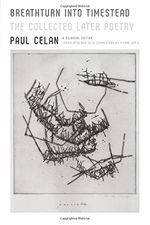
Throughout his life, Paul Celan was haunted by the experience of the Shoah, and his later works see him undergoing something analogous to the turn in Heidegger’s thinking. Until the publication of Breathturn (which marks the beginning of Breathturn Into Timestead), Celan was heavily influenced by both traditional poetry from a variety of languages and the surrealists with whom he spent much of his youth. Even his darkest poems, such as the famous “Todsfuge,” or “Deathfugue,” contain an element of metaphorical lightness, a pleasure in the play of images, despite the horror of their content.
A man lives in the house he plays with his vipers he writes
he writes when it grows dark to Deutschland your golden hair Margareta
he writes it and steps out of doors and the stars are all sparkling, he whistles his hounds to come close
he whistles his Jews into rows has them shovel a grave in the ground
he commands us to play up for the dance.
But, like Heidegger, Celan turned away from the traditional models of his field. This is not, of course, to say that he abandons the tradition of German poetry. If anything, despite his dissatisfaction with the trappings of an inherited poetics, Celan’s turn is his renewed attempt to carry through the Holocaust the central essence of that canon.
more here.
‘Ravensbrück,’ by Sarah Helm

When we hear the phrase “concentration camp,” we usually envision the huge extermination centers the Germans built in Poland as part of their “final solution to the Jewish question,” their effort to murder every Jew they could find. But though it was relatively small, and though it wasn’t primarily an extermination center, Ravensbrück helps us understand how thoroughgoing an onslaught on humanity Nazi Germany perpetrated, and how central to its identity was its implacable urge to enslave and kill those it considered undesirable.
According to researchers at the United States Holocaust Memorial Museum, the Germans established 980 concentration camps; 30,000 slave labor camps; 1,150 Jewish ghettos; 1,000 P.O.W. camps; 500 brothels where women were used as sex slaves; and many other places where victims were killed — 42,500 sites in all.
One of those sites was Ravensbrück, opened in 1939 and situated about 50 miles north of Berlin. The camp’s demography changed as the war progressed. At first the prisoners were what the Nazis called “asocials,” including prostitutes, “race defilers,” “criminals,” Roma and Sinti, as well as political prisoners, especially Communists. But the camp’s population swelled as Germany conquered ever more of Europe, so that it came to include inmates from over 30 countries, including Jews.
more here.
Besieged by virtual demands on our attention, we are losing touch with the world

In Aldous Huxley’s utopian novel Island, mynah birds are trained to fly around the island’s proto-hippy paradise calling, “Attention! Attention!” and “Here and now, boys!”, to keep people alert to the moment.
This seemed a fine idea in 1962, when the novel appeared, but it might work less well in today’s world. Our problem is not so much one of vague absent-mindedness as of bombardment by exactly the sort of uncalled-for twittering Huxley was proposing as a solution. Each time we walk down the street, take a cab, enter an airport or navigate the internet, we field volleys of demands on our attention from advertisers and corporations, as well as from supposed public service announcements and the general cacophony. We don’t need more alerts; we need filters for screening the existing ones out.
Many of us try to achieve this by putting up a wall of phone screens and earphones when we go out. Behind the wall, we are free to tune into our elective world of music, games, and communications with far-off friends. Unfortunately, this can undermine our ability to work with the given world instead of against it. It isolates us and helps turn us into what Simon Schama has recently called a “look-down” generation: always lowering our eyes to a representation of something not there, rather than looking out at what is there — which includes other people.
Such ideas provide the starting point for Matthew Crawford’s The World Beyond Your Head: How to Flourish in an Age of Distraction, which follows his successful The Case for Working With Your Hands (or Shop Class as Soulcraft, as the US edition was more evocatively called).
more here.
About Elly Is Suspenseful, Visually Masterful, and, on Its Own Terms, Perfect
David Edelstein in Vulture:

Elly’s eventual disappearance might be straightforward, or it might be based on factors we don’t yet understand. She could be dead or back in Tehran or somewhere between the beach and the city. As the tension mounts, fissures open up.
More here.
What should happen when parents, acting on religious beliefs, reject medical care for their offspring?
Abraham Verghese in The New York Times:

With Matthew gone, members of Rita Swan’s church banded together, arguing that “children with meningitis die all the time . . . especially in hospitals”; Matthew’s death was evidence that medical science couldn’t do much better. Rita and Doug were ostracized for speaking out at what they saw as medical malpractice. Looking back, Rita Swan offered an explanation for her failure to treat her son, although she had a doctorate in English from Vanderbilt and her husband had one from the University of Vermont in mathematics. Both were well informed, but their faith had cut them off from lifesaving treatment: “Christian Science has all the features of a cult,” she explained. “We should never have allowed ourselves to be isolated like that.”
This story is central to “Bad Faith,” which explores how religious beliefs can undermine medical care.
More here.
Saturday Poem
Moonlight in Mourning of Someone
.
An eyewitness recounts: “At the beginning I was simply stunned by
what he was doing, when I saw him walking above the tips of silver-
grass swaying in the breeze, wondering if he wasn’t indeed Bodhi-
dharma! He raised his cane high, shoved both of his arms outward
and hard, as if he were roaring; maybe he thought he was Moses
parting the Red Sea. Though the stream was shallow, there were
caverns left by illegal excavations. But I didn’t hear any sound of
water; it was early morning on the sixteenth day of the month, the
moon was especially full, the sky was very blue, so there was no
reason why he could not reach the other shore.”
what he was doing, when I saw him walking above the tips of silver-
grass swaying in the breeze, wondering if he wasn’t indeed Bodhi-
dharma! He raised his cane high, shoved both of his arms outward
and hard, as if he were roaring; maybe he thought he was Moses
parting the Red Sea. Though the stream was shallow, there were
caverns left by illegal excavations. But I didn’t hear any sound of
water; it was early morning on the sixteenth day of the month, the
moon was especially full, the sky was very blue, so there was no
reason why he could not reach the other shore.”
Neither his clothes nor even his shoes were wet. According to the
autopsy report, he was drowned by moonlight.
.
by Shang Qin
translation: 2005, Michelle Yeh

‘They,’ the Singular Pronoun, Gets Popular
Ben Zimmer in the Wall Street Journal:

According to standard grammar, “they” and its related forms can only agree with plural antecedents. But English sorely lacks a gender-neutral singular third-person pronoun, and “they” has for centuries been pressed into service for that purpose, much to the grammarians’ chagrin. Now, it seems, those who have held the line against singular “they” may be easing their stance.
“They” most often turns singular in common usage when its antecedent is considered generic, not referring to a single known person. Nearly everyone would find that they can stomach the “they” in this very sentence, agreeing with “nearly everyone.”
Things get trickier when the antecedent of “they” more clearly refers to one person. Areader of this column may not like what they see in this sentence, for instance.
More here.
Bruce Riley, Resin Painter
Bruce from Jason Stanfield on Vimeo.
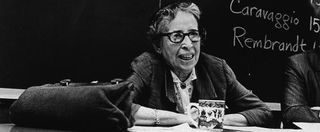
The Hannah Arendt Guide to Friendship
Saul Austerlitz in The New Republic:
Hannah Arendt was a good friend. When she was a teenage girl, she was forbidden by her mother and stepfather from visiting an acquaintance named Anne Mendelssohn, but she went anyway, walking to a nearby town at night, throwing pebbles at Anne’s window, and cementing a lifelong friendship. She came to the rescue of her friend and intellectual sparring partner Mary McCarthy after she suffered a traumatic miscarriage, as Jon Nixon tells us in his engaging biography, Hannah Arendt and the Politics of Friendship, and again while she was going through an emotionally draining divorce. She sent care packages to her former teacher and mentor Karl Jaspers when he and his wife were stuck in Germany, impoverished and hungry, after the war. She protected her husband Heinrich Blucher, as much a friend as a romantic partner, during his professional difficulties as an academic.
Arendt’s web of allegiances opens up a new avenue of approach into her career. More than a bodiless thinker, or a walking scandal, Arendt is depicted here as a woman hungry for companionship, and for the exchange of ideas. It also opens up an area of inquiry into the complex and under-explored dynamic of friendship. “Friendships are not the application of some theory of friendship,” Nixon writes, “nor do they rely on an ongoing reflective meta-dialogue between the friends regarding the nature of their friendship. … There is a great deal that is appropriately and courteously implicit in friendship.” Nixon intends Arendt to be an exemplar of what he repeatedly hints is a now-lost era.
Arendt saw friendship as a middle ground between the solitude and solipsism of internal dialogue, and the terror of the public square. It was a protected space in which ideas could be unveiled, sanded down, hardened, and polished. Her friends were her intellectual compatriots, and her boundless loyalty toward them was also an expression of her deep-seated appreciation for their kindnesses. Friendship was an intensely appealing concept for a woman who spent much of her life as a refugee among refugees, a Jew expelled from her country of birth, adrift in foreign countries. It was a protective amulet, as well as a symbol of the higher values crushed under the boot of totalitarianism. Nazism’s mission was “to eradicate totally any trace of human freedom,” and friendship’s playfulness and compassion was a symbol of rebellion against fascism’s inhumanity.
More here.
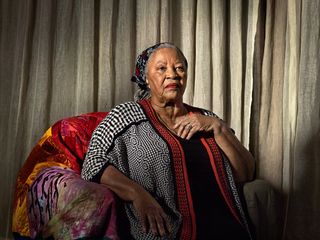
The Radical Vision of Toni Morrison
Rachel Kaadzi Ghanash in The NYT Magazine (Katy Grannan for The New York Times):
[W]hen the poet Henry Dumas went to his death, the way so many black boys and men do, it was Morrison, who never had a chance to meet him and published his work posthumously, who sent around a book-party announcement that was part invitation, part consolation, which read: “In 1968, a young black man, Henry Dumas, went through a turnstile at a New York City subway station. A transit cop shot him in the chest and killed him. Circumstances surrounding his death remain unclear. Before that happened, however, he had written some of the most beautiful, moving and profound poetry and fiction that I have ever in my life read.”
Two years after Dumas’s death, Morrison published her first novel, at 39. In many ways, she had prepared the world for her voice and heralded her arrival with her own editorial work. And yet the story of Pecola Breedlove, a broken black girl who wants blue eyes, was a novel that no one saw coming. Morrison relished unexpectedness. The first edition of “The Bluest Eye” starts Pecola’s story on the cover: “Quiet as it’s kept, there were no marigolds in the fall of 1941. We thought, at the time, that it was because Pecola was having her father’s baby that the marigolds did not grow.”
Morrison’s work, since she published that first novel, has always delivered a heavy load. Her books are populated by both history and the people who are left out of history: a jealous, mentally ill hairdresser with a sharp knife (“Jazz,” 1992); a man who as a child suckled at his mother’s breast until those in the community found it odd (“Song of Solomon,” 1977); an enslaved woman, who would rather slice her own daughter's neck than let captivity happen to her (“Beloved,” 1987); and a destitute little girl, belly swollen with her father’s child, holding a Shirley Temple cup, desperate to have Temple’s bright blue eyes (“The Bluest Eye,” 1970).
On one level, Morrison’s project is obvious: It is a history that stretches across 11 novels and just as many geographies and eras to tell a story that is hardly chronological but is thematically chained and somewhat continuous. This is the project most readily understood and accepted by even her least generous critics. But then there is the other mission, the less obvious one, the one in which Morrison often does the unthinkable as a minority, as a woman, as a former member of the working class: She democratically opens the door to all of her books only to say, “You can come in and you can sit, and you can tell me what you think, and I’m glad you are here, but you should know that this house isn’t built for you or by you.” Here, blackness isn’t a commodity; it isn’t inherently political; it is the race of a people who are varied and complicated. This is where her works become less of a history and more of a liturgy, still stretching across geographies and time, but now more pointedly, to capture and historicize: This is how we pray, this is how we escape, this is how we hurt, this is how we repent, this is how we move on.
More here.
Philosophy of Markets
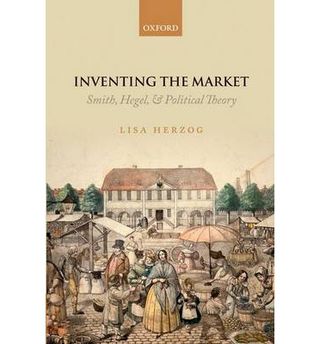
Richard Marshall interviews Liza Herzog in 3:AM Magazine:
3:AM: When you discuss the philosophy of markets you begin by pointing out that economists theorizing and modeling markets are inadequate. What’s the problem?
LH: Economic models make simplifying assumptions about human agency and about social interaction. If one only used these models to answer the questions they are supposed to answer, taking into account their methodological limitations, there wouldn’t be any problem. But often they are used to make much wider claims. For example, predications are based on a theoretical model, but with insufficient discussion of whether the assumptions of the model also hold in reality. Along the way, one often finds that normative judgments sneak in, but without being made explicit. Thus, one cannot even ask critical questions, for example whether certain theories serve the interests of certain social groups – whether they are ideologies in the classical sense.
3:AM: You also suggest that philosophers like Rawls’s on justice and others discussing social and political issues like Elizabeth Anderson tend to discuss the market as something to be tamed from the outside rather than be the central subject. Can you say something about this?
LH: Markets are often treated as “black boxes” in normative theorizing, maybe because of an implicit assumption that they are the economists’ business, not ours. Thinking about the boundaries of markets, and about their place in society, is very important, but it is not the only question we can, and should, ask about them. We also need to think about the internal structures of markets: what is their ontology, what kinds of social relations do they create between individuals, what internal distributive features do they have? Some might say that by treating markets from a philosophical perspective, we bestow too much honor to them, replicating the dominance that the economic sphere already has on our lives. But I think we can best resists the tendencies of markets to colonize the life world, as Habermas put it, if we get a better understanding of what they are, and what is problematic about them.
More here.
Friday, April 10, 2015
Sam Harris and Johann Hari discuss the “war on drugs”
From Sam Harris's blog:

The drug war started almost exactly 100 years ago. That means our great-grandparents could wander into any pharmacy and buy cocaine or heroin. Why did the drug war begin, and who started it?
J. Hari: It’s really fascinating, because when I realized we were coming up to this centenary, I thought of myself as someone who knew a good deal about the drug war. I’d written about it quite a lot, as you know, and I had drug addiction in my family. One of my earliest memories is of trying to wake up one of my relatives and not being able to.
And yet I just realized there were many basic questions I didn’t know the answer to, including exactly the one you’re asking: Why were drugs banned 100 years ago? Why do we continue banning them? What are the actual alternatives in practice? And what really causes drug use and drug addiction?
To find the answers, I went on this long journey—across nine countries, 30,000 miles—and I learned that almost everything I thought at the start was basically wrong. Drugs aren’t what we think they are. The drug war isn’t what we think it is. Drug addiction isn’t what we think it is. And the alternatives aren’t what we think they are.
If you had said to me, “Why were drugs banned?” I would have guessed that most people, if you stopped them in the street, would say, “We don’t want people to become addicted, we don’t want kids to use drugs,” that kind of thing.
What is fascinating when you go back and read the archives from the time is that that stuff barely comes up.
More here.
lagos must prosper

The city of Lagos takes the form of an awkwardly shaped octopus, with tentacles reaching east and west, plucking up land that was once outside of its edges or part of neighbouring states. The metropolis, the commercial capital of Nigeria, is inundated with water, a fact never more obvious than during the rainy season – about half the year. Pushed up against a lagoon, riddled with creeks and canals and lacking drains, the city sinks under the rain and roads disappear. Lagosians pull up their trousers to wade through the water and cars slow to a near-halt as they tentatively plow through rapidly forming lakes. Most residents live on what is called the mainland, the body of the octopus, where quarters continue to become denser as migrants pour into the city. Settlers build precariously on the wetlands, and the homes, constructed quickly and cheaply, routinely fall in on their residents. At least one hundred and thirty-five buildings in Lagos have collapsed over the last seven years, some of them of considerable scale and some of which were schools.
Every morning, more than 60 per cent of the mainland’s inhabitants, from the upper-class neighbourhoods to the poorest shanty towns, cross three choked bridges, leaving the mainland to work on a series of islands. The original downtown of the city is a tight grid of markets, parks and commercial and government buildings called Lagos Island. Today, the city center includes Victoria Island, Lagos’s financial centre, and its adjacent residential area, Ikoyi.
more here.
Enjoying the Low Life?
Nicholas Kristof in the New York Times:
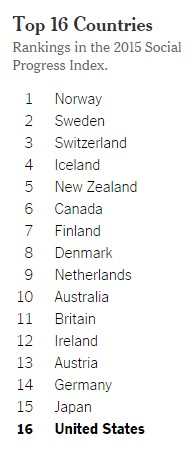
Yet let’s get real. All this hasn’t benefited all Americans. A newly released global index finds that America falls short, along with other powerful countries, on what matters most: assuring a high quality of life for ordinary citizens.
The Social Progress Index for 2015 ranks the United States 16th in the world. We may thump our chests and boast that we’re No. 1, and in some ways we are. But, in important ways, we lag.
The index ranks the United States 30th in life expectancy, 38th in saving children’s lives, and a humiliating 55th in women surviving childbirth. O.K., we know that we have a high homicide rate, but we’re at risk in other ways as well. We have higher traffic fatality rates than 37 other countries, and higher suicide rates than 80.
We also rank 32nd in preventing early marriage, 38th in the equality of our education system, 49th in high school enrollment rates and 87th in cellphone use.
Ouch. “We’re No. 87!” doesn’t have much of a ring to it, does it?
Michael E. Porter, the Harvard Business School professor who helped devise the Social Progress Index, says that it’s important to have conventional economic measures such as G.D.P. growth. But social progress is also a critical measure, he notes, of how a country is serving its people.
More here.
Fear in the Cockpit
Jeff Wise in Nautilus:

The plane’s black boxes recorded what happened next. Liao reached forward and pulled back on one of the engine throttle levers. But he pulled back on the left one—the one for the good engine. Now the plane was 1,000 feet over one of the most densely populated cities in the world, 25 tons of metal, fuel, and human flesh, with no engines to keep it in the air. A worrisome but manageable problem had suddenly become an imminent and severe one.
More here.
Should You Obey the Law?
Did natural selection make the Dutch the tallest people on the planet?
Martin Enserink in Science:

The Dutch have become so much taller in such a short period that scientists chalk most of it up to their changing environment. As the Netherlands developed, it became one of the world's largest producers and consumers of cheese and milk. An increasingly egalitarian distribution of wealth and universal access to health care may also have helped. Still, scientists wonder whether natural selection has played a role as well.
More here.
Neverending story
Kaelen Wilson-Goldie in Bookforum:
In the months that have passed since three young men, two of them ex-convicts, gunned down the staff of a satirical magazine and patrons of a kosher grocery in Paris, killing seventeen people, including several artists—during which time another young man, also an ex-con, shot up a café and a synagogue in Copenhagen, killing two more, including a filmmaker—much has been written to put these events in context. With each new text, the narrative has thickened with nuance, anger, digression, and distraction, as writers, in accordance with their nature, have tied themselves in knots to make sense of the killings in terms of terrorism, religious intolerance, ideological indoctrination, postcolonial injustice, racial prejudice, economic depravation, government neglect, bad schools, terrible prisons, dangerous clerics, and the potential for radicalization among disaffected young men prone to messianic delusion.
In one way or another, all of these texts belong to what Adam Phillips, describing Freud, has termed “a long spiritual, religious tradition of crisis writing.” Perhaps that ever-expanding mass of storytelling, messy and oversensitive and argumentative as it may be, is truer to the experience of these events around the world, where reactions have been everywhere mixed, and nowhere the same, not even in the mind of a single person, to say nothing of the popular imagination of a single place.
In Europe and the United States, a story of the attacks has settled into a moment of much-needed but still dubious repose, as responsibility is passed to “moderate Muslims” around the globe to deal with religious extremism, reform their faith, and thicken their skin. “What is entirely out of the government’s control—out of anyone’s control,” argues Mark Lilla, writing about France in the New York Review of Books, “is what happens next in the larger Muslim world.”
This is true enough. But there are a great many cities out there in the not-so-distant, not-so-frightful Muslim world. In those cities, one might listen for the subtleties of a self-reflexive criticism and hear a brash and lively satire in return. One might discover a rich history of progressive ideas that have developed in close proximity to Islam over hundreds of years. Beirut, Cairo, and Istanbul are three such cities. Others are just as relevant, but in these three, artists have established a particularly strong tradition of pushing public discourse. And in these three, regular people are dealing all the time with the kinds of dangers and ideological distortions that ripped through France and Denmark this winter.
Read the rest here.