Notes on Abdullah Hussain: HM Naqvi remembers a master of Urdu realism

H. M. Naqvi in Scroll:

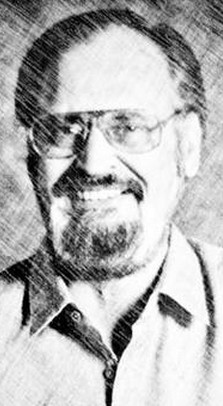
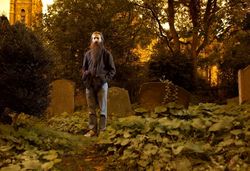
ScreenHunter_1289 Aug. 04 12.47When Abdullah Hussain ashed a cigarette, he always missed the ashtray. There was an inevitable salting in his immediate periphery. He had large, dramatic hands that he used to swat the air when he spoke. He spoke English with a slight, lilting British intonation, tending to accent vowels. He chose his words carefully but did not seem to care about his appearance. I spent time palavering with him at my place, his place, in hotel rooms where the curtains always seemed drawn, but never saw him comb his hair or dwell before the mirror. He would change from one pair of track pants to another, from one crumpled shirt to another before leaving for a dinner or a session at a literary festival. He lumbered like a giant emerging from a cave into the bright light of day.

It was not as if Abdullah Sahab didn't care what people made of him, and it was not if he didn't care for company, but he didn't suffer fools, didn't care for crowds. Once he told me, “Lots of people come…you know, scores of people…I don't know them, never seen them ‒ they have never heard of me, probably, and never read a word that I have written, and they just want to come and have they their picture taken…In the last few months, there must have been thousands and thousands…It's ridiculous…It's like taking a picture of Humayun's tomb.”

More here.

Tuesday Poem

Pasco, Barabara
.
.
I find I am descending in a propeller plane upon Pasco
in the state of Washington. I accept this;
I have reasons for participating in the experiential sequence
that has brought me here. Down below the land is printed
with huge circles, doubtless an irrigation system,
doubtless it makes sense. There are people who understand it
living with dignity in square houses
and the result possibly is one billion radishes.
Now some so-called time has passed. This nation
is a huge nation in which the infinity of for example
Washington State
is just one segment of an even less thinkable hugeness
and yet zim zim zim zim United Airlines has me
here in my Eastern metropolis
with its ten thousand makers of third-rate pizza
uncannily far from the possible radishes of Washington State.
The taxi driver experiments with narrow streets
to shorten our detour caused by sports fans and he says
the Eagles will out-tough the Steelers.
I defer to his judgment, I am conserving my powers.
After “a while” I have this unsettlingly smooth tuna salad
with a pale pickle
in a drugstore designed by Dwight D. Eisenhower,
reading a few poems by David Rivard. I have thoughts.

Read more »

Truly I Say To You Today That Bono Is An Asswipe

Albert Burneko in The Concourse:

ScreenHunter_1288 Aug. 04 12.39At the intersection of all the annoying things a rock star can be—messianic, pretentious, vapid, dumb, old, creatively bankrupt, grandiose, utterly bereft of self-awareness, calcified into a grotesque oily wire-rack-in-the-grocery-store knockoff of himself, part of U2, et cetera—there sits Bono in his stupid housefly glasses, playing with his dick. He is, in the words of Deadspin’s own Tim Marchman, “the worst music man of all time.” He is puke, and I want to punch him in the ear.

Here is a sentence: This past Wednesday, Bono spoke at an Amnesty International ceremony at Ellis Island, celebrating the 40th anniversary of John Lennon receiving his green card. Here is another sentence: John Lennon did not immigrate to the United States through Ellis Island, Amnesty International had nothing to do with his immigration to the United States, and Bono never knew him. Nevertheless, a tapestry was unfurled, depicting, with metaphoric incoherence, Manhattan as a Lennon-piloted yellow submarine shining its light on Liberty Island, which is not Ellis Island. Bono spoke, and claimed Lennon and the Beatles as Irishmen—because Lennon’s derelict father may or may not have been descended from the Irish, and for the more important reason that nothing in American culture is better public relations than making a too-big deal of flimsy, possibly spurious Irish heritage.

(To be honest, I don’t much care about which part of the British Isles rightly may claim John Lennon’s ancestry. He mostly was a self-promoting misogynist checkbook activist who imagined no possessions from one of the most exclusive addresses in the history of planet earth, so whichever country wants him can have him. This is beside the point, which is that Bono sucks.)

More here.

Monday, August 3, 2015

Sunday, August 2, 2015

Being A Woman: Who Gets To Decide?

Barbara J. King in NPR:

WomanThis week, Switzerland's Court of Arbitration for Sport ruled that the Indian sprinter Dutee Chand may race as a woman in international competition. This decision is significant because, just last year, Chand was denied by track and field's governing body (the International Association of Athletics Federations or IAAF) the right to compete against women because her natural levels of testosterone were considered too high for a female athlete. As The New York Times reported Monday, Chand is now cleared for the 2016 Summer Olympics in Rio de Janeiro — if she qualifies. It's likely that this ruling also will serve as a legal precedent for women in sports beyond just track and field. The court did grant the IAAF two years to provide further evidence in support of their so-called “hyperandrogenism regulation.” Chand's victory, therefore, rests on a suspension, rather than an outright overturning, of the biologically based rule.

Even so, there's no doubt this ruling represents a step forward for women like Chand who refuse to alter their bodies by chemical or surgical means in order to conform to arbitrary biological standards of what it means to be a woman. Also this week, a young man named Gavin Grimm from Gloucester, Va., was profiled in a piece by The New York Times editorial board. Grimm, whom I have met and talked with, is a transgender teenager who was assigned female status at birth but who now identifies as male. Originally, when he asked to use the male restroom at his high school, all went smoothly. Then, parents got wind of the fact and the small semi-rural county where I live exploded. I attended (and briefly spoke at) last fall's school board meeting about the issue, a gathering accurately described by the Times in this passage:

“Gavin Grimm sat quietly in the audience last November as dozens of parents at a school board meeting in Gloucester County, Va., demanded that he be barred from using the boys' restrooms at school. They discussed the transgender boy's genitals, expressed concern that he might expose himself and cautioned that being in a men's room would make the teenager vulnerable to rape. One person called him a 'freak.'”

More here.

Life after Faith

Philip_Kitcher

Richard Marshall interviews Philip Kitcher in 3:AM Magazine:

3:AM: You’ve written books on science in a democratic society, living with Darwin, the ethical project and an invitation to Joyce’s Finnegan’s Wake. This is a broad field of interests and captures the flavour of your philosophical position where you argue for the importance of both science and humanities. How did your philosophical career begin? Were you always asking questions, reading and thinking?

Philip Kitcher: I rather stumbled into philosophy. When I began my undergraduate career at Cambridge, I studied mathematics (pure and applied, with a dash of theoretical physics). Under the British system, I’d had to specialize at age 15, and I found it very hard to decide between mathematics and literature (English, French, and German). After two years of undergraduate study, it was clear that I was bored by the regime of problem-solving required by the Cambridge mathematical tripos. A very sensitive mathematics don recommended that I talk to the historian of astronomy, Michael Hoskin, and the conversation led me to enroll in the History and Philosophy of Science for my final undergraduate year. I’d originally intended to concentrate in history of science, but reading Thomas Kuhn’s The Structure of Scientific Revolutions prompted me to switch to philosophy of science. Despite the fact that I hadn’t done any serious philosophy as Princeton understood it, I was accepted as a graduate student in the philosophy side of Princeton’s HPS program (now defunct). I struggled at first, but eventually managed to correct some of my initial ignorance.

But I think that, all along, I was occupied by a range of questions, often different from those fashionable in the professional philosophy of the past half century, that have sometimes troubled philosophers in the past. It’s taken me several decades to work out my own philosophical agenda, and it is, as your question suggests, wide. Some people would probably describe it as quite weird. Maybe this interview will dissolve some of that sense of weirdness.

More here.

A Dream Undone

Voting-rights-top-img-superJumbo-v8

Jim Rutenberg in The New York Times:

The fundamental promise of American democracy is that every citizen gets a vote, but delivering the franchise from on high and in the face of violent local opposition has always been a complicated legal proposition. The 13th Amendment freed the slaves, and the 14th Amendment gave them citizenship. But the key to Reconstruction was the 15th Amendment, ratified in 1870, which did something far more radical, not just guaranteeing (male) former slaves the right to vote but giving Congress the authority to enforce that right state by state, an authority that to this day many legislators see as a drastic intrusion into local affairs.

The new laws immediately enfranchised more than 700,000 black Southerners. Although blacks made up just 13 percent of the overall United States population, they made up 36 percent of the South’s population and a much higher percentage in some states, including a majority in Mississippi and South Carolina. Their enfranchisement was a shock to the political system that almost exclusively benefited Republicans, the party of Lincoln.

Like its former Confederate neighbors, North Carolina sent several black Republicans to Congress. In the state’s General Assembly, legislators with the support of black Republicans wrote a new state Constitution in 1868 that created state-supported public schools; apportioned state representation based on population rather than wealth — a setback for the 1 percent of that era, the plantation owners; and, eventually, instituted a property tax.

Democrats throughout the South responded to the growing influence of black legislators with a brutal effort to suppress the black vote, enforced by the Ku Klux Klan and its many paramilitary imitators, who kept blacks from election polls at gunpoint and whipped or lynched many who resisted. The Southern Democrats ran on an open message of white supremacy and quickly retook statehouses, city halls and courthouses throughout the South. Within 15 years of the Civil War’s end, Reconstruction was just a memory. What followed was deconstruction: the era of Jim Crow, the poll tax, the literacy test, double primaries and a host of other mechanisms that blocked the black vote. For decades, most black citizens in the South had no practical right to vote.

More here.

The God quest: why humans long for immortality

Philip Ball in New Statesman:

AubreyFor an introduction to this bioger­ontological mythology, I recommend last year’s documentary The Immortalists, which profiles two of the most vocal advocates of scientific immortality: the computer scientist Aubrey de Grey and the biotech entrepreneur Bill Andrews. Yet the film shows that these men aren’t lone mavericks with unconventional ideas about ageing and its abolition, but participants in a complex and self-supporting network of techno-myth. And as is the case with, for example, human cloning, nutrition and the surprising properties of water, there is no convenient partitioning here into respectable and cranky science. In consequence, the immortality market can’t simply be eliminated by the appliance of science; it needs to be understood as a cultural phenomenon. Ageing is partly genetic but there are no “ageing genes” – merely ordinary genes that may cause problems in later life. Age-related conditions such as heart failure, dementia and cancer typically stem from an interplay between genes and environment: we can inherit predispositions but environmental factors such as diet and pollution affect whether they manifest. (Research that was widely reported early this year as showing that most cancers are due to “bad luck”, irrespective of environmental influences, in fact had a more complex message.)

It is surprising, perhaps alarming, that we know so little about ageing.

More here.

Philosophy in a Divided World

Averroes_and_prophyry

An interview with Carlos Fraenkel, over at 5 Books:

Can philosophy save the Middle East?

I think it can contribute to diminishing tensions, but I don't think it can save the Middle East. My wife sometimes jokingly says I should take down ISIS and that would guarantee me the Nobel Prize. But some people really have these very inflated expectations of philosophy and think it's a panacea that can solve every problem. I don't think so.

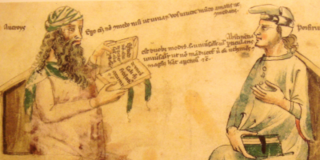
One example of where I think it can actually make a positive contribution is a series of workshops I did over the last few years. The first one took place at a Palestinian university in East Jerusalem. I co-taught a class there with the Palestinian intellectual and philosopher Sari Nusseibeh, who was also the president of the university. The basic idea was to read texts by Plato and the medieval Muslim and Jewish philosophers who build on Plato, and develop a philosophical interpretation of Islam and Judaism.

We started with Plato and one of the questions we discussed was 'Is violence justified?' That's obviously a key question of both sides of the conflict in Israel-Palestine. Nusseibeh himself is a prominent advocate of non-violent resistance against the Israeli occupation, but non-violence is not a very popular idea among the average Palestinian citizen. Understandably: people get hit, they want to hit back. Nusseibeh argued that non-violence might be a more efficient means to achieve the ends that Palestinians want to achieve, namely ending the occupation and gaining sovereignty. His argument was that Israel is a kind of enlightened occupier, like the British in India. Non-violent resistance doesn't always work, but it does work in some contexts. It worked in India and he thinks it would also work in Palestine.

We had a very interesting discussion about that when we read Plato's Republic, because one of the key virtues that Plato advocates in the Republic is self-control, he thinks it's something every human being should develop. Without self-control, you cannot live according to the instructions of reason because your emotions will always push you to do things that go against reason. We discussed how self-control can help you not to hit back when you're facing an aggressor, knowing that not hitting back will actually serve your purpose better. You hold back your anger, you take the hit and you do something that will be more efficient to defeat your opponent. I think you can see there how this philosophical idea of living according to reason via self-control can make a positive contribution in this particularly fraught Middle-Eastern context. Does that mean philosophy can save the Middle East?

More here.

Say goodbye to the weirdest border dispute in the world

ScreenHunter_1286 Aug. 02 20.00

Adam Taylor in the Washington Post:

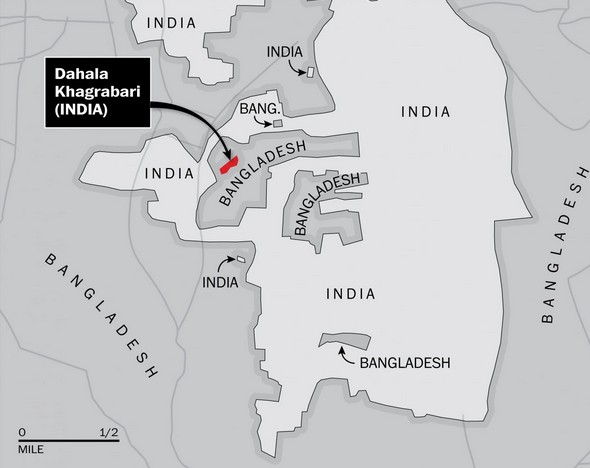
Just after midnight Saturday, one of the most perplexing border disputes in the world officially ended. India and Bangladesh began the exchange of over 160 enclaves – small areas of sovereignty completely surrounded on all sides by another country – and in so doing ended a dispute that has lasted almost 70 years.

This act will have a major effect on the lives of more than 50,000 people who resided in these enclaves in Cooch Behar. Where they had been surrounded by a country they didn't have citizenship in for decades, now they will finally gain access to things like schools, electricity and health care.

For curious cartographers and others obsessed with geopolitical oddities, however, it's an end of an era. The exchange between India and Bangladesh means that the world will not only lose one of its most unique borders, but it will also lose the only third-order enclave in the world – an enclave surrounded by an enclave surrounded by an enclave surrounded by another state.

More here. [Thanks to Ali Minai.]

Hospital checklists are meant to save lives — so why do they often fail?

Emily Anthes in Nature:

ScreenHunter_1285 Aug. 02 19.51Before making the first incision, confirm the patient's identity. Mark the surgical site. Ask about allergies. Discuss any anticipated blood loss. Introduce yourself by name. These are some of the 19 tasks on the World Health Organization (WHO) Surgical Safety Checklist, a simple list of actions to be completed before an operation in order to cut errors and save lives.

In 2007 and 2008, surgical staff at eight hospitals around the world tested the checklist in a pilot study. The results were remarkable. Complications such as infections after surgery fell by more than one-third, and death rates dropped by almost half. The WHO recommended that all hospitals adopt its checklist or something similar, and many did. The UK National Health Service (NHS) immediately required all of its treatment centres to put the checklist into daily practice; by 2012, nearly 2,000 institutions worldwide had tried it. The idea of checklists as a simple and cheap way to save lives has taken hold throughout the clinical community. It has some dynamic champions, including Atul Gawande, a surgeon at Brigham and Women's Hospital in Boston, Massachusetts, who led the pilot study and has spread the word through talks, magazine articles and a best-selling book, The Checklist Manifesto (Metropolitan, 2009).

But this success story is beginning to look more complicated: some hospitals have been unable to replicate the impressive results of initial trials. An analysis of more than 200,000 procedures at 101 hospitals in Ontario, Canada, for example, found no significant reductions in complications or deaths after surgical-safety checklists were introduced.

More here.

Funhouse Psychotherapy With Poker Chips

Walter Kirn in Good:

ScreenHunter_1284 Aug. 02 19.45The man beside me at the blackjack table, a tipsy, middle-aged salesman, was on a winning streak. Again and again, over half an hour of play, he’d drawn the cards he’d needed to beat the dealer, amassing stacks of $100 chips that came, by my count, to more than $6,000. Fortune was smiling on him, but not on me—I was down $200. It was hard not to feel like I was doing something wrong, even though I was playing by the book, employing what blackjack manuals call “perfect strategy.” As the salesman’s streak continued, my sense of self-pity deepened to the point that I began to place irrational bets, playing wild hunches that didn’t pan out and left me even further in the hole. Experience told me that it was time to stop, and so I did, fighting a voice that told me to play on, that my rotten luck was bound to change. An hour later, I passed by the table and saw the salesman sitting with his head down, his winnings gone. He’d listened to another voice, apparently: One that told him his marvelous luck would carry on.

Since taking up gambling in my early 30s, I’ve learned that the casino is a harsh classroom. In a thousand ways, it has taught me two main lessons: that the odds are the odds, and they will always ultimately prevail; and that the mind (and particularly the ego) is full of trickery. These tricks take myriad forms, but they share a common theme: The odds apply chiefly to others. You are special.

More here.

Sunday Poem

Gathering Mushrooms
.

As he knelt by the grave of his mother and father
the taste of dill, or tarragon-
he could barely tell one from the other-

filled his mouth. It seemed as if he might smother.
Why should he be stricken
with grief, not for his mother and father,

but a woman slinking from the fur of a sea-otter
In Portland, Maine, or, yes, Portland, Oregon-
he could barely tell one from the other-

and why should he now savour
the tang of her, her little pickled gherkin,
as he knelt by the grave of his mother and father?

*

He looked about. He remembered her palaver
on how both earth and sky would darken-
'You could barely tell one from the other'-

while the Monarch butterflies passed over
in their milkweed-hunger: 'A wing-beat, some reckon,
may trigger off the mother and father

of all storms, striking your Irish Cliffs of Moher
with the force of a hurricane.'
Then: 'Milkweed and Monarch 'invented' each other.'

*

He looked about. Cow's-parsley in a samovar.
He'd mistaken his mother's name, 'Regan, ' for Anger';
as he knelt by the grave of his mother and father
he could barely tell one from the other.
.

Saturday, August 1, 2015

mary ellen marks (1940 – 2015)

1270719940446336401Stefany Anne Golberg at The Smart Set:

In a photograph titled “Ward 81″, a woman sits on a bed. She is young, a teenager. She sits cross-legged and wears her clothes and hair like a teenager would. The wall behind this teenage girl is covered in pictures. The pictures, magazine cutouts, are taped to the wall and some of the edges have been carefully rounded with scissors. There are pictures of animals and a picture of a tree. Below a picture of the Mona Lisa the name BRENDA is written in marker. In this room that could belong to any teenager, the walls are strangely close. The bed is pushed up to the radiator and the metal headboard is too white and plain. The young woman’s eyes are blank—one eye tilts toward her nose. Her left arm is outstretched bearing the evidence of self-inflicted wounds and on the wall above the radiator, also written in marker, are the words, “I wish to die.”

This photograph was taken by Mary Ellen Mark, who died on May 25. Mark was adamant that her work be called documentary photography. “I’m a documentary photographer,” she told Bomb magazine in 1989. “That’s what I’ve always wanted to be; that’s where my heart and soul is.” The word “document,” when applied to photographs, conveys the sense of proof, evidence, testimony. A document is an affirmation of the subject being documented — a proof of that subject’s existence, if nothing else.

more here.

a voyage around ‘Las Meninas’

8cf28242-3c6e-42c8-b132-f706a8b16793Simon Schama at the Financial Times:

Jacobs, one of the great non-fiction writers of this and the last century, is usually found shelved under “travel writing”, which is the truth but certainly not the whole truth, any more than it adequately describes the books of Bruce Chatwin or Patrick Leigh Fermor. Wherever they happened to go, the travel all these writers undertook was essentially a journey through themselves, and the reports they made drew their power from the geography of their memories. It was their imaginations that roamed as much as their boats or mules.

Memory, too, is the central strand of Jacobs’ last book,Everything is Happening, about his long obsession with Diego Velázquez’s elaborate mirror-game of truth and illusion, “Las Meninas” (The Maids of Honour). All too often, incomplete works are posthumously published as acts of friendship, piety or curiosity rather than for their intrinsic value. This is emphatically not the case with Everything is Happening. Ending as it does just with Jacobs on the verge of entering the royal palace in Madrid where Velázquez’s painting originally hung, the broken narrative is tantalising (though supplied with an excellent coda and introduction by his friend Ed Vulliamy) since one has the impression that, for all the oceans of print that have been expended on the notoriously enigmatic picture, Jacobs is about to give us a decisive revelation.

more here.