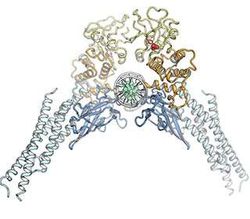
Mutations in key cancer protein suggest new route to treatments

From PhysOrg:

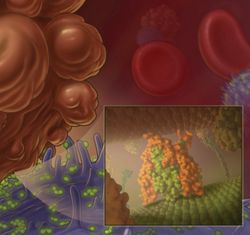
MutationsinkFor years, scientists have struggled to find a way to block a protein known to play an important role in many cancers. The protein, STAT3, acts as a transcription factor—it performs the crucial task of helping convert DNA into the RNA instructions used to make new proteins. But when overly active, STAT3 performs this task too well, fueling the growth and division of abnormal cells, and contributing to cancer. Scientists have taken various approaches to selectively blocking STAT3 in cancer, but none have produced successful treatments.

Now, researchers led by Rockefeller University's James E. Darnell, head of the Laboratory of Molecular Cell Biology, have suggested a new way to target STAT3. In research published November 9 in the Proceedings of the National Academy of Sciences, they report successfully disrupting STAT3's ability to act as a transcription factor, suggesting a basis for new, targeted approaches to fighting cancer. “We have described some interesting mutations in the STAT3 protein that, if we could mimic with a drug, could become very valuable tools in our fight against cancer,” says Darnell, Vincent Astor Professor Emeritus at Rockefeller. “Some of the mutations, in particular, seem really exciting.” Many scientists—and drug companies—have focused on STAT3 because it is overactive in virtually all of the major human cancers: breast, prostate, lung, colon, and some blood malignancies. But earlier efforts have not succeeded in finding drugs that block the protein at low enough doses, Darnell says.

More here.
Thursday Poem

A Bum

Tonight, again,
I went by him
And I heard him say
He has nothing on which to lie
But the hard, cold ground.
He talked about himself in the third person,
A prolongued psalmody of griefs,
That human wretch
With swollen legs,
Who sleeps in the street
Near my house.
And some nights
He also paints a sexy woman
In erotic scenes by the sea,
Born, like Venus, from the foam.
They were sweet love ballads
Sung by an indian mummy
Under a sign that said:
HEALTH CARDS
In big, red letters,
While like a scalpel
The wind from the moors
Cut into his body
And deepened the wound of memory.
That night I wished I could dream his dreams
in that moment, again,
but in another bed, in another time.

by Nicolás Suescún
translation by author
from Poetry International

Wednesday, November 18, 2015

Is great philosophy, by its nature, difficult and obscure?

Keith Frankish in Aeon:

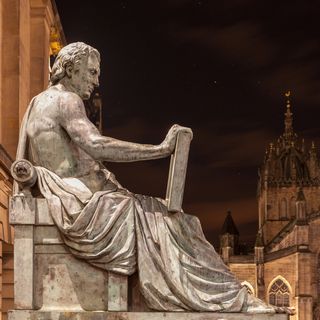
Header_DavidHumeGreat philosophy is not always easy. Some philosophers – Kant, Hegel, Heidegger – write in a way that seems almost perversely obscure. Others – Kierkegaard, Nietzsche, Wittgenstein – adopt an aphoristic style. Modern analytic philosophers can present their arguments in a compressed form that places heavy demands on the reader. Hence, there is ample scope for philosophers to interpret the work of their predecessors. These interpretationscan become classics in their own right. While not all philosophers write obscurely (eg, Hume, Schopenhauer, Russell), many do. One might get the impression that obscurity is a virtue in philosophy, a mark of a certain kind of greatness – but I’m skeptical.

More here.

Don’t Give ISIS What It Wants

Stephen M. Walt in Foreign Policy:

ScreenHunter_1499 Nov. 18 22.59When a shocking event like the Paris attacks occurs, we know how the world will respond. There will be dismay, an outpouring of solidarity and sympathy, defiant speeches by politicians, and a media frenzy. Unfortunately, these familiar reactions give the perpetrators some of what they want: attention for their cause and the possibility their targets will do something that unwittingly helps advance the perpetrators’ radical aims.

What is most needed in such moments is not anger, outrage, or finger-pointing, but calm resolution, cool heads, and careful thought. What happened in Paris is an untold tragedy for the victims and deeply offensive to all we hold dear, but we must respond with our heads and not just our hearts. Here are five lessons to bear in mind as we reassess the dangers and search for an effective response.

More here.

The Mathematical Case for Hypocrisy

John Allen Paulos in Slate:

151117_SCI_Hypocrisy-Probable.jpg.CROP.promo-xlarge2The present political and cultural climate seems to have led to an intensifying of the natural human tendency to hurl charges of hypocrisy at one another. Rather than partaking in this pleasant activity and pointing to the many current instances of political or personal hypocrisy, I’d like here to offer a partial defense of the notion.

Hypocrisy thrives on black-or-white, either-or thinking. Once we accept such dichotomies, we naturally look for the apostasies and hypocrisies of benighted people on the wrong side of the ethical or cognitive tracks but rarely for real understanding.

I have received my share of emails, for example, from people who have written (actually screeched in capital letters) that I’m a hypocrite because of some article, book, or column of mine that, let’s say, recommended a cost-benefit analysis of something they, and they thought I, held sacrosanct.

Conventional understandings would suggest that I hold liberal positions on most issues, but I’ve known many “liberals,” myself included, as well as many “conservatives” whose private actions and beliefs on some issues were on the opposite end of a spectrum (assuming that there is such a thing as a spectrum) from their public ones. As such, they are often judged to be hypocritical. Examples might be environmentalists who don’t recycle, libertines who rail against porn, gun-control advocates who have an arsenal of high-powered weapons in their basements, “pro-family” people with several marriages under their belts, etc. Are these people necessarily hypocritical, as commentators and biographers might be strongly tempted to say, or is it just easier to note their apparent conflicts than it is with other less “well-defined” people?

More here.

a trip to North Korea

KoreaEben Wood at The American Scholar:

Rising above Pyongyang’s low skyline is the Ryugyong Hotel, which recalls the city’s ancient name, meaning “Capital of Willows.” Construction began in the late ’80s but came to a halt in 1992, as the North entered its post-Soviet famine years. The pyramid-shaped “Hotel of Doom,” as Western journalists call it, is sheathed in glass, but its interior remains largely empty and unfinished. As much as Pyongyang’s other landmarks, like the flame-topped Juche Tower or the huge bronze statues of Kim Il-sung and Kim Jong-il, before which onlookers are asked to bow and leave flowers in respect, the Ryugyong marks the city’s hallucinatory core.

An American friend and I had entered North Korea through Shenyang, China, a fast-growing provincial capital about five hours by high-speed train from Beijing. We were participating in a weeklong tour timed to coincide with the 60th anniversary of the 1953 armistice that paused, but did not formally end, the Korean War. As Americans, we were prohibited from entering North Korea by train. Instead, we boarded an Air Koryo flight from Shenyang’s modern airport and less than an hour later, after a quick drink service, arrived in North Korea’s capital, where we would meet the other members of our Canadian-led tour group.

more here.

Why Did the Killers Target the Eagles of Death Metal Concert?

497240926-people-comfort-each-other-in-front-of-a-memorial-set-up.jpg.CROP.promo-xlarge2Justin E.H. Smith at Slate:

One thing to notice, first, is that they did not target wealthy old operagoers, or fat plutocrats and their diamond-encrusted mistresses. They targeted the young, multiethnic, bohemians of Paris, people who likely have limited resources of money and endless capacity for the enjoyment of life. This is an image of a certain kind of Parisian life that is old and familiar enough for even the limited imagination of a fundamentalist to understand. As an ISIS communiqué issued Saturday morning announced, Paris was chosen in part because it is a “capital of prostitution and obscenity.”

Are the Eagles of Death Metal obscene? Well, sort of. They like to mix things up in ways they aren’t supposed to be mixed up. They are not obscene, however, in ways that many progressive Westerners of a liberal or leftist orientation understand this notion. They do not hoard wealth and resources and force others to live in abject poverty. They do not help to maintain impediments to the health, well-being, and social integration of refugees and other marginalized communities. These are varieties of obscenity with which ISIS is significantly less concerned. Their precise aim in the Paris attacks was to eliminate the very people who serve as a check on rampant xenophobia and violent reaction in France: to kill the utopia of the young multicultural bohemians who believe, above all, in happiness.

more here.

an ethics of the novel

Knausgaard-Vanishing-Point-690Karl Ove Knausgaard at The New Yorker:

Perhaps the foremost characteristic of our age, what sets it apart from all others before it, is that the sheer volume of images of the world—not just the world of the past, but also, and perhaps especially, that of the present, the world of which we are a part—is so massive. Any event, anywhere on the planet—an earthquake, a plane crash, an act of terrorism—will be available for us to view only moments later, in on-the-scene images we see and consider as we go about our day-to-day lives, stuck in our tailbacks of traffic, as we make our coffee, visit the bathroom, wash our clothes, prepare our meals, set our tables. Usually, we keep these different levels of reality apart, or at least I do. Even the worst disasters are something I merely register, with varying degrees of horror, as if the world outside were a film, a play, a performance, of concern to me only in the most superficial manner. At the same time, and more profoundly, such images provide a release insofar as they allow me the freedom of never having to be entirely present in my actual surroundings, in the routine state of boredom they constantly threaten to dull me with, since one’s attention is continuously being directed toward something else, to what is happening right now: the occurrence, the event, the news item.

But then, occasionally, albeit remarkably seldom, what happens is that the two levels of reality converge and become one. Last time it happened was this autumn.

more here.

CRISPR: A path through the thicket

Mathews et al in Nature:

MicroscopeThe ease of use, accuracy and efficiency of the genome-editing tool CRISPR/Cas9 has led to its broad adoption in research, as well as to preliminary applications in agriculture and in gene therapies involving non-reproductive (somatic) cells. It is also possible in some jurisdictions to deploy CRISPR/Cas9, and related techniques1, in human germline cells (sperm and eggs) as well as in early embryos2. In September, a network of more than 30 scientists, ethicists, policymakers, journal editors and funders called the Hinxton Group gathered in Manchester, UK, to address the ethical and policy issues surrounding the editing of human genomes in the early stages of development and in germline cells (see go.nature.com/xikxv2). Similar meetings have been and are being held elsewhere in the world, and several position statements have been published (see, for instance, go.nature.com/enfxjz and go.nature.com/fes1wc).

…Establish a model regulatory framework that could be adopted internationally. Various groups, including ours, agree that numerous technical and safety issues need to be addressed before genome-editing technologies could feasibly be used in reproductive clinical applications. Many also share our strong conviction that basic research involving genome editing should not be halted or hampered. Such studies are likely to have tremendous value, including in human-reproduction applications that do not involve genome editing, and potentially in the development of treatments using somatic cells.

More here.

Wired Well

Tara Parker-Pope in The New York Times:

Wellcover-tmagArticleOnce personal health technology meant little more than bathroom scales, thermometers and electric toothbrushes. Now, these devices and apps are everywhere: on our wrists, in our phones, the bedroom, the kitchen, even on our children and pets. In this special issue of Science Times, we explore the lives of newly wired consumers and the consequences, good and bad, that arise from our increasing reliance on trackers, monitors, guides and a vast array of other devices to better our health.

Fitness
­Health consumers are counting steps, measuring heart rates and tracking sleep. The Consumer Electronics Association estimates that device makers will sell more than 40 million personal health and wellness devices this year; sales may reach $8 billion by 2018.

Food
Home meals are now high-tech affairs: a number of apps and devices aim to make cooking less complicated, helping users source healthful ingredients and stick to nutritious diets.

More here.

Wednesday Poem

You cannot know the I of Me
unless you crack the I of thee”

The Three Christs

Waiting for the Norwegian poet to read
her poems, you delineated the differences
between you and her by pointing to Jesus.

Her version, you said, was radiating outwards,
wave and astral particle, revelatory energy
and blinding light, inherently metaphysical.

Your version, however, was dusty and dog-
tired, having walked too long too far in feet
that ached, in draggled robes, in desperate

need of a hot bath, bread, a goblet of wine,
something to take his mind of those carping
apostles, those omnipresent Roman soldiers.

Sitting here, alone, looking out at the play
of sun and shadow on crenellated ferns,
I’m conjuring a third Christ, neither weary

nor luminous, but one who lives nowhere
save within me, indwelling life illimitable
that I will remain estranged from so long

as I insist on insisting, on putting my own
pleasure, which is all I know deeply or well,
first. A Christ who wears my body’s garment.

Raise the stone, there thou shalt find me;
cleave the wood and there I am. Let not
him who seeks cease until he finds. When

he finds, he shall be astonished. Astonished,
he shall reach the Kingdom. Having reached
the Kingdom, he shall (shall he? shall I?) rest.

by Ravi Shankar
from Green Mountains Review,
Vol. XXIV, No. 1, 2011

Tuesday, November 17, 2015

The Greatness of William Blake

Richard Holmes in the New York Review of Books:

ScreenHunter_1498 Nov. 18 10.13There are many William Blakes, but mine arrived with the tigers in the 1960s. The first line I ever read by Blake was not in a book, but laid out in thick white paint (or should I say illuminated) along a brick wall in Silver Street, Cambridge, England, in 1968. It was not poetry, but prose: “The tigers of wrath are wiser than the horses of instruction.” It sent a strange shiver down my spine, as it did for thousands of other university students in England and America that year.

It turns out that, according to The New York Times of December 28, 1968, exactly the same line from Blake’s “Proverbs of Hell” appeared on big posters at the conference of the Modern Language Association in New York. According to the Times it signified that “Radical Agitation Among Scholars Grows,” and it led to several arrests.

This of course was the time of radical disturbances on university campuses across Europe, as well as Vietnam War and civil rights protests in America. Very quickly we all seemed to be reading Blake’s preface to Milton.

More here.

When scientists falsify data, they try to cover it up by writing differently in their published works. A pair of Stanford researchers have devised a way of identifying these written clues

Bjorn Carey at the Stanford Website:

15861-fraud_newsEven the best poker players have “tells” that give away when they're bluffing with a weak hand. Scientists who commit fraud have similar, but even more subtle, tells, and a pair of Stanford researchers have cracked the writing patterns of scientists who attempt to pass along falsified data.

The work, published in the Journal of Language and Social Psychology, could eventually help scientists identify falsified research before it is published.

There is a fair amount of research dedicated to understanding the ways liars lie. Studies have shown that liars generally tend to express more negative emotion terms and use fewer first-person pronouns. Fraudulent financial reports typically display higher levels of linguistic obfuscation – phrasing that is meant to distract from or conceal the fake data – than accurate reports.

To see if similar patterns exist in scientific academia, Jeff Hancock, a professor of communication at Stanford, and graduate student David Markowitz searched the archives of PubMed, a database of life sciences journals, from 1973 to 2013 for retracted papers. They identified 253, primarily from biomedical journals, that were retracted for documented fraud and compared the writing in these to unretracted papers from the same journals and publication years, and covering the same topics.

More here.

The Saudi Wahhabis are the real foe

Nassim Nicholas Taleb in Politico:

ScreenHunter_1497 Nov. 18 10.03Since 2001 our policy for fighting Islamic terrorists has been, to put it politely, missing the elephant in the room, sort of like treating symptoms and completely missing the disease.

Policymakers and slow-thinking bureaucrats stupidly let terrorism grow by ignoring the roots. So we lost a generation: Someone who went to grammar school in Saudi Arabia (our “ally”) after September 11 is now an adult, indoctrinated into believing and supporting Salafi violence, hence encouraged to finance it — while we got distracted by the use of complicated weapons and machinery.

Even worse, the Wahhabis have accelerated their brainwashing of East and West Asians with their madrassas, thanks to high oil revenues.

More here.

Isis wants Christians and Muslims to fight a war. Will Republicans take the bait?

Ali Gharib in The Guardian:

TedThe distended Republican presidential field’s response to the terror attacks in Paris is a conglomeration of policy proposals that look something like this: a ground invasion of Syria and Iraq that will explicitly be less careful about killing civilians, combined with a policy of relief for refugees only if they’re Christians. One can almost see the Islamic State’s top ideologues and propagandists celebrating. And why not? Muslims the world over, which Isis views (wrongly) as a sea of potential recruits, could be forgiven for viewing the Republican rhetoric as a declaration of holy war against their co-religionists. I wish my thumbnail descriptions of Republicans’ talking points were a joke, but they’re not. And the policies described by the candidates line up almost exactly with the image of America that Isis seeks to portray in its propaganda. The target for Isis’s messaging was made abundantly clear in a statement last month from the group: “Islamic youth everywhere, ignite jihad against the Russians and the Americans in their crusaders’ war against Muslims,” said Isis spokesman Abu Mohammad al-Adnani.

Florida senator and Republican presidential hopeful Marco Rubio might as well have had this very idea in mind when he said, repeatedly, of the fight against Isis: “This is a clash of civilizations.” Rubio relished in his identification of Isis as an “Islamic” group – a notion President Barack Obama disavowed yet again on Monday morning:

When I hear folks say that, well, maybe we should just admit the Christians, but not the Muslims … when I hear political leaders suggesting that there would be a religious test for which a person who’s fleeing from a war-torn country is admitted, when some of those folks themselves come from families who benefited from protection when they were fleeing political persecution, that’s shameful.

Florida governor Jeb Bush, who has otherwise taken to defending his brother’s legacy, however ahistorically, even disavowed George W Bush’s proclamations that the “global war on terror” wasn’t “against Islam, or against faith practiced by the Muslim people”.

More here.

Super natural killer cells’ destroy cancer in lymph nodes to halt metastasis

From KurzweilAI:

Super-natural-killer-cellsCornell biomedical engineers have developed specialized white blood cells they call “super natural killer cells” that seek out cancer cells in lymph nodes with only one purpose: to destroy them, halting the onset of cancer tumor cell metastasis. “We want to see lymph-node metastasis become a thing of the past,” said Michael R. King, the Daljit S. and Elaine Sarkaria Professor of Biomedical Engineering and senior author of a paper in the journal Biomaterials. For tumor cells, the lymph nodes are a staging area in the body and play a key role in advancing metastasis throughout the body. In the study with mice, the biomedical engineers killed cancerous tumor cells within days by injecting liposomes (spherical vesicles that can act as carriers) armed with TRAIL (Tumor necrosis factor Related Apoptosis-Inducing Ligand). The liposomes attached to “natural killer” cells — a type of white blood cell — residing in the lymph nodes.

Inducing cancer-cell suicide

King says these natural killer cells in the body became the “super natural killer cells,” which found the cancerous cells and induced apoptosis (cell suicide). The cancer cells self-destruct and disintegrate, preventing the lymphatic spread of cancer any further by “completely eliminating lymph node metastases in mice,” said King. In cancer progression, there are four stages. At stage I, the tumor is small and has yet to progress to the lymph nodes. In stages II and III, the tumors have grown and likely will have spread to the lymph nodes. At stage IV, the cancer has advanced from the lymph nodes to organs and other parts of the body. Between 29 and 37 percent of patients with breast, colorectal, and lung cancers are diagnosed with metastases in their tumor-draining lymph nodes — those lymph nodes that lie downstream from the tumor — and those patients are at a higher risk for distant-organ metastases and later-stage cancer diagnoses. In January 2014, King and his colleagues published research (see “Piggy-backing proteins ride white blood cells to destroy metastasizing cancer“) that demonstrated that by attaching the TRAIL protein to white blood cells, metastasizing cancer cells in the bloodstream were annihilated. “So, now we [also] have technology to eliminate lymph node metastases,” King said. He said human testing of the TRAIL drug could be done “short of a few years from now.”

More here.

Tuesday Poem

The Tortoise

Wrinkled skin. Age? Must be three or four hundred
Like dark circles beneath the eyes, the western
Hemisphere engraved on the shell, so extraordinary
But absolutely silent now after all those wars
Won’t listen, won’t speak, won’t look either
We only gather in a crowd every evening
Eating small portions of that old story
Vanished phrases, broken words, missing letters
Still we eat the story, sharing it amongst ourselves
Thousands of years ago, in some race or the other,
Once, yes, once, I had defeated the hare.

by Srijato
from Chhotoder Chiriyakhana
Ananda Publishers, Kolkata, 2013
translation: 2015, Arunava Sinha

Monday, November 16, 2015