
by Brooks Riley
Category: Recommended Reading
Sunday, November 22, 2015
My Long Chat With Karl Ove Knausgaard
Christian Lorentzen in New York Magazine:
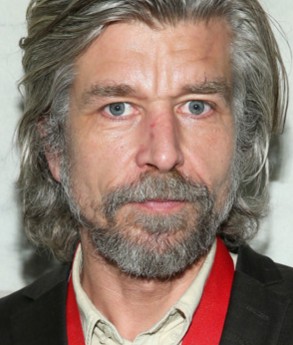
We walked east a few blocks and up to 44th Street for a drink at the Blue Bar of the Algonquin Hotel. I was disappointed to learn that massive international literary celebrity is such that you can pass through Times Square without being stopped by a fan. Knausgaard stands about six-foot-six, and his hair and beard at age 46 are a touch grayer than they appear on the cover of book two of his My Struggle series — the fourth of six volumes that appeared in English translation last spring. Two nights before he had been fêted at a gala at the New York Public Library, and he would be again that night at MoMA. At the Algonquin, Knausgaard had a black coffee and a Diet Coke, and I had a bloody Mary. I’ve been told that I’m a laconic interlocutor and in this Knausgaard was more than my match; on the recording of our conversation, the long pauses are filled with Sinatra songs playing from the bar’s speakers.
More here.
Claimed Breakthrough Slays Classic Computing Problem; Encryption Could Be Next
Tom Simonite in MIT Technology Review:
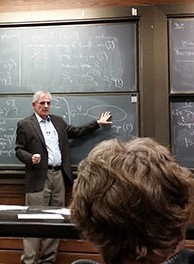
In a packed lecture theater on Tuesday and Thursday this week, University of Chicago professor László Babai gave the first two of a series of three lectures describing his new solution to a problem called graph isomorphism. The problem asks a computer to determine whether two different graphs—in the sense of a collection of “nodes” connected into a network, like a social graph—are in fact different representations of the same thing.
Babai’s lectures have caused excitement because graph isomorphism is known as a very challenging problem believed for more than 30 years to be not too far from the very hardest class of problems for computers to solve. If Babai is right, it is in fact much closer to falling into the class of problems that can be solved efficiently by computers, a category known as P (see “What Does ‘P vs. NP’ Mean for the Rest of Us?”).
“This has caught everyone’s imagination because the improvement is so large,” says Richard Lipton, a professor who works on theoretical computer science at Georgia Institute of Technology. “He got it down to a much lower class.” After MIT associate professor Scott Aaronson heard about Babai’s claim, he bloggedthat it could be “the theoretical computer science result of the decade.”
More here.
The Return of the Arab Dictator
Janine di Giovanni and Noah Goldberg in Newsweek:
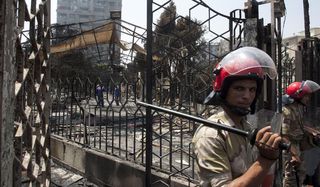
But the general’s main concern—as a staunch military man who has been in the army since the age of 23—was the rise of armed factions in the Middle East. “We are concerned by the undoing of the national state and the rule of law by armed militias,” el-Sissi emphasized at the gathering, just days before a Russian passenger plane went down in the Sinai Desert in what increasingly looks like a bombing by the Islamic State militant group (ISIS).
After being lauded at Manama, where he met with the German minister of defense and other bigwigs, el-Sissi flew home to take stock of the Russian airline crisis and to prepare for an official visit to Britain, where he would meet with Prime Minister David Cameron. After a period when the West was cautious about his ascent to power, el-Sissi’s visit underlined the fact that he is firmly back at international diplomacy’s top table, just weeks after Egypt was elected to the U.N. Security Council.
More here. [Thanks to Ken Roth.]
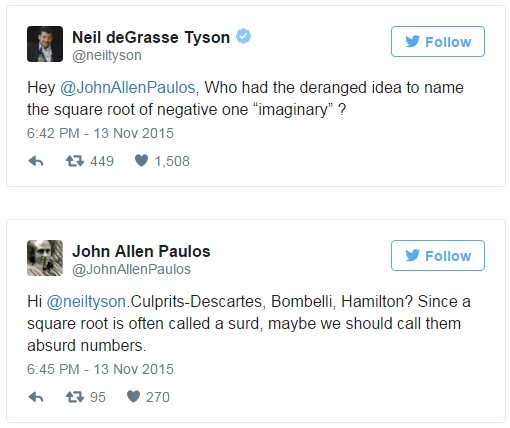
Neil deGrasse Tyson interrogates John Allen Paulos on Twitter
More here.
Aziz Ansari Takes Up Space
Hari Raghavan in Avidly:
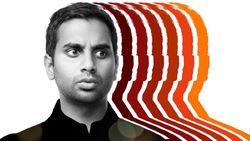
I was reminded of all this anew when I recently started watching Netflix’s remarkable new series, Master of None. In its premiere episode, the show’s main character Dev (Aziz Ansari) spends a day babysitting his friends’ two white kids who couldn’t be more terrible (my opinion). They visit a frozen yogurt shop, where one of the kids promptly proceeds to point at strangers and yell out their ethnicities: “Black! Chinese man!” The scene is hilarious, obviously, but it’s strangely incisive, too, about how at ease white people– especially children!– are with classifying and claiming space for themselves by pointing fingers at others.
Ta-Nehisi Coates writes of just this phenomenon in his memoir Between the World and Me, when he thinks back to a scene he once observed in Harlem – young white parents, letting their son run free ahead of them, stomping and screaming as he pleases. Coates laments that many children of color may never know this same joy or how to claim space themselves, for the realities their parents fear; his own child was once shoved on an escalator by a white woman twice his age. It’s not that the people who live with this certainty mean to offend in the questions they ask or things they grab. It’s that they have a unique ability to claim space (or feel entitled to it) while forgetting how the people of color around them, conversing with them, are constantly compelled to shrink themselves.
It’s a delicate kind of shape-shifting that takes an eventual toll, and Aziz Ansari, first generation South Asian that he is, seems to know something of the burden in the question his show asks repeatedly: How can he (and I by extension, and others like us) carve out and claim space in a culture or establishment that doesn’t allow us the room?
More here.
Being an ‘Elephant Mom’ in the Time of the Tiger Mother
Priyanka Sindhar-Sharma in The Atlantic:

…If you’re wondering what 'elephant parent' means, it’s the kind of parent who does the exact opposite of what the tiger mom, the ultra-strict disciplinarian, does. Here’s a short video clip that shows how real elephants parent. And that’s what I’m writing about here—parents who believe that they need to nurture, protect, and encourage their children, especially when they’re still impressionable and very, very young. My elephant mom was a doctor with infinite patience. I failed a Hindi test when I was in fifth or sixth grade, and I remember going to her, teary-eyed, with my results—and hearing her tell me that it didn’t matter. There were many more tests ahead. As I sobbed in her lap, she stroked my hair, hugged me, and told me there would be another test, and I could pass that one. (I did get the annual proficiency prize for Hindi a year later at the same school.)
More here. (Note: For my sister Ga who is both an amazing mother and an elephant lover)
Fleet Foxes | Blue Ridge Mountains
One Way Street Fragments for Walter Benjamin
Michael Wood – In search of Beowulf
Sunday Poem
Last night as I was sleeping,
I dreamt—marvelous error!—
that a spring was breaking
out in my heart.
I said: Along which secret aqueduct,
Oh water, are you coming to me,
water of a new life
that I have never drunk?
Last night as I was sleeping,
I dreamt—marvelous error!—
that I had a beehive
here inside my heart.
And the golden bees
were making white combs
and sweet honey
from my old failures.
Last night as I was sleeping,
I dreamt—marvelous error!—
that a fiery sun was giving
light inside my heart.
It was fiery because I felt
warmth as from a hearth,
and sun because it gave light
and brought tears to my eyes.
Last night as I slept,
I dreamt—marvelous error!—
that it was God I had
here inside my heart.
by Antonio Machado
from Times Alone, Selected Poems of…
Wesleyan University Press, 1983
translation: Robert Bly
Saturday, November 21, 2015
Violence, victors and victims: how to look at the art of the British empire
William Dalrymple in The Guardian:
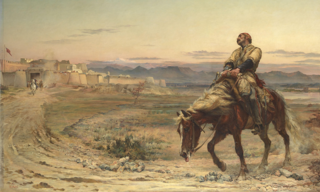
This fleeting snatch of conversation prompted Fleming to write a celebrated essay about how isolated and provincial postwar, post-imperial Britain had suddenly become. Twenty years earlier, he realised, half his friends and contemporaries would have been working in such cities across the British empire. Now, he wrote, “a man who has just come back from Rangoon is a rare and potentially interesting phenomenon. The contraction of our empire on one hand, and our incomes on the other, have reduced very considerably our knowledge – as a nation – of the world.” Gone were the days when “remote, romantic place names became domesticated in English households, and grandmothers headed for Asia in the Autumn … [Now] our horizons have shrunk … The British at the moment are more out of touch with the rest of the world than they have been for several generations.
This introversion, and the growing confusion and embarrassment it began to generate about the recent colonial past, had a dramatic effect on the arts in postwar Britain, and particularly on attitudes towards the country’s substantial holdings of imperial art. Throughout the 1950s and 60s, images of empire came to be regarded with something between a deep ambivalence and a profound distaste: paintings with Indian, African or Caribbean imperial themes seemed at best fuddy-duddy and passe, at worst mawkishly jingoistic.
More here.
All the old dances from the 80s and 90s
19 amazing untranslatable words
From The Telegraph:

–Bakku-shan (Japanese) A woman who looks beautiful – but only when viewed from behind
-Zhaghzhagh (Persian) The chattering of teeth in the cold
–Backpfeifengesicht (German) A face badly in need of a fist
–Schnapsidee (German) A brilliant plan one hatches while drunk
–Prozvonit (Czech) To save money by calling someone's mobile phone and hanging up after one ring so they will call you back
–Bilita Mpash (Bantu, in the Congo) A wonderful dream that surpasses good dreams. One that starts your day on a high and that you could properly describe as the opposite of a nightmare
More here.
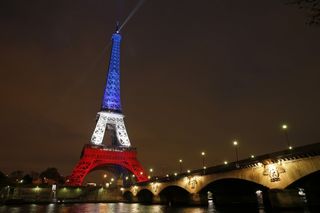
Magical Thinking about Isis
Adam Shatz in the LRB:
Before the Lebanese civil war, Beirut was known as the Paris of the Middle East. Today, Paris looks more and more like the Beirut of Western Europe, a city of incendiary ethnic tension, hostage-taking and suicide bombs. Parisians have returned to the streets, and to their cafés, with the same commitment to normality that the Lebanese have almost miraculously exhibited since the mid-1970s. Même pas peur, they have declared with admirable defiance on posters, and on the walls of the place de la République. But the fear is pervasive, and it’s not confined to France. In the last few weeks alone, Islamic State has carried out massacres in Baghdad, Ankara and south Beirut, and downed a Russian plane with 224 passengers. It has taunted survivors with threats of future attacks, as if its deepest wish were to provoke violent retaliation.
Already traumatised by the massacres in January, France appears to be granting that wish. ‘Nous sommes dans la guerre,’ François Hollande declared, and he is now trying to extend the current state of emergency by amending the constitution. Less than 48 hours after the event, a new round of airstrikes was launched against Raqqa, in concert with Russia. With a single night’s co-ordinated attacks, IS – a cultish militia perhaps 35,000 strong, ruling a self-declared ‘caliphate’ that no one recognises as a state – achieved something France denied the Algerian FLN until 1999, nearly four decades after independence: acknowledgment that it had been fighting a war, rather than a campaign against ‘outlaws’. In the unlikely event that France sends ground troops to Syria, it will have handed IS an opportunity it longs for: face to face combat with ‘crusader’ soldiers on its own soil.
Recognition as a war combatant is not IS’s only strategic gain. It has also spread panic, and pushed France further along the road to civil strife. The massacre was retribution for French airstrikes against IS positions, but there were other reasons for targeting France. Paris is a symbol of the apostate civilisation IS abhors – a den of ‘prostitution and vice’, in the words of its communiqué claiming responsibility for the attacks. Not only is France a former colonial power in North Africa and the Middle East but, along with Britain, it helped establish the Sykes-Picot colonial borders that IS triumphantly bulldozed after capturing Mosul. Most important, it has – by proportion of total population – more Muslim citizens than any other country in Europe, overwhelmingly descendants of France’s colonial subjects. There is a growing Muslim middle class, and large numbers of Muslims marry outside the faith, but a substantial minority still live in grim, isolated suburbs with high levels of unemployment. With the growth rate now at 0.3 per cent, the doors to the French dream have mostly been closed to residents of the banlieue. Feelings of exclusion have been compounded by discrimination, police brutality and by the secular religion of laïcité, which many feel is code for keeping Muslims in their place. Not surprisingly, more than a thousand French Muslims have gone off in search of glory on the battlefields of Syria and Iraq. Most of these young jihadis became radicalised online not in the mosque. Some, like the perpetrators of the attacks in January and November, have histories of arrest and time spent in prison; about 25 per cent of IS’s French recruits are thought to be converts to Islam. What most of the jihadis appear to have in common is a lack of any serious religious training: according to most studies, there is an inverse relationship between Muslim piety and attraction to jihad. As Olivier Roy, the author of several books on political Islam, recently said, ‘this is not so much the radicalisation of Islam as the Islamicisation of radicalism.’
More here.
Ta-Nehisi Coates: A Country Built on Black Bodies
Lindsay Beyerstein interviews Ta-Nehisi Coates in Point of Inquiry:
Coates joins Lindsay Beyerstein to discuss the heightening racial tension in America, the result of what he describes as a country built on black bodies and black suffering. In this evocative conversation, Coates compels us to look clearly at our illusions about American identity and social mobility, and explores what difficult remedies will be necessary to begin to rectify the damage American policies have done to black men and women over the centuries. He also considers how his atheism has influenced his own thinking about civil rights, justice, and forgiveness.
More here.
Research Paper: ISIS-Turkey List
David L. Phillips in Huffington Post:
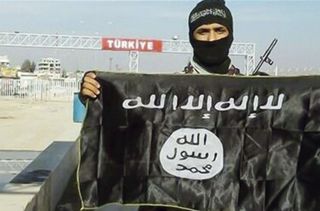
Is Turkey collaborating with the Islamic State (ISIS)? Allegations range from military cooperation and weapons transfers to logistical support, financial assistance, and the provision of medical services. It is also alleged that Turkey turned a blind eye to ISIS attacks against Kobani.
President Recep Tayyip Erdogan and Prime Minister Ahmet Davutoglu strongly deny complicity with ISIS. Erdogan visited the Council on Foreign Relations on September 22, 2014. He criticized “smear campaigns [and] attempts to distort perception about us.” Erdogan decried, “A systematic attack on Turkey's international reputation, “complaining that “Turkey has been subject to very unjust and ill-intentioned news items from media organizations.” Erdogan posited: “My request from our friends in the United States is to make your assessment about Turkey by basing your information on objective sources.”
Columbia University's Program on Peace-building and Rights assigned a team of researchers in the United States, Europe, and Turkey to examine Turkish and international media, assessing the credibility of allegations. This report draws on a variety of international sources — The New York Times, The Washington Post, The Guardian, The Daily Mail, BBC, Sky News, as well as Turkish sources, CNN Turk, Hurriyet Daily News, Taraf, Cumhuriyet, and Radikal among others.
Allegations
Turkey Provides Military Equipment to ISIS
• An ISIS commander told The Washington Post on August 12, 2014: “Most of the fighters who joined us in the beginning of the war came via Turkey, and so did our equipment and supplies.”
• Kemal Kiliçdaroglu, head of the Republican People's Party (CHP), produced a statement from the Adana Office of the Prosecutor on October 14, 2014 maintaining that Turkey supplied weapons to terror groups. He also produced interview transcripts from truck drivers who delivered weapons to the groups. According to Kiliçdaroglu, the Turkish government claims the trucks were for humanitarian aid to the Turkmen, but the Turkmen said no humanitarian aid was delivered.
• According to CHP Vice President Bulent Tezcan, three trucks were stopped in Adana for inspection on January 19, 2014. The trucks were loaded with weapons in Esenboga Airport in Ankara. The drivers drove the trucks to the border, where a MIT agent was supposed to take over and drive the trucks to Syria to deliver materials to ISIS and groups in Syria. This happened many times. When the trucks were stopped, MIT agents tried to keep the inspectors from looking inside the crates. The inspectors found rockets, arms, and ammunitions.
Mary Beard’s ‘SPQR’ and Tom Holland’s ‘Dynasty’
How on earth did they do it? The Greek historian Polybius, writing in the second century B.C., was the first to ask the question: “Who could be so indifferent or so idle that they did not want to find out how, and under what kind of political organization, almost the whole of the inhabited world was conquered and fell under the sole power of the Romans in less than 53 years?” It was not as if Rome was a promising spot: a swampy piece of ground up a barely navigable river surrounded by scrubby hills, its few thousand inhabitants alternately flooded out and ravaged by malaria.
Even its founding myth suggested a bumpy ride ahead: Romulus and Remus, those twins born to a delinquent priestess, were abandoned on the banks of the Tiber, then rescued by an improbable she-wolf, who suckled them. This shared ordeal engendered no brotherly love. Romulus murdered Remus on the city’s first day, and then with his gang abducted a bunch of women from the Sabine Hills to provide mothers for their children. So Rome began with a murder and a mass rape. From the start, its people were aggressive and acquisitive, and its narrow streets were a hide-out for the riffraff of Italy. Romans were like New Yorkers. They came from somewhere else, and they were proud of it.
In “SPQR,” her wonderful concise history, Mary Beard unpacks the secrets of the city’s success with a crisp and merciless clarity that I have not seen equaled anywhere else.
more here.
‘TRAM 83’ BY FISTON MWANZA MUJILA
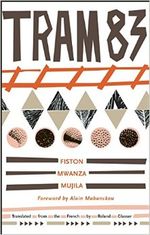
For a country as vast as it is, the Democratic Republic of the Congo has not produced much literature. (Ruthless oppression and exploitation will have that effect.) Tram 83 may not be a novel in the usual sense—it is more of a francophone triumph of style over substance—but it is a welcome voice from that quarter, and a promise of lively works to come.
As the book begins, a young man named Requiem waits at a decrepit railway station for his old friend Lucien to arrive. Requiem and Lucien haven’t seen each other in years. A woman named Jacqueline once came between them in some never-explained way.
Lucien is the prototypical starving artist, dressed in black and furiously at work on his play, which a contact in Paris has promised to produce. Requiem writes a bit too, but he also makes introductions (he’s a pimp), moves “merchandise” (he’s a drug dealer, or maybe a smuggler), and exercises leverage over foreigners with the use of compromising photos (he’s a blackmailer).
Requiem’s most attractive quality is his genuine enthusiasm for the hookers who congregate in a nightclub called Tram 83. “Your thighs have the allure of a vodka bottle,” he tells one, and he gets incensed at Lucien for his indifference to the pleasures on offer.
more here.
TS Eliot, the poet and the professor

There is a telling exchange with Edmund Wilson, who had offered a sympathetic and intelligent review of The Waste Land. Wilson, Eliot politely protested in a letter, had “over-understood” his poem. It’s an interesting term. In one of his most cited utterances, Eliot declared that “genuine poetry can communicate before it is understood”. Possibly the poem will never be understood, in the sense that a crossword puzzle is solved. But the poem does not, for that reason, fail in its poetic purpose. If, that is, it is “genuine”. There is a strong whiff of incense-wafting here — Cardinal Newman’s “grammar of assent” is evoked. As with Christianity, great poetry requires an act of faith: something beyond mere “understanding”. One should never forget that Eliot is the greatest of his century’s religious poets.
Eliot would jest, on coming across some particularly owlish exegesis, that the critic had got more from the poem than he, Eliot, did. Of “The Love Song of J. Alfred Prufrock” (1915) he recalled, wearily, “I have . . . seen some quite astonishing over-interpretation of this poem”. Should we approach his poems in something of the spirit of children going to a performance of the musical he inspired, Cats — not to understand but to experience and enjoy? That is too simple, of course, but on the right lines.
It would be easy to argue that Christopher Ricks and his assisting co-editor Jim McCue have, with this massive annotation, over-ballasted the ship.
more here.