this referendum has unleashed the worst in us

27661060226_1598768344_o-1Jon Day at n+1:

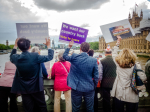
It began as an internal matter of party discipline. The offer of a referendum was a strategic decision made by the Conservative Party in the run up to last year’s general election. It was offered both as Prime Minister David Cameron’s concession to the eurosceptic wing of his own party—which had been hammering him on the issue of EU membership from the shires of middle England for years—and as a way of shoring up his nationalist credentials against the upstart band of blazer-wearing, spittle-spewing paranoiacs who call themselves the UK Independence Party.

Though they have one MP in the Commons (their leader Nigel Farage sits prettily in the European Parliament even as he rails against it) UKIP are more of a single-issue pressure group than a real political party. Nevertheless they have proved depressingly effective at whipping up anti-outsider sentiment: against Romanians and Bulgarians, against Turkey joining the EU, against Syrian refugees. It seemed as though they might well dilute the vote for the Tories—as well as for Labour, in some constituencies—during the 2015 election, so that giving way on the question of an EU referendum made some sense for the Conservatives. Both major parties felt comfortable, if not compelled, to make immigration a campaigning issue.

more here.
The Challenges of Male Friendships

Jane Brody in The New York Times:

BrodyChristopher Beemer, a 75-year-old Brooklynite, is impressed with how well his wife, Carol, maintains friendships with other women and wonders why this valuable benefit to health and longevity “doesn’t come so easily to men.” Among various studies linking friendships to well-being in one’s later years, the 2005 Australian Longitudinal Study of Aging found that family relationships had little if any impact on longevity, but friendships increased life expectancy by as much as 22 percent.

…From childhood on, Dr. Olds said, “men’s friendships are more often based on mutual activities like sports and work rather than what’s happening to them psychologically. Women are taught to draw one another out; men are not.” Consciously or otherwise, many men believe that talking about personal matters with other men is not manly. The result is often less intimate, more casual friendships between men, making the connections more tenuous and harder to sustain. Dr. Olds said, “I have a number of men in my practice who feel bad about having lost touch with old friends. Yet it turns out men are delighted when an old friend reaches out to revive the relationship. Men might need a stronger signal than women do to reconnect. It may not be enough to send an email to an old friend. It may be better to invite him to visit.” Some married men consider their wives to be their best friend, and many depend on their wives to establish and maintain the couple’s social connections, which can all but disappear when a couple divorces or the wife dies. Differences between male and female friendships start at an early age. Observing how his four young granddaughters interact socially, Mr. Beemer said, “They have way more of that kind of activity than boys have. It may explain why as adults they continue to do a much better job of it.” In defense of his gender, he observed, “Men have a harder time reaching their emotions and are less likely than women to reveal their emotional side. But when you have a real friendship, it’s because you’ve done just that.” He has found that “it’s important to expose yourself and be honest about what’s going on. If you reveal yourself in the right way to the right person, it will be just fine. There are risks, you can’t force it. Sometimes it doesn’t work — you get a don’t-burden-me-with-that kind of response and you know to back off. But more often men will respond in kind.” Mr. Beemer has worked hard to establish and maintain valuable relationships with other men of a similar vintage. He joined a men’s book group that meets monthly, and after about two years, he said, “it became a group where the members really mean something to one another.”

More here.

Tuesday Poem

Touch

We made our own laws.
I want to be a Hawk,
A Dolphin, a Lion, we’d say

In stores where team logos hung
Like animal skins.

By moonlight,
We chased each other
Around the big field

Beneath branches sagging
As if their leaves were full of blood.

We didn’t notice when policemen
Came lighting tree bark
& our skin with flashlights.

They saw our game
For what it was:

Fingers clutching torso,
Shoulder, wrist—a brawl.
Some of the boys escaped,

Their brown legs cut by thorns
As they ran through the brush.

It’s true, we could have been mistaken
For animals in the dark,
But of all our possible crimes,

Blackness was the first.
So they tackled me,

And read me my rights without saying:
You Down or Dead Ball.
We had a language

They did not use, a name
For collision. We called it Touch.
.

by Terrance Hayes
from Hip Logic
Penguin, 2002
.

Monday, June 27, 2016

perceptions

Tumblr_mnt4vxX2kg1rouua1o7_1280

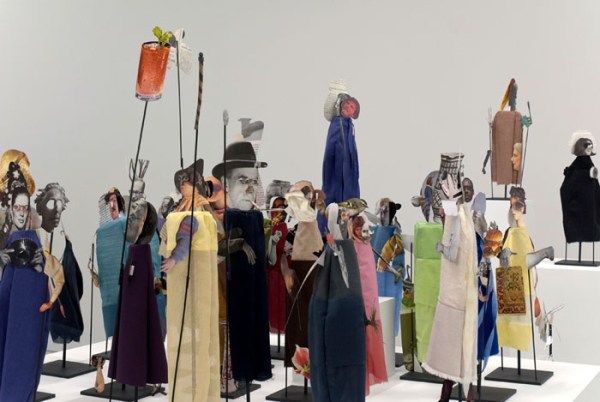
Geoffrey Farmer. The Surgeon and The Photographer. From Stage Presence, SFMOMA 2012.

Installation: paper, textiles, wood, & metal.

“… Farmer collaged photographic reproductions from books into 365 puppet-like sculptures, each approximately the size of a hand, thirty of which are included in this exhibition. The puppets bristle with multiple identities; each angle presents a new figuration as disproportionate and layered appendages cohere into forms. They are totemic but not possessed of any spirit. Rather, they are waiting for occupation and activation.

More here, and here.

Sunday, June 26, 2016

A history of masturbation

Barry Reay in Aeon:

ScreenHunter_2062 Jun. 26 23.10The anonymous author of the pamphlet Onania (1716) was very worried about masturbation. The ‘shameful vice’, the ‘solitary act of pleasure’, was something too terrible to even be described. The writer agreed with those ‘who are of the opinion, that… it never ought to be spoken of, or hinted at, because the bare mentioning of it may be dangerous to some’. There was, however, little reticence in cataloguing ‘the frightful consequences of self-pollution’. Gonorrhoea, fits, epilepsy, consumption, impotence, headaches, weakness of intellect, backache, pimples, blisters, glandular swelling, trembling, dizziness, heart palpitations, urinary discharge, ‘wandering pains’, and incontinence – were all attributed to the scourge of onanism.

The fear was not confined to men. The full title of the pamphlet wasOnania: Or the Heinous Sin of Self-Pollution, and all its Frightful Consequences (in Both Sexes). Its author was aware that the sin of Onan referred to the spilling of male seed (and divine retribution for the act) but reiterated that he treated ‘of this crime in relation to women as well as men’. ‘[W]hilst the offence is Self-Pollution in both, I could not think of any other word which would so well put the reader in mind both of the sin and its punishment’. Women who indulged could expect disease of the womb, hysteria, infertility and deflowering (the loss of ‘that valuable badge of their chastity and innocence’).

Another bestselling pamphlet was published later in the century:L’onanisme (1760) by Samuel Auguste Tissot. He was critical of Onania, ‘a real chaos … all the author’s reflections are nothing but theological and moral puerilities’, but nevertheless listed ‘the ills of which the English patients complain’.

More here.

In Indonesia, Non-Binary Gender is a Centuries-Old Idea

Modern Western culture is slowly acknowledging gender fluidity, but “third genders” and other classifications have existed throughout history.

Jessie Guy-Ryan in Atlas Obscura:

ScreenHunter_2061 Jun. 26 23.03This week, an Oregon judge ruled to allow Jamie Shupe, a 52-year-old former Army mechanic, to list themselves as non-binary—that is, neither male nor female on their driver’s license. The ruling is likely the first time that an individual has been allowed to legally identify as non-binary in the United States, and represents part of a growing effort around the world to extend legal recognition to those whose identities fall outside the masculine/feminine gender binary.

Some might assume that the shift towards viewing gender as fluid or encompassing identities beyond the binary is a novel cultural change; in fact, several non-Western cultures—both historically and today—have non-binary understandings of gender. In Indonesia, one ethnic group shows us that the idea that gender identity is expressed in more ways than two is actually hundreds of years old.

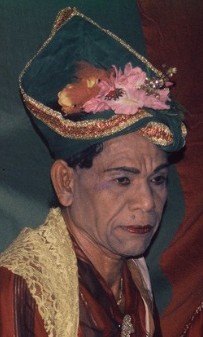
The Bugis are the largest ethnic group in South Sulawesi, Indonesia, and are unique in their conception of five distinct gender identities. Aside from the cisgender masculinity and femininity that Westerners are broadly familiar with, the Bugis interpretation of gender includes calabai (feminine men), calalai (masculine women) and bissu, which anthropologist Sharyn Graham describes as a “meta-gender” considered to be “a combination of all genders.”

More here.

Across the Universe

Steven Wheeler in Inference:

As the 1960s drew to a close, Rainer Weiss was working as an associate professor at MIT’s Department of Physics.1 Asked to teach an undergraduate course on general relativity by the department chairman, Weiss found himself in the unenviable position of teaching an unfamiliar subject. “I had a terrible time with the mathematics,” Weiss recalled, “[a]nd I tried to do everything by making aGedankenexperiment out of it.”2

Weiss’s students were curious about the work of physicist Joseph Weber and, in particular, his attempts to detect gravitational waves. Predicted by Albert Einstein’s theory of general relativity, gravitational waves were a much-debated phenomenon for which no experimental evidence had been found. Weber’s efforts were centered on resonant mass detectors of his own design: suspended aluminum cylinders two meters in length and a meter in diameter fitted with a ring of piezoelectric crystals.3 Weber believed that the cylinders would, in effect, act like giant tuning forks; a passing gravitational wave would ring the cylinders at their resonant frequency. In a 1969 paper published by the Physical Review, Weber claimed to have found evidence for gravitational waves.

More here.

How the New Science of Computational History Is Changing the Study of the Past

From the MIT Technology Review:

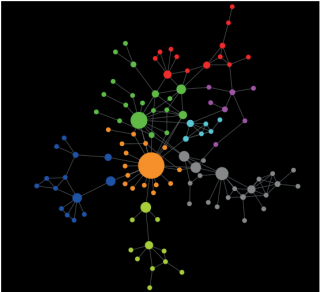
Computational-historyOne of the curious features of network science is that the same networks underlie entirely different phenomena. As a result, these phenomena have deep similarities that are far from obvious at first glance. Good examples include the spread of disease, the size of forest fires, and even the distribution of earthquake magnitude, which all follow a similar pattern. This is a direct result of their sharing the same network structure.

So it’s usually no surprise that the same “laws” emerge when physicists find the same networks underlying other phenomena. Exactly this has happened repeatedly in the social sciences. Network science now allows social scientists to model societies, to study the way ideas, gossip, fashions, and so on flow through society—and even to study how this influences opinion.

To do this they’ve used the tools developed to study other disciplines. That’s why the new field of computational social science has become so powerful so quickly.

But there’s another field of endeavor that also stands to benefit: the study of history. Throughout history, humans have formed networks that have played a profound role in the way events have unfolded. Historians have recently begun to reconstruct these networks using historical sources such as correspondence and contemporary records.

More here.

A Stark Nuclear Warning

Jerry Brown in the New York Review of Books:

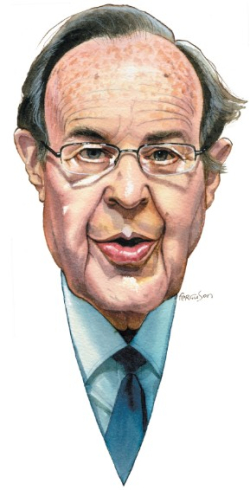
ScreenHunter_2060 Jun. 26 22.48I know of no person who understands the science and politics of modern weaponry better than William J. Perry, the US Secretary of Defense from 1994 to 1997. When a man of such unquestioned experience and intelligence issues the stark nuclear warning that is central to his recent memoir, we should take heed. Perry is forthright when he says: “Today, the danger of some sort of a nuclear catastrophe is greater than it was during the Cold War and most people are blissfully unaware of this danger.”1 He also tells us that the nuclear danger is “growing greater every year” and that even a single nuclear detonation “could destroy our way of life.”

In clear, detailed but powerful prose, Perry’s new book, My Journey at the Nuclear Brink, tells the story of his seventy-year experience of the nuclear age. Beginning with his firsthand encounter with survivors living amid “vast wastes of fused rubble” in the aftermath of World War II, his account takes us up to today when Perry is on an urgent mission to alert us to the dangerous nuclear road we are traveling.

Reflecting upon the atomic bombing of Hiroshima and Nagasaki, Perry says it was then that he first understood that the end of all of civilization was now possible, not merely the ruin of cities.

More here.

‘I don’t remember a time when words were not dangerous’

Hisham Matar in The Guardian:

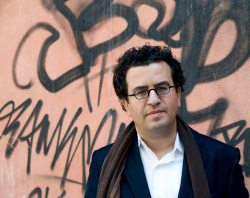
HishamI don’t remember a time when words were not dangerous. But it was around this time, in the late 1970s, when I was a young schoolboy in Tripoli, that the risks had become more real than ever before. There were things I knew my brother and I shouldn’t say unless we were alone with our parents. I don’t remember my mother or father explicitly telling us what not to say. It was simply implied and quickly understood that certain words strung together in a particular order could have grave consequences. Men were locked up for saying the wrong thing or because they were innocently quoted by a child. “Really, your uncle said that? What’s his name?” It was as though a listening, bad-intentioned ghost was now present at every gathering. It brought with it a new silence – wary and suspicious – that was to remain in our lives for many years. Even when I was writing my first novel in a shed in Bedfordshire, beside the River Great Ouse, I could feel the disapproving hot breath of the dictator at my neck. It did not matter that I was writing in English and yet to have a publisher; I was nonetheless writing into and against that silence. But back when I was still a boy, when I only lived in one language, that silence, like black smoke from a new fire, was still growing. Lists, drafted by the authorities, were read on television. They contained the names of those to be questioned. That was how, one afternoon, I heard our name, by which I mean my father’s name, read out. He was abroad. He did not return to Tripoli. A year or so later, we left the country to be reunited with him in Cairo where a new life began: new schools and new teachers.

More here.

Why Trump Makes Me Scared for My Family

Aziz Ansari in The New York Times:

Aziz“DON’T go anywhere near a mosque,” I told my mother. “Do all your prayer at home. O.K.?” “We’re not going,” she replied. I am the son of Muslim immigrants. As I sent that text, in the aftermath of the horrible attack in Orlando, Fla., I realized how awful it was to tell an American citizen to be careful about how she worshiped. Being Muslim American already carries a decent amount of baggage. In our culture, when people think “Muslim,” the picture in their heads is not usually of the Nobel Peace Prize winner Malala Yousafzai, Kareem Abdul-Jabbar or the kid who left the boy band One Direction. It’s of a scary terrorist character from “Homeland” or some monster from the news. Today, with the presidential candidate Donald J. Trump and others like him spewing hate speech, prejudice is reaching new levels. It’s visceral, and scary, and it affects how people live, work and pray. It makes me afraid for my family. It also makes no sense.

There are approximately 3.3 million Muslim Americans. After the attack in Orlando, The Times reported that the F.B.I. is investigating 1,000 potential “homegrown violent extremists,” a majority of whom are most likely connected in some way to the Islamic State. If everyone on that list is Muslim American, that is 0.03 percent of the Muslim American population. If you round that number, it is 0 percent. The overwhelming number of Muslim Americans have as much in common with that monster in Orlando as any white person has with any of the white terrorists who shoot up movie theaters or schools or abortion clinics.

More here.

Saturday, June 25, 2016

How an internet mapping glitch turned a random Kansas farm into a digital hell

Kashmir Hill in Fusion:

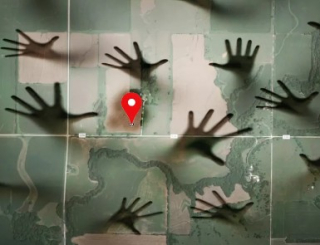
ScreenHunter_2059 Jun. 26 11.39An hour’s drive from Wichita, Kansas, in a little town called Potwin, there is a 360-acre piece of land with a very big problem.

The plot has been owned by the Vogelman family for more than a hundred years, though the current owner, Joyce Taylor née Vogelman, 82, now rents it out. The acreage is quiet and remote: a farm, a pasture, an old orchard, two barns, some hog shacks and a two-story house. It’s the kind of place you move to if you want to get away from it all. The nearest neighbor is a mile away, and the closest big town has just 13,000 people. It is real, rural America; in fact, it’s a two-hour drive from the exact geographical center of the United States.

But instead of being a place of respite, the people who live on Joyce Taylor’s land find themselves in a technological horror story.

For the last decade, Taylor and her renters have been visited by all kinds of mysterious trouble. They’ve been accused of being identity thieves, spammers, scammers and fraudsters. They’ve gotten visited by FBI agents, federal marshals, IRS collectors, ambulances searching for suicidal veterans, and police officers searching for runaway children. They’ve found people scrounging around in their barn. The renters have been doxxed, their names and addresses posted on the internet by vigilantes. Once, someone left a broken toilet in the driveway as a strange, indefinite threat.

All in all, the residents of the Taylor property have been treated like criminals for a decade. And until I called them this week, they had no idea why.

More here.

Who isn’t equipped for a pandemic or bioterror attack? The WHO

Annie Sparrow in the Bulletin of the Atomic Scientists:

Business and politics have always influenced international efforts to solve public health problems. Unfortunately that remains as true in the era of Ebola, Zika, and bioweapons as it did in the 19th century, when cholera—a disease that spreads more quickly and kills faster than any other pathogen—began its deadly global march. Beginning in 1817, cholera spread relentlessly from the Ganges Delta across Asia, reaching Europe in 1830 and North America in 1832, taking millions of lives along the way. It ultimately precipitated the first of 14 International Sanitary Conferences in 1851. At the time, the typical response to cholera was to quarantine ships traveling from affected areas, but this practice, which slowed commerce, was expensive and unpopular. The World Health Organization (WHO), whose origins lie in those early cholera pandemics, says they “were catalysts for intensive infectious disease diplomacy and multilateral cooperation in public health.” But in fact, the first six International Sanitary Conferences were entirely unproductive due to conflicting interests: government fears about losing profits from trans-Atlantic trade took priority over the need to reduce the international death toll. Consensus was achieved only at the seventh conference in 1892, after the opening of the Suez Canal for use by all countries made standardized quarantine regulations necessary. The participating states then unanimously approved and ratified the first of four International Sanitary Conventions, the forerunner of today’s International Health Regulations, which commit all governments to work toward stopping the spread of infectious disease and other global health threats.

More here.

In Parenthesis: in praise of the Somme’s forgotten poet

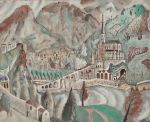
David Jones, Lourdes, 1928, Kettle's Yard_mainOwen Sheers at The Guardian:

In his introduction, TS Eliot hailed In Parenthesis as “a work of genius”. Graham Greene placed it “among the great poems of the century”. WH Auden claimed “it does for the British and Germans what Homer did for the Greeks and Trojans”; he wrote to Jones to tell him “your work makes me feel very small and madly jealous”. On entering a party and seeing Jones sitting in the corner, WB Yeats bowed low to “salute the author of In Parenthesis”.

Perhaps the most considered response came from Herbert Read, an ex‑solider himself, whose reviews of In Parenthesis are shot through not just with admiration, but also a sense of gratitude. “For the first time,” he wrote, “all the realistic sensory experiences of infantrymen have been woven into a pattern which, while retaining all the authentic realism of the event, has the heroic ring which we associate with the old chansons de geste … a book which we can accept as a true record of our suffering and as a work of art in the romantic tradition of Malory and the Mabinogion.”

Read’s acknowledgment of In Parenthesis’s ability to simultaneously contain the contemporary and the ancient, the literary and the demotic, the realistic and the mythic, and of the “pattern” underpinning its whole, are key to understanding the power of Jones’s achievement.

more here.

Calvin Trillin Looks Back on 50 Years Covering Black Life in America

26gilliam-sub-blog427Dorothy Butler Gilliam at The New York Times:

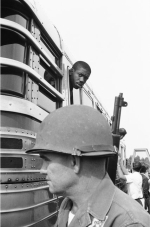
In 1964, Trillin captured an exchange with King that speaks to our current political moment. King was flying to Mississippi when a young white man with “a thick drawl” and self-identifying as a Christian leaned across the aisle and questioned whether King’s movement was teaching Christian love or inciting violence. King explained that “love with justice” was a basic tenet of the nonviolent civil rights movement, and asked him what he thought of the new civil rights law. The inquisitor said he hadn’t read it.

“I think parts of it just carry on the trend toward federal dictatorship,” the man said. King later asked him if he was going to vote for Goldwater, the Republican nominee. “Yes, I expect I will,” the man answered. “I’ve voted for losers before.” King shook his head as the white man exited the plane. “His mind has been cold so long, there’s nothing that can get to him.”

In today’s hostile political climate, when an air of fatalist resentment seems to emanate from supporters of Donald Trump, that conversation, with a change of names, could easily occur.

Demonstrating that racism extended beyond the South, Trillin wrote about the successful battle whites waged against integration in Denver schools in 1969. In “Doing the Right Thing Isn’t Always Easy,” he patiently debunks the coded language of white supremacy the segregationists used to warn of “forced mandatory crosstown busing on a massive scale.” By 2015, Trillin writes in an update, most of the city’s white residents have fled to the suburbs, and “only 29 of Denver’s 188 schools could be considered integrated.”

more here.