From Burmese Dissident to Mystifying Politician

BN-OS134_ebadi_J_20160629142853

Shirin Ebadi in the Wall Street Journal:

In advance of a United Nations envoy’s visit to the country, Burmese officials in June instructed U.N. officials to refer to Burma’s Muslim minority as “people who believe in Islam in Rakhine state.” This is the latest chapter in what has become a tragic campaign to reassure Buddhist nationalists that the government will continue to oppress the Rohingya—even to the point of denying them their name and citizenship in Burma.

Sadly, this campaign is being led by Nobel peace laureate Aung San Suu Kyi.

After decades of defiant activism, house arrest and unimaginable personal sacrifice, Ms. Suu Kyi is finally in a position to bring democracy to her country. Ms. Suu Kyi’s party won Burma’s national elections in November 2015, and this spring, in addition to being named foreign minister, she was appointed state counselor, the de facto prime minister. The new title effectively gives her the power to run Burma.

I’m sure it is a responsibility that my fellow Nobel peace laureate—a woman who was under house arrest off and on for more than two decades—takes very seriously. Yet those of us who spoke up for Aung San Suu Kyi those many years when her human rights were being violated—including His Holiness the Dalai Lama and Archbishop Desmond Tutu—are deeply pained that she won’t extend the same respect for human rights to Burma’s more than one million Rohingya.

Like thousands of human-rights defenders around the world, we have also called upon Burma to respect the rights of other political prisoners and minorities in Burma—including the Karen, the Shan and the Chin. Global human-rights organizations, along with courageous grass roots organizations in Burma, have documented how the Burmese military and state have suppressed these minorities through religious persecution, killings, rape, disappearances, torture and other crimes against humanity.

More here.

Brexit: The Tectonic Plates

Mg_6338b-by-matthias-grauwinkel (1)

Sanjay G. Reddy over at his website:

UK voters who favoured remaining may be aggrieved by what they view as a poor choice in a flawed process, by the majority of voters who might have individually or collectively acted differently on another day — if they had more time to reflect, or if more had turned out, for instance. However, those who favoured leaving might also have viewed the aspects of Europe to which they objected as being the product of poor choices in a flawed process, by citizens too deferential to institutions and to bureaucracies and given too few democratic rights. In both cases, a more subtle view of democracy, recognizing the claims of parts of the whole, and giving them fuller realization in terms of process and outcomes, was needed. For example, under the circumstances the referendum vote might have been avoided by giving the UK fuller concessions including a temporary exception from the free mobility requirement of the EU while Eastern European wages caught up sufficiently to diminish flows, but this was not acceptable to the grandees of Europe, especially as Eastern European integration had been a political as well as economic project. (It is interesting that those who view this commitment as ‘fundamental’ do not take the same view when it comes to international mobility more generally). On the other side, the referendum mechanism provided insufficient recognition of the vital interests involved, especially as they were perceived by territorial minorities such as the Scots and non-territorial minorities with vital interests, such as the young. This is a specific and unusually stark version of a more general democratic conundrum.

Of course, the need for such choices is never fated. Political decisions, such as that of the Conservatives to address the challenge from UKIP by dignifying its narrative, and the failure of Labour to provide a robust progressive case for remaining, ushered in the impossible.

More here.

‘Healing’ detected in Antarctic ozone hole

Matt McGrath in BBC News:

OzoneThe scientists said that in September 2015 the hole was around 4 million sq km smaller than it was in the year 2000 – an area roughly the size of India. The gains have been credited to the long term phasing out of ozone-destroying chemicals. The study also sheds new light on the role of volcanoes in making the problem worse. The natural production and destruction of ozone in the stratosphere balances itself out over long time, meaning that historically there has been a constant level to protect the Earth by blocking out harmful ultraviolet radiation from the Sun. Its absence increases the chances of skin cancer, cataract damage, and harm to humans, animals and plants. British scientists first noticed a dramatic thinning of ozone in the stratosphere some 10 kilometres above Antarctica in the mid 1980s. In 1986, US researcher Susan Solomon showed that ozone was being destroyed by the presence of molecules containing chlorine and bromine that came from chlorofluorocarbons (CFCs). These gases were found in everything from hairsprays to refrigerators to air conditioning units. The reason the thinning was occurring mainly over Antarctica was because of the extreme cold and large amounts of light. These helped produce what are termed Polar Stratospheric Clouds. In these chilled-out clouds, the chlorine chemistry occurs that destroys the ozone.

Thanks to the global ban on the use of CFCs in the Montreal Protocol in 1987, the situation in Antarctica has been slowly improving. Several studies have shown the declining influence of CFCs, but according to the authors this new study shows the “first fingerprints of healing” and the ozone layer is actively growing again. Prof Solomon and colleagues, including researchers from the University of Leeds in the UK, carried out detailed measurements of the amount of ozone in the stratosphere between 2000 and 2015. Using data from weather balloons, satellites and model simulations, they were able to show that the thinning of the layer had declined by 4 million sq km over the period. The found that more than half the shrinkage was due solely to the reduction in atmospheric chlorine.

More here.

‘The Arrangements’: A Work of Fiction

Chimamanda Ngozi Adichie in The New York Times:

The New York Times Book Review asked the acclaimed novelist Chimamanda Ngozi Adichie to write a short story about the American election. A second work of election fiction by a different writer will follow this fall.

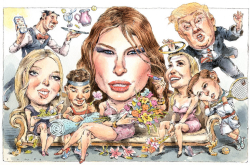
TrumpMelania decided she would order the flowers herself. Donald was too busy now anyway to call Alessandra’s as usual and ask for “something amazing.” Once, in the early years, before she fully understood him, she had asked what his favorite flowers were. “I use the best florists in the city, they’re terrific,” he replied, and she realized that taste, for him, was something to be determined by somebody else, and then flaunted. At first, she wished he would not keep asking their guests, “How do you like these great flowers?” and that he would not be so nakedly in need of their praise, but now she felt a small tug of annoyance if a guest did not gush as Donald expected. The florists were indeed good, their peonies delicate as tissue, even if a little boring, and the interior decorators Donald had brought in — all the top guys used them, he said — were good, too, even if all that gold yellowness bordered on staleness, and so she did not disagree because Donald disliked dissent, and he only wanted the best for them, and she had what she really needed, this luxurious peace. But today, she would order herself. It was her dinner party to celebrate her parents’ anniversary. Unusual orchids, maybe. Her mother loved uncommon things.

Her Pilates instructor, Janelle, would arrive in half an hour. She had just enough time to order the flowers and complete her morning skin routine. She would use a different florist, she decided, where Donald did not have an account, and pay by herself. Donald might like that; he always liked the small efforts she made. Do the little things, don’t ask for big things and he will give them to you, her mother advised her, after she first met Donald. She gently patted three different serums on her face and then, with her fingertips, applied an eye cream and ­sunscreen. What a bright morning. Summer sunlight raised her spirits. And Tiffany was leaving today. It felt good. The girl had been staying for the past week, and came and went, mostly staying out of her way. Still, it felt good. Yesterday she had taken Tiffany to lunch, so that she could tell Donald that she had taken Tiffany to lunch.

“She adores all my kids, it’s amazing,” Donald once told a reporter — he was happily blind to the strangeness in the air whenever she was with his children.

More here.

Saturday Poem

A Ghazal from Ghalib

مقدمِ سیلاب سے دل کیا نشاط آہنگ ہے

خانۂ عاشق مگر سازِ صدائے آب تھا

The waters rise past the rafters in my house.
Their undulant music calms my rage tonight.

I was homeless before: it was a proper life.
Wine-free, woman-free, I had peace all night.

I was sightless in the cave of desire. Outside,
His light shone brilliantly night after night.

Is this nothing to you, that we live or die?
Time was, our pain kept you up all night.

It happened long ago. Afraid of losing us,
She parted the veil till her beauty sang all night.

Glad I stopped him. Ghalib was so rattled,
His tears may have drowned the stars tonight.
.

translation by M. Shahid Alam
Northeastern University
.

Friday, July 1, 2016

Government Under Review

Bureaucrats_600_2

Daniel E. Ho and Becky Elias examined whether peer review for public servants can make the law more consistent in Boston Review:

Like many good arguments, this one started over a stiff drink. An Earl Grey MarTEAni, to be precise.

In January 2010, Nathalie Louissaint, a New York City health inspector, visited Pegu Club, an upscale cocktail bar. She watched as the bartender mixed the signature tea-infused drink. Borrowing a technique from the nineteenth century, the bartender added raw egg whites, which give the drink a silky body and an alluring layer of foam. Louissaint decided that the raw egg warning on the menu was insufficient and cited the bar for a health code violation.

The citation outraged many. Paul Clarke, a Seattle-based food writer, was perplexed by the department’s rigid position on raw eggs, writing on the website Serious Eats, “Does this mean the health department will begin targeting restaurants that serve raw eggs in a Caesar salad?” Others decried the health department’s seeming mandate to use pasteurized eggs, but those, said Pegu Club owner Audrey Sanders, “impart this really funky wet-diaper nose.” One bartender, who insisted on anonymity for fear of reprisal, told the New York Times, “If they make it illegal to serve egg-white drinks, that would be Hurricane Katrina for us.” In response to the uproar, the health department overruled the inspector.

This confusion is no outlier. Nationwide, implementation of health codes varies dramatically across inspectors and health departments. In Seattle, two inspectors observed Caesar salad dressing prepared with raw (unpasteurized) eggs in the same restaurant, but disagreed about whether to cite a violation. Contrary to New York City health department guidelines, New York State’s website doesn’t mention menu warnings, instead admonishing, “Consider using commercially pasteurized eggs in recipes that use eggs or consider removing the item from your menu.” The Centers for Disease Control and Prevention (CDC) document that 80 percent of restaurants nonetheless use unpasteurized eggs.

When it comes down to it, the marTEAni fight is not so much about eggs as it is an endemic challenge across government. From airport security checkpoints and routine traffic stops to home construction permits, citizens and government interact frequently through individual officials. At times, the decisions of these frontline government officials can seem disturbingly arbitrary.

More here.

Beyoncé: many things all at once

P20_Oja

Carol Oja in the TLS:

In the two months since Lemonade’s release, it has provoked an extraordinary cultural critique, with articles ranging from besotted fandom to probing essays about its racial and feminist politics. In fact, the visual album is simultaneously clear-as-a-bell and obscure, even at times surreal. In the “Denial” section, for example, Beyoncé falls off a very tall building, then is submerged under water. She floats like a ghost over a bed, ultimately striding forth from a building that suggests a seat of power, and she does so amid yet another surge of water. The omnipresence of water conjures up the devastation of Hurricane Katrina, which later moves to the foreground in “Formation”. The narrative ostensibly has an autobiographical thread, albeit with a celebrity tinge, with many critics claiming that it exposes Jay Z’s infidelity.

At a deeper level, Lemonade decries the history of oppression of African American women. “The most disrespected person in America is the black woman”, intones the sampled voice of Malcolm X after “Don’t Hurt Yourself”, the third song in the album.

Lemonade, then, is many things all at once: an extended feminist anthem with a Civil Rights inflection, performance art with an experimental edge, a revenue-generating media spectacle with high-flying aims. It juxtaposes the deep past with the vivid present, still photography with moving images, black-and-white with colour, African and Native American imagery with that of the American South, vandalism with tenderness. A startling twist is that Lemonade was released through Tidal, a streaming service owned by Jay Z and Beyoncé – the same Jay Z whom the work ostensibly exposes as an adulterer. As of mid-May,Lemonade had attracted 1.2 million new subscribers to Tidal.

Lemonade’s political intentions have been questioned: can ideological integrity coexist with big profits? Beyoncé “positively exploits images of black female bodies – placing them at the center, making them the norm”, asserts bell hooks, the African American feminist and social theorist. Yet, she concludes, “Ultimately Lemonade glamorizes a world of gendered cultural paradox and contradiction. It does not resolve”. “Glamour” certainly describes Lemonade, with Beyoncé singing, rapping, and dancing in magnificent gowns and artfully flowing hair. The women around her are also exquisitely turned out. “I’m so reckless when I rock my Givenchy dress (stylin’)”, Beyoncé intones in “Formation”, which has frequently been called a “Black Power Anthem” in the press. She flips the bird there, with perfectly manicured nails and wrists laden with expensive silver jewelry.

More here.

Comics versus Art

CVA_BASIC

Hillary Chute reviews Bart Beaty new book in Critical Inquiry:

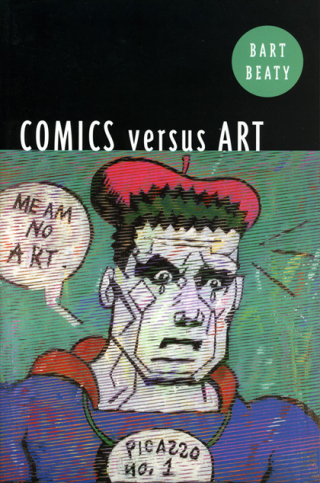
The cultural legitimization of comics; it is a topic that I, a scholar of contemporary literature and visual culture who has focused on comics, find singularly boring. It can feel backwards looking, instead of forward thinking. I certainly note this issue constantly, a natural impulse, as I track the public discourse around anything that compels me, but I have found that today the question of how and if comics is legitimated is often the least interesting avenue of inquiry one could consider about the form. I am, however, fascinated by the question of what constitutes art, as a practice and as material iteration—and how the form of comics has presented a productive challenge, particularly in the post WWII period, to conceptions of art and literature, and how and where they meet. Bart Beaty’s Comics versus Art, with its polemical title and 1978 Gary Panter illustration of a cape and beret-sporting superhero on the cover, appears a welcome and exciting contribution; finally someone, I thought, will wade right into these murky waters for the length of entire monograph, unfolding connections and possibilities; the title must just be a hook. Beaty, an English professor at Toronto who published the excellent studies Frederic Wertham and the Critique of Mass Culture (2005) and Unpopular Culture: Transforming the European Comic Book in the 1990s(2007), among others, has also translated some of the most sophisticated French scholarship on comics by Thierry Groensteen and Thierry Smolderen.

But the simplicity of the title is the real critical framework here. Beaty “interrogates the specific historical and social processes that have led to the devaluation of comics as a cultural form and takes note of the recent rise to art world prominence of (certain kinds of) comics. . . . In an increasingly postmodern world in which the distinction between high and low culture is often assumed to have been eroded, outmoded biases continue to persist” (p. 7). Beaty argues throughout, predictably, that the art world hasn’t accepted comics on its own terms, yet. Specifically, Beaty is interested in analyzing comics from a sociological perspective as its own “distinct art world” and network. Inspired by Howard Saul Becker’s 1982 Art Worlds (along with Pierre Bourdieu and a smattering of Friedrich Nietzsche’s theory ofressentiment), he disputes what he suggests are formalist definitions of comics that ignore the “comics world” and its relation to cultural value.

More here.

the philosophy of ugliness

P1_Ground1Ian Ground at the Times Literary Supplement:

Central to what is known as the “paradox of the ugly” is that ugliness does not just repel but also invites fascination and (prima facie at least) aesthetic appreciation. Thus the blobfish, the no doubt proud recipient of the ugliest animal award, the goblin shark and the naked mole rat hold – and in an as yet unexplained sense, reward – our attention. Deformity and injury – for all the moral problems that swirl around our reactions – excite a morbid fas­cination. And, of course, countless artworks and traditions have long enlisted negative responses to the revolting, disgusting, horrific and abject in pursuit of their positive goals.

Three strategies can go some way to sidestepping the sense of paradox. First, we may say that the paradox arises because of a failure to distinguish between the aesthetically and the artistically valuable. The ugly may be put to beautiful artistic purpose. But in such cases it could be that the aesthetically bad may be artistically good. For example, it would be intelligible to say of Francis Bacon’s “Screaming Pope” that the painting is insufficiently ugly. The ugly may be beautifully represented by the artist.

Second, we may say that the ugly is the vehicle for the appreciation of certain thoughts and feelings that could not otherwise be expressed. It might be the vehicle for cognitive value, for instance, in the traditional artistic duty of holding up a mirror to its audience. Third, we may say that the delight we take in the ugly is a parasitic response to the norm.

more here.

On Pier Paolo Pasolini’s “The Long Road of Sand”

4400202_killing-of-italian-director-pier-paolo-pasolini_89cc7501_mAra H. Merjian at Bookforum:

Setting out in his Fiat 1100 from the Ligurian coast in June of 1959, Pier Paolo Pasolini spent the next couple months wending his way around Italy’s seemingly endless shoreline, arriving—at summer’s end—in the northeastern seaport of Trieste, not far from the Slovenian border. Commissioned by the magazine Successo, Pasolini’s spirited travelogue appeared in successive issues, illustrated with shots by the photographer Paolo di Paolo of chaises longues and beachside cafés, the holiday jet-set and throngs of teenagers clad in swimwear. Expertly translated by Stephen Sartarelli (whose renderings of Pasolini’s poetry came out from University of Chicago Press in 2014), this handsome English-language edition of Pasolini’s features photographs by Philippe Séclier, who retraced Pasolini’s journey, taking images that provide striking counterpoints to the text and update di Paolo’s repertoire in a more personal, intimate vernacular.

A notoriously heretical Marxist and sworn enemy of modernity, Pasolini calls to mind anything but the bourgeois trappings of “success.” His verse, cinema, journalism, and theater waged, in fact, tireless opposition against Italy’s neo-capitalist transformation, in nearly every medium imaginable. Yet here, just as the country’s post-war “economic miracle” picks up steam, we find Pasolini waxing enthusiastic about its future, reveling in those countless pockets of dialect and regional culture that still marked the peninsula’s coast, from sprawling resort towns to tiny fishing villages.

more here.

thinking about postcapitalism

4168CHYVRPLOwen Hatherley at The London Review of Books:

The point Mason reiterates again and again is that in the struggle between postcapitalism and its alleged neoliberal enemies, ‘everything is pervaded by a fight between network and hierarchy.’ This is perhaps the issue on which he differs most from Srnicek and Williams. The first part of Inventing the Future mounts a critique of local, self-organised, non-hierarchical politics. Srnicek and Williams prefer to call it ‘folk politics’, though it seems as deeply enmeshed in the internet and its social networks as the futurism they advocate; more so, in fact. The participants in folk politics, like Mason’s young networked individuals, prefer ‘the everyday over the structural … feeling over thinking’. Their exponents can be found in Occupy, 15M in Spain, the Zapatistas and most forms of politics predicated on direct action: immediacy is all. In folk politics, ‘the importance of tactics and process is placed above strategic objectives,’ so that the mode of communication – whether the face-to-face deliberations in a protest camp or the use of social media to organise – becomes a fetish, and political content secondary. So far as Srnicek and Williams are concerned, the idea of being the change you want to see in the world practically guarantees that change won’t take place.

Why does folk politics apparently thrive in the networked world of contemporary protest? Because, they claim, it creates a warm glow, a sense that you are indeed ‘doing something’, reinforced when a minor battle is actually won: ‘Small successes – useful, no doubt, for instilling a sense of hope – nevertheless wither in the face of overwhelming losses.’ The ‘key challenge facing the left today,’ they write, ‘is to reckon with the disappointments and failures of the most recent cycle of struggles.’

more here.

Trump & Me by Mark Singer: ‘an extremely funny profile’

Stephen Robinson in The Telegraph:

TrumpThis is a journalist’s account of the ordeal of spending time with Donald Trump, and it is often very funny indeed, for it turns out that Trump’s elaborately sculpted hairweave is by no means the weirdest thing about him. Like any true narcissist and mountebank, Trump often talks of himself in the third person, and like some very rich men, he views women as commodities to be traded when marital sentiment turns bearish. When Singer asks him if he confides in anyone during moments of tribulation, he replies: “Nobody, it’s just not my thing.” So then what, Singer asks, is Trump’s notion of ideal company – well, comes the reply, “a total piece of ass”. Now on the campaign trail, he demands a high wall be built along the southern border with Mexico, and showily suggests that Muslims be banned from the United States until he has got the Islamist terror thing sorted out. Despite the hand-wringing of the Republican establishment, these are not “gaffes”, for they do not reveal a concealed truth; nor are they evidence of a blunt political outsider speaking truth to Washington elites. They are just cynical little morsels tossed into the crowd of angry American men (mostly) who are fed up with stagnant wages and immigrants. Trump lies so brazenly and routinely that one former New York political figure declared he would not trust a word he said even “if his tongue were notarised”. The man who presents himself as a self-made tycoon in fact inherited a multi-million-dollar New York real estate fortune from his father. The self-styled tough guy was not drafted for the Vietnam war because of a “heel spur”, although this did not give Trump pause when he questioned the valour of Senator John McCain, who was held prisoner for five years by the North Vietnamese.

…There is a type of liberal, conventional American who will tell you how it is “real scary” that Trump could one day be president. That will not happen, of course, as they know perfectly well: the Trump campaign is already showing signs of unravelling, and it is not impossible that the party elders will strike to kill him off at the convention in Cleveland next month. But anyway, it isn't feasible to run for the White House against American women, Hispanics, Muslims and gays. As a Republican presidential contender you can afford one or two useful enemies, but not the whole gamut, because then the numbers simply don’t work. Trump’s campaign is now failing because, as Singer notes, he has “no core beliefs, no describable political philosophy, and not an iota of curiosity about the practicalities of policy or governance”. Ultimately, you almost feel sorry for the man, with his “suspicion that an interior life was an intolerable burden” and his germophobe’s terror of shaking hands with the great unwashed he claims to represent.

More here.

The Laws of Mixed Reality — without the rose-colored glasses

John Rousseau in KurzweilAI:

Matrix-RevolutionsThe future of human consciousness will be a hybrid affair. We will live and work in a ubiquitous computing environment, where physical reality and a pervasive digital layer mix seamlessly according to the logic of software and the richness of highly contextual data. This is mixed reality (MR) — and it will soon simply be reality: projected onto our mind’s eye, always on, always connected, and deeply personalized. It will be delivered first through a head-mounted display, and ultimately embedded in our perception via subtler inputs. The resulting human network will be a massive, dynamic system capable of generating enormous value for humankind, as we embrace our cyborg future and the superpowers it enables. We’re not there yet, though this vision is far from science fiction. Today’s MR/VR products are somewhat clunky in terms of hardware, awkward in terms of user experience, and constrained by practical performance issues and limited content. However, these are temporary limitations that will be solved in time — and probably more quickly than we expect. Future hardware will be capable of rendering high-resolution digital content that blends seamlessly with our environment, and devices will be small enough to wear all the time. The complex UX challenges will be resolved, and new interaction models will emerge along with a new computing paradigm. And eventually, the infrastructure, bandwidth, content, and connectivity will be in place to support a fully integrated experience.

…There is a clear risk that the types of behaviors we notice now — being “in your phone” rather than in the world — will be exacerbated by mixed reality. Future digital experiences need to counter this tendency and improve our ability to be present for ourselves and others, and help users balance complex streams of information, notifications, and stimuli within a holistic experience. There is an opportunity to counter the addictive aspects of technology (FOMO — fear of missing out) that impair our ability to focus, lead to increasingly short attention spans, and lessen human productivity and potential.

More here.

Friday Poem

A Color of the Sky

Windy today and I feel less than brilliant,

driving over the hills from work.

There are the dark parts on the road

when you pass through clumps of wood

and the bright spots where you have a view of the ocean,

but that doesn’t make the road an allegory.

I should call Marie and apologize

for being so boring at dinner last night,

but can I really promise not to be that way again?

And anyway, I’d rather watch the trees, tossing

in what certainly looks like sexual arousal.

Otherwise it’s spring, and everything looks frail;

the sky is baby blue, and the just-unfurling leaves

are full of infant chlorophyll,

the very tint of inexperience.

Last summer’s song is making a comeback on the radio,

and on the highway overpass,

the only metaphysical vandal in America has written

MEMORY LOVES TIME

in big black spraypaint letters,

which makes us wonder if Time loves Memory back.

Last night I dreamed of X again.

She’s like a stain on my subconscious sheets.

Years ago she penetrated me

but though I scrubbed and scrubbed and scrubbed,

I never got her out,

but now I’m glad.

What I thought was an end turned out to be a middle.

What I thought was a brick wall turned out to be a tunnel.

What I thought was an injustice

turned out to be a color of the sky.

Outside the youth center, between the liquor store

and the police station,

a little dogwood tree is losing its mind;

overflowing with blossomfoam,

like a sudsy mug of beer;

like a bride ripping off her clothes,

dropping snow white petals to the ground in clouds,

so Nature’s wastefulness seems quietly obscene.

It’s been doing that all week:

making beauty,

and throwing it away,

and making more.

.

by Tony Hoagland

from What Narcissism Means to Me

Graywolf Press, St. Paul, Minnesota
.

Thursday, June 30, 2016

How War Lost Its Politics

1466542064Dudziak666

Mary L. Dudziak in Dissent:

As the Obama administration announced plans to step up its military campaign against ISIS this spring, a twenty-eight-year-old army officer, Captain Nathan Michael Smith, took President Barack Obama to court. He argued that the war against ISIS is illegal because Congress has not authorized it. Smith’s action highlights persistent problems with the legal basis for the military campaign, and has generated interest and support from leading legal scholars. And so President Obama, a law professor turned president who pledged to bring in the rule of law to restrain presidents’ use of force, finds himself the target of a lawsuit arguing that his own military initiative is unlawful.

Captain Smith is stationed in Kuwait, as part of the American military effort to defeat ISIS in Iraq and Syria. His claimed injury is that fighting an illegal war requires him to violate his oath to “preserve, protect, and defend the Constitution of the United States.” His lawsuit challenges the fractured logic of the legal basis for the military campaign, including the idea that the Authorization for the Use of Military Force against those who perpetrated the September 11, 2001, terrorist attacks and their supporters somehow extends to an organization that did not exist at the time.

But something more fundamental underlies this dispute. The reason the president has been unable to get Congress to pass a new war authorization isn’t because Congress opposes military action against ISIS, and it isn’t a simple matter of partisan stalemate. It is because there is no real political constituency for military matters. Faraway conflicts upend lives on the battlefield. As long as someone else’s family does the fighting, U.S. military operations have little impact on Americans at home. Most Americans are protected from the costs of armed conflict. There is no required military service since Congress eliminated the draft in 1973. Other changes in the way the country wages war—relying on contractors to reduce the number of troops, and on technologies that make war appear more precise and less destructive—contribute to a buffer between American civilians and the wars their country is fighting. Without voters paying attention, neither the president nor Congress is held accountable.

More here.

Democracy — Too Much of a Good Thing?

Democracy2

Roslyn Fuller and Andrew Sullivan in the LA Review of Books:

ANDREW SULLIVAN’S RECENT New York magazine essay,Democracies End When They Are Too Democratic, rattled many a reader and provoked a heated debate that spilled over to the pages of The New York Times, among other publications (seehere). Sullivan’s provocative thesis is that the United States, in this election year of the Trump candidacy, may be perilously close to a collapse into tyranny precisely because it is too democratic — drawing on Plato’s critique of the instability of a “government by the people.” To the exact contrary is the view of LARB contributor Roslyn Fuller, whose recent book Beasts and Gods: How Democracy Changed Its Meaning and Lost Its Purpose takes the American system to task for modeling itself on the Roman Republic instead of the Athenian democracy; that is, for not being democratic enough. We invited Roslyn Fuller to offer a riposte to Sullivan’s views, and gave Andrew Sullivan an opportunity to reply — which he embraced. What follows is Fuller’s all-out attack on the notion that we may be suffering from a surfeit of democracy and Sullivan’s reply.

Don Franzen, Los Angeles Review of Books‘s Law Editor

¤

America Needs More Democracy, Not Less
by Roslyn Fuller

It is said that a little knowledge is a dangerous thing, and nowhere was this more apparent to me than when reading Andrew Sullivan’s recent article inNew York magazine. In it, Sullivan uses a smattering of knowledge about ancient Greece to declare that the United States is falling apart because it has too much democracy. In Sullivan’s view, just like the ancient Greeks, we have become a permissive and disorganized society, incapable of passing any judgment on ourselves and decaying from within. The final proof: Donald Trump.

It would be a much more convincing argument if ancient Greek democracy had decayed from within or if it had looked anything like what passes for democracy in the United States of America. But while Sullivan complains about others’ lack of judgment, he falls into the opposite category — judging in ignorance.

More here.

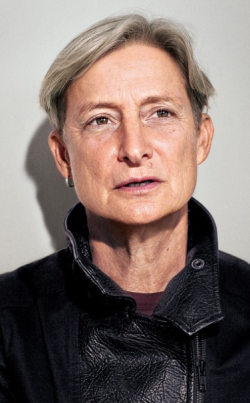
Judith Butler: The radical theorist who spawned a gender-queer nation — and became a pop celebrity in the process

Molly Fischer in New York Magazine:

ScreenHunter_2069 Jun. 30 21.00What sage could have predicted that heteronormativity would eventually make its way into the vocabulary of teen magazines and shareable web content? Only, perhaps, the queer theorist Judith Butler.

Butler laughs when I tell her about the Teen Vogueverdict on Jaden Smith. “I think there aren’t very many of us who could have foreseen it,” Butler says, considering the blossoming mainstream interest in gender issues. We are speaking shortly after President Obama publicly voiced his support for transgender rights in the fight against North Carolina’s bathroom law, and gender — as something in need of definition, as something potentially ambiguous or complex — is at the center of national debate. “Such an utterance coming out of a U.S. president would be impossible in the 1990s,” Butler says.

Gender Trouble, published in 1990, made Butler a star: It introduced “performativity,” the idea that gender isn’t something we are but something we continually do, opening the door for “cultural configurations of sex and gender [to] proliferate,” as she put it in the book’s conclusion, “confounding the very binarism of sex, and exposing its fundamental unnaturalness.” If not for Butler’s work, “you wouldn’t have the version of genderqueer-ness that we now have,” says Jack Halberstam, a gender-studies professor at Columbia.

More here.

The parlance of pilots

Mark Vanhoenacker in Aeon:

Header_Essay-NN11455125I like how different the language of the sky is from everyday English – indeed, we might give it its own name, Aeroese (though it’s also sometimes, and less aspirationally, called Aviation English). Above all, I love how Aeroese can somehow manage, in its technical, obscuring precision, to capture the high romance of flight – an aspect of my job, no matter how much I love it, that in the cockpit we rarely have reason to consider directly.

A prominent feature of Aeroese is its deep nautical roots. Think portand starboard, forward and aft; deck; log; captain and first officer;bulkhead, hold and galley; rudder and tiller; wake; knot; even waves, as in mountain waves, an atmospheric disturbance that can produce turbulence. And of course the word aeronautical itself.

In a profession that, for all its joys, often seems to lack deep traditions, I like that aviation has borrowed much of its language (and its uniforms) from the older world of the sea. This heritage is something I went out of my way to capture in the title of my book, Skyfaring: A Journey with a Pilot(2015). Seafaring is a word I’ve always loved – it makes me think of icy masts, and charts held in place by oil lamps, and of Herman Melville’sMoby-Dick (1851), written a mile or so from my childhood home in western Massachusetts, which so carefully chronicles and sanctifies the language of the sea. Skyfaring, then, I convinced my editors; a word I thought I’d coined, until I found it was the title of a poem by William Watsonpublished in the late 19th century, some years before the Wright Brothers got airborne.

More here.

ali: Canonizing an American Radical

1b15decb97a7e442d17245363ff90a02_XLPaul Reyes at The Oxford American:

Ali spent twenty-one years as a fighter, between 1960 and 1981, and the best fight images from that time work as counterpoint. His brashly promised defeat of Sonny Liston in 1964 made him champion, and their rematch a year later provided his most iconographic fight image, a violent pietà: Ali looming over Liston, who buckled in the first round, demanding furiously of him: “Get up and fight, sucker!” The complement to this moment comes with Ali’s first defeat, in the “Fight of the Century” against Joe Frazier (1971), in the echo of Frazier’s left hook: Ali tilting backward, his legs crooked and useless, his face wearing a cancelled look. Other images, other moments, connect this way: Liston staring from his stool (1964), mentally zapped, ignoring the bell for the seventh round, inaugurating Ali’s wild career as champion, countered by Ali slouched on his own stool in the fight against Larry Holmes (1980), a fight widely dreaded (Ali, thirty-eight, was already showing signs of damage in his slurred speech). Ali looks so bruised and zombie-like in this photo, it seems doctored. He would fight once more after this, but against Holmes the door was basically shut.

Photographs of Ali’s fights are innumerable, many of them hypnotic, but the images of him in more common circumstances are what both humanized and beatified him: meditative at training camp in Deer Lake, Pennsylvania, or clowning on a Louisville sidewalk, or talking easily with a gaggle of children in his front yard in Miami.

more here.

Kant and Merkel

Big_c10bbca5d8Alexander Görlach at The European:

Angela Merkel has emerged the loser from the refugee crisis. And, alongside her, the Kantian imperative, a philosophy deeply entrenched in German culture, has lost as well. This is true despite 70 percent of Germans professing a moral obligation to help refugees and people in need. Derived from the Golden Rule, this obligation has even entered the German language in idiomatic form: “Do unto others as you would have them do unto you.” To Kant, for whom religion was mostly a reservoir for moral rules of action, it also suited the universal approach to ethics in the Enlightenment era. His moral imperative remains a cornerstone of German ethics. But despite the high approval ratings, this past year Germany has witnessed the rise of a massive right-wing populist movement strongly opposed to Kant’s dictum.

Citizens in other European countries express less of a moral obligation towards refugees. For example, the English have struggled to understand the actions of the German government: “The Germans have gone crazy,” they say. Or, in the English parliament: “Angela Merkel has become impertinent.” Something about the English has become clear: defined by David Hume’s utilitarianism, they could not be further from Kant, who looked at a thing by its very nature (“a thing in itself”) rather than at its overall usefulness.

more here.