by Richard Passov
“…If I were to say my fellow man that we shall send to the moon 240,000 miles away from the control center station in Houston a giant rocket more than 300 ft tall the length of this football field made of new metal alloys some of which have not yet been invented capable of standing heat and stresses more than have ever been experienced fitted together with more precision than the finest watch carrying all of the equipment needed for propulsion, guidance control, communication, food and survival on an untried mission to an unknown celestial body and then return it safely to earth re-entering at speeds of over 25,000 miles per hour causing heat about half that of the surface of the sun and do all this and do it right … then we must be bold.”
—President John F. Kennedy
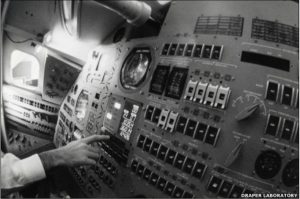
On May 25th, 1961, President Kennedy gave a State of the Union address to a joint session of Congress. Though only five months into his term, Kennedy had reached a low point. The prior month witnessed Yuri Gregorian become the first man to orbit earth and the failed invasion at the Bay of Pigs.
After acknowledging Russian resistance to a nuclear test ban treaty, Kennedy asked Congress to fund a rapid deployment force, a programing effort to counter Soviet and Chinese propaganda and a nation-wide effort to build fallout shelters to “…insure against an enemy miscalculation…”
It was only in the final minutes that he turned to space. The time had come, he said, for “…a great new American enterprise, which may hold the key to our future on earth.” That enterprise was to send a man to the moon and back before the end of the decade “…in full view of the world.” And so the Apollo Space Program was launched.
Rather than assume the chairmanship of the Space Council, established as part of the 1958 National Aeronautics and Space Act and which Eisenhower tried to disband, Kennedy saw it as a parking spot for his troublesome Vice President. Before taking office, he asked for an amendment to the Act to allow Lyndon Johnson to assume the chairmanship. Read more »


 In 1928, when Julia de Burgos was fourteen, Hurricane San Felipe devastated Puerto Rico. The Category Five storm left not a single building unscathed, least of all the wood casita in a mountain barrio in Carolina where De Burgos was born. Three hundred people died in what would be, for the next ninety years, the most violent storm in the island’s history. Julia de Burgos did not record her experience.
 Easter Monday bank holiday feels like a good moment to put aside politics and consider something far more portentous: evolution. Recently I was walking alongside a canal in central London, surrounded by concrete, glass, steel and tarmac, when I heard the call of a grey wagtail. Looking to my right I saw this bold, fast, yellow-bottomed bird, which I associate with wild rocky rivers in the north, flitting into a canal tunnel. Later that week I stared up at two peregrine falcons circling high above parliament — and got funny looks from passers-by.
 There was a time, several decades ago, when America’s two-party system was praised for its moderation. Unlike European parliamentary democracies where “
 Visit the average university campus and it is likely that the newest and most ostentatious building will be occupied by the business school. The business school has the best building because it makes the biggest profits (or, euphemistically, “contribution” or “surplus”) – as you might expect, from a form of knowledge that teaches people how to make profits.
 For the dozen