Leon Vlieger at The Inquisitive Biologist:
 Evolution is often characterised rather one-sidedly in terms of a struggle for existence, “red in tooth and claw”, and selfish genes. And yet, as evolutionary biologist Jonathan Silvertown shows here, cooperation in biology is both widespread and ancient. In his entertaining Dinner with Darwin which I reviewed way back in 2018, he briefly touched on food sharing in humans as one example of cooperation; in Selfish Genes to Social Beings, he gives the topic at large the book-length treatment it deserves. Silvertown here writes for a broad audience, explicitly including those without a formal background in biology. With nary an equation in sight, he relies on a potent combination of human-interest stories, wit, and ingenious metaphors to convince you that cooperation is an important component driving evolution.
Cooperation initially flummoxed biologists, yet, Silvertown contends, a few straightforward conditions are sufficient for its appearance. I might just as well hit you over the head with his take-home messages now. Two conditions are required for cooperation to evolve. First, the benefits to the individuals involved have to outweigh the costs. Attentive biologists might immediately pipe up that that simple statement hides important technicalities, while others will undoubtedly exclaim: “Yes, but what about…?— bear with me, I will get to this. Second, there has to be a way for cheaters to be detected and excluded, or otherwise. the system will buckle under their exploitation.
More here.
Enjoying the content on 3QD? Help keep us going by donating now.
 Market economies, in which the key productive inputs such as land, labor, and capital are bought and sold, display a notable long-run tendency toward business concentration, high inequality, political capture, domination of the laboring classes, and ultimate economic sclerosis. Auspicious beginnings in economic and political freedom and relative equality seem ineluctably, despite periods of reprieve, to end in oligarchy, authoritarianism, and decline.
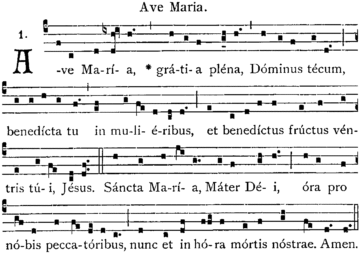 The origins of Gregorian chant are enigmatic. It appears to have its roots in fourth-century Jerusalem. The link with Pope Gregory the Great (590-604) is the byproduct of early spin, based on what is probably an erroneous assumption that he composed and collected early chant.
 George Clooney has been sneaking outside to smoke. Not like his friend Barack Obama used to, when he was running for president and his wife, Michelle, was after him to quit. Clooney doesn’t even like smoking.
 In today’s fast-paced world, many of us rush to deliver our messages without taking the time to tailor or test them. At work, we rely on boilerplate presentations, or “
 Are the Baltic Sea states, as former Estonian president Lennart Meri once put it, the factory of Europe’s future? Oliver Moody’s brilliantly written, convincingly argued and compelling book makes a good argument that it is in the plucky, resilient and often overlooked littoral states of the Baltic that the spirit of Europe burns strongest.
 In 2021, Mark McGowan, who was then the premier of Western Australia, made a
  Last spring, a team of nearly 1,000 cosmologists announced that dark energy — the enigmatic agent propelling the universe to swell in size at an ever-increasing rate —
  In Jean Bodin’s “Colloquium of the Seven About Secrets of the Sublime,” a fabulously wealthy Venetian nobleman named Coronaeus
  My childhood home
  A
A How many ways can you say the word ‘love’? In Arabic, Abbas El-Zein tells us in his memoir Bullet Paper Rock (2024), there are at least twenty-five, perhaps up to one hundred, words that express love in all its shades. The word jawa, for instance, refers to ‘alternating states of hope and despondency that a lover endures’. More than a word with a double meaning, it points to another kind of dynamic: the emotional tides typical of a lover’s conundrums about their beloved. Hope and despondency may initially strike us as incompatible, even oppositional, in meaning, yet they are less so than they appear. For El-Zein, expressions of love also contain ‘the possibility of [love’s] deficit, of a certain fragility inherent to the utterance’. In jawa, this four-letter container, we see mirrored back the tenuous fulfilment of love El-Zein describes. Just as love can be reciprocated and fulfilled, it can also be undercut and anguished by the prospect of its own defeat.