
Tom Randall at Bloomberg:
 In just a few weeks, humanity may take its first paid ride into the age of driverless cars.
Waymo, the secretive subsidiary of Google’s parent company, Alphabet Inc., is planning to launch the world’s first commercial driverless car service in early December, according to a person familiar with the plans. It will operate under a new brand and compete directly with Uber and Lyft.
Waymo is keeping the new name a closely guarded secret until the formal announcement, said the person, who asked not to be identified because the plans haven’t been made public.
“Waymo has been working on self-driving technology for nearly a decade, with safety at the core of everything we do,” the company said in an emailed statement. A Waymo spokesperson declined to comment on the name of the new service or timing of the launch.
More here.
 Entrepreneur Andrew Yang has a big goal for a relatively unknown business person: to reach the White House. And he’s aiming to get there by selling America on the idea that all citizens, ages 18-64, should get a check for
  Mitchell settled in the imaginations of pop listeners in the early 70s. In the UK, “Big Yellow Taxi” was a biggish hit in the summer of 1970, its glassily sardonic reflections upon humanity’s relationship with the environment marking out the flaxen-haired Scando-Canadian hippie-chick who sang it as a poster girl for a certain kind of wholesome big-R Romanticism. She was fey, frowning, Nordically bony, the perfect package for the deal: a one-take archetype. What the songs didn’t articulate and the voice didn’t swoop upon like a slender bird, the hair flowed over in a river of molten gold. Like nature busily abhorring a vacuum, Mitchell flooded space that ought perhaps to have been filled by an array of other women before her: the role of thoughtful, poetically articulate, unsentimental, insubordinate, self-expressive female countercultural pop icon. It was a tough job and maybe Mitchell didn’t ask for it, but she certainly got it and then did it with never less than questioning commitment.
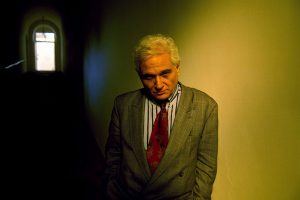 In 1962 Derrida published a book-length introduction to his translation of Husserl’s short work The Origin of Geometry in which the seeds of his later thinking were already evident, but it was in 1967 that he truly made his mark on the French philosophical scene. In that year he published no fewer than three books, and in so doing displayed the startling originality and productiveness that was to characterize his career until his death from pancreatic cancer in 2004: L’écriture et la difference, La voix et le phénomène and De la grammatologie. Five years later, another trio of books appeared, cementing Derrida’s position at the forefront of what became known in the English-speaking world as “post-structuralism”: La Dissemination, Marges de la philosophie and Positions. There followed a steady stream of publications; a recent posthumous volume produced by his favourite French publisher, Galilée, lists fifty-seven books from their own house and another thirty-one from other publishers – and this list includes only the first two volumes in the planned series of hitherto unpublished seminars delivered over more than forty years.
 Many people are familiar with Maslow’s hierarchy of needs, in which he argued that basic needs such as safety, belonging, and self-esteem must be satisfied (to a reasonable healthy degree) before being able to fully realize one’s unique creative and humanitarian potential. What many people may not realize is that a strict hierarchy was not really the focus of his work (and in fact,
 In cosmological or Darwinian terms, a millennium is but an instant. So let us fast forward not for a few centuries or millennia, but for an astronomical timescale millions of times longer than that. The stellar births and deaths in our galaxy will gradually proceed more slowly, until jolted by the environmental shock of an impact with the Andromeda Galaxy, maybe four billion years hence. The debris of our galaxy, Andromeda and their smaller companions—which now make up what is called the Local Group—will thereafter aggregate into one amorphous swarm of stars. Many billions of years after that, gravitational attraction will be overwhelmed by a mysterious force latent in empty space that pushes galaxies apart from each other. Galaxies accelerate away and disappear over a horizon. All that will be left in view, after 100bn years, will be the dead and dying stars of our Local Group, which could continue for trillions of years. Against the darkening background, sub-atomic particles such as protons may decay, dark matter particles annihilate and black holes evaporate—and then silence.
 Plastic is everywhere, and suddenly we have decided that is a very bad thing. Until recently, plastic enjoyed a sort of anonymity in ubiquity: we were so thoroughly surrounded that we hardly noticed it. You might be surprised to learn, for instance, that today’s cars and planes are, by volume, about 50% plastic. More clothing is made out of polyester and nylon, both plastics, than cotton or wool. Plastic is also used in minute quantities as an adhesive to seal the vast majority of the 60bn teabags used in Britain each year.
 One evening this fall at a house in West Hollywood,
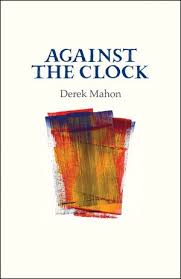 Derek Mahon’s new volume of poems, Against the Clock, again proves him one of the greatest contemporary masters of poetic form. Preoccupied as he is with his advancing age and the “final deadline” looming in the future, the suppleness and subtleness of his flexible rhythms and rhymes keep the subject from becoming ponderous. Mahon knows all about the dark side of life, but has an extraordinary ability to set his style against it, as it were, so that his formal ingenuity provides a counterweight. It would be false to say that the darkness is vanquished ‑ it is not. A Mahon poem does not engage in illusionary antics or light-headed optimism. It knows the type of world in which it must reside. But its own energy carries it through with panache: “life is short and time, the great reminder, / closes the file of new poems in line / for the printer and binder” ‑ and these lines in parenthesis no less. Rhymes as unusual as “reminder” and “binder” abound in this volume, and display one of Mahon’s greatest talents: his ability to take so-called traditional forms and subject them to change and play. At this point in his career it seems effortless. His play with the units of poetic form is creative to the point of ingenuity ‑ but not quite, since Mahon sets himself against ingenuity for its own sake, or wordplay that is not anchored by deep feeling. And yet “play” is the right word for what this serious poet allows himself to do, and perhaps must do.
 “Every poet is an optimist,” Baldwin
 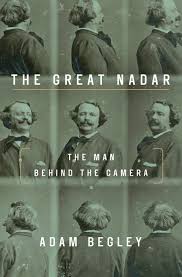 ‘Like
‘Like 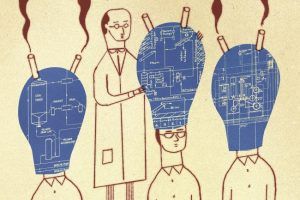 At Wayne State University, a commuter campus in Detroit where faculty members and students struggle to turn people out for events, the
 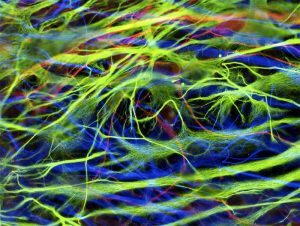 Japanese neurosurgeons have implanted ‘reprogrammed’ stem cells into the brain of a patient with Parkinson’s disease for the first time. The condition is only the second for which a therapy has been trialled using induced pluripotent stem (iPS) cells, which are developed by reprogramming the cells of body tissues such as skin so that they revert to an embryonic-like state, from which they can morph into other cell types. Scientists at Kyoto University use the technique to transform iPS cells into precursors to the neurons that produce the neurotransmitter dopamine. A shortage of neurons producing dopamine in people with Parkinson’s disease can lead to tremors and difficulty walking.
 Seven years since the heady days of