Emma Christie in 3:am Magazine:
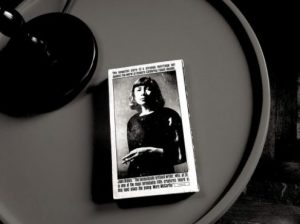 I think much of my body awareness, in addition to my literary awareness, comes from Joan Didion. In Play It As It Lays, her 1970 novel (less popular than Slouching Towards Bethlehem, but still beloved), bodies are unpredictable geodes. Protagonist Maria’s (Mar-eye-ah’s) insides are vibrant with colour and edges and productive capability, but also completely invisible. She mines for menstruation in there, hoping she isn’t pregnant, which of course she is. A doctor ‘scrapes’ her zygote (a geological-seeming name in itself) out in an abortion scene that is refreshingly without either cynicism or romanticised maternal strickenness. But it doesn’t particularly matter (at least superficially) what goes on in there, in the novel’s bright and weird physical and psychological interiors. Didion is more interested in the woman’s outside, and what it can control. Maria has dreams that a “shadowy Syndicate” occupy her home in an illicit disposal operation. The grey flesh of victims clogs sinks, and water in drains begins to rise. So, certainly, a fear of the watery interior banishes Maria from her home into a tiny apartment, and structures several chapters of the novel. But my impression is that, despite being a clear-eyed writer of insides (especially those of women like herself) and a notable mid-century explorer of what Maggie Nelson has called “a situation of meat”, the disturbing softness and fallibility of the body and of consciousness, Didion is more interested in the hard geological outside, and whether it is hard, and how hard it is. What is women’s hardness? In the end, Maria—whose character is a variation on and also a criticism of the ‘madwoman in the attic’ trope—smokes half a joint, accrues a new psychosis or fixation, and moves back into that fleshy house with a life of its own, braving the interior.
What is that other thing that makes a geode interesting? Mostly, the contrast of the inside with its uninspiring, potato-like exterior. In this way, Didion is interested in Maria’s “insanity”, but again I have the impression that the relationship between stable exterior and unstable interior life is what interests her most: the watery swishing and scary unpredictability of Maria’s thoughts exists in tension with her presentation, her image, her interaction, her appearance, her milieu, her visible body perhaps most importantly.
More here.

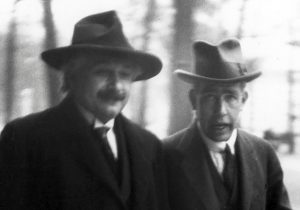 The theory produces a good deal but hardly brings us closer to the secret of the Old One,’ wrote Albert Einstein in December 1926. ‘I am at all events convinced that He does not play dice.’
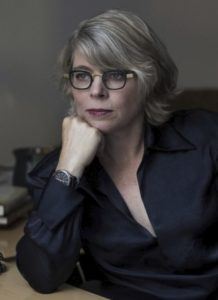 The book was supposed to end with the inauguration of Barack Obama. That was Jill Lepore’s plan when she began work in 2015 on her new history of America, These Truths (W.W. Norton). She had arrived at the Civil War when Donald J. Trump was elected. Not to alter the ending, she has said, would have felt like “a dereliction of duty as a historian.”
 Europe’s outlook can appear bleak these days: the Brexit downward spiral continues, both Emmanuel Macron and Angela Merkel are weakened, and Italy’s
  Toward the end of the Obama presidency, the work of James Baldwin began to enjoy a renaissance that was both much overdue and comfortless. Baldwin stands as one of the greatest American writers of the twentieth century, and any celebration of his work is more than welcome. But it was less a reveling than a panic. The eight years of the first black president were giving way to some of the most blatant and vitriolic displays of racism in decades, while the shooting deaths of Trayvon Martin, Michael Brown, and others too numerous to list sparked a movement in defense of black lives. In Baldwin, people found a voice from the past so relevant that he seemed prophetic.
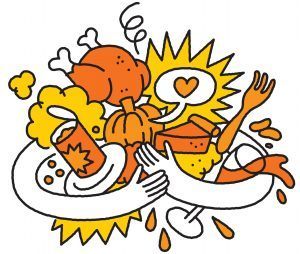 In our house, it has always been the most dreaded part of Thanksgiving. More painful than hand-scrubbing the casserole pan. More excruciating than listening to our libertarian cousin. I speak of the custom of forced gratitude — of going around the table and telling everyone what we’re thankful for.
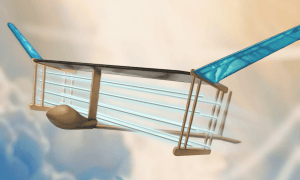 The first ever “solid state” plane, with no moving parts in its propulsion system, has successfully flown for a distance of 60 metres, proving that heavier-than-air flight is possible without jets or propellers.
 During nine years as dean of Harvard Medical School, I enthusiastically supported efforts to enhance diversity, equity and inclusion. Two years after leaving that role, I recently
  The 1815 Congress of Vienna was the most important diplomatic encounter of the 19th century. When a Parisian court painter called Jean-Baptiste Isabey depicted the scene, most of the figures around the conference table were aristocrats. Fast forward to its closest 20th-century equivalent — the Paris Peace Conference, convened at the end of the first world war: barely half a dozen out of more than 60 delegates had titles, and of these one was a recent baronet and another a maharajah.
 The GOP understands how important labor unions are to the Democratic Party. The Democratic Party, historically, has not. If you want a two-sentence explanation for why the Midwest is turning red (and thus, why Donald Trump is president), you could do worse than that.
 There’s a verbal tic particular to a certain kind of response to a certain kind of story about the thinness and desperation of American society; about the person who died of preventable illness or the Kickstarter campaign to help another who can’t afford cancer treatment even with “good” insurance; about the plight of the homeless or the lack of resources for the rural poor; about underpaid teachers spending thousands of dollars of their own money for the most basic classroom supplies; about train derailments, the ruination of the New York subway system and the decrepit states of our airports and ports of entry.
 If anyone is entitled to misgivings about the pernicious world of publishing, it’s Helen DeWitt, the long-suffering veteran of a by-now-well-known bevy of artistic successes and commercial failures. The Last Samurai, an exuberantly experimental novel about a child prodigy and his brilliant but depressive mother, made a triumphant debut at the Frankfurt Book Fair in 1999, but its publication was fraught. DeWitt fought to retain her idiosyncratic typesetting, faced off with a belligerent copy editor, and saw few profits in the wake of financial disputes with her publisher. Worse still, the imprint responsible for The Last Samurai folded in 2005. Though the book commanded a dedicated cult following, it went out of print until New Directions reissued it 11 years later.
 Ask medieval historian Michael McCormick what year was the worst to be alive, and he’s got an answer: “536.” Not 1349, when the Black Death wiped out half of Europe. Not 1918, when the flu killed 50 million to 100 million people, mostly young adults. But 536. In Europe, “It was the beginning of one of the worst periods to be alive, if not the worst year,” says McCormick, a historian and archaeologist who chairs the Harvard University Initiative for the Science of the Human Past.
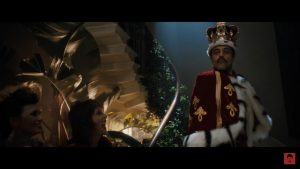 I’ve never cried to “We Are The Champions.”
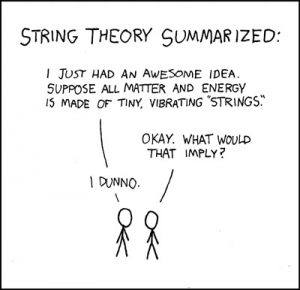 Way back in 1996 science writer John Horgan published The End of Science, in which he made the argument that various fields of science were running up against obstacles to any further progress of the magnitude they had previously experienced. One can argue about other fields (please don’t do it here…), but for the field of theoretical high energy physics, Horgan had a good case then, one that has become stronger and stronger as time goes on.
 Among the string of resignations triggered by the draft Brexit agreement with the European Union (EU), one stood out. In a double whammy for an embattled Prime Minister, Rehman Chishti the MP for Gillingham and Rainham resigned as both Vice Chairman of the Conservative Party as well as the PM’s Trade Envoy to Pakistan. Aside from citing Theresa May’s shambolic handling of Brexit negotiations,