
Enjoying the content on 3QD? Help keep us going by donating now.
Category: Recommended Reading
Economists Say America’s Trade Deficits Are a Sign of Dominance Not Weakness
Paul Wiseman in Time:
 Trump and his trade advisers insist that the rules governing global commerce put the United States at a distinct disadvantage. But mainstream economists—whose views Trump and his advisers disdain—say the president has a warped idea of world trade, especially a preoccupation with trade deficits, which they say do nothing to impede growth.
The administration accuses other countries of erecting unfair trade barriers to keep out American exports and using underhanded tactics to promote their own. In Trump’s telling, his tariffs are a long-overdue reckoning: The U.S. is the victim of an economic mugging by Europe, China, Mexico, Japan and even Canada.
It’s true that some countries charge higher taxes on imports than the United States does. Some manipulate their currencies lower to ensure that their goods are price-competitive in international markets. Some governments lavish their industries with subsidies to give them an edge.
However, the United States is still the second-largest exporter in the world, after China.
More here.
Enjoying the content on 3QD? Help keep us going by donating now.
The big idea: should you trust your gut?
Alex Curmi in The Guardian:
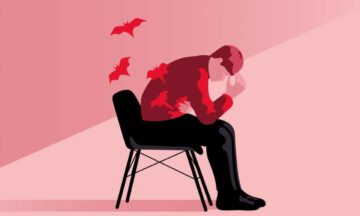 ‘What should I do?” Whether openly stated or implicit, this is the question a new client usually raises in their first therapy session. People come to see me for many reasons: relationship problems, addiction and mental health difficulties, such as anxiety. Increasingly, I have found that beneath all of these disparate problems lies a common theme: indecision, the sense of feeling stuck, and lack of clarity as to the way forward.
Making decisions is difficult. Anyone who has lain awake contemplating a romantic dilemma, or a sudden financial crisis, knows how hard it can be to choose a course of action. This is understandable, given that in any scenario we must contend with a myriad conflicting thoughts and emotions – painful recollections from the past, hopes for the future, and the expectations of family, friends, and co-workers.
More here.
Enjoying the content on 3QD? Help keep us going by donating now.
Thursday Poem
Instrument, 1865
The thick elms and cottonwood of the bluff still bore
the scars of battle that had raged in this place four
long years before. Trunks of trees had been stripped
of bark and splintered by cannon shot. Branches
had been torn from the canopy of maple above,
and their loss gave the trees an aspect both unbalanced
and misshapen. Six months before, at Centralia, he
vowed he would never surrender. But that had been in
some other reality, the reality of battle frenzy, where
the world falls away and there is only the awful and
exhilarating and terrifying present, which is like the
face of God, where creation meets destruction with
man as God’s instrument.
by Desmond Barry
from The Chivalry of Crime
Little Brown and Company, 2002
Enjoying the content on 3QD? Help keep us going by donating now.
A Protein Ratio Could Predict Alzheimer’s Disease Progression Decades in Advance
Sahana Sitaraman in The Scientist:
 In 1906, a 50-year-old woman in Germany died of a mysterious illness. Before her death, she presented with a combination of symptoms that stumped doctors—progressive memory loss, paranoia, confusion, and aggression. A closer look into her brain post-mortem revealed abnormal clumps and tangled bundles of fibers. This was the first documented case of Alzheimer’s disease, described in detail by Alois Alzheimer, a clinical psychiatrist and neuroanatomist.1 His characterization of the disease pathology is still used for diagnosis of this neurodegenerative disorder. Scientists now know that the clumps are plaques formed by the protein fragment amyloid-beta (Aβ) and the tangles are abnormal accumulations of the protein tau within neurons.
More here.
Enjoying the content on 3QD? Help keep us going by donating now.
Wednesday, April 9, 2025
Claire Messud reads “Lolita” on its 70th anniversary
Claire Messud in the Los Angeles Review of Books:
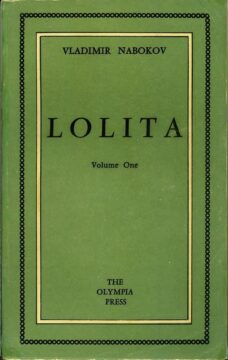 At 70, Vladimir Nabokov’s most famous book, Lolita, is decidedly problematic. It is, after all, a novel narrated by a pedophile, kidnapper, and rapist (also, lest we forget, murderer) who tells his story from prison, who relates his crimes with a pyrotechnic verbal exhilaration that is tantamount to glee, who seduces each reader into complicity simply through the act of reading: to read the novel to the end is to have succumbed to Humbert Humbert’s insidious, sullying charms. Framed by the banal platitudes of John Ray Jr., the fictional psychologist whose foreword introduces the account (“‘Lolita’ should make all of us—parents, social workers, educators—apply ourselves with still greater vigilance and vision to the task of bringing up a better generation in a safer world”), Humbert’s exuberant voice seduces the reader, even as so many of the novel’s characters are foolishly, sometimes fatally, seduced. What are we doing, when we read this book with such pleasure? What was Nabokov doing, in writing this unsettling novel?
More here.
Enjoying the content on 3QD? Help keep us going by donating now.
How a Problem About Pigeons Powers Complexity Theory
Ben Brubaker in Quanta:
 They say a bird in the hand is worth two in the bush, but for computer scientists, two birds in a hole are better still. That’s because those cohabiting birds are the protagonists of a deceptively simple mathematical theorem called the pigeonhole principle. It’s easy to sum up in one short sentence: If six pigeons nestle into five pigeonholes, at least two of them must share a hole. That’s it — that’s the whole thing.
“The pigeonhole principle is a theorem that elicits a smile,” said Christos Papadimitriou(opens a new tab), a theoretical computer scientist at Columbia University. “It’s a fantastic conversation piece.”
But the pigeonhole principle isn’t just for the birds. Even though it sounds painfully straightforward, it’s become a powerful tool for researchers engaged in the central project of theoretical computer science: mapping the hidden connections between different problems.
More here.
Enjoying the content on 3QD? Help keep us going by donating now.
Brian Eno explains the selfishness of the super rich
Enjoying the content on 3QD? Help keep us going by donating now.
Why Universities Must Start Litigating—and How
David Pozen, Ryan Doerfler, and Samuel Bagenstos in The Nation:
 The Trump administration’s assault on higher education continues to escalate. The White House has pressured universities into shutting down diversity and equity programs of all sorts, terminated hundreds of millions of dollars in research grants inconsistent with its political agenda, and moved to slash reimbursements for the grants that remain. The Department of Education has opened investigations into more than 60 colleges and universities. Most alarming, the Department of Homeland Security has started sending agents onto campuses across the country to arrest and deport noncitizen students and faculty who have engaged in pro-Palestinian advocacy.
In hindsight, all of this looks predictable. Vice President Vance gave a speech in 2021 titled “The Universities Are the Enemy.” The Heritage Foundation’s Project Esther calls for the use of counterterrorism tactics to “disrupt and degrade” student activism in the name of combating antisemitism. And attacks on universities’ finances and freedoms have become a defining feature of authoritarian regimes worldwide.
More here.
Enjoying the content on 3QD? Help keep us going by donating now.
Are We Computers?
Enjoying the content on 3QD? Help keep us going by donating now.
Library Graffiti
April White at JSTOR Daily:
The words were etched in four languages, scratched into the edge of the pale wood by at least a dozen different hands, perhaps over the course of decades. When researchers translated and contextualized the overlapping text—faded in some spots, deliberately scratched out in others—they discovered messages of pride and dismissal, hope and despair, deep musings and passing thoughts shared in poetic verse, lyrics, symbols, and now-indecipherable allusions. If the slender board had been 2,000 years old, the find might have been a Rosetta Stone, celebrated as the key to unlocking the stories of long-disappeared cultures. But in the stacks of the Alderman Library on the campus of the University of Virginia, the pencil and ink on the carrel shelf looked like nothing more than meaningless graffiti to almost everyone—except Professor Lise Dobrin and her students. In the spring of 2019, the budding anthropologists of Dobrin’s Literacy and Orality course began to document the graffiti that had collected on the 176 study carrels in the nine-story Alderman Library “New Stacks” since the building’s construction in 1967. The idle doodles and stray observations inked onto the peg boards, painted concrete, and stained wood furniture were destroyed when the building was demolished in the summer of 2020 to make way for a new library.
more here.
Enjoying the content on 3QD? Help keep us going by donating now.
Emerson as Emersonian
Mark Jarman at The Hudson Review:
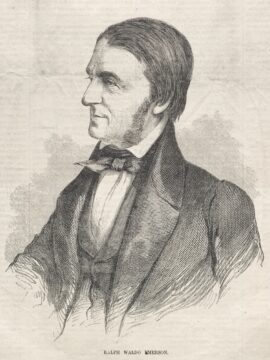 What was Emersonian? I first saw the term used in an essay by Harold Bloom called “The New Transcendentalism” about “the visionary strain” in the American poets W. S. Merwin, John Ashbery, and A. R. Ammons. Their excellence as poets (Bloom ranked them 3, 2, 1) depended almost entirely on their Emersonianism. Bloom wrote as if everyone, including the women he omitted, knew what it meant. Now I think he meant unrestrained by conventions of a closed system, like Christianity or the Boy Scouts of America. To be Emersonian was to be true to one’s own system, whatever that might be, idealist, visionary, in any case, a poetry of the sublime and the large statement, the lingua franca of Wallace Stevens, say, but also the kitchen sink realism of William Carlos Williams, though not as wild and visionary as William Blake, or as talented. Could we say existentialist? American poets who dwelt in the Emersonian sunshine might write free verse or in song meters, like Blake. Nevertheless, Emerson’s idealism was both principle and excuse for their poetry, with Whitman and Dickinson as influential figures. Whitman’s muse was installed amid the kitchenware. Dickinson’s lived in her upstairs bedroom. Domesticated but wild, wolves in Victorian sheepskin, these Emersonians were ordained to go uncollared but prophetic, unpenned with fountain pen in hand.
more here.
Enjoying the content on 3QD? Help keep us going by donating now.
Wednesday Poem
Words Are Everything Else
our first teacher?
survival
her reward?
evolution
fleeing the sabretooth
we cried out in fear
others heard it
as warning.
so we were harried
into language
where we found
bricks for a palace
now we doubly dwell
creatures of events
yet inhabitants
of a house of mystery
by Nils Peterson
Enjoying the content on 3QD? Help keep us going by donating now.
Mad Men’s Influence on Jon Hamm’s ‘Your Friends and Neighbors’ Is Real
H. Alan Scott in Newsweek:
 If there’s anyone who knows how to play a wealthy man with a secret, it’s Jon Hamm. From Mad Men‘s Don Draper to Andrew Cooper turning to a life of crime to maintain his lavish lifestyle in his new series Your Friends and Neighbors (Apple TV+), Hamm knows. “I’m really good casting for this, if I do say so myself,” Hamm laughs, “absurd wealth is what we’re looking at here,” and the secrets its pursuit can reveal. “Late-stage capitalism and rampant materialism, and what does it really mean? Why are we measuring ourselves against other people using the metric of just who has a bigger pile of stuff?” While he knows “not everybody can resonate with having to make their $300,000 mortgage” like his character, “people can certainly identify with losing their job through no fault of their own.” Between Mad Men and some of his Emmy-nominated work on The Morning Show, Fargo and Landman, Hamm is confident that he’s “earned my place,” but is mostly “fortunate” that he gets to work with those he admires. “To work with those people is a tremendous gift.”
More here.
Enjoying the content on 3QD? Help keep us going by donating now.
Vanity Fair’s Heyday
Bryan Burroughs in The Yale Review:
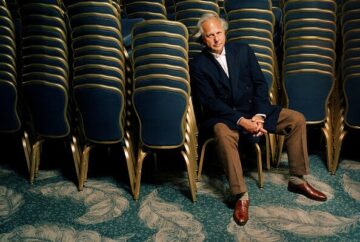 For sheer cushiness, there’s a case to be made that there has never been a more palatial home for writers than Vanity Fair during Graydon Carter’s twenty-five-year run as editor from 1992 to 2017—a halcyon era for magazines that, given the internet-fueled destruction of print publications over the last fifteen years, already feels like ages ago. I was a writer there for all of it, and I savored every minute. If I share my part of its story accurately, you will probably hate me.
It is really Carter’s tale to tell, though. His winged impresario hair and singsong baritone made Graydon, as he was universally known, an icon of the period, a chortling counterpoint to The New Yorker’s Eustace Tilley mascot.
More here.
Enjoying the content on 3QD? Help keep us going by donating now.
Tuesday, April 8, 2025
Notes on the Making of the Neoliberal Subject, 1880–2025
James E. Block in The Hedgehog Review:
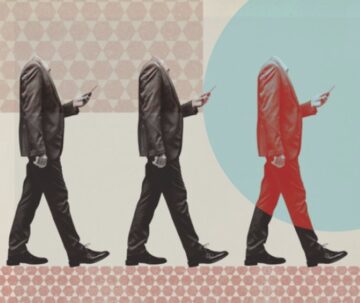 The classic liberal society of participatory institutions, competitive markets, and social mobility, which formerly nurtured and sustained the American belief in individual freedom and opportunity along with popular self-rule, is today scarcely a memory. In its place, the corporate organization of society—expanding for 150 years with its encompassing hierarchies and concentrations of power—recast American society and its popular practices and expectations. Amid the unending acceleration of production and technological innovation, omnipresent merchandisers and round-the-clock digital stimulants cajole and persuade individuals to pursue unprecedented enticements: indulgence in limitless appetitive striving and the pseudo-celebrity of ceaseless self-inflation. Facing an ever more constricting social reality and temptations ever less compatible with the core liberal virtues of moderation and self-restraint, Americans may wonder what is still liberal about their axiomatically liberal society. If the answer is cautionary, where does this leave us? And what options do we have?
More here.
Enjoying the content on 3QD? Help keep us going by donating now.
Better Living Through Disaster
Caitlin L. Chandler at The Baffler:

Illich’s 1971 book, Deschooling Society, was a bestseller that made his name beyond the counterculture, but his 1973 primer Tools for Conviviality was most prominently displayed in ISSA’s library. In it, Illich warned of large-scale future catastrophes stemming from unchecked economic growth and industrialization. Technologies, he believed, had to serve communities and foster autonomy rather than prop up the credentialing power of institutions and the managerial class, which taught people to become desiring consumers and eroded their capacity for free thought and self-reliance. “The bureaucratic management of human survival is unacceptable on both ethical and political grounds,” wrote Illich, referring to technocratic solutions to ecological crisis that set limits on growth “just at the point beyond which further production would mean utter destruction.” As an alternative to this “managerial fascism,” he proposed the concept of “conviviality.” A convivial society would not only reject outright the gospel of industrial growth for its own sake; it would “guarantee for each member the most ample and free access to the tools of the community and limit this freedom only in favor of another member’s equal freedom.”
more here.
Enjoying the content on 3QD? Help keep us going by donating now.
The Tricky Sex Lives of Birds
Nathan H. Lents at Undark:
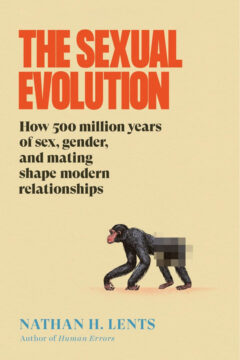 For generations, anthropologists have argued whether humans are evolved for monogamy or some other mating system, such as polygyny, polyandry, or promiscuity. But any exploration of monogamy must begin with a bifurcation of the concept into two completely different phenomena: social monogamy and sexual monogamy.
Sexual monogamy is just what it sounds like: The restriction of sexual intercourse to within a bonded pair. Social monogamy, also known as economic monogamy, describes the bonding itself, a strong, neurohormone-driven attachment between two adults that facilitates food and territory sharing, to the exclusion of others, for at least one breeding season, and generally purposed towards raising offspring.
Because these two aspects of monogamy are so often enjoined among humans, they are considered two sides of the same coin. But, as it turns out, they are entirely separable among animals.
More here.
Enjoying the content on 3QD? Help keep us going by donating now.
Srećko Horvat: After the Apocalypse
Enjoying the content on 3QD? Help keep us going by donating now.
The Future of AI and its Impact on Humanity: Sam Altman speaks to Ben Nelson
Enjoying the content on 3QD? Help keep us going by donating now.