
Category: Recommended Reading
Remembering Ann Snitow (1943–2019)
Laurie Stone at n+1:
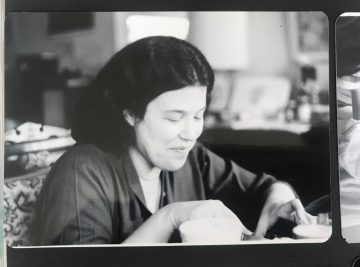 Last night I was talking with our mutual friend S, and she said, “I always wanted to hear what Ann would say. She would listen to others present arguments, and then, when it was her turn to speak, she would find the beautiful bits in what she’d heard and put it all back together in a way that was brilliant and original and made people think she was extending their ideas.”
I googled you after you died, and a piece popped up about Shulamith Firestone, in which you are quoted calling her “incandescent” and saying “it was thrilling to be in her company.” That’s so like you. Pretty much everyone else in the essay says how difficult she was, and the piece is depressing to read, not only because Firestone went mad and died one of those emaciated-bag-lady feminist deaths, but because it described the awful fractiousness in the early days of the women’s movement, where, if you signed your name to a piece of writing, other women called you an egomaniac and worse, said you were acting like a man.
more here.
The Morisot Sisters
Julian Barnes at the LRB:
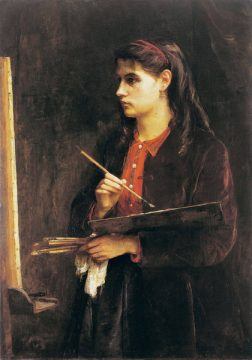
In 1865-68, Edma had painted a portrait of her sister: standing at the easel, brush in hand, in fiercely concentrating profile. It is a remarkably talented work, both as a character portrayal and as a construction. Berthe is wearing a plum-brown velvet coat over which her dark brown hair falls; underneath, there is a red blouse whose colour is picked up in her thin red headband. The tonality is generally dark, except for two fierce slashes of light. On the extreme left of the picture, the illuminated edge of Berthe’s canvas descends at a slight angle to the vertical. In the centre, a broader fall of light at the opposite angle illuminates a determined face, three white shirt buttons, the fingers of a painting hand and the whiteness of a dangling rag; it also falls, more discreetly, on the tip of her brush and the thin edge of her palette. The picture is rightly placed at the start of the Musée d’Orsay show, and has a double poignancy: internally, because it allows us to discern the strength of character which will make Berthe Morisot a true artist, even though she herself can’t. But also externally, because it is one of only two pictures by Edma to survive. At some point, and with what motivation we can only guess, she destroyed all her work except for this canvas and a landscape. The assertion of unfulfilled talent can often sound a little theoretical; but there is further evidence. In late 1873 Degas, who was helping to organise the First Impressionist Exhibition, wrote to Mme Morisot to seek her help in persuading Berthe to contribute: ‘We think Mlle Berthe Morisot’s name and talent are too important to us to do without,’ he writes.
more here.
The Friendship between Oliver Sacks and Lawrence Weschler
T. M. Luhrmann at The American Scholar:
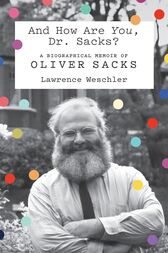 Written by one brilliant writer about another, this remarkable book is, in part, about the craft of writing. But in the main, it’s an account of author Lawrence Weschler’s friendship with Oliver Sacks, a man whom he describes as “impressively erudite and impossibly cuddly.” Sacks comes across as singular. For many years, he lived by himself on City Island, not far from Manhattan, in a house he acquired when he swam out there, saw a house he liked, learned that it was for sale, and bought it that afternoon, his wet trunks dripping in the real estate agent’s office. He regularly swam for miles in the ocean, sometimes late at night. He loved cuttlefish and motorcycles, which he rode, drug-fueled, up and down the California coast when he was a neurology resident at UCLA. A friend of his from that time recalled, “Oliver wouldn’t behave, he wouldn’t follow rules, he’d eat the leftover food off the patients’ trays during rounds, and he drove them nuts.”
more here.
We Need New Stories – an excellent nose for hypocrisy
Bidisha in The Guardian:
 Brexit, Trump, colonialism, Tommy Robinson, “incels”, identity politics: award-winning Guardian journalist Nesrine Malik’s new book stares into the heart of our current seething political volcano and gives it a cool hosing down. Her overall point is that we have not been ambushed by some sort of unpleasant surprise or hit a random crisis speed bump. Instead, we are experiencing a “culmination” of longstanding factors shored up by enduring “toxic delusions” that are “rehashing… themes that are decades old”. Whether it is Brexiters and Trump harking back to some mythical time of national power, peace and plenty, far-right activists bellowing about their human right to offend being impinged or columnists representing university students’ desire for more racially diverse syllabuses as a form of spoilt bullying,
Malik takes each claim, peels back its fallacies and exposes its roots. This is all the more necessary in an age where “views that had previously been consigned to the political fringes made their way into the mainstream via social and traditional media organisations that previously would never have contemplated their airing. The proliferation of media outlets meant that it was not only marginalised voices that secured access… but also those with more extreme and fringe views.” With careful analysis and a great historian’s expertise for synthesising a huge amount of information into a clear arc, she engages in a powerful and persuasive debunking exercise. The most successful chapters of We Need New Stories are the central four, which tackle claims that political correctness has run away with itself, free speech is under threat, identity politics has weakened the drive for true equality and that England’s greatness lies in its colonial past.
More here.
Can Genetics Explain Human Behavior?
Bill Sullivan in The Scientist:
 As author George R.R. Martin would attest, good writing takes time. For eons, DNA has been writing genetic scripts for “survival machines,” evolutionary biologist Richard Dawkins’s term for living organisms—their primary purpose being to live long enough to propagate their DNA. As author Samuel Butler recognized in 1877, “A hen is only an egg’s way of making another egg.”
But our planet has limited resources, so survival machines that had a leg up on the competition won the DNA replication relay. Selfish genes were locked in an arms race to craft survival machines that were better, stronger, faster. About 600 million years ago, an ancestral neuron emerged that heralded a new weapon: intelligence. It took nearly 4 billion years, but DNA has finally built a survival machine intelligent enough to expose DNA’s game. We are the first species to meet our maker.
The realization that we’re an apparatus for the dissemination of genes is quite different from traditional creationist narratives. It is even more humbling to reflect on the power of a related revelation: instead of passively watching genetic stories unfold, we can now become the authors. Are we ready for this awesome responsibility? In just a half century, we resolved the structure of DNA, made genome sequencing easy, and discovered ways to edit genes. Although we don’t fully understand its language, some are now eager to take a red pen to the genome. With the help of the first human genome, published in 2003, researchers have revealed genes involved in certain diseases, and this knowledge is guiding the discovery of novel therapeutics.
More here.
Wednesday Poem
And They’re Running
running in their Reeboks their Asics their Saucony’s running
… with their iPods MP3s and Blackberries their cell phone plan
… with unlimited minutes and playlists longer than the 10,000 things
… inscribed in the Tao Te Ching
they’re running in spandex breathable cotton tank tops golf hats
… bare-backed bare-chested some with tattoos the width of murals
… some with dogs—dogs ahead behind beside the pure bred
… pedigreed Border Collie Bichon Frise Labradoodle Whippet
… Standard Poodle groomed like labyrinthine shrubbery
they’re running for their lives to look better in the boardroom bedroom
… on the dance floor in the mirror gasping sweating grunting
… as if one could make exhausted love with oneself
they’re running with their newborns their infants toddlers half-
… legal adoptees from China Ethiopia Belarus Honduras
… their in vitro twins saddled in designer strollers
they’re running one assumes away from death away along the river
… while others chose to march and pray to sit and sing refuse
… to move in Zuccotti Park in the freedom to be still and gather
they’re running through daylight savings time time saving saving
… time a belief in amassing the disappearing hours
… collectible as postage stamps Nikes snow globes sea glass
… while others run towards God pedometers wrapping biceps like tefillin
No one seems to notice the anomalous walker immobile because
… he’s exhausted afraid of failing falling out of breath breathless
… while the sun sprays shattered gold across the Hudson
For anyone bothering to look at all closely would’ve known
… he’d fallen that something fractured tore or broke within him
but they’re running running running running and the only others pausing
… seek to lessen the lactic acid build-up to stretch and stretch out
… pressing palms against a wall or railing as if suddenly apprehended
….for a nameless crime patted down and frisked by un-seeable detectives.
by Peter Marcus
from Tribute to New Yorkers
Rattle #48, Summer 2015
Tuesday, September 3, 2019
The Virtues of the Semicolon; or, Rebellious Punctuation
Cecelia Watson in Literary Hub:
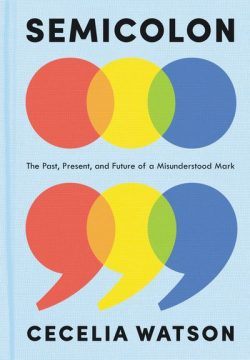 In 1906, Dutch writer Maarten Maartens—acclaimed in his lifetime but now mostly forgotten—published a surreal, satirical novel called The Healers. The book centers on one Professor Lisse, who has conjured up a potential bioweapon: the Semicolon Bacillus, an “especial variety of the Comma.” The doctor has killed hundreds of rabbits demonstrating the Semicolon’s toxicity, but, at the beginning of the novel, he hasn’t yet succeeded in getting his punctuation past the human immune system, which destroys Semicolons instantly as soon as they enter the mouth.
Maartens wrote at a time when the semicolon was still an exceptionally popular punctuation mark—so popular that grammarians forecast the extinction of the colon, which 19th-century writers had abandoned in favor of semicolons. “The colon is now so seldom used by good writers,” an 1843 grammar pronounced, “that rules for its use are unnecessary.”
Not everyone was so sanguine about the trendy semicolon shouldering colons off the page; one of the 19th-century’s most accomplished grammarians, Goold Brown, tried to rescue the colon by urging writers that their beloved semicolons depended on the colon for sense.
More here.
Sean Carroll’s Mindscape Podcast: Michele Gelfand on Tight and Loose Societies and People
Sean Carroll in Preposterous Universe:
 Physicists study systems that are sufficiently simple that it’s possible to find deep unifying principles applicable to all situations. In psychology or sociology that’s a lot harder. But as I say at the end of this episode, Mindscape is a safe space for grand theories of everything. Psychologist Michele Gelfand claims that there’s a single dimension that captures a lot about how cultures differ: a spectrum between “tight” and “loose,” referring to the extent to which social norms are automatically respected. Oregon is loose; Alabama is tight. Italy is loose; Singapore is tight. It’s a provocative thesis, back up by copious amounts of data, that could shed light on human behavior not only in different parts of the world, but in different settings at work or at school.
More here.
1971 Rapes: Bangladesh Cannot Hide History
Anushay Hossain in Forbes:
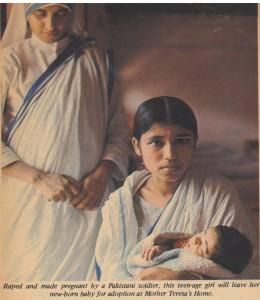 The post- Liberation War generation of Bangladesh know stories from 1971 all too well. Our families are framed and bound by the history of this war. What Bangladeshi family has not been touched by the passion, famine, murders and blood that gave birth to a new nation as it seceded from Pakistan? Bangladesh was one of the only successful nationalist movements post-Partition. Growing up, stories of the Mukti Bahini, (Bengali for “Freedom Fighter”), were the stories that raised us.
My mother told me in 1971, you would send out the men in your family to look in large public parks for the bodies of loved ones who had “disappeared,” picked up by Pakistani soldiers. Despite the endless killings and torture, she still says, “There was a feeling in the air that you could do anything. Everyone knew Independence was only a matter of time.”
But the one thing we did not hear about as much as we heard about the passionate fighting that defeated the Pakistani Army were the rapes that took place in 1971. Many academics state that the first time rape was consciously applied as a weapon of war was during the Bangladesh War of Independence.
More here.
Evil and Moral Clarity: An interview with Susan Neiman
The Many Lives of Romare Bearden
Nell Painter at The Nation:
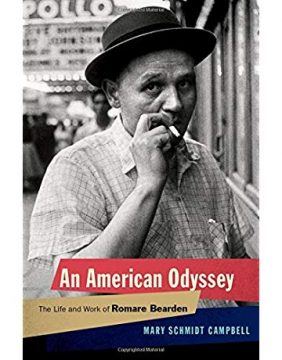 Campbell’s extraordinarily rich biography offers its readers many rewards. Nowhere here is the awkwardness of critics unfamiliar with the history of black art or who isolate it from its frames of reference or consider only how black artists ought to criticize race in America. Hers is a self-confident study of an artist’s life in all its contexts.
The assurance of Campbell’s narrative and the strength of her critical insights stem from the depth of her experience as an art historian and her leading roles at the Studio Museum in Harlem and New York University’s Tisch School of the Arts. She also has the advantage of having known and corresponded with Bearden for years, even curating an exhibit, “Mysteries: Women in the Art of Romare Bearden,” in 1975. Campbell’s proximity to Bearden allows her to capture his generosity as a colleague and mentor as well as his larger role in the art world.
more here.
On ‘The Last Black Man in San Francisco’ and ‘Bandana’
Niela Orr at The Baffler:
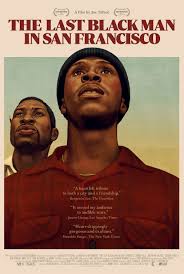 IT BEGINS THE WAY so many conventionally existential works of art do: with two men waiting for something. At the beginning of Joe Talbot’s The Last Black Man in San Francisco, a favorite at this year’s Sundance film festival, best friends Jimmie Fails IV (played by himself) and Montgomery Allen (Jonathon Majors) are perched on a road and set against nature, facing us. Only here, Jimmie and Mont are waiting for a bus that may or may not come. “They do not move,” Waiting for Godot’s famous set directions, would certainly apply.
Jimmie and Montgomery wonder about the bus schedule and watch a street corner preacher critique the forced migration of the city’s people of color. The scene is all Bay Area hella chill; it’s a brisk morning, and the men are so laidback you wonder if they have anywhere they need or want to be.
more here.
Three Lives and the Making of a Cosmopolitan Culture
Donald Rayfield at Literary Review:
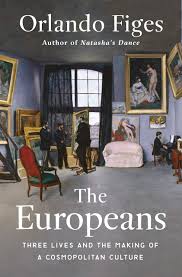 At the heart of The Europeans is an extraordinary ménage à trois. The novelist Ivan Turgenev was for two-thirds of his life in love with the singer and composer Pauline Viardot, wife of the entrepreneur and connoisseur Louis Viardot, who accepted Turgenev as a friend and shooting companion. The relationship (briefly a ménage à quatrewhen Pauline and Charles Gounod fell in love) was sustained by the emotional intelligence of all three and by the balance of interests. They were voluntary exiles (Louis was French, Pauline was Spanish and Turgenev was Russian) who spent much of their lives in Germany, notably in Baden-Baden. Turgenev left Russia, returning only for short visits, to escape police surveillance and to avoid critics outraged by the either too radical or too reactionary protagonists of his novels. Pauline and her husband were abroad largely because of her career as an opera singer.
more here.
The original anti-vaxxers
Gareth Williams in MIL:
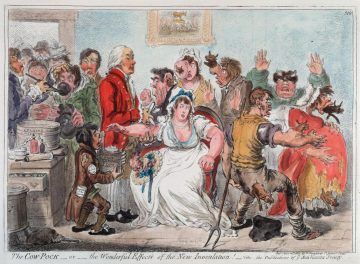 In September 1798 a self-published book with an outlandish premise was about to change the world. At first sight, “An Inquiry into the Cowpox” looked more like a piece of vanity publishing than one of the greatest landmarks in the history of medicine. Its author, a doctor called Edward Jenner, was largely unknown outside rural Gloucestershire. In a 75-page illustrated manual, Jenner explained how people could protect themselves from smallpox – a horrific brute of a disease that killed one person in 12 and left many survivors scarred for life – by inoculating themselves with cowpox, an obscure disease that affected cattle. This extraordinary process was to be known as vaccination, from the Latin for cow.
The “Inquiry” was an instant sensation. Within a few years, vaccination became mainstream medical practice in Britain, Europe and North America, while the King of Spain sent it as a “divine gift” to all the Spanish colonies. By the time Jenner died in 1823, millions had come to regard him as a hero. His admirers included Native Americans, the Empress of Russia (who sent him a diamond ring out of gratitude), and Napoleon, who “could refuse this man nothing” even though France and England were at war. In 1881 Louis Pasteur proposed that the term “vaccination” should be used for any kind of inoculation.
But not everyone thought Jenner was a saint. In 1858 Prince Albert unveiled a statue to Jenner in Trafalgar Square, amid much pomp and circumstance. There was such an outcry that two years later the statue was carted away to a lower-key resting place in Kensington Gardens. Jenner’s earliest and most vocal opponents had been men of the church, who reasoned that smallpox was a God-given fact of life and death. If the Almighty had decided that someone would be smitten by smallpox, then any attempt to subvert this divine intention was blasphemy.
More here.
Woman is first to receive cornea made from ‘reprogrammed’ stem cells
David Cyranoski in Nature:
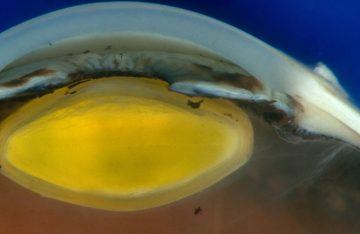 A Japanese woman in her forties has become the first person in the world to have her cornea repaired using reprogrammed stem cells. At a press conference on 29 August, ophthalmologist Kohji Nishida from Osaka University, Japan, said the woman has a disease in which the stem cells that repair the cornea, a transparent layer that covers and protects the eye, are lost. The condition makes vision blurry and can lead to blindness.
To treat the woman, Nishida says his team created sheets of corneal cells from induced pluripotent stem (iPS) cells. These are made by reprogramming adult skin cells from a donor into an embryonic-like state from which they can transform into other cell types, such as corneal cells. Nishida said that the woman’s cornea remained clear and her vision had improved since the transplant a month ago. Currently people with damaged or diseased corneas are generally treated using tissue from donors who have died, but there is a long waiting list for such tissue in Japan.
More here.
Tuesday Poem
Andromeda
Already the countdown has begun:
four billion years before Andromeda
collides with the Milky Way, rupturing
forever that footpath through the forest
of dreamers’ jewels. I would scoff,
if I did not recall the tracery of fine hairs
swirled across an infant’s skull
like the softest of inbound galaxies.
Andromeda, all your starry wonders
cannot salve the ache of baby teeth
chanced upon, this 2 A.M.,
at the bottom of a bedside drawer.
.
by Campbell McGrath
from Nouns & Verbs
Harper Collins, 2019
Sunday, September 1, 2019
Idleness as Flourishing
Kieran Setiya in Public Books:
 It is hard work to write a book, so there is unavoidable irony in fashioning a volume on the value of being idle. There is a paradox, too: to praise idleness is to suggest that there is some point to it, that wasting time is not a waste of time. Paradox infuses the experience of being idle. Rapturous relaxation can be difficult to distinguish from melancholy. When the academic year comes to an end, I find myself sprawled on the couch, re-watching old episodes of British comedy panel shows on a loop. I cannot tell if I am depressed or taking an indulgent break. As Samuel Johnson wrote: “Every man is, or hopes to be, an Idler.” As he also wrote: “There are … miseries in idleness, which the Idler only can conceive.”
This year brings three new books in praise of wasting time: a manifesto by MIT professor Alan Lightman; a critical history by philosopher Brian O’Connor; and a memoir by essayist Patricia Hampl. Each author finds a way to write in the spirit of idleness. Yet none of them quite resolves our double vision. Even as they bring its value into focus, they never shake a shadow image of the shame in being idle.
Why idleness now? Because we are too busy, too frantic; because of the felt acceleration of time. Lightman supplies a measure. “Throughout history,” he writes, “the pace of life has always been fueled by the speed of communication.”
More here.
The truth about the female brain
Saloni Dattani in UnHerd:
 “The so-called ‘female’ brain,” says Rippon, “has suffered centuries of being described as undersized, underdeveloped, evolutionarily inferior, poorly organised and generally defective.” Such assertions were, and still are, so widespread that Rippon admits feeling as though she’s playing “Whac-a-Mole”. She has barely disproved the newest study professing to demonstrate how men and women’s brains differ, when another is published.
Rippon’s opponents, whom she calls biological determinists, argue that we know sex differences in the brain are innate because they are evident even in young infants, before socialisation has had the opportunity to exert its influence. But according to Rippon, “the general consensus appears to be that, once variables such as birth weight and head size have been taken into account, there are very few, if any, structural sex differences in the brain at birth”.
She claims that the emergence of sex differences between boys and girls’ brains as they age is evidence for the role of brain plasticity and socialisation in shaping these differences – that is, if and when sex differences exist at all.
More here.
Israel and Palestine in the Age of Trump
Yair Wallach in the Los Angeles Review of Books:
 In early June 2018, in an interview to the BBC in London, Prime Minister Benjamin Netanyahu seemed relaxed and upbeat. Sitting in a room overlooking the river Thames, he celebrated the newfound cooperation between Israel and Arab states, hinting at Israel’s strengthening relationship with Gulf states. When asked about relations with the Palestinians, Netanyahu was less enthusiastic. He blamed Palestinian leadership for refusing negotiations. Prompted to spell out his vision for a peaceful resolution of the century-old Israel-Palestine conflict, he proposed a model in which “they’ll have all the rights to govern themselves, and none of the powers to threaten us […] we would have the overriding security responsibility.” Would this be a Palestinian state? Netanyahu deflected: “state minus, autonomy plus – I don’t care how you call it.” He dismissed the notion that the West Bank was Occupied Palestinian territory. “Who says it’s their land?” As for the relevance of international law, Netanyahu scoffed “I don’t buy current fads.”
For readers of Seth Anziska’s Preventing Palestine, these comments would sound very familiar. They echo closely Israeli rhetoric that is forty years old.
More here.